
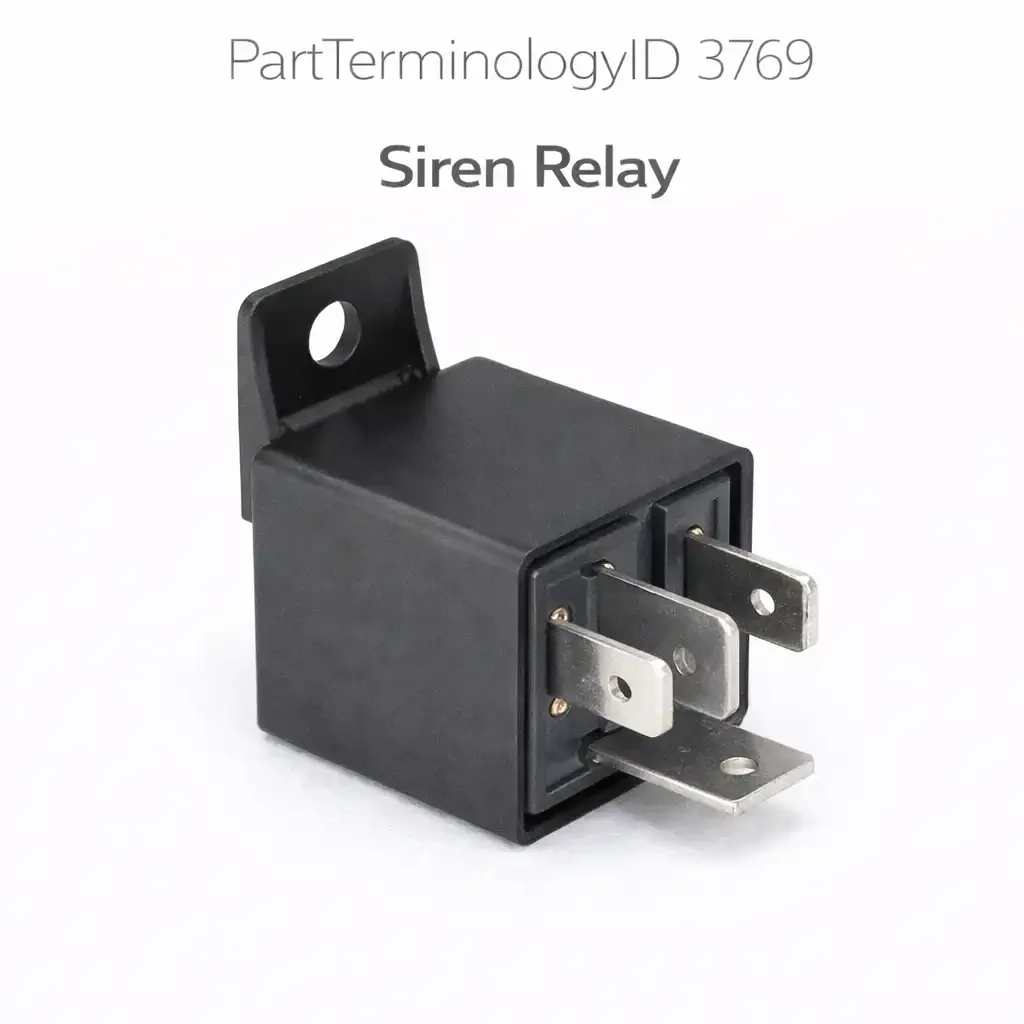
The Siren Relay, cataloged under PartTerminologyID 3769, is the electromechanical relay in the factory vehicle security system that delivers battery voltage to the alarm siren transducer when the alarm control module commands an alert. The relay sits between the alarm or body control module's low-current trigger output and the siren's high-current supply line. When the alarm module detects a trigger condition, such as an unauthorized door opening, a hood or trunk intrusion, a shock sensor event, or a tilt sensor reading, it energizes the siren relay coil through a ground-side or voltage-side driver output. The relay closes its contacts, battery voltage flows to the siren unit, and the siren produces its audible alert. When the alarm module de-energizes the coil, whether through a valid disarm signal from the key fob or through the expiration of the alarm cycle timer, the relay contacts open and the siren goes silent.
The relay exists in this circuit because the alarm module's internal driver output cannot supply the current the siren demands directly. A siren transducer drawing several amps through an alarm module output would damage the module's driver circuitry. The relay solves this by keeping the high-current siren supply path entirely separate from the module's low-current control output, allowing a small module driver transistor to control a load it could never power directly. This is the same architecture used across horn relays, cooling fan relays, and fuel pump relays throughout the vehicle, and the diagnostic approach is identical: confirm the coil trigger before condemning the relay, and confirm the relay output before condemning the siren.
What the Relay Does
Alarm Module Trigger Architecture
The siren relay coil receives its activation signal from the vehicle's alarm or body control module. On most domestic platforms, the module provides a switched ground at the relay coil ground terminal when the alarm is triggered, with constant battery voltage supplied to the opposite coil terminal from the always-hot fuse supplying the alarm circuit. The relay energizes when the module pulls its coil terminal to ground and de-energizes when the module releases it. On some platforms, particularly older European designs, the trigger polarity is reversed, with the module providing a switched positive output to the relay coil and the opposite coil terminal connected to chassis ground.
The relay's contact side carries a separate always-hot supply from a dedicated siren circuit fuse. When the relay closes, this battery voltage flows through the contacts to the siren's positive supply terminal. The siren's ground return is a direct chassis ground connection at or near the siren mounting location. This circuit architecture means the siren has power available the moment the relay closes, with no ignition interlock. Factory security systems are designed to sound the alarm with the ignition off, which is their primary use case, so the siren relay supply is always-hot regardless of ignition position.
Arm and Disarm Chirp Function
On platforms where the siren produces a brief chirp when the alarm is armed or disarmed by the key fob, that chirp also passes through the siren relay. The alarm module pulses the relay coil briefly, the relay closes for a fraction of a second, and the siren produces a single short tone. The absence of arm and disarm chirps is therefore a valid symptom of siren relay failure, though it is equally consistent with a failed siren, a failed module output, or a programming setting that has disabled audible arm confirmation. Many vehicles allow the owner or dealer to enable or disable the arm chirp as a preference setting, and a vehicle where the chirp was previously present but has been silently disabled through a programming change presents identically to one with a failed relay from the driver's perspective.
Panic Function
The panic function, typically activated by a dedicated button on the key fob, also operates through the siren relay. The module energizes the siren relay continuously for the duration of the panic cycle, which on most platforms runs for approximately 30 seconds before timing out. A siren relay that fails intermittently at sustained current may produce a panic function that works briefly and then stops, while normal alarm operation with its shorter siren cycles appears unaffected. This intermittent-under-sustained-load behavior is characteristic of relay contacts that have developed elevated resistance from pitting or oxidation, where the voltage drop across the degraded contacts reduces the current available to the siren during extended operation.
Relationship to the Horn Relay
On many domestic platforms, the factory security system does not use a dedicated siren at all. Instead, the alarm module triggers the horn relay circuit and uses the vehicle's horn as its audible alert device. On these platforms, PartTerminologyID 3769 does not apply because there is no dedicated siren relay in the circuit. The horn relay handles the alarm sound output, and a silent alarm on these vehicles is a horn relay or horn fault rather than a siren relay fault. Distinguishing between siren-equipped platforms and horn-as-alarm platforms is essential for correct ACES fitment, because including horn-only platforms in the siren relay application data generates no-fit returns when buyers find no siren relay socket in their vehicle.
On platforms equipped with a dedicated siren, the siren relay and the horn relay are separate components. The siren relay supplies a standalone siren transducer mounted in a protected location, typically in the engine compartment near the firewall or behind a fender liner. The horn relay supplies the vehicle's audible horn. A vehicle with both a siren and a horn will have both relays operating independently when the alarm triggers, producing a combined horn and siren output that is louder and more complex in tone than either component alone.
Top Return Scenarios
False Alarm Sensor Fault Misidentified as Relay Failure
A vehicle that alarms repeatedly without apparent cause is not exhibiting a relay failure. The siren relay is passive in this circuit: it closes when the alarm module tells it to and opens when the module releases it. A relay that causes nuisance alarms would have to be stuck closed, which would produce a continuous siren sound rather than intermittent triggered alarms. Nuisance alarms are caused by faults in the alarm trigger inputs: a hood switch with a broken or corroded contact that intermittently signals an open hood, a shock sensor calibrated too aggressively or responding to low-frequency vibration from traffic or music, a door latch sensor with worn contacts that produces a false door-open signal, a failing tilt or motion sensor sending spurious trigger inputs, or a key fob with a worn or intermittently shorted panic button producing accidental panic triggers.
A buyer who has experienced multiple nuisance alarms and orders the relay in hope of stopping them will return a functional relay. The relay cannot generate a false alarm on its own. Diagnosing nuisance alarms requires working through the alarm module's trigger input list: temporarily disconnecting the shock sensor and observing whether the nuisance alarms stop, testing each door latch switch for clean contact closure, verifying the hood and trunk switch operation, and checking whether the alarm only triggers when the vehicle is parked on a slope or when the key fob is in a pocket or bag that can accidentally activate the panic button.
Siren Failure Misidentified as Relay Failure
The siren unit is the higher-probability failure in the alarm sound circuit compared to the relay. Sirens are mounted in exposed engine compartment locations subject to road spray, salt, and temperature cycling. Many factory sirens, particularly on European platforms, incorporate an internal rechargeable backup battery that allows the siren to continue sounding even if the main vehicle battery is disconnected during a theft attempt. This internal battery eventually degrades, begins leaking, and corrodes the siren's internal circuit board. A siren with a failed internal battery or corroded circuit board produces no sound when the relay closes and the supply voltage reaches its terminals.
The test that separates siren failure from relay failure is supply voltage measurement at the siren's positive terminal during an alarm event or during a key fob panic trigger. If supply voltage appears at the siren terminal when the module commands the alarm, the relay is confirmed functional and the siren is the fault. If supply voltage does not appear at the siren terminal, measure the relay output contact terminal with the coil energized to determine whether the relay is closing. A relay that closes but delivers no voltage to the siren has a blown downstream fuse or a wiring break between the relay output and the siren. This measurement sequence pinpoints the fault location without guesswork.
Alarm Module Output Failure Misidentified as Relay Failure
A failed alarm module driver output produces no coil trigger signal at the relay coil terminal, and the relay never closes regardless of its condition. The symptom is a completely silent alarm: the vehicle arms and disarms normally through key fob inputs, the security system indicator light functions correctly, door lock and unlock commands from the fob work, but no audible output occurs during alarm trigger events or panic button presses. From the driver's perspective, the silent alarm is consistent with a failed relay, a failed siren, or a failed module output.
The coil trigger test is the separator. Measure voltage at the relay coil trigger terminal during an alarm event or panic activation. If the trigger signal is present and the relay fails to close its contacts, the relay is the fault. If the trigger signal is absent, the alarm module's driver output has failed, the wiring between the module and the relay coil is open, or a module fuse has blown. Ordering the relay without this measurement risks replacing a functional relay when the fault is at the module output or in the wiring between the module and the relay.
Arm Chirp Programming Change Misidentified as Relay Failure
Many factory security systems allow the owner or a dealer to enable or disable the audible arm confirmation chirp through a programming procedure. On platforms where this setting exists, a previous owner or a dealer service visit may have silenced the arm chirp without the current owner's knowledge, producing a vehicle that arms and disarms silently. The current owner may interpret the absence of a chirp as evidence of a relay or siren failure when the system is fully functional and simply programmed to operate without audible confirmation.
Before diagnosing absent arm chirps as a relay fault, confirm that a genuine alarm trigger event such as a door opened while armed or a panic button press produces no siren output. If the alarm triggers silently with no siren sound during an actual alarm event, a circuit fault is present. If the alarm event triggers normally but the arm and disarm chirps are absent, consult the factory service information for the platform's arm chirp programming procedure and verify the current setting before ordering any components.
Siren Supply Fuse Failure Misidentified as Relay Failure
The siren relay's contact-side supply comes from a dedicated always-hot fuse in the underhood or instrument panel fuse box. A blown siren supply fuse prevents battery voltage from reaching the relay's contact terminal, so the relay cannot deliver voltage to the siren even when the coil is energized and the contacts close successfully. The result is a silent alarm that is indistinguishable from a failed relay to any test short of measuring voltage at the relay's contact supply terminal.
Fuses in always-hot circuits blow because of downstream short circuits. A siren supply fuse that blows should prompt inspection of the siren wiring harness and the siren unit itself for a short to ground before the fuse is simply replaced. A siren with a shorted internal component, moisture-damaged wiring, or a compromised connector will blow the replacement fuse immediately and may damage the new relay contacts if the relay is replaced without correcting the underlying short.
Listing Requirements
Every listing for PartTerminologyID 3769 should include:
ACES fitment data restricted to vehicle makes, models, and model years equipped with a factory dedicated siren transducer and a discrete siren supply relay, with applications for platforms that use the horn as the sole alarm output excluded from this PartTerminologyID
A statement that nuisance alarms and false triggers are sensor or module input faults rather than relay faults, and that the relay cannot cause a false alarm event
A note that the siren unit is the higher-probability component failure in the alarm sound circuit compared to the relay, and that supply voltage at the siren's terminal must be confirmed before the siren is condemned
A note that the siren supply fuse must be checked before ordering the relay on a silent alarm complaint, as a blown fuse produces identical symptoms to a failed relay
A clear distinction from the horn relay, with a note that platforms using the horn as the alarm output do not have a dedicated siren relay
Frequently Asked Questions
My alarm keeps going off randomly. Will a new relay fix this?
No. Nuisance alarms are caused by false trigger inputs reaching the alarm module, not by relay failure. A relay that could cause a nuisance alarm would have to be stuck closed, which would produce a continuous siren sound rather than triggered alarm events. Nuisance triggers come from alarm input sensors: shock sensors calibrated too aggressively, door latch switches with worn or corroded contacts producing false door-open signals, hood or trunk switches with intermittent contact, tilt sensors responding to wind or slope changes, or key fob buttons that are accidentally activating the panic function from inside a pocket or bag. Diagnose and correct the trigger input before ordering any components.
My alarm triggers normally but there is no siren sound. What should I check first?
Check the siren supply circuit fuse first. A blown fuse produces a completely silent alarm with a functional relay. If the fuse is intact, measure supply voltage at the siren's positive terminal during an alarm event or panic trigger. If supply voltage is present at the siren terminal, the relay is functional and the siren unit has failed. If supply voltage is absent at the siren terminal, measure the relay coil trigger terminal to confirm the module is commanding the relay. If the trigger is present and the relay contacts are not closing, the relay is the fault. If the trigger is absent, the alarm module output or its wiring is the fault location.
My vehicle has no siren sound and I cannot find a siren relay socket. Does my vehicle use this relay?
Some vehicles do not have a dedicated siren relay. Factory security systems on many domestic platforms route the alarm output through the horn relay circuit rather than to a standalone siren. If the factory security system on your vehicle uses the horn as its audible alert, there is no siren relay socket to find. Consult the factory wiring diagram to confirm whether your vehicle's security system uses a dedicated siren or the horn circuit. If the alarm previously used the horn and is now silent, the horn relay or a horn fuse is the more likely fault location.
What is the difference between the Siren Relay and the Horn Relay?
The horn relay (PartTerminologyID 3407) controls voltage to the vehicle's horn and activates when the driver presses the horn button or when the security system uses the horn as its alarm output. The siren relay controls voltage to a dedicated alarm siren transducer that is a separate component from the horn, typically mounted in a protected engine compartment location and used exclusively for security system alerts. On vehicles equipped with both a dedicated siren and a horn-based alarm confirmation, both relays may activate simultaneously during an alarm event.
Can a siren relay cause a battery drain?
Yes, but only if the relay contacts are stuck in the closed position. A relay with welded or mechanically stuck contacts delivers continuous battery voltage to the siren even after the alarm module de-energizes the coil. Most siren transducers draw enough current to produce an audible sound in this condition, so a stuck-closed relay is typically noticed immediately rather than draining the battery silently. A more subtle battery drain scenario involves a relay with a shorted coil that draws excessive current through the module's driver output, but this is uncommon and is accompanied by other module fault symptoms. If a battery drain is suspected in the alarm circuit, confirm whether the siren relay coil is being held energized by the module or whether the contacts are mechanically stuck by removing the relay and observing whether the drain disappears.
What Sellers Get Wrong
Listing the relay as a solution for nuisance alarm complaints
Nuisance alarms are the most common alarm system complaint and are entirely caused by trigger input faults rather than relay faults. A listing that presents the siren relay as a repair for a vehicle that alarms too often will generate returns from buyers who find their nuisance alarm continues unchanged after relay replacement because the relay had nothing to do with it.
Including horn-only alarm platforms in the fitment data
A significant share of domestic vehicles equipped with factory security systems use the horn rather than a dedicated siren as their alarm output. These vehicles have no siren relay socket. Including them in the fitment data produces no-fit returns from buyers who search the fuse box and find no relay matching the listing. Platform-by-platform verification against the factory wiring diagram is the only reliable method for establishing correct application boundaries.
Not distinguishing relay failure from siren failure
The siren unit, especially on European platforms with internal backup batteries, fails more often than the relay. A listing that does not explain the supply voltage test that separates siren failure from relay failure sends buyers to the relay when the siren is the actual fault. These returns come back as functional relays because the siren was never confirmed as receiving voltage before the relay was ordered.
Not addressing the arm chirp programming variable
Many platforms allow silent arm confirmation to be set as a preference. A listing that treats absent arm chirps as a relay symptom without noting the programming variable generates orders from buyers whose vehicles have simply been programmed for silent operation. Confirming that the alarm triggers silently during an actual alarm event, rather than just observing absent chirps during arm and disarm, is the correct diagnostic gate before ordering the relay.
Cross-Sell Logic
Alarm siren transducer (the higher-probability component failure in the alarm sound circuit; a siren with a failed internal backup battery or corroded circuit board from moisture ingress produces no output when the relay correctly delivers supply voltage; should be verified with a supply voltage measurement at the siren terminal before ordering)
Siren supply circuit fuse (the first diagnostic checkpoint for a silent alarm; a blown fuse produces the same all-silent symptom as a failed relay at a fraction of the cost; a recurring blown fuse indicates a short circuit that must be corrected before replacing any other component)
Hood latch switch or hood pin switch (one of the most common nuisance alarm trigger sources; a corroded or misadjusted hood pin switch intermittently signals an open hood to the alarm module and triggers the alarm without any actual intrusion; relevant when the nuisance alarm pattern correlates with rough road driving or engine compartment vibration)
Door latch switch or door jamb switch (false door-open signals from worn door latch contacts are a primary nuisance alarm source; relevant when the nuisance alarm triggers most often after door closures or on vehicles where one door's latch mechanism shows wear)
Shock or impact sensor (overly sensitive shock sensors are a primary nuisance alarm source; relevant when the nuisance alarm triggers most often in noisy environments, near bass from audio systems, or when truck traffic passes nearby)
Key fob transmitter (an aftermarket key fob replacement for the alarm remote; relevant when alarm confirm chirps are absent and module-level diagnosis confirms the module is outputting correctly but range or response is compromised)
Final Take
PartTerminologyID 3769 occupies a narrow application window defined by two boundaries: platforms with a factory security system that produces an audible alert, and platforms where that alert comes from a dedicated siren transducer with its own relay rather than from the horn relay circuit. Getting the application boundary right eliminates the most common no-fit return before it reaches the buyer. Every platform where the factory alarm routes its audible output through the horn relay rather than to a dedicated siren must be excluded from the fitment data, and that distinction requires wiring diagram verification rather than model-year assumptions.
Within the correct applications, the content work that prevents returns rests on two pillars. The first is the nuisance alarm separation: the relay has no capacity to generate a false alarm, and any listing that implies it does will attract buyers whose shock sensor, door switch, or hood pin switch is the actual fault. The second is the siren-first diagnostic sequence: supply voltage at the siren terminal during an alarm event confirms the relay is closing and removes it from the fault hierarchy immediately, directing the diagnosis toward the siren unit where the failure probability is actually higher. A buyer who arrives at the relay after confirming trigger voltage present, relay output voltage absent, and fuse intact has correctly isolated the relay as the fault and will be satisfied with the outcome.