
Side Marker Relay (PartTerminologyID 3768): Diagnosis, Return Prevention and Listing Guide
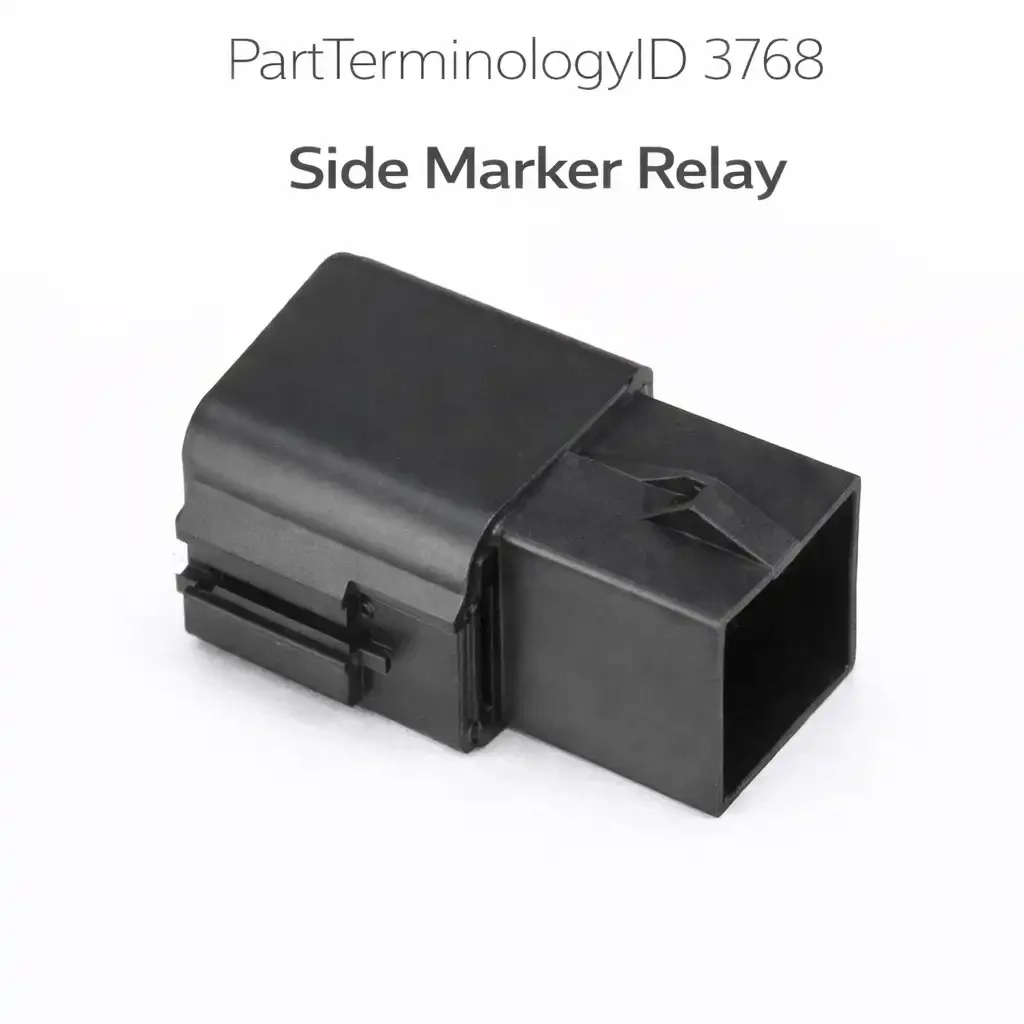
The Side Marker Relay, cataloged under PartTerminologyID 3768, controls the voltage supply to the side marker lamp circuit. Side marker lamps are the amber front-facing and red rear-facing position lamps mounted on the sides of the vehicle body that allow other road users to see the vehicle's width and presence from an angle. They illuminate when the parking or running lights are activated and remain on as steady-burning position lamps for as long as the lighting switch is in the parking or headlamp position. On platforms where a dedicated side marker relay exists, the relay closes when the headlamp switch activates the parking lamp circuit and supplies battery voltage to all side marker lamps as a group. The relay opens when the lighting switch returns to off, extinguishing the side marker lamps regardless of ignition position.
Side marker lamps became federally mandated for US passenger cars on January 1, 1968 under FMVSS 108, which required amber front and red rear side markers on all new passenger cars sold in the United States. Light trucks followed in 1970. Every passenger car and light truck sold new in the US since those dates has had side marker lamps as standard equipment, but not every one of them uses a discrete relay to supply the side marker circuit. Many platforms wire the side marker lamps directly from the parking lamp circuit fuse with no relay in the supply path at all. PartTerminologyID 3768 applies only to vehicles where a discrete relay exists in the side marker supply circuit, and ACES fitment verification against the platform's factory wiring diagram is the most important discipline in this PartTerminologyID.
What the Relay Does
Supply Circuit Position and Activation
On platforms with a discrete side marker relay, the relay sits between the parking lamp circuit supply and the side marker lamp harness. The relay coil receives its trigger from the headlamp or parking lamp switch output, the same signal that triggers the parking lamp circuit. When the driver activates the parking lamp or headlamp position, the switch output energizes the relay coil, the relay closes, and battery voltage flows through the relay contacts to the side marker lamp supply wire that feeds all side marker lamps on the vehicle.
The side marker relay on these platforms typically controls all four side marker lamps together as a single circuit: both front ambers and both rear reds share the same relay supply. This means a failed relay, whether open-contact or blown fuse in the supply circuit, extinguishes all four side marker lamps simultaneously. A single dark side marker while others remain illuminated does not implicate the relay, as the relay's failure mode produces a total-side-marker-out condition across all four lamps at once.
Relationship to the Parking Light Relay
The Side Marker Relay (PartTerminologyID 3768) and the Parking Light Relay (PartTerminologyID 3640) are related but distinct components on platforms that use both. The Parking Light Relay controls the supply to the front parking lamps, rear tail lamps, and license plate lamps — the main forward and rearward white and amber/red visible lighting positions. The Side Marker Relay controls specifically the side-facing amber and red lamps on the body sides. Both relays receive their coil trigger from the same headlamp switch output, so both close simultaneously when the lighting switch is activated. However, they are separate relays supplying separate lamp circuits, and they can fail independently. A failed parking light relay leaves the vehicle without front and rear position illumination while the side markers may still function, and vice versa.
On platforms where only one of these relay types appears in the ACES data, the manufacturer combined the side marker and parking lamp supply into a shared circuit, which is common and eliminates the side marker relay entirely. Do not apply fitment entries for PartTerminologyID 3768 to platforms where the side markers share a supply fuse or relay with the parking lamps rather than having a dedicated supply relay of their own.
Side Marker Lamp Circuit Architecture Variations
Side marker lamp circuits on applicable platforms fall into two basic architectures. The simpler architecture supplies both terminals of each side marker bulb socket directly, with one terminal connected to the relay supply output and the other connected to chassis ground. In this arrangement, each side marker bulb illuminates independently as a simple voltage-to-ground lamp, and the relay's only function is to supply or remove voltage from the lamp's positive terminal.
The more complex two-wire dual-function architecture, common on vehicles designed to satisfy regulations that permit or require side markers to flash alternately with the turn signal, connects one lamp terminal to the parking lamp supply and the other lamp terminal to the turn signal feed rather than to ground. In this arrangement, the side marker bulb operates as a bridge between the parking lamp circuit and the turn signal circuit. When the parking lamps are on and the turn signal is off, current flows through the bulb from the parking lamp supply terminal to the turn signal circuit as a ground return path, illuminating the side marker at reduced intensity. When the turn signal flashes on, both ends of the bulb see voltage simultaneously and the lamp goes dark, creating an alternating flash effect where the side marker extinguishes each time the turn signal fires. This two-wire architecture is relevant to the side marker relay because it means the relay supplies only the parking lamp terminal of the bulb, and the lamp's behavior during turn signal operation depends on the turn signal circuit as well as the relay supply. A buyer experiencing alternating-flash side markers during turn signal operation is observing correct behavior on a two-wire system, not a relay fault.
LED Conversion Complications
LED side marker bulb substitution creates diagnostic complications on two-wire alternating-flash systems because LEDs are polarity-sensitive and will not conduct in both directions through the lamp socket the way a filament bulb does. On two-wire systems, the filament provides a low-resistance bidirectional current path that makes the alternating-flash behavior work. An LED in the same socket blocks reverse current flow, disrupting both the alternating flash function and the basic illumination function in some operating conditions. Buyers who have installed LED side marker bulbs and are experiencing side marker illumination problems that began with the LED installation have a bulb compatibility problem rather than a relay problem. The relay's condition is not relevant until the original-style filament bulbs have been reinstalled and the fault persists.
Top Return Scenarios
Individual Lamp Out Misidentified as Relay Failure
The most common side marker lamp complaint is a single dark lamp at one corner of the vehicle. A failed relay produces all-four-lamps-out because the relay supplies the entire side marker circuit as a single shared supply. A single dark lamp with others functioning is a bulb failure, a lamp socket ground fault, a corroded lamp socket terminal, or a wiring fault at that specific lamp location. It is not a relay fault. The diagnostic separation is immediate: if other side markers are illuminated when the parking lamps are on, the relay is confirmed functional and the fault is local to the dark lamp.
Bulb failure is the highest-probability cause of a single dark side marker on any vehicle. Side marker bulbs operate whenever the parking or headlamps are on, which on many vehicles accumulates more burning hours than any other exterior lamp on the vehicle. On vehicles driven regularly in darkness or in jurisdictions where daytime running lamps cause the side markers to illuminate, bulb life is further shortened. A buyer who has not replaced the side marker bulb and orders the relay on a single-lamp dark complaint will return a functional relay.
Fuse Failure Misidentified as Relay Failure
On platforms with a dedicated side marker relay, the relay's supply circuit has a fuse in the supply line. A blown supply fuse removes voltage from the relay's contact-side terminal, producing a condition where all four side markers are dark and the relay cannot supply any lamps even if the relay itself is functional. A buyer who does not check the side marker supply circuit fuse before ordering the relay may receive a functional relay, install it, and find all four lamps remain dark because the blown fuse was never replaced.
The fuse is the first diagnostic checkpoint for a total-side-marker-out condition. Fuses blow because of circuit faults rather than age, so a blown side marker fuse should prompt inspection of the side marker lamp sockets and harness for a short to ground before the fuse is simply replaced. A recurring blown fuse indicates a short circuit that will destroy the new relay contacts if the relay is replaced without finding and correcting the short.
Corrosion at the Side Marker Lamp Socket Misidentified as Relay Failure
Side marker lamps are mounted in the front fenders and rear body panels in locations that are directly exposed to road spray, moisture, and winter road salt. The lamp socket contacts and the harness connector at the lamp are among the most corrosion-vulnerable electrical connections on the vehicle. Socket corrosion produces high contact resistance between the socket terminal and the bulb base, reducing the voltage available to the bulb and causing dim illumination that worsens progressively until the lamp stops illuminating entirely. This corrosion-caused dimness and eventual lamp failure can affect all four side markers approximately simultaneously on a vehicle of the same age, producing a symptom of dim or dark side markers across all positions that superficially resembles a relay supply voltage issue.
The diagnostic test that separates socket corrosion from relay supply failure is to measure supply voltage at the relay output terminal when the parking lamps are on. If supply voltage is present at the relay output, the relay is functional and the voltage delivery problem is between the relay output and the lamp sockets. If supply voltage is absent at the relay output with the coil trigger confirmed present, the relay contacts have failed. A buyer who does not perform this test cannot distinguish relay contact failure from socket corrosion, and ordering the relay without this test risks a no-correction return when the fault is at the lamp socket rather than the relay.
Headlamp Switch Failure Producing No Coil Trigger
The relay coil trigger comes from the headlamp switch parking lamp output. A headlamp switch with failed parking lamp position contacts does not produce the coil trigger signal, and the relay never closes regardless of its condition. The symptom of a failed headlamp switch parking position is identical to a failed relay from the driver's perspective: parking and running lights, including side markers, do not illuminate when the lighting switch is activated. On platforms where the parking relay and side marker relay share the same coil trigger wire from the headlamp switch, a failed switch produces a total exterior lighting failure that affects both relay circuits simultaneously.
The coil trigger test distinguishes switch failure from relay failure. Measure voltage at the relay coil trigger terminal when the headlamp switch is in the parking lamp position. If trigger voltage is present and the relay does not close, the relay is the fault. If trigger voltage is absent, the headlamp switch or the wiring between the switch and the relay coil is the fault. A relay order without this measurement risks ordering the relay to fix a headlamp switch problem.
LED Bulb Conversion Fault Misidentified as Relay Failure
A buyer who has installed LED side marker bulbs and is experiencing side marker illumination problems that began immediately after the LED installation has a bulb incompatibility problem rather than a relay problem. LED bulbs in two-wire alternating-flash side marker sockets block the reverse current flow that the two-wire circuit requires, disrupting normal illumination in parking lamp mode, interfering with the alternating-flash behavior, or causing the lamps to glow faintly rather than extinguishing cleanly during turn signal activation. None of these symptoms are caused by the relay. The relay's supply function is unchanged by the bulb type, and replacing the relay while leaving incompatible LED bulbs installed produces no change in the symptom.
Listing Requirements
Every listing for PartTerminologyID 3768 should include:
ACES fitment data restricted to vehicle makes, models, and model years where a discrete side marker supply relay exists in the circuit, verified against the platform's factory wiring diagram, with no entries for platforms where the side marker lamps share a supply directly from the parking lamp circuit fuse or relay without a dedicated intermediate relay
A clear statement that a failed relay produces total-side-marker-out across all four lamps simultaneously, and that a single dark side marker while others function implicates the bulb, socket, or local wiring rather than the relay
A note that the side marker supply circuit fuse must be checked before the relay is ordered on a total-out complaint, as a blown fuse produces identical symptoms to a failed relay
A clear distinction between PartTerminologyID 3768 and PartTerminologyID 3640 (Parking Light Relay), identifying the relay category each controls
A note that LED side marker bulb installations on two-wire alternating-flash systems produce illumination faults that are bulb-compatibility issues rather than relay faults
Frequently Asked Questions
All four of my side markers are out. Is this the relay?
Total side-marker-out with the parking lamps otherwise functioning is consistent with a relay fault, but the supply circuit fuse must be checked first. A blown fuse produces the same symptom and is a faster, lower-cost repair. If the fuse is intact, confirm that the relay coil receives its trigger voltage when the headlamp switch is in the parking lamp position. If trigger voltage is present and the relay does not close its contacts, the relay is the fault. If trigger voltage is absent, the headlamp switch or its wiring is the fault location. If voltage is present at the relay output but the side markers remain dark, the fault is between the relay output and the lamp sockets.
Only one side marker is out. Is this the relay?
No. A relay fault in the side marker supply circuit produces a total-out condition across all four lamps because the relay supplies the entire side marker circuit as a shared supply. A single dark lamp with others illuminated is a bulb failure, a socket corrosion issue, or a local wiring fault at that lamp's position. Confirm the bulb's condition before any further diagnosis. Side marker bulbs have a finite service life and burn more hours than most other exterior lamps on the vehicle.
My side markers flash with the turn signals. Is something wrong with the relay?
Side markers that flash alternately with the turn signals are exhibiting correct behavior on vehicles with two-wire alternating-flash side marker circuits, where one terminal of the side marker bulb is connected to the parking lamp supply and the other to the turn signal feed. This is an intentional design permitted under FMVSS 108, and in many markets it is the preferred behavior for improved visibility of the turn signal from the side. The relay has no involvement in the alternating-flash behavior, which is produced by the circuit architecture of the two-wire lamp connection, not by any relay switching action.
What is the difference between the Side Marker Relay and the Parking Light Relay?
The Parking Light Relay (PartTerminologyID 3640) controls the supply to the front parking lamps, rear tail lamps, and license plate lamps. The Side Marker Relay (PartTerminologyID 3768) controls specifically the side-facing amber front and red rear position lamps on the body sides. Both relays close when the headlamp switch activates the parking lamp circuit, but they supply different lamp groups and can fail independently. A platform with both relays in its circuit will have parking lamp function without side markers, or side marker function without front and rear parking lamps, if one relay has failed while the other remains functional.
My side markers are dim rather than completely out. Is this the relay?
Dim side markers are more commonly caused by lamp socket corrosion creating resistance between the socket terminal and the bulb base than by relay contact resistance. Socket corrosion reduces the voltage delivered to the bulb below the full supply voltage, causing the filament to run below design temperature and produce less light. Measure supply voltage at the relay output terminal when the parking lamps are on. If full supply voltage is present at the relay output but the lamps are dim, the voltage drop is occurring between the relay output and the bulb, implicating socket corrosion or harness resistance rather than the relay. Clean the socket terminals and lamp bases and retest before ordering the relay.
What Sellers Get Wrong
Listing the relay as a first-response part for any dark side marker complaint
Most dark side marker complaints involve a single lamp and are caused by a burned-out bulb or corroded socket. The relay produces total-out across all four lamps when it fails, and single-lamp complaints are outside the relay's failure mode. A listing that presents the relay as a go-to repair for any side marker complaint attracts single-lamp buyers who return a functional relay after finding the dead bulb or cleaning the socket terminal resolved the issue.
Not verifying relay presence in ACES data before including applications
A substantial share of vehicles with side marker lamps supply them directly from the parking lamp circuit fuse without a dedicated relay. Including these platforms in the fitment data generates no-fit returns where buyers find no matching relay socket. Platform-by-platform verification against the factory wiring diagram is not optional in this PartTerminologyID. Every application entry that is not wiring-diagram-confirmed is a potential no-fit return.
Not distinguishing total-out diagnosis from single-lamp diagnosis
The diagnostic path for a total-out complaint leads through the fuse, then the coil trigger, then the relay contacts, then the supply wire to the lamp sockets. The diagnostic path for a single-lamp complaint never involves the relay. Listing content that conflates these two complaint types sends buyers with single-lamp faults to a relay that cannot correct their problem.
Not flagging LED bulb incompatibility on two-wire alternating-flash platforms
LED side marker bulb substitution is a common modification, and on two-wire alternating-flash systems it produces illumination faults that look like relay or wiring problems to buyers who are unfamiliar with the two-wire circuit architecture. A listing that does not mention LED compatibility issues will attract buyers who installed LED bulbs, experienced subsequent illumination problems, and concluded the relay must have failed, when reinstalling the original filament-type bulbs would resolve the issue without any relay replacement.
Cross-Sell Logic
Side marker lamp bulbs for all four positions (the highest-probability cause of any individual dark side marker; should be confirmed before ordering the relay; available in amber for front and red for rear in the applicable base type for the platform)
Side marker lamp sockets or pigtails (for socket corrosion severe enough that cleaning does not restore adequate contact; corroded sockets cause dim or intermittent illumination that progresses to complete lamp failure while the relay supply is confirmed functional)
Parking Light Relay (PartTerminologyID 3640) (a distinct relay on platforms with separate parking lamp and side marker relay circuits; relevant when the side marker relay tests functional but the front parking and rear tail lamps are also out, implicating the parking lamp relay rather than the side marker relay)
Side marker supply circuit fuse (the first diagnostic checkpoint for total-side-marker-out; a blown fuse produces identical symptoms to a failed relay at no relay cost; also the indicator of a short circuit that should be located before any replacement component is installed)
Headlamp switch (the source of the relay coil trigger; a failed parking lamp position contact in the switch prevents the relay coil from receiving its trigger voltage, producing a no-relay-close condition that is not corrected by relay replacement)
Side marker lamp housing or lens assembly (for moisture intrusion damage where water entering the housing through a cracked lens or failed housing seal has corroded the socket terminals and may have caused the short that blew the supply fuse)
Final Take
PartTerminologyID 3768 applies to a specific platform architecture where a dedicated relay exists in the side marker lamp supply circuit rather than the more common arrangement where side markers draw directly from the parking lamp circuit fuse. Getting the application boundary right is the foundational discipline in this category, because the no-fit return rate on platforms without a dedicated side marker relay is entirely preventable through wiring-diagram verification before the application is included in ACES data.
Within the platforms where the relay correctly applies, the content that prevents returns is built around two diagnostic filters. The first is the single-versus-total lamp failure distinction: the relay produces total-out across all four lamps when it fails, and any complaint involving a single dark side marker while others remain on is a bulb or socket fault rather than a relay fault. The second is the fuse-first principle: the supply circuit fuse produces the same all-four-out symptom at a fraction of the diagnostic investment and is the correct first checkpoint before the relay is ordered. A buyer who has confirmed all four lamps dark, the supply fuse intact, the coil trigger voltage present, and no output voltage at the relay contacts has correctly isolated the relay as the fault and will be satisfied with the repair.