
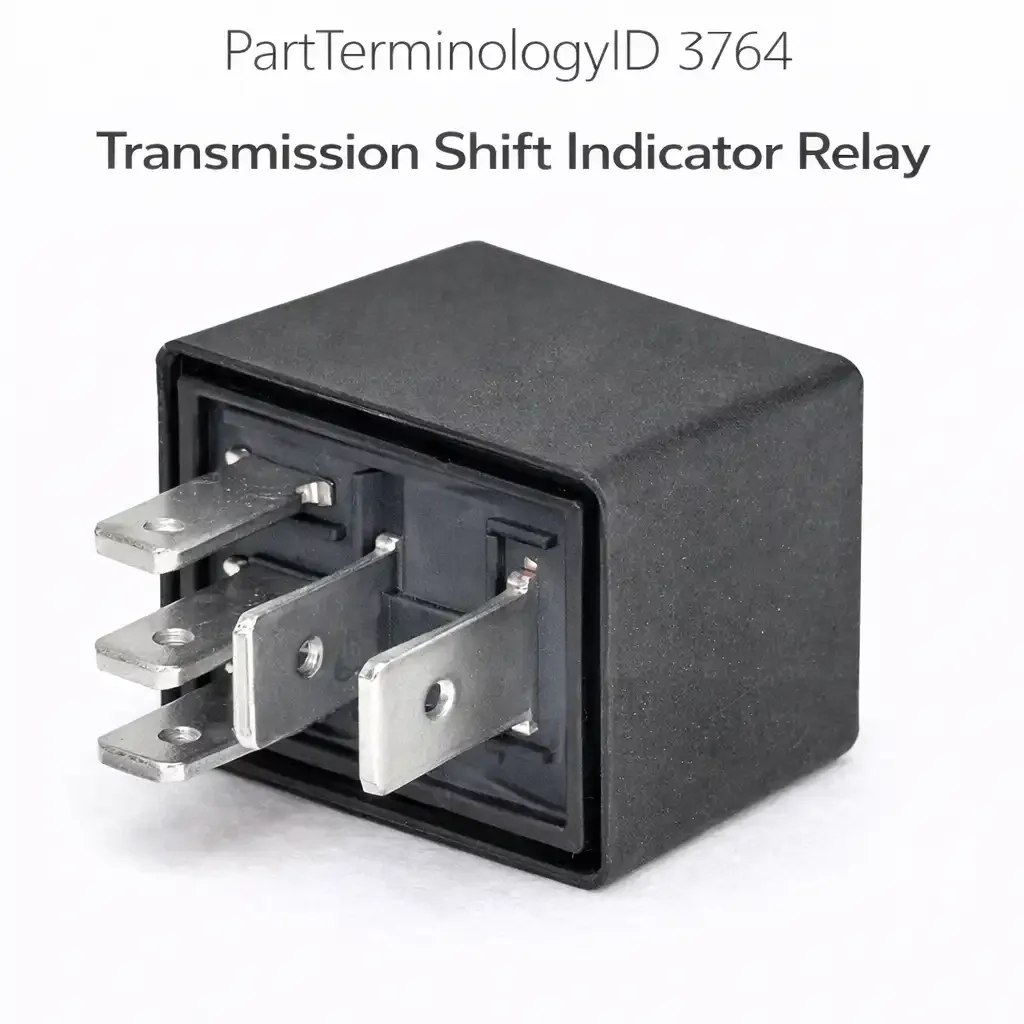
The Transmission Shift Indicator Relay, cataloged under PartTerminologyID 3764, controls the ignition-switched voltage supply to the lamp circuit that illuminates the gear position indicator display on automatic transmission vehicles. When the ignition is on, the relay closes and supplies voltage to the indicator lamp or lamp array that lights the PRNDL designation at the steering column or floor console, allowing the driver to see which gear position is currently selected. When the ignition is off, the relay opens and the indicator lamp goes dark. The relay's function is purely a lighting supply function: it does not detect gear position, does not communicate with the transmission control module, and does not affect transmission operation in any way. A failed relay produces a dark or unilluminated shift indicator. Gear selection, shifting, and transmission function continue normally.
PartTerminologyID 3764 applies to a specific generation of automatic transmission vehicles that used a discrete electromechanical relay to supply the shift indicator lamp circuit rather than routing the lamp supply directly from the ignition switch fuse panel. This architecture was most common on domestic passenger cars and light trucks from the late 1970s through the mid-1990s, particularly on column-shift applications where the indicator lamp circuit was separated from the instrument illumination circuit and controlled through a dedicated relay. On modern vehicles, the gear position indicator is rendered digitally by the instrument cluster based on serial data messages from the PCM or TCM, and no discrete shift indicator relay of the type described by this PartTerminologyID exists in the circuit. The 3764 relay is a pre-digital-cluster component, and ACES fitment data should reflect this application boundary precisely.
What the Relay Does
Lighting Supply Architecture on Applicable Platforms
On the vehicle platforms where PartTerminologyID 3764 applies, the shift indicator lamp circuit receives its voltage supply through the relay rather than directly from the ignition switch accessory circuit or the instrument illumination circuit. The relay coil is typically triggered by the ignition switch run position output, closing the relay when the key is turned to run or start and opening it when the key is removed. The relay contacts then pass battery voltage or ignition-switched voltage to the indicator lamp supply terminal.
The lamp itself is physically located at the column shift indicator housing or the floor console shift quadrant, depending on the vehicle's shifter configuration. The lamp illuminates the translucent PRNDL designation panel, backlit so the driver can read the current gear position from the pointer or indicator arrow. On column-shift vehicles, the indicator pointer is typically a mechanical arm driven by a cable or linkage from the shift lever, and the lamp simply illuminates the background behind whichever position the pointer has moved to. On floor-console vehicles, similar mechanical or electromechanical arrangements position an illuminated indicator against the gear designation panel.
What the Relay Does Not Do
The Transmission Shift Indicator Relay does not participate in gear position detection or reporting. The actual determination of which gear the transmission is in is handled separately by the transmission range sensor, the neutral safety switch, or the park/neutral position switch, depending on the platform and model year. These components send gear position signals to the instrument cluster, the PCM, or directly to individual indicating lamps on older systems. The 3764 relay's only involvement is supplying voltage to the lamp or lamp circuit that provides the background illumination for the indicator display. Failure of the 3764 relay does not affect gear position detection, transmission control, starter circuit interlock, or reverse lamp operation, all of which are controlled by separate circuits.
This functional distinction is the most important diagnostic filtering element in this PartTerminologyID. A buyer whose complaint involves the wrong gear showing on the instrument cluster display, intermittent gear detection, limp mode, erratic shifting, or no-start conditions related to the neutral safety circuit has a fault in the transmission range sensor or related circuits, not in the shift indicator lamp supply relay.
Relay Versus Direct-Fuse Supply Architecture
Not all automatic transmission vehicles used a relay to supply the shift indicator lamp. Many platforms wired the indicator lamp directly from an ignition-switched fuse, without any relay in the supply path. On these platforms, a dark shift indicator means a blown fuse, a failed bulb, or a broken wire, not a failed relay. Including vehicles with direct-fuse indicator lamp supply in the ACES fitment data for PartTerminologyID 3764 generates no-fit returns from buyers who find no relay in the circuit after ordering.
The presence of a relay in the shift indicator supply circuit should be verified against the vehicle's factory wiring diagram before including an application in the fitment data. The relay is a feature of platforms where the lamp supply circuit was intentionally separated from the ignition switch fuse output and controlled through a relay, typically to reduce ignition switch loading on platforms with high accessory current demands or to allow BCM-controlled switching of the indicator lamp supply independent of the main ignition switch circuit.
Modern Platform Architecture and This PartTerminologyID's Boundaries
Beginning in the early to mid-1990s, instrument clusters shifted from individual discrete lamp circuits for each gauge and indicator function toward integrated electronic clusters that received serial bus data from the PCM, TCM, and BCM and rendered all display functions through the cluster's internal electronics. On these platforms, the PRNDL display is a segment LCD, a vacuum fluorescent display, or an icon-based digital display driven by the cluster's internal microprocessor. There is no discrete relay in the gear position display circuit on these vehicles, and a dark or missing gear position display is a cluster fault, a PCM-to-cluster communication fault, or a transmission range sensor fault, not a relay fault.
Fitment data for PartTerminologyID 3764 must be limited to vehicles where a discrete shift indicator lamp supply relay exists in the circuit, which in practice means earlier-generation platforms with analog instrument clusters and mechanical or simple electromechanical PRNDL indicator assemblies.
Top Return Scenarios
Burned-Out Indicator Lamp Misidentified as Relay Failure
The indicator lamp bulb is the highest-probability cause of a dark shift indicator on any platform where this relay applies. The indicator lamp illuminates continuously whenever the ignition is on and the vehicle is operated, accumulating more burn hours than most other instrument lamps on the vehicle. Bulb failure is a maintenance-level repair that requires no relay replacement. A buyer who does not confirm bulb condition before ordering the relay will receive and install a functional relay and find the indicator still dark because the bulb failure was never addressed.
The bulb confirmation test on most applicable platforms requires accessing the indicator lamp housing at the column shift indicator or console shift quadrant and testing the bulb for continuity or substituting a known-good bulb. On some platforms this requires partial column shroud or console disassembly, which discourages the confirmation step and leads to relay ordering as a first resort. Listing content that explicitly names bulb failure as the most likely cause of a dark shift indicator, ahead of the relay, is the primary return prevention investment in this PartTerminologyID.
Transmission Range Sensor Fault Misidentified as Relay Fault
A transmission range sensor or neutral safety switch that has failed or is out of adjustment can cause incorrect or no gear position indication in the instrument cluster on platforms where the cluster reads its PRNDL display from the range sensor signal rather than from the relay-supplied lamp circuit. The symptom of a missing or incorrect gear display, on modern digital cluster platforms especially, is a transmission range sensor or PCM-to-cluster communication issue, not a relay issue. However, on earlier analog cluster platforms with discrete lamp circuits per gear position, a range sensor fault can also cause incorrect lamp illumination by failing to complete the ground path for individual position lamps, mimicking the appearance of a lamp supply fault.
The diagnostic separation on analog multi-lamp systems is straightforward: if all gear position lamps are dark simultaneously, the supply circuit, which includes the relay, is suspect. If specific gear position lamps are dark while others illuminate correctly, the fault is in the individual position's ground path through the range sensor contacts, not in the common lamp supply relay. A buyer who presents with selective gear position lamp failure, where park lights up but drive does not, has a range sensor issue and not a relay issue.
Ignition Switch or Supply Circuit Fault Misidentified as Relay Fault
The relay coil trigger comes from the ignition switch's run position output. If the ignition switch's run position contact is degraded or has high resistance, the relay coil may not receive sufficient voltage to close, producing a dark shift indicator that appears to be a relay fault but is actually an ignition switch contact fault. On high-mileage vehicles where the ignition switch has been operated tens of thousands of times, contact resistance in the run position output is a common age-related fault that produces partial or intermittent supply losses to multiple ignition-switched circuits simultaneously.
If the shift indicator dark condition occurs alongside other ignition-switched circuit complaints, such as blower motor drop-out, radio muting, or instrument cluster dimming, the ignition switch is more likely the fault than the shift indicator relay. A relay that fails to close when its coil receives the correct trigger voltage has a coil fault. A relay that fails to close because its coil trigger voltage is below the coil's pull-in threshold due to ignition switch contact resistance is exposing an ignition switch fault rather than a relay fault. Measuring the coil trigger voltage against specification before condemning the relay prevents ordering a relay to fix an ignition switch problem.
BCM-Controlled Platforms Without Discrete Relay
On some platforms produced in the transitional period between direct-fuse indicator lamp supply and fully digital cluster architectures, the BCM controls the shift indicator lamp supply through an internal output rather than through a discrete electromechanical relay. On these platforms, there is no 3764 relay to replace, and a dark shift indicator is a BCM output fault or a BCM programming fault, not a relay fault. A buyer on one of these platforms who orders the 3764 relay will find no matching relay socket in the vehicle.
Supply Voltage Present at Lamp with No Illumination
On platforms where the relay controls only the supply side of the lamp circuit and the lamp's ground path is completed through the transmission range sensor position contacts, a dark indicator can occur with the relay confirmed functional and supply voltage confirmed present at the lamp supply terminal. If the lamp does not illuminate despite correct supply voltage, the lamp's ground path through the range sensor contacts is open. This is a range sensor contact fault, not a relay fault. The relay test in this scenario confirms the relay is not the fault before the range sensor diagnosis begins.
Listing Requirements
Every listing for PartTerminologyID 3764 should include:
ACES fitment data restricted to vehicle makes, models, and model years that used a discrete electromechanical relay in the shift indicator lamp supply circuit, verified against the platform's factory wiring diagram, with no entries for vehicles that supply the indicator lamp directly from the ignition switch fuse or through BCM-controlled outputs
A clear statement that this relay controls only the lamp illumination supply for the shift position indicator, and has no effect on gear position detection, transmission control, starter circuit operation, or reverse lamp operation
A note that the indicator lamp bulb is the most likely cause of a dark shift indicator and should be confirmed functional before ordering this relay
A note distinguishing individual-lamp dark conditions, which indicate range sensor contact faults in the ground path, from all-lamps-dark conditions, which indicate a supply circuit fault where the relay is a candidate
A note that this relay is not applicable to vehicles with digital instrument cluster gear position displays, where the PRNDL indication is rendered by the cluster's internal electronics from serial bus data
A note that the ignition switch run position output voltage should be confirmed at the relay coil terminal before condemning the relay on platforms where ignition switch wear is a known age-related issue
Frequently Asked Questions
My shift indicator is completely dark. Is this the relay?
The most likely cause of a completely dark shift indicator is a burned-out indicator lamp bulb, which should be confirmed before ordering the relay. If the bulb tests functional, check the supply circuit fuse associated with the shift indicator lamp circuit, as a blown fuse produces the same symptom as a failed relay with less likelihood of being relay-related. If the fuse is intact and the bulb is functional, measure supply voltage at the relay output terminal with the ignition on. Absence of voltage at the relay output with the ignition on indicates either a failed relay or an absent coil trigger. Measure coil trigger voltage to determine which is the fault.
Only some of my gear position lamps are dark. Is this the relay?
A relay fault in the supply circuit produces a condition where all gear position lamps are dark simultaneously, because the relay supplies voltage to the entire lamp circuit rather than to individual position lamps. If specific positions, such as Drive or Reverse, are dark while others, such as Park or Neutral, illuminate correctly, the fault is in the ground path for the dark positions rather than in the supply relay. On most applicable platforms, the individual gear position lamp ground paths are completed through the transmission range sensor's position contacts. A range sensor that has worn or corroded contacts on specific positions produces selective lamp failure rather than total indicator darkness.
Does this relay affect whether my car will start?
No. The shift indicator lamp supply relay has no connection to the starter circuit. Starting interlock is controlled by the park/neutral position switch or neutral safety switch, which is a separate component on a separate circuit. A failed shift indicator relay may leave the PRNDL display dark but does not affect the vehicle's ability to start in Park or Neutral. If the vehicle will not start and the shift indicator is also dark, the two conditions are likely coincidental, and the no-start condition should be diagnosed through the neutral safety switch and starter relay circuit rather than through the shift indicator lamp supply relay.
My gear position shows incorrectly on the instrument cluster but the lamps seem fine. Is this the relay?
Incorrect gear position display, where the cluster shows the wrong gear or no gear while the illumination level is normal, is a transmission range sensor, PCM-to-cluster communication, or instrument cluster internal fault, not a shift indicator lamp supply relay fault. The relay's only function is to supply voltage to the lamp circuit. It has no involvement in which gear position the display indicates. Incorrect indication with normal illumination is outside the relay's functional scope.
Is this relay present in vehicles with digital instrument cluster displays?
No. Vehicles with fully digital instrument cluster displays receive gear position data over a serial bus from the PCM or TCM and render the PRNDL display through the cluster's internal electronics. There is no discrete shift indicator lamp supply relay in these vehicles' circuits. PartTerminologyID 3764 applies exclusively to earlier-generation platforms with mechanical or analog shift indicator assemblies where a discrete lamp supply relay exists in the circuit.
What Sellers Get Wrong
Not naming the indicator lamp as the highest-probability fault
The indicator bulb burns continuously during vehicle operation and has a finite service life that is typically reached before the relay fails on any vehicle where this relay applies. A listing that presents the relay as the primary diagnostic direction for a dark shift indicator without naming the bulb as the first checkpoint will generate relay orders from buyers whose bulb simply needs replacement. This is the highest-volume misdirected order in this PartTerminologyID, and naming the bulb check explicitly as the first step is the single most effective return prevention element in the listing.
Including modern digital cluster vehicles in ACES fitment data
Digital cluster platforms do not have a discrete shift indicator lamp supply relay. Including them in the fitment data generates no-fit returns where buyers find no relay socket in the circuit after the relay arrives. Every application entry in the ACES data for this PartTerminologyID should be verified against the platform's factory wiring diagram to confirm that a discrete relay exists in the shift indicator lamp supply circuit before the application is included.
Not distinguishing this relay from the transmission range sensor
The transmission range sensor and the neutral safety switch are the components that detect and report gear position. The shift indicator lamp supply relay supplies the voltage that illuminates the lamp that the driver sees. These are completely separate circuits serving different functions, and a listing that conflates them, or that does not clearly state the relay's function is limited to lamp supply, will attract buyers with range sensor faults who install the relay and find their incorrect or missing gear display unchanged.
Not addressing the ignition switch as an upstream fault source
Ignition switch run-position contact resistance is a common age-related fault on the high-mileage vehicles where this relay is most frequently needed. A relay coil that does not receive adequate trigger voltage cannot close regardless of the relay's condition, and measuring coil trigger voltage is the test that separates relay failure from upstream ignition switch failure. A listing that does not prompt this test will generate relay returns from buyers whose ignition switch was the actual fault.
Cross-Sell Logic
Shift indicator lamp bulb (the highest-probability cause of a dark shift indicator on any platform; should be confirmed functional before the relay is ordered; available as a discrete replacement bulb or integrated lamp assembly depending on the platform)
Transmission range sensor or neutral safety switch (the component responsible for gear position detection and individual lamp ground path completion on platforms with discrete per-position lamps; the correct repair for selective lamp failure where specific gear positions are dark while others illuminate correctly, and for incorrect gear display conditions where illumination level is otherwise normal)
Ignition switch (the upstream source of the relay coil trigger voltage; worn ignition switch run-position contacts produce insufficient coil trigger voltage, preventing the relay from closing on platforms where the coil trigger comes directly from the ignition switch run output)
Column shift indicator assembly (the complete mechanical assembly that houses the indicator lamp, pointer, and position designations on column-shift platforms; a cracked or broken indicator housing can produce dark indicator conditions through lamp displacement rather than circuit failure)
Supply circuit fuse for the shift indicator lamp (the fastest first check for a dark indicator; a blown fuse produces identical symptoms to a failed relay but requires only fuse replacement; should be confirmed intact before the relay is ordered)
Instrument cluster (on platforms where the cluster drives individual gear position lamps or integrates the PRNDL display internally; a cluster fault on these platforms produces dark or incorrect indication regardless of relay condition)
Final Take
PartTerminologyID 3764 is a narrow, platform-specific relay that applies to a defined generation of domestic automatic transmission vehicles and has no application on modern digital cluster platforms. The application boundary is the most important fitment discipline in this category, because the symptom it addresses, a dark gear position indicator, occurs across a wide range of platforms and model years, most of which do not have this relay in their circuits at all. Every no-fit return in this category is a fitment data failure, and every no-correction return is a diagnostic failure that could have been prevented by a bulb check or a range sensor diagnosis.
For the platforms where this relay correctly applies, the listing that prevents returns leads with the bulb, identifies the range sensor as the cause of selective-position lamp failures, names the ignition switch as the upstream variable when coil trigger voltage is absent, and is clear that the relay's function begins and ends with lamp supply voltage. A buyer who has confirmed a good bulb, a good fuse, and a confirmed absent output at the relay's contact terminal with the ignition on has correctly isolated the relay as the fault and will be satisfied with the repair. Every buyer short of that diagnostic sequence is ordering on symptom rather than confirmation, and most of them will need a bulb or a range sensor rather than this relay.