
Secondary Air Injection Relay (PartTerminologyID 3756): Diagnosis, Return Prevention and Listing Guide
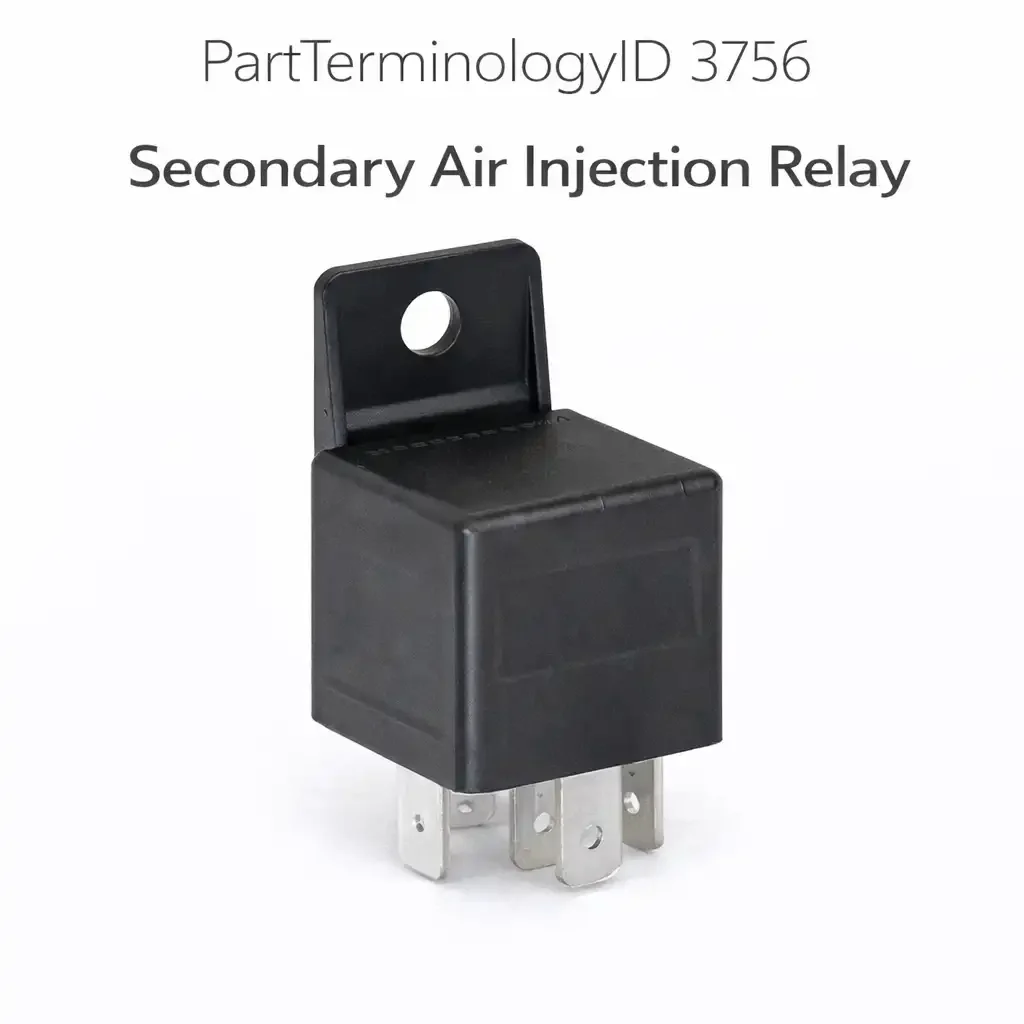
The Secondary Air Injection Relay, cataloged under PartTerminologyID 3756, delivers battery voltage to the electric air pump motor in the vehicle's secondary air injection (AIR) system. On cold engine start, the PCM closes the relay by grounding the relay coil, the pump motor spins, and pressurized fresh air is pushed through the check valve and solenoid valve assembly into the exhaust ports or pre-catalyst exhaust stream. The additional oxygen promotes more complete combustion of the rich cold-start exhaust mixture, reduces hydrocarbon and carbon monoxide emissions during warm-up, and accelerates catalytic converter light-off. Once the engine reaches closed-loop operating temperature, the PCM opens the relay, the pump stops, and the AIR system remains inactive until the next cold start.
The relay's job is straightforward: close when the PCM commands it, pass battery current to the pump motor, open when the PCM commands it off. What makes this relay category diagnostically demanding is the component environment around it. The AIR pump motor draws 20 to 40 amperes during operation, and the relay contacts bear that full load on every cold start. The check valve between the pump and the exhaust manifold is the most age-fragile component in the system, and when it fails, exhaust backflow enters the pump housing, corrodes the pump internals, and causes catastrophic pump failure that draws locked-rotor current through the relay contacts before the fuse blows. A relay that tests functional in isolation may have failed contacts because of a locked pump that failed because of a check valve that let exhaust into the air circuit. The relay is one node in a failure chain that always needs to be understood as a system rather than as an isolated component.
What the Relay Does
Cold-Start Operation Sequence
The PCM initiates AIR system operation at cold start when coolant temperature is below a calibrated threshold, typically in the range of 30 to 55 degrees Celsius depending on the platform, and ambient air temperature meets the system's enable conditions. The PCM grounds the relay coil, the relay closes, and battery voltage reaches the pump motor. Simultaneously, the PCM commands the AIR switching solenoid valve open, allowing the pump's pressurized output to reach the exhaust ports or pre-catalyst pipe. The pump runs for a fixed warm-up period, typically 30 to 90 seconds, after which the PCM opens the relay and closes the solenoid valve.
On platforms with dual-bank exhaust systems, there may be two solenoid valves, one per bank, with the relay supplying the pump and the solenoid valves directing airflow independently. On these platforms, the relay (PartTerminologyID 3756) is the single power supply relay for the pump motor, distinct from the solenoid valve switching circuit. P0418 is the specific OBD-II diagnostic trouble code for the pump relay circuit, while P0412 addresses the solenoid valve circuit. Buyers who present with P0412 need the solenoid valve or its circuit, not the pump relay.
PCM Monitoring of the Relay Circuit
The PCM monitors the relay control circuit voltage to verify that the relay responds correctly to its commands. When the PCM grounds the relay coil to command the relay on, the control circuit voltage should drop near zero. When the PCM releases the relay coil ground to command the relay off, the control circuit voltage should return to near battery voltage. If the PCM detects control circuit voltage that does not match the expected state for its current command, P0418 sets. This monitoring architecture means P0418 can be set by a failed relay coil, a failed coil ground path, an open or shorted control circuit wire between the PCM and the relay, or a relay coil that the PCM cannot pull to ground because of excessive coil resistance. The PCM circuit monitoring distinguishes this relay category from relay categories where the PCM only observes downstream results rather than directly monitoring the relay control circuit.
Relay Contact Load and Failure Mode
The AIR pump motor's 20 to 40 ampere draw during operation subjects the relay contacts to a substantial load with every cold start. A new relay has contact capacity well in excess of this load, but contacts that have sustained elevated current from a mechanically stressed or failing pump develop surface resistance through pitting and oxidation faster than contacts in lower-load circuits. On aged vehicles where the pump bearing has worn, where the pump impeller has sustained moisture corrosion, or where the pump has been running partially seized, the current draw through the relay contacts during the pump's final operating cycles can exceed the relay's rated contact capacity, accelerating contact wear and producing a relay that fails at a contact level while testing as functional at the coil level.
A relay with burned contacts produces high contact resistance that reduces the pump motor's supply voltage, causing the pump to run slowly, produce insufficient air pressure, and set P0411 for insufficient airflow even when the relay does not set P0418 for a relay circuit fault. A pump that receives 9 or 10 volts through degraded relay contacts instead of 12 volts may run but not produce adequate air volume to satisfy the PCM's airflow monitoring threshold. This voltage drop across the relay contacts is an underdiagnosed contributor to P0411 codes where the pump tests functional on direct battery power but fails the PCM's cold-start flow test.
Platforms Without a Discrete Relay
Not all secondary air injection systems use a discrete relay that matches PartTerminologyID 3756. Some platforms drive the AIR pump motor through a solid-state PCM output driver, eliminating the discrete relay entirely. Others use a powertrain relay or main relay that supplies the AIR pump circuit rather than a dedicated AIR pump relay. ACES fitment data for 3756 should reflect only platforms where a discrete secondary air injection pump relay is present in the circuit, distinct from the PCM driver or the main powertrain relay, to prevent orders on vehicles where no such relay exists.
Top Return Scenarios
P0411 Code Misidentified as Relay Fault
P0411, Secondary Air Injection System Incorrect Flow Detected, is the most common OBD-II code associated with AIR system complaints, and it is not a relay circuit code. P0411 sets when the PCM's flow monitoring indicates that insufficient air is entering the exhaust during the pump's operating window, or that airflow is detected outside of the expected window. The causes of P0411 include a failed AIR pump motor, a clogged or failed check valve, a failed solenoid valve that does not open when commanded, collapsed or disconnected air hoses, cracked exhaust ports or pipes that produce backpressure leaks, and relay contact voltage drop severe enough to reduce pump output below the threshold. The relay is one of the lowest-probability causes of P0411, because a relay that is failing typically sets P0418 before it reaches the contact degradation level that would reduce pump output enough to set P0411 without also triggering the relay circuit monitoring code.
A buyer with P0411 and no P0418 who orders the relay is operating on the assumption that an undetected relay circuit fault is producing insufficient airflow, when the pump, check valve, and solenoid valve are each more probable fault sources. The relay is not the correct diagnostic direction for a standalone P0411. A buyer with both P0411 and P0418 may have a relay circuit fault contributing to airflow insufficiency, but P0418 is the gateway code that identifies the relay circuit as a confirmed fault location rather than a suspected one.
AIR Pump Failure Misidentified as Relay Failure
The AIR pump motor is the most commonly replaced component in the secondary air injection system and is the most common cause of both P0411 and P0418. Pumps fail through bearing wear, impeller corrosion from exhaust backflow through a failed check valve, and internal moisture damage. A pump that has failed mechanically draws excessive current through the relay, which trips the circuit fuse, which causes the relay's supply terminal to lose voltage, which the PCM interprets as a relay circuit fault and sets P0418. The P0418 code in this scenario is accurate in that the relay circuit is not behaving as expected, but the root cause is the pump failure that blew the fuse, not a failed relay.
The diagnostic pivot is fuse condition. If the AIR pump circuit fuse is blown when P0418 is present, the relay was not the origin of the failure. Replacing the fuse and the relay without addressing a seized or corrosion-failed pump will result in a second blown fuse and a second set of the same codes. A buyer who orders the relay without checking the fuse condition and pump motor rotation is solving the symptom rather than the cause, and the return follows when the new relay's fuse blows again within the first cold start cycle.
Check Valve Water Ingestion Damage Chain
The check valve between the AIR pump output and the exhaust manifold prevents exhaust gas from flowing backward into the pump housing when the pump is off. A check valve that has failed open allows hot exhaust gases and condensate moisture to enter the pump housing, corrodes the impeller and motor windings, and causes pump failure. On vehicles operated in cold climates, water accumulating in the air plumbing can be drawn into the pump at the next cold start, causing a hydraulic lock condition that draws locked-rotor current through the relay contacts. Locked-rotor current is several times the pump's normal operating current and will blow the circuit fuse, weld the relay contacts in the closed position, or damage both the relay and the pump simultaneously.
A buyer who presents with a melted relay socket, a blown fuse, and a non-operational pump is experiencing the downstream consequences of a check valve failure. Replacing the relay without replacing the pump and the check valve returns a vehicle that blows its new relay within the first few cold start cycles as the replacement pump encounters the same exhaust backflow that destroyed its predecessor.
P0418 Without Pump Voltage Test Before Ordering
P0418 confirms that the relay circuit is not behaving as expected, but it does not specify whether the relay coil has failed, whether the control circuit between the PCM and the relay has an open or short, whether the relay's supply circuit fuse has blown, or whether the relay contacts have welded. Each of these fault conditions sets the same P0418 code. A buyer who orders the relay on the basis of P0418 alone, without testing whether the relay coil receives its PCM ground command, whether the relay's supply fuse is intact, and whether the PCM control circuit has continuity, may receive a functional relay and install it into a circuit where the fuse, the wiring, or the PCM driver is the actual fault.
The relay coil test with a direct 12V supply and a ground confirms whether the relay's internal coil and contacts function. If the relay coil activates the contacts on a bench test, the relay is functional and the circuit or fuse is the fault. If the relay coil does not activate the contacts on a bench test, the relay has an internal failure and replacement is the correct repair.
Welded Contact Relay Producing Continuous Pump Operation
A relay with contacts welded in the closed position delivers continuous voltage to the AIR pump motor, causing the pump to run at all times rather than only during cold start warm-up. The pump motor is not designed for continuous operation, and continuous running causes premature pump failure through overheating and bearing wear. This symptom, a pump that runs continuously rather than for a brief post-startup interval, is caused by welded relay contacts rather than relay contact resistance or coil failure. A buyer who notices the AIR pump running constantly, or who hears an unusual buzzing or humming from the pump location after the engine has fully warmed up, has a welded-contact relay rather than a failed-open relay, and the relay is the correct repair in this scenario without any further diagnostic confirmation needed.
Listing Requirements
Every listing for PartTerminologyID 3756 should include:
ACES fitment data limited to vehicle makes, models, model years, and engine configurations that were factory-equipped with an electric secondary air injection pump system using a discrete pump relay, with no entries for platforms where the pump is driven directly by the PCM, by a belt-driven system, or by a shared powertrain relay
A clear statement that the relay-specific OBD-II code is P0418, and that P0411 (insufficient airflow) is not a relay circuit code and does not implicate the relay as a primary suspect without an accompanying P0418
A note that a blown AIR pump circuit fuse accompanying P0418 indicates pump failure as the root cause, and that relay replacement without pump and check valve inspection will result in a second blown fuse
A note that pump motor direct-power testing must be performed before ordering to confirm the pump is not seized or drawing locked-rotor current, as a pump fault that damages relay contacts is not corrected by relay replacement alone
A note identifying the distinction between the pump relay (PartTerminologyID 3756) and the AIR solenoid valve switching circuit (P0412) so buyers with solenoid valve codes order the correct component
Frequently Asked Questions
I have a P0418 code. Is the relay definitely bad?
P0418 confirms the relay circuit is not responding as the PCM expects, but the relay itself is one of several possible fault locations. Before ordering, confirm the circuit fuse is intact, because a blown fuse caused by pump failure produces the same P0418 code as a failed relay. If the fuse is intact, bench-test the relay with a direct 12V supply and ground to confirm whether the internal coil and contacts are functional. If the relay bench-tests functional, inspect the PCM control circuit wiring for continuity between the PCM and the relay coil terminal. If the relay fails the bench test, replacement is confirmed.
What is the difference between P0411, P0412, and P0418?
These three codes address three different components in the secondary air injection system. P0411 indicates insufficient airflow detected, meaning the PCM's monitoring did not observe adequate air entering the exhaust during the pump's operating window; the causes include a failed pump, a clogged or failed check valve, a failed solenoid valve, and degraded air hoses. P0412 indicates a fault in the solenoid valve switching circuit, the valve that directs the pump's output to the exhaust manifold or pre-catalyst pipe. P0418 indicates a fault in the pump relay circuit specifically. Ordering the relay for P0411 or P0412 without an accompanying P0418 is ordering the wrong component for the code's indicated fault location.
The fuse keeps blowing after I replace the relay. What is causing this?
A repeatedly blown AIR pump circuit fuse indicates that the pump motor is drawing excessive current. The most common cause is a pump with a mechanically seized or heavily corroded impeller drawing locked-rotor current that exceeds the fuse rating. The check valve should be inspected immediately, because a failed check valve allows exhaust backflow to corrode the pump internals over time, eventually seizing the motor. The correct repair sequence is to inspect and replace the check valve, test the pump motor for free rotation before installation, and replace the fuse and relay together once the pump condition is confirmed. Replacing the fuse and relay alone without addressing the pump condition will reproduce the failure within one to three cold start cycles.
My AIR pump runs all the time after the engine warms up. Is this a relay problem?
Continuous pump operation after warm-up is the symptom of welded relay contacts. A relay with contacts fused in the closed position delivers uninterrupted voltage to the pump regardless of the PCM's command state. The PCM may set a fault code if its control circuit monitoring detects that the relay is not responding to an off command. The relay is the correct repair for this symptom, and it should be replaced before the continuous operation causes premature pump failure from overheating and bearing fatigue.
Does a failed secondary air injection relay affect drivability?
No. The AIR system operates only during the cold-start warm-up period, typically the first 30 to 90 seconds of engine operation from a cold soak. A failed relay that prevents pump operation produces no effect on engine power, idle quality, fuel economy, or any drivability parameter. The only consequences of relay failure are an illuminated check engine light, potential failure of OBD-II emissions readiness monitors, and failure of emissions testing in jurisdictions that test for SAI system operation. On a vehicle operated exclusively in states without emissions testing requirements, a failed AIR relay has no operational consequence whatsoever beyond the MIL.
What Sellers Get Wrong
Listing the relay as the primary diagnostic direction for P0411
P0411 is an airflow code, not a relay circuit code. The relay does not appear in the diagnostic procedure for a standalone P0411 until the pump, check valve, solenoid valve, and air hoses have been evaluated and found functional, and even then, relay contact voltage drop is the suspected relay mechanism rather than an outright relay circuit failure. A listing that leads with P0411 as the gateway code for the relay generates orders from buyers who have an airflow problem caused by a failed pump or check valve, not a relay circuit fault. P0418 is the correct primary code reference for this PartTerminologyID.
Not addressing the fuse-blown-pump-failed failure chain
The most destructive and most common failure pattern in this PartTerminologyID is the chain that runs from failed check valve to exhaust backflow to pump corrosion to locked-rotor current to blown fuse to relay damage. A listing that sells the relay without prompting fuse condition inspection and pump motor testing sends buyers into a return cycle where the new relay fails at the same rate as the original because the pump that destroyed the original relay is still in the circuit. This failure chain documentation is the most valuable content investment in the 3756 listing.
Not distinguishing the relay from the solenoid valve circuit
P0412 and P0418 are adjacent codes in the secondary air injection system code family, and buyers unfamiliar with the system architecture regularly confuse them. A listing that does not explicitly state that P0412 is the solenoid valve circuit code and P0418 is the pump relay circuit code attracts buyers with solenoid valve faults who install the relay and find the same code remains. The two components are in different positions in the system with different part numbers and different OBD-II code assignments, and the listing should make this distinction explicit.
Not acknowledging that some platforms lack a discrete relay
A meaningful share of vehicles equipped with secondary air injection use a PCM-driven solid-state output rather than a discrete electromechanical relay to power the pump. Fitment data that includes these platforms generates no-fit returns where buyers receive the relay and find no relay socket in the circuit. ACES verification against the specific platform's electrical system architecture is required to confirm that a discrete relay exists before including a vehicle application in the fitment data.
Cross-Sell Logic
AIR pump motor (the most frequently replaced component in the secondary air injection system; a pump that tests functional on direct battery power but fails the PCM's cold-start flow test may have a worn bearing or corroded impeller reducing its output pressure; a pump with seized rotation is the root cause behind most blown AIR fuse and damaged relay presentations)
Check valve for the secondary air injection system (the component whose failure initiates the water and exhaust backflow damage chain that destroys pumps, blows fuses, and welds relay contacts; replacement should accompany any pump or relay replacement on a vehicle where check valve condition has not been recently confirmed)
AIR solenoid valve assembly (the PCM-commanded valve that opens to allow the pump's output to reach the exhaust manifold; a failed solenoid valve sets P0412 rather than P0418 and is the correct repair for buyers with P0412; also a frequent cause of P0411 when the valve fails to open correctly)
AIR pump circuit fuse (the immediate diagnostic checkpoint before any relay or pump replacement; a blown fuse with P0418 indicates overcurrent from pump failure rather than relay circuit failure, and the fuse replacement history reveals whether a recurring fault has been destroying components in sequence)
AIR pump supply wiring harness (the harness section between the relay output terminal and the pump motor connector is routed through the engine bay in proximity to exhaust heat sources, and heat damage to insulation produces intermittent shorts that set P0418 codes while the relay and pump test functional)
Scan tool with AIR system bidirectional control (allows KOEO activation of the AIR relay and pump to confirm relay and pump operation without requiring a cold engine start; the most efficient diagnostic tool for confirming relay function before ordering)
Final Take
PartTerminologyID 3756 sits in a return-risk-elevated category because the codes that bring buyers to it, primarily P0411 and P0418, have high rates of misattribution to the relay when the pump, check valve, or fuse circuit is the actual fault. P0411 should not be generating relay orders without an accompanying P0418, and P0418 should not generate a relay order without a fuse check and bench test that confirm the relay rather than the wiring or pump as the fault origin.
The AIR system is an emissions-only system. It has no drivability effect, no performance consequence, and no safety implication. That means buyers can take the time to run a correct diagnostic sequence before ordering, and listings that deliver this diagnostic sequence serve buyers well by redirecting the pump buyer, the check valve buyer, and the fuse buyer away from an unnecessary relay purchase. The relay is a real and replaceable fault source in this category, but it is downstream of several higher-probability components, and protecting return rate in 3756 means making the full fault hierarchy visible to buyers before they add a relay to their cart.