
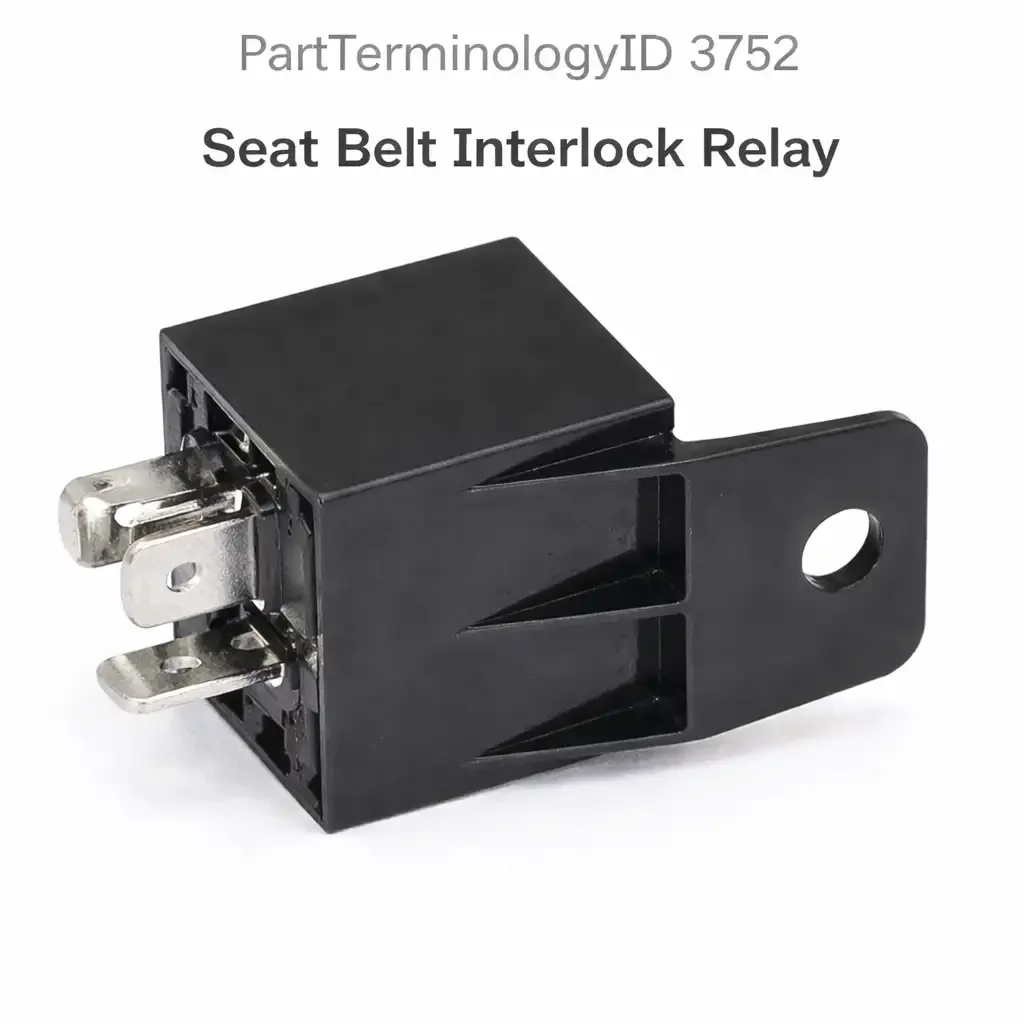
The Seat Belt Interlock Relay, cataloged under PartTerminologyID 3752, is the switching relay that allowed or denied starter solenoid engagement based on the output of the 1974 model year seat belt starter interlock logic module. When the interlock module's logic circuit determined that the required seat occupancy and belt fastening sequence had been completed correctly, it sent a ground signal to the relay coil, the relay closed, and the starter solenoid control circuit was completed, allowing the engine to crank. If the logic module determined the sequence was incorrect or incomplete, it withheld the ground signal, the relay remained open, and the starter circuit was interrupted regardless of key position. The relay is the enforcement mechanism between the interlock module's decision-making logic and the starter solenoid's physical actuation.
PartTerminologyID 3752 applies exclusively to the 1974 model year and to a portion of early 1975 model year vehicles built before the legislative repeal took effect. Federal Motor Vehicle Safety Standard 208, as amended in August 1973, required every 1974 passenger car sold in the United States to be equipped with either automatic occupant protection, which a small number of GM vehicles met with air bags, or an ignition interlock that prevented engine operation if the driver or front outboard passenger had not fastened their seat belt. Every other 1974 model year passenger car used the interlock. President Ford signed legislation repealing the interlock requirement on October 27, 1974, eliminating it from all future vehicles. 1975 model year production had already begun before the repeal, and vehicles built through the early weeks of 1975 production at most manufacturers were equipped with the interlock hardware, though many were either shipped with the system disconnected or had it disabled at the dealership at customer request.
The buyer for PartTerminologyID 3752 today is almost exclusively a classic vehicle restorer working on a numbers-correct or show-condition 1974 vehicle. The overwhelming majority of surviving 1974 vehicles had their interlock systems bypassed or disconnected within the first few years of service, and most have remained disabled ever since. A buyer ordering this relay for a driver-quality restomod or a daily use application is almost certainly better served by the established bypass procedure than by a relay replacement that returns a fifty-year-old system to service. Restoration buyers and concours-level restorers are the appropriate audience for this PartTerminologyID, and listing content that acknowledges this context serves those buyers while filtering out misapplication orders from buyers who simply need their 1974 car to start.
What the Relay Does
Position in the Starter Interlock Circuit
The seat belt starter interlock system had three main electrical components in addition to the relay: the seat weight sensor strips under the front seats, the buckle switches in the seat belt latches, and the interlock logic module mounted under the instrument panel on the passenger side of the vehicle. The relay connected the interlock module's output to the starter solenoid control circuit.
On vehicles equipped with this system, the normal starter circuit path from the ignition switch's start position to the starter solenoid's control terminal was routed through the interlock relay contacts rather than going directly to the solenoid. The ignition switch start position provided the relay's contact-side voltage supply. The interlock module controlled the relay coil ground path. When the module confirmed a correct seat-belt-fastened sequence, it completed the relay coil ground, the relay closed, and start voltage reached the solenoid. The key, the relay, and the solenoid formed a series circuit: all three had to function for the engine to crank.
The Required Sequence Logic
The interlock system was not simply a buckle-detection circuit. It used a logic module with sequence detection, developed by Delco Electronics using a custom integrated circuit, to verify that the correct order of events had occurred: the occupant must sit down first, which triggered the seat weight sensor, and then fasten the belt buckle, which triggered the buckle switch. The module latched this sequence confirmation and allowed one start attempt. If the belt was buckled before sitting down, or if the belt was already buckled from a previous trip and the driver simply sat down, the module's sequence logic rejected the condition and denied the start. This sequence requirement was the source of most driver frustration with the system, because fastening the belt before sitting down, which many people naturally did, would not satisfy the module's logic.
The module also included restart memory: once a start had been successfully completed, the system allowed engine restart without requiring a new belt-fastening sequence for some period of time or under some driving conditions, depending on manufacturer implementation, to accommodate situations like a momentary stall or a brief stop where the driver had not exited the vehicle.
The Underhood Bypass Relay and Override Button
Every vehicle equipped with the seat belt interlock also had an underhood override switch, which on most platforms was mounted on a bright orange bracket on the firewall or inner fender near the brake booster. Pressing the override button allowed one start attempt regardless of seat belt status, permitting a mechanic to move the vehicle without buckling up or allowing the driver to start the engine when the interlock system had malfunctioned. The override was engineered as a single-use-per-press device: pressing the button and holding it provided only one start attempt, and taping or blocking the button in the pressed position did not provide continuous bypass. The button had to be pressed for each start that was to bypass the interlock.
The override button functioned through a separate bypass relay on some platforms, while on others it provided a direct electrical path around the interlock relay contacts. The distinction between the interlock relay (PartTerminologyID 3752) and the override bypass relay matters for parts ordering: both could fail independently, and failure of the bypass relay produced a different symptom than failure of the interlock relay.
Contact Resistance Failure Mode
The interlock relay contacts carried the full current load of the starter solenoid control circuit with every engine start. Over fifty years of service, relay contacts develop pitting and oxidation even under normal cycling conditions. A relay with increased contact resistance may produce an intermittent start condition where the engine cranks occasionally with no change in seat belt behavior, or may produce a complete no-start condition that the underhood override button cannot correct because the fault is in the relay contacts themselves rather than in the interlock logic. Relay contact resistance also produces a voltage drop across the relay contacts under the momentary high current of the solenoid trigger, which can cause a solenoid that tests with correct supply voltage at rest to receive insufficient voltage during the start attempt.
Top Return Scenarios
Interlock Logic Module Failure Misidentified as Relay Failure
The interlock logic module is a more likely cause of no-start on a 1974 interlock-equipped vehicle than the relay itself. The module contains a custom integrated circuit and associated discrete components that were built to early 1970s component reliability standards using what manufacturers were willing to pay for a government-mandated system they did not want. Module failures, including failed integrated circuits, failed discrete transistors and diodes, and corroded solder joints from decades of service and thermal cycling, are the most common electrical failure mode in surviving interlock systems. A module that has lost its output capability does not complete the relay coil ground path regardless of seat belt status, producing an interlock relay that never closes and a no-start condition indistinguishable from a failed relay.
The diagnostic test that separates module failure from relay failure is to apply a direct ground to the relay coil ground terminal. If the relay closes and the solenoid activates with a direct coil ground, the relay is functional and the module is not producing its output. If the relay does not close with a direct coil ground, the relay coil or contacts have failed. This test takes under a minute with a test wire and a chassis ground connection, and it determines whether the relay or the module is the fault before any part is ordered. A buyer who orders the relay without this test may receive a functional relay, install it, and find the vehicle still does not start because the module was the fault all along.
Seat Weight Sensor and Buckle Switch Failure Misidentified as Relay Failure
A seat weight sensor that has an open circuit does not signal the module that an occupant is present, causing the module to treat every start attempt as an unoccupied-seat condition. A buckle switch that fails open does not signal the module that the belt has been fastened. Either condition prevents the module from completing its sequence logic, preventing the module from ever producing its relay coil ground output, resulting in a no-start that is caused by sensor failure rather than relay failure. On fifty-year-old vehicles, the seat weight sensor strips under the seat bottoms and the belt buckle latch switches are the most corrosion-prone and age-fragile components in the system, as they involve physical flexing, compression, and moisture exposure far more than the relay does.
The diagnostic approach is to test whether the interlock system responds correctly to sensor simulation before diagnosing the relay or the module. If applying a direct ground to the relay coil produces starter engagement, the relay is confirmed functional, and the module and sensor inputs become the focus. If applying a simulated belt-fastened signal through the module's sensor input path produces a relay coil ground output, the module is functional and the sensors are the fault. Working through the system from the sensor inputs forward is the correct diagnostic sequence for a 1974 no-start complaint on an interlock-equipped vehicle.
Bypass Relay Failure Misidentified as Interlock Relay Failure
On platforms where the underhood override system used a separate bypass relay, failure of the bypass relay produces a condition where the override button press does not result in a start attempt. A buyer who presses the underhood override button, gets no start, and then orders the interlock relay may receive and install a functional relay and still find the vehicle does not start via the override because the bypass relay, not the interlock relay, was the fault. These are two different relay positions in the interlock circuit, and they fail independently. The diagnostic distinction is whether the normal belt-fastened start sequence also fails or whether only the override button fails. If a correctly sequenced belt-fastened start attempt also produces no start, the interlock relay or module is the fault location. If the belt-fastened start works but the override button does not, the bypass relay is the fault location.
Corroded Contact No-Start on a System That Has Been Bypassed
Some 1974 vehicles had their interlock system bypassed at the relay level, where the relay's contact terminals were jumped rather than the interlock being removed, and the relay itself was left in place in its socket. Over decades, a bypassed relay may appear to be in circuit but the bypass jumper connection may have developed resistance or failed, restoring the open relay contacts to the starter circuit path. A vehicle that starts intermittently or fails to start on a 1974 car that the owner believes to have a bypassed interlock may have a failed bypass modification rather than a failed relay, and the correct repair is to inspect and repair the bypass connection rather than replace the relay.
No-Fit Orders from Non-Restoration Buyers
A buyer with a 1974 vehicle that does not start and who finds PartTerminologyID 3752 in a search may order this relay under the assumption that restoring the factory interlock system to operation will solve their no-start condition, when the correct solution is the established bypass procedure. The bypass, which involves routing the ignition switch start signal directly to the starter solenoid control terminal, is a well-documented, reversible, and widely accepted modification for 1974 vehicles. It eliminates all interlock-related no-start conditions permanently and has been the standard repair for interlock-related issues since the late 1970s. A non-restoration buyer who orders the relay, reinstalls the interlock system, and then encounters a no-start due to the module or sensors will return the relay as non-corrective.
Listing Requirements
Every listing for PartTerminologyID 3752 should include:
ACES fitment data restricted to 1974 model year passenger cars and early production 1975 model year vehicles that were factory-equipped with the seat belt starter interlock system, with no application entries for 1975 vehicles built after the interlock repeal took effect at each manufacturer
A clear statement that this relay is a restoration part intended for concours or show-quality restorations of 1974 vehicles, and that non-restoration owners seeking to resolve a no-start condition should use the established interlock bypass procedure rather than this relay
A note that the interlock logic module is the more likely fault source for a no-start on a functioning interlock system, and that relay coil ground terminal testing must be performed to confirm whether the module or the relay is the fault before ordering
A note that seat weight sensors and buckle switches are additional high-probability fault sources on vehicles where the interlock system is still in place, and that sensor testing should precede relay diagnosis
A note identifying the distinction between this relay and the underhood override bypass relay, as these serve different positions in the system and produce different failure symptoms
A note acknowledging that the vast majority of 1974 vehicles have had this system bypassed or disabled and that the part serves an extremely narrow restoration market
Frequently Asked Questions
My 1974 car won't start and I found the seat belt interlock relay. Is this the problem?
Possibly, but the relay is not the most likely fault. The interlock logic module under the instrument panel is a more likely failure source than the relay, because the module's custom integrated circuit and discrete electronic components are significantly more age-fragile than the relay's mechanical contacts. Test the relay directly by applying a temporary ground wire to the relay coil ground terminal with the ignition in the start position. If the starter engages with a direct coil ground, the relay is functional and the module, sensors, or wiring are the fault. If the starter does not engage with a direct coil ground, the relay contacts or coil have failed and the relay is the correct repair. For most owners of 1974 vehicles, the simpler long-term solution is the bypass procedure that routes the ignition start signal directly to the solenoid and eliminates interlock-related no-start conditions permanently.
What is the bypass procedure for the 1974 seat belt interlock?
The bypass connects the ignition switch start-position output wire directly to the starter solenoid control terminal, removing the interlock relay and module from the start circuit entirely. The specific wires and connection points vary by manufacturer. On Chrysler products, connecting the two yellow wires at the interlock reset relay directly to each other is the commonly documented bypass. On GM products, disconnecting the belt buckle harness connector at the base of the steering column or under the seat was the simplest approach on many platforms. On Ford products, similar direct wire connections at the interlock module bypassed the system. Factory service manuals and manufacturer-specific restoration forums have the exact wire colors and connection points for each vehicle. The bypass is legal at the federal level, as the legislation repealing the interlock mandate specifically included a provision authorizing disconnection of the system.
I pressed the bypass button under the hood and the car still won't start. Is the interlock relay bad?
If the underhood override button press does not produce a start attempt, the fault may be in the bypass relay on platforms that use one, in the override switch mechanism itself, or in the interlock relay. The override button was designed to provide one start attempt per press by routing a temporary signal around the interlock logic, not by directly bypassing the starter circuit in all cases. If neither a button press nor a belt-fastened start sequence produces engine cranking, a direct coil ground test on the interlock relay determines whether the relay is functional. If the relay closes with a direct coil ground but neither the button nor the belt sequence closes it through normal operation, the override circuit and the interlock module are both suspect.
Is there any reason to restore the interlock to working order rather than simply bypass it?
For a concours-judged show vehicle being restored to correct factory configuration, a functioning interlock system is part of the vehicle's as-built specification and may be required for period-correct judging. The NCRS and similar organizations that judge vehicles to factory-correct standards document the interlock system as an original feature of 1974 vehicles, and some judging guidelines specifically evaluate whether the system was present and described correctly in the documentation. Outside of this concours restoration context, there is no practical reason to restore the interlock system to operation. The legislation repealing it specifically authorized its disconnection, the components are fifty years old and failure-prone, and the bypass is a well-established and universally accepted modification for 1974 vehicles.
My 1974 car has the orange bracket on the firewall but no relay. Was the interlock removed?
The orange bracket, which held the override switch and bypass relay on most platforms, was sometimes left on vehicles when the interlock was disabled or removed. GM in particular continued to install the orange bracket at some assembly plants after the interlock mandate was repealed, because the assembly line setup had not yet been revised. The presence of the bracket does not confirm that the interlock is functional or that the relay is still in place. Inspect the interlock relay socket location under the instrument panel and the harness connections at the seat sensors to determine whether the system is intact or has been bypassed at the relay level.
What Sellers Get Wrong
Treating this as a general no-start relay for 1974 vehicles
The Seat Belt Interlock Relay is not a general diagnostic repair relay. It is a restoration part for a specific system that was present for one model year, that virtually every surviving vehicle has had removed or bypassed, and that has a well-established bypass procedure as the standard repair for no-start conditions. Positioning this relay as a solution for a 1974 no-start complaint without clearly establishing that the relay is a restoration part and that the bypass is the practical solution for non-restoration owners generates returns from buyers who receive the relay, install it, and still cannot start their vehicle because the module or sensors are also fifty years old and also failed.
Not identifying the interlock module as the higher-probability fault
The module is more likely to have failed than the relay over fifty years. The relay has mechanical contacts that develop oxidation but retain their basic function for decades in low-use applications. The module has a custom integrated circuit and discrete electronic components that have no comparable longevity track record in a thermally cycled automotive environment. A listing that names the relay as the primary suspect for a no-start without naming the module as the more likely alternative sends buyers to the wrong part in the majority of cases.
Omitting the early 1975 production VIN boundary in fitment data
1975 vehicles produced after the interlock repeal took effect were built without the interlock system. The transition point varies by manufacturer and assembly plant, and is a specific VIN or production date boundary for each platform. ACES fitment data that lists all 1975 vehicles of a given model produces no-fit returns from buyers whose 1975 vehicles were built after the interlock was deleted from the assembly line. The production VIN boundary is the most important fitment data element in this PartTerminologyID beyond the obvious 1974 model year restriction.
Not acknowledging the bypass context for non-restoration buyers
A listing that presents this relay as a straightforward replacement part without acknowledging that the bypass is the accepted and legally authorized standard repair will attract buyers who are not engaged in concours restoration, who install the relay, and who then encounter one of the other aged system component failures that are virtually guaranteed on a fully assembled fifty-year-old interlock system. The bypass is the right answer for the non-restoration market, and a listing that says so protects return rate by filtering out buyers for whom this part is not the correct solution.
Cross-Sell Logic
Interlock logic module (the more likely fault for a no-start on a 1974 interlock-equipped vehicle; the module's custom integrated circuit and discrete components are more age-fragile than the relay's mechanical contacts, and module failure prevents the relay coil from ever receiving its ground signal regardless of seat belt status)
Seat weight sensor strips (the under-seat compression sensors that signal the module when an occupant is present; open circuit failure prevents the module from detecting occupancy and therefore from completing the start sequence; a higher-probability fault than the relay on aged systems because of fifty years of compression cycling and moisture exposure)
Belt buckle latch switches (the switches in the seat belt buckle mechanism that signal the module when the belt is fastened; open circuit failure on these switches prevents the module from receiving the belt-fastened confirmation; another higher-probability fault than the relay due to age and mechanical use)
Underhood override switch and bypass relay (the emergency start provision that allows one start per button press regardless of belt status; a separate component from the interlock relay that fails independently and produces a different symptom pattern)
Factory service manual for the specific model year and platform (essential for any restoration or diagnostic work on the interlock system; the exact wire colors, connector locations, and bypass procedures vary by manufacturer, and the service manual is the authoritative source for the vehicle-specific configuration)
Neutral safety switch (shares the start circuit with the interlock relay on automatic transmission vehicles; a failed neutral safety switch produces the same symptom as a failed interlock relay on a vehicle with both systems functional, and the neutral safety switch is a more commonly replaced component on 1974 vehicles than the interlock relay)
Final Take
PartTerminologyID 3752 is one of the most historically circumscribed relay PartTerminologyIDs in the catalog. It applies to a single federally mandated system that was in production for less than eighteen months, that was so unpopular that Congress acted to eliminate it mid-model-year, and that was subsequently bypassed or disabled on virtually every surviving vehicle within the first few years of service. The relay is not a practical repair part for the overwhelming majority of 1974 vehicles still in circulation today. It is a restoration part, and it belongs in a listing context that makes that clearly understood.
For the concours restoration buyer who needs this relay, the critical diagnostic information is the coil ground test that separates relay failure from module failure, and the understanding that sensor and module age-related failure is far more likely than relay contact failure on a vehicle where the interlock has remained in place and untouched for decades. For the non-restoration buyer who is simply trying to make a 1974 car start reliably, the bypass procedure is the correct solution and should be named plainly in the listing. A listing that delivers this context to buyers protects return rate on a part that has the narrowest legitimate application window of almost any relay in the aftermarket catalog, and every misdirected order is avoidable with the right content.