
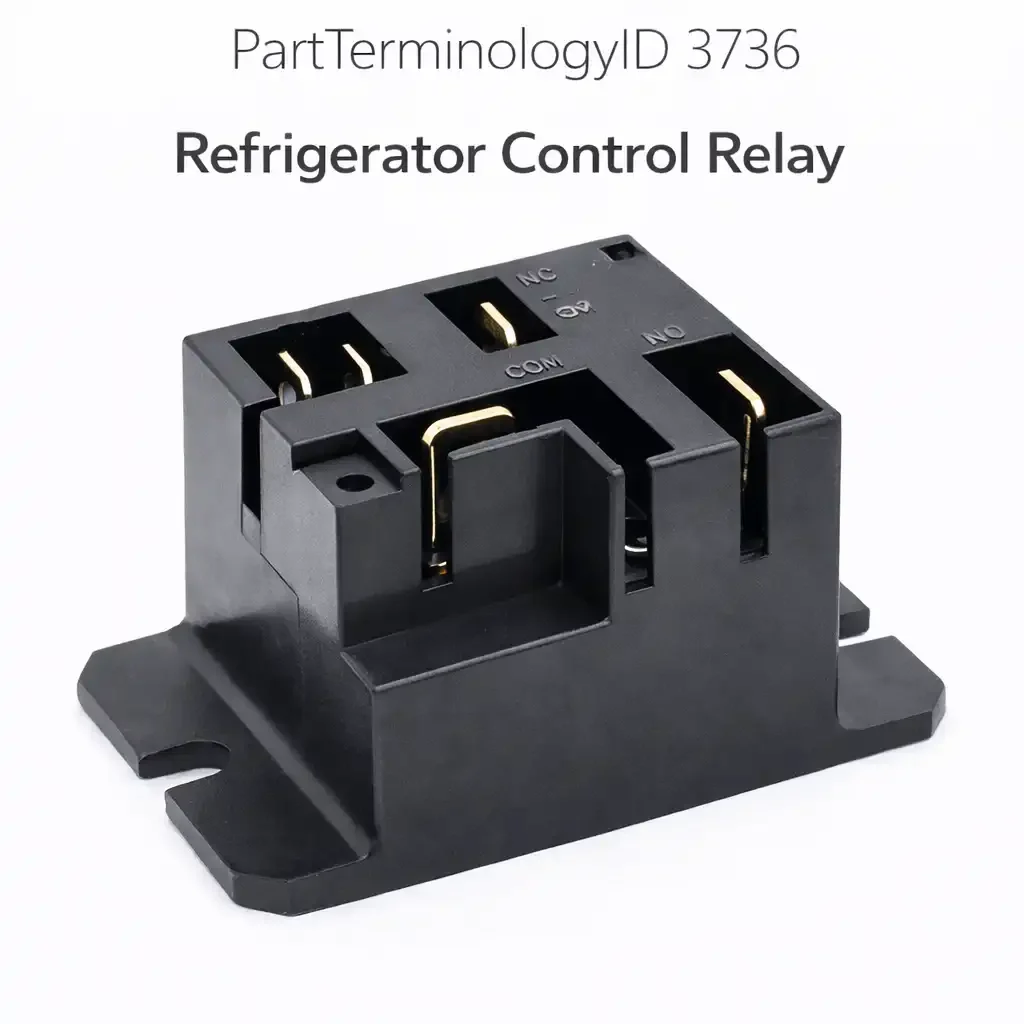
The Refrigerator Control Relay, cataloged under PartTerminologyID 3736, is the relay that cycles the cooling function of a factory-installed in-vehicle refrigerator unit in response to the unit's temperature control circuit. Where the Refrigerator Relay (PartTerminologyID 3732) gates whether the refrigerator unit receives ignition-switched supply voltage at all, the Refrigerator Control Relay operates one level deeper: it is the relay commanded by the refrigerator's thermostat or temperature control module to switch the compressor motor or cooling solenoid on and off as the unit cycles to maintain the set interior temperature. The 3732 relay determines whether power reaches the refrigerator. The 3736 relay determines whether the refrigerator's cooling mechanism runs within the unit.
This distinction is the most important content element in the 3736 category. A refrigerator that receives no supply voltage has a 3732 fault or an upstream fuse fault. A refrigerator that has supply voltage, runs the interior fan, and shows signs of electrical activity but does not cycle the compressor or does not maintain temperature has entered the fault territory of the 3736 relay, the thermostat, or the temperature control board. Getting that separation right before ordering is what prevents the no-correction return, where the buyer receives the relay, installs it, and finds the refrigerator still does not cool because the thermostat or control board was the actual fault rather than the control relay it commands.
What the Relay Does
Compressor Cycling in Response to the Temperature Control Circuit
A refrigerator maintains temperature through an on/off cycle. When the interior temperature rises above the thermostat's cut-in point, the thermostat closes its contacts, completing the circuit that triggers the control relay coil. The relay coil energizes, the contacts close, and voltage reaches the compressor motor or the cooling solenoid. The compressor runs, the refrigerant circuit removes heat from the interior, and the interior temperature drops. When the interior temperature falls to the thermostat's cut-out point, the thermostat opens its contacts, the relay coil loses its trigger signal, the contacts open, and the compressor stops. This cycling continues as long as the refrigerator unit has supply power and the thermostat is set to a temperature below ambient.
The Refrigerator Control Relay is the switching element that handles the compressor's operating current in this cycle. The thermostat contacts carry only the low-current relay coil trigger signal, not the full compressor motor current. The relay's contacts carry the compressor motor current, which on a 12V compressor-based in-vehicle refrigerator ranges from three to eight amperes during normal cycling. This load separation between the thermostat's control signal and the compressor's operating current is the core reason the control relay exists: it allows a small, fragile thermostat contact to manage a large, current-intensive compressor motor without the thermostat contacts being directly exposed to that load.
Relay Position in the Temperature Control Architecture
On most factory in-vehicle refrigerator systems using a self-contained 12V compressor, the temperature control architecture follows a consistent sequence. Supply voltage enters the unit through the ignition-switched supply relay circuit (3732). From there, it splits to the interior fan, which typically runs continuously while the unit has power, and to the control relay coil's supply terminal. The thermostat provides the coil's ground path or its trigger voltage, depending on whether the system uses a ground-switched or power-switched coil trigger. When the thermostat calls for cooling, the coil path is completed, the relay closes, and the compressor receives its operating voltage from the relay's contact-side supply.
On in-vehicle refrigerator units that use an electronic temperature control board rather than a mechanical thermostat, the control board reads the interior temperature sensor and outputs a relay coil trigger signal when it determines cooling is needed. In this architecture, the Refrigerator Control Relay's coil is driven by the control board's output, and a failed control board that does not produce the trigger signal is indistinguishable from a failed relay coil by observation alone. The diagnostic procedure is the same: confirm trigger voltage at the relay coil terminals with the temperature set to call for cooling. If trigger voltage is present and the relay does not close, the relay is the fault. If trigger voltage is absent, the fault is in the thermostat or control board.
Relationship to Factory A/C Refrigerant-Based Systems
On factory in-vehicle refrigerator installations that use shared A/C refrigerant lines rather than a self-contained 12V compressor, the Refrigerator Control Relay typically governs a solenoid valve that routes refrigerant to the unit when cooling is demanded. In this architecture, the thermostat or control module sends the trigger signal to the relay coil, the relay closes, the solenoid valve opens, and refrigerant flows through the unit's evaporator to provide cooling. When the thermostat's demand is satisfied, the relay drops out, the solenoid valve closes, and refrigerant flow to the unit stops.
In this solenoid-valve architecture, the control relay contact load is significantly lower than in a compressor-motor architecture because the solenoid valve draws only a fraction of the current that a compressor motor draws. However, the diagnostic approach is the same: confirm the relay's coil trigger from the thermostat or control module, and confirm the relay's output voltage at the solenoid valve connector. On these systems, the A/C system must also be evaluated as a variable, because a refrigerator unit that has a functioning control relay and solenoid valve still does not cool if the vehicle's A/C refrigerant charge is insufficient or if the A/C system is not running.
Intermittent and Heat-Related Failure Modes
The Refrigerator Control Relay on a factory in-vehicle refrigerator system operates in a physically confined, thermally loaded environment. The relay is typically mounted inside or immediately adjacent to the refrigerator unit, which generates heat during compressor operation. Relay contacts that are exposed to elevated ambient temperatures over years of service develop increased resistance before they fail completely, producing intermittent cooling behavior, where the unit cools adequately on cold days and fails to reach temperature on hot days, rather than an abrupt and total loss of cooling. This temperature-dependent intermittent pattern is one of the diagnostic indicators that points toward the control relay rather than the thermostat, because a thermostat fault tends to produce either continuous compressor operation or no compressor operation rather than a temperature-dependent intermittent pattern.
Corrosion on the relay socket terminals is a related failure mode in in-vehicle installations. The refrigerator unit's location inside the vehicle cabin or cargo area exposes the relay circuit to humidity, temperature cycling, and occasionally condensation near the refrigerator unit's exterior surfaces. Socket terminal corrosion creates contact resistance that reduces the relay's output voltage to the compressor, causing the compressor to run slowly, overheat, and eventually fail to start under load while starting normally at a cool ambient temperature. Terminal inspection and cleaning is a diagnostic step that precedes relay replacement when intermittent cooling is the presenting complaint.
Top Return Scenarios
Thermostat Failure Misidentified as Control Relay Failure
The temperature control thermostat is the most common cause of a no-cooling complaint where supply voltage is confirmed present at the refrigerator unit. The thermostat's job is to produce the relay coil trigger signal when the interior temperature rises above the cut-in point. A thermostat with failed contacts does not complete the relay coil trigger path, the control relay never closes, and the compressor never runs. The symptom is identical to a failed relay coil from observation alone: the refrigerator has power, the fan may run, but the compressor does not cycle and the unit does not cool.
The diagnostic pivot is to confirm relay coil trigger voltage with the interior temperature warmer than the thermostat's set point. If the interior temperature is already at or below the thermostat's set point, the thermostat is not calling for cooling and the relay will correctly remain open. Allow the interior to warm or temporarily set the thermostat to its coldest setting to force a call for cooling, then measure trigger voltage at the relay coil terminals. If trigger voltage is present and the relay does not click and close, the relay is the fault. If trigger voltage is absent with a confirmed call for cooling, the thermostat has failed and is not producing its trigger signal. Replacing the relay without this trigger voltage confirmation sends buyers to a no-correction return when the thermostat was the actual fault.
Temperature Control Board Failure Misidentified as Control Relay Failure
On refrigerator units with an electronic temperature control board, the board reads the interior temperature sensor and outputs the relay coil trigger. A control board that has failed due to a failed output transistor, a failed temperature sensor connection, or internal circuit damage does not produce the relay coil trigger signal regardless of what temperature the interior has reached. The presenting symptom is the same as a failed relay or a failed thermostat: the compressor does not cycle and the unit does not cool.
The diagnostic path on board-controlled systems starts with confirming whether the board's output terminal is producing trigger voltage when the interior temperature is above the set point. This may require checking for board fault codes on systems that support self-diagnostics before manual voltage testing. A board that is producing correct trigger voltage but the relay is not closing narrows the fault to the relay. A board that is producing no trigger voltage, with the sensor confirmed functional, narrows the fault to the board. Replacing the relay in a board-controlled system without confirming board output voltage is the most common source of no-correction returns in this PartTerminologyID.
Supply Voltage Absent at the Unit Misidentified as Control Relay Failure
If the refrigerator unit receives no supply voltage, neither the control relay's coil supply terminal nor its contact-side supply terminal has voltage, and the compressor cannot run regardless of the control relay's condition. This is a 3732 supply relay fault or a blown supply circuit fuse, not a 3736 control relay fault. The diagnostic sequence must confirm supply voltage at the refrigerator unit's main supply connector before any internal component diagnosis begins. Without supply voltage at the unit, control relay diagnosis is not meaningful because the relay has no power to pass to the compressor even if it closes.
A buyer who skips the supply voltage check and orders the control relay when the supply relay or fuse is the actual fault receives a part that, when installed, still produces a non-cooling refrigerator because the supply circuit fault was never addressed. Listing content that establishes supply voltage confirmation as the first step prevents this return category.
Compressor Failure Misidentified as Control Relay Failure
A compressor motor that has failed mechanically or electrically does not run even when the control relay correctly closes and delivers supply voltage to the compressor terminals. If the control relay clicks and closes, and supply voltage is confirmed at the compressor terminals, and the compressor still does not run, the fault is in the compressor, its overload protector, or its internal start device, not in the control relay. On 12V compressor units, the compressor's overload protector is a separate component that interrupts the compressor circuit if the compressor overheats, and an overload protector that has opened due to repeated overtemperature events produces a no-start symptom that is indistinguishable from a failed relay until voltage at the compressor terminals is confirmed.
The compressor fault confirmation test is direct: measure voltage at the compressor motor terminals when the control relay is confirmed closed. Voltage present and motor not running eliminates the relay as the fault and confirms the compressor, overload, or internal start device as the fault source. A buyer who replaces the control relay when the compressor was already confirmed to have supply voltage will return a functional relay.
Intermittent Cooling Attributed to Control Relay Before Socket Terminal Inspection
Intermittent cooling, where the unit cools correctly under certain conditions but fails to reach temperature under others, is commonly caused by corrosion on the relay socket terminals creating variable contact resistance before the relay contacts are involved at all. Socket terminal corrosion increases in proportion to the unit's age and the humidity exposure at the relay's installation location. Cleaning the socket terminals with an appropriate electrical contact cleaner and confirming terminal condition resolves a meaningful fraction of intermittent cooling complaints without relay replacement. A listing that does not prompt terminal inspection before relay replacement sends buyers to an unnecessary purchase in these cases, and when the new relay produces the same intermittent behavior because the socket terminals were not cleaned, the relay is returned as defective when it was never the fault.
Listing Requirements
Every listing for PartTerminologyID 3736 should include:
ACES fitment data reflecting only the specific vehicle makes, models, model years, and option package configurations that were factory-equipped with a dedicated in-vehicle refrigerator unit requiring a discrete control relay in the cooling cycle circuit
A clear statement distinguishing PartTerminologyID 3736 from PartTerminologyID 3732: the supply relay (3732) controls whether the unit receives ignition-switched power; the control relay (3736) controls whether the cooling function cycles within the unit; both may be present in the same vehicle and serve different fault scenarios
A note that the thermostat is the most common cause of no-compressor-cycling where supply voltage is confirmed present at the unit, and that relay coil trigger voltage must be confirmed before the relay is diagnosed
A note that on electronic control board platforms, the control board must be confirmed producing its relay coil trigger output before the relay is condemned
A note that the refrigerator's main supply voltage must be confirmed at the unit before internal component diagnosis, as a supply circuit fault produces a no-cooling symptom indistinguishable from a control relay fault
A note that intermittent cooling complaints should prompt relay socket terminal inspection before relay replacement, as terminal corrosion is a common cause of intermittent contact resistance on aged factory refrigerator circuits
Frequently Asked Questions
My fridge has power, the fan runs, but the compressor never starts. Is this the control relay?
This symptom is consistent with either a failed control relay, a failed thermostat that is not producing the relay coil trigger, or on electronic board platforms, a failed control board that is not outputting the trigger signal. Confirm relay coil trigger voltage at the relay coil terminals with the interior temperature above the thermostat's set point before ordering. If trigger voltage is present and the relay does not click and close, the relay is the fault. If trigger voltage is absent with a warm interior and the thermostat set for cooling, the thermostat or control board is the more likely fault.
What is the difference between the Refrigerator Relay (PartTerminologyID 3732) and this one?
The 3732 relay is in the vehicle's fuse panel and controls whether the refrigerator unit receives supply voltage at all. It is ignition-switched: the refrigerator gets power when the ignition is on and loses power when the ignition is off. The 3736 relay is inside or immediately associated with the refrigerator unit and controls whether the compressor or cooling solenoid runs in response to the thermostat's demand. Both relays must be functional for the refrigerator to cool. If the unit has no power at all, the 3732 relay or its fuse circuit is the fault. If the unit has power but the compressor never cycles, the 3736 relay, the thermostat, or the control board is the fault.
My fridge cools fine in the morning but stops cooling in the afternoon. Could this be the control relay?
Temperature-dependent intermittent cooling is consistent with relay contact resistance that increases with heat. A relay with contacts that function at cool ambient temperatures but develop excessive resistance as they warm up produces exactly this symptom pattern. It is also consistent with a thermostat bimetallic element that loses calibration at elevated temperatures, though that typically produces continuous compressor operation rather than intermittent cooling. Before ordering the relay, inspect the relay socket terminals for corrosion, as terminal resistance rather than contact resistance produces the same temperature-dependent symptom. If the socket terminals are clean and the relay is confirmed intermittent by direct bench testing with a 12V source, the relay is the correct repair.
The compressor runs continuously and the fridge gets too cold. Is the control relay bad?
Continuous compressor operation without cycling off is typically a thermostat fault rather than a relay fault. A thermostat with contacts stuck in the closed position keeps the relay coil triggered continuously, so the relay stays closed and the compressor runs without interruption. The relay is functioning correctly in this scenario: it is receiving a continuous trigger signal and correctly passing that signal to the compressor. The fault is that the trigger signal itself should be intermittent and is not. The thermostat is the component to diagnose for continuous compressor operation symptoms.
My vehicle has both a 3732 and a 3736 relay listed. Do I need both?
Only if both relays have failed, which is uncommon but possible in aged systems with extended service history. The diagnostic sequence determines which relay is the fault. If the refrigerator has no supply voltage at all with the ignition on, the 3732 relay or its upstream fuse circuit is the fault. If the refrigerator has supply voltage at the unit but the compressor does not cycle, the 3736 relay, the thermostat, or the control board is the fault. Replacing both relays preemptively without diagnostic confirmation increases parts cost and does not reduce diagnostic uncertainty if neither relay was actually faulty.
What Sellers Get Wrong
Not distinguishing PartTerminologyID 3736 from PartTerminologyID 3732 in listing content
These two relay PartTerminologyIDs exist in the same vehicle on platforms with factory refrigerators, and they address completely different fault scenarios. A listing for the 3736 that does not explicitly distinguish it from the 3732 will direct buyers with supply circuit faults to the wrong relay, and buyers with a confirmed internal no-cycling complaint may order the supply relay instead of the control relay. The distinction between upstream supply control and downstream compressor cycling control is the primary content investment that prevents cross-ordering between these two adjacent PartTerminologyIDs.
Not naming the thermostat as the higher-probability fault for no-cycling complaints
The thermostat is a more likely fault than the control relay for a no-cycling complaint because the thermostat bimetallic contact degrades through far more mechanical and thermal cycles than the relay contacts experience. A thermostat that opens its contacts prematurely, that has excessive contact resistance, or whose calibration has drifted prevents the relay coil trigger from ever completing its circuit. Listing content that names relay coil trigger voltage confirmation as the required pre-order diagnostic step protects against the return that occurs when the buyer replaces the relay and finds the unit still does not cycle because the thermostat was the fault all along.
Treating intermittent cooling as a relay fault without prompting terminal inspection
Relay socket terminal corrosion produces intermittent contact resistance that mimics relay contact failure. The terminal inspection is a no-cost diagnostic step that resolves a meaningful share of intermittent cooling complaints. A listing that directs buyers straight to relay replacement for intermittent complaints generates returns from buyers whose socket terminals were the actual fault and whose new relay exhibits the same intermittent behavior through the same corroded socket.
Not addressing the electronic control board population
A growing portion of factory in-vehicle refrigerator units replaced mechanical thermostats with electronic temperature control boards in model years spanning the mid-2000s onward, depending on the vehicle platform and refrigerator system supplier. On these units, the control board drives the relay coil rather than a bimetallic thermostat. A listing that does not acknowledge this architecture leads board-controlled platform buyers to replace the relay when the board's output transistor or sensor input circuit is the actual fault, producing a no-correction return.
Cross-Sell Logic
Temperature control thermostat for the in-vehicle refrigerator unit (the most likely fault for a no-cycling complaint where relay coil trigger voltage is confirmed absent; the thermostat degrades through more mechanical and thermal cycles than the relay contacts and is a higher-probability fault source for cycling failure)
Temperature control board for the in-vehicle refrigerator unit (the correct diagnosis target on electronic board-controlled platforms when the board's output trigger voltage is confirmed absent; a board that does not produce relay trigger output despite a warm interior temperature and a functional temperature sensor has an internal fault that relay replacement cannot correct)
Refrigerator Relay (PartTerminologyID 3732) (the upstream supply relay in the same vehicle; relevant when the no-cooling complaint includes absence of supply voltage at the refrigerator unit rather than a cycling fault with supply voltage confirmed present)
Interior temperature sensor for the refrigerator unit (on electronic board-controlled platforms, a failed temperature sensor produces the same symptom as a failed control board or failed relay because the board cannot produce a trigger signal without accurate sensor input; confirm sensor continuity and resistance before condemning the board or relay)
Refrigerator circuit fuse (the fastest first check for any no-power or no-cooling complaint; a blown supply fuse removes all supply voltage from the unit and prevents any internal component including the control relay from operating)
Relay socket repair terminals (for intermittent cooling complaints where socket terminal corrosion is identified during inspection; terminal replacement restores contact quality without relay replacement when the relay itself tests functional on a bench)
Final Take
PartTerminologyID 3736 is one relay removed from the symptom that brings buyers to the category. The presenting complaint, a refrigerator that has power but does not cool, points at a short list of components including the control relay, the thermostat or control board that drives it, the compressor and its overload, and the relay socket terminals. The relay is one candidate among four, and it is not the most likely one. The thermostat is more likely on mechanical platforms, and the control board is more likely on electronic platforms, because both of those components carry more cumulative stress than the relay contacts over the unit's service life.
The listing that prevents returns in this category is built around the trigger voltage test: confirm that the thermostat or control board is producing its coil trigger signal before the relay is diagnosed as the fault. That single diagnostic step separates relay failure from thermostat and board failure with a multimeter and two probe placements, and it takes under a minute. A buyer who performs this test and confirms trigger voltage present with no relay closure has identified the relay as the correct repair with confidence. A buyer who skips this step and orders on symptom alone is operating on a one-in-four guess, and three of those four outcomes produce a no-correction return. Listing content that delivers this test procedure to the buyer at the point of purchase serves the buyer, reduces returns, and correctly positions the 3736 as the precise component for a fault that has been properly isolated rather than a default order for anything that smells like a cooling problem.