
Wiper Relay (PartTerminologyID 3728): Diagnosis, Return Prevention and Listing Guide
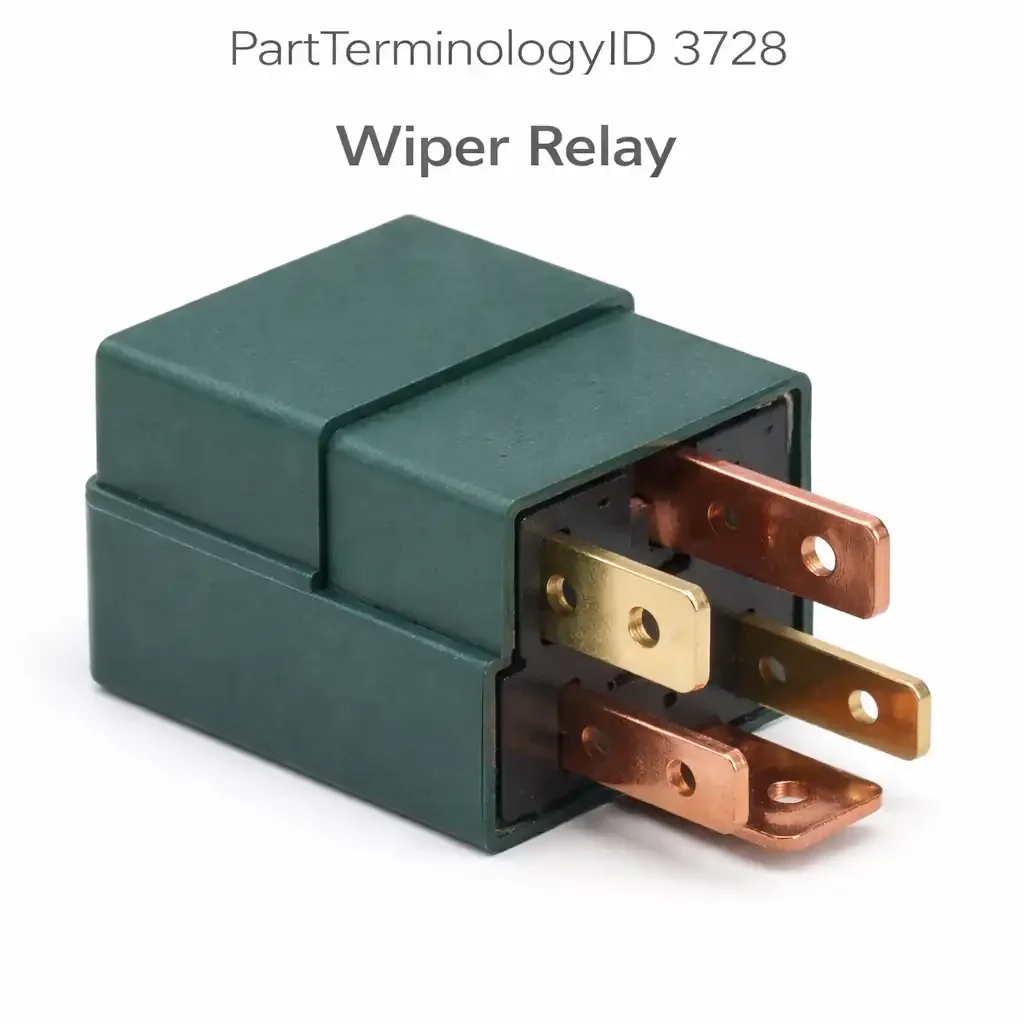
The Wiper Relay, cataloged under PartTerminologyID 3728, is the primary on/off power relay in the windshield wiper circuit. Its job is straightforward: when the wiper switch is activated, the relay coil receives a trigger signal from the wiper switch or the BCM, the relay contacts close, and battery voltage is delivered to the wiper motor's supply terminal, enabling the motor to run. When the wiper switch is turned off and the motor completes its park cycle, the relay drops out and removes power from the motor supply path. Without this relay closing, the wiper motor receives no operating voltage and the wipers do not move regardless of switch position.
PartTerminologyID 3728 represents the main on/off relay in the wiper supply circuit, which is architecturally distinct from the Wiper Pulse Relay (PartTerminologyID 3696) that controls intermittent timing logic. The distinction matters because the two relay types produce different symptom profiles and serve different positions in the wiper circuit. The Wiper Relay governs whether the motor receives power at all. The Wiper Pulse Relay governs whether the motor receives power in timed pulses during intermittent operation. A failure in the Wiper Relay eliminates all wiper function at every switch position. A failure in the Wiper Pulse Relay typically eliminates only the intermittent speed positions while leaving continuous low and high speeds functional. Getting the symptom scope right before ordering is the first step in preventing the return.
What the Relay Does
On/Off Supply Control in the Wiper Motor Circuit
When the driver moves the wiper stalk to any active position, the wiper switch sends a signal that triggers the wiper relay coil. The nature of that trigger signal varies by platform: on simpler OEM architectures, the wiper stalk directly completes a ground path or supplies voltage to the relay coil. On BCM-controlled platforms, the stalk sends a logic signal to the BCM, and the BCM outputs a relay coil trigger based on its internal wiper control logic. In either case, the result is the same: the relay coil energizes, the contacts close, and battery voltage reaches the wiper motor.
The relay contacts carry the full current load of the wiper motor in operation. A wiper motor running at low speed draws approximately three to five amperes under normal conditions. At high speed the draw is higher. If the wipers are run against a frozen or obstructed windshield, the motor's stall current can momentarily reach well above the rated contact load. This is the most common mechanism by which wiper relay contacts are damaged in service: the driver activates the wipers on a frozen windshield, the motor stalls, the current spikes, and the relay contacts either pit and develop resistance or weld closed. A relay with pitted contacts may then exhibit intermittent engagement at normal speed, while a relay with welded contacts keeps the motor powered even after the switch is turned to off.
Multiple-Relay Architectures
On many OEM platforms, the wiper circuit uses more than one relay. A common two-relay arrangement uses the Wiper Relay (3728) as the main on/off power relay and a separate high/low speed relay to route supply voltage to either the motor's high-speed winding or its low-speed winding. In this architecture, the Wiper Relay must close for any wiper operation to occur, and the high/low relay then determines which motor winding receives voltage based on the stalk position.
A failure of the main Wiper Relay eliminates all wiper function regardless of speed selection, because neither winding receives supply voltage when the main relay contacts are open. A failure of the high/low speed relay produces a speed-selective failure: either only high speed works while low speed is absent, or only low speed works while high speed is absent, depending on which contact path has failed. On platforms with this two-relay architecture, buyers who have a speed-selective wiper fault are experiencing the high/low relay failure, not the main Wiper Relay failure, and listing content should make this distinction clear.
Some platforms use three relays: one for on/off power, one for high speed, and one for intermittent pulse timing. The 3728 relay maps to the on/off position in this architecture. If the intermittent positions fail while continuous low and high speed work, that fault belongs to the Wiper Pulse Relay (3696), not the 3728. If all positions fail simultaneously, the on/off relay is the candidate.
BCM-Integrated Wiper Relay Platforms
On a growing population of modern vehicles, the BCM does not drive a discrete wiper relay through a relay socket in the fuse panel. Instead, the BCM contains internal solid-state switches or relay circuits that control the wiper motor directly via the BCM's output drivers. The external fuse panel relay socket labeled wiper relay on older vehicles does not exist on these platforms. A buyer whose vehicle uses BCM-integrated wiper control and who is experiencing wiper failure has a fault in the BCM itself, in the wiper stalk switch's communication to the BCM, or in the wiring between the BCM and the motor, not in a discrete relay.
Selling a discrete wiper relay into a BCM-integrated platform produces a no-fit return because there is no relay socket for the part. ACES fitment data must reflect the model years where the transition from discrete relay architecture to BCM-integrated wiper control occurred, which varies by manufacturer and platform.
Park Switch and the Relay's Role in Park Operation
When the driver turns the wiper switch off, the wiper motor does not stop immediately. The motor continues to run through the relay contacts until the park cam inside the motor gearbox rotates the internal park switch to the parked position, which then opens the motor's own internal circuit and allows the motor to stop with the blades in the home position at the base of the windshield. On most platforms, the relay contacts must remain closed during this final park sweep even after the stalk switch is moved to off, because the motor needs supply voltage to complete the sweep.
The park circuit routing differs by platform. On some architectures, the relay contacts remain closed during the park sweep because the motor's own park switch is wired to maintain the supply path until parking is complete. On others, the BCM detects the park switch position signal and holds the relay energized until it confirms the park position. A relay that drops out immediately when the stalk is moved to off, before the park cycle completes, produces a symptom of wipers stopping in a mid-windshield position rather than parking at the base. This is one of the symptoms that distinguishes a partially failed relay from a fully functional park switch, and it is also a symptom of a failed park switch in the motor itself. Both must be diagnosed to avoid ordering the wrong component.
Top Return Scenarios
Wiper Motor Failure Misidentified as Relay Failure
The wiper motor is the most common cause of complete wiper failure and is a more likely fault than the wiper relay. A motor that has burned out, developed an open winding, or lost its ground connection produces exactly the same symptom as a failed relay: no wiper movement in any switch position. The diagnostic pivot between motor failure and relay failure is a test of motor supply voltage. With the ignition on and the wiper switch in any active position, verify whether battery voltage is present at the motor's supply terminal. If supply voltage is present and the motor does not run, the motor is the fault, not the relay. If supply voltage is absent, the fault is in the supply path and the relay becomes a candidate for diagnosis.
The relay click test gives a first-pass indication before reaching for the meter. With the ignition on, have a helper operate the wiper switch while listening for the relay's audible click from the fuse panel. An audible click on each switch activation means the coil is energizing and the relay is mechanically closing. A clicking relay whose contacts are then confirmed delivering voltage to the motor eliminates the relay as the fault entirely. A relay that clicks but delivers no voltage at its output terminal has failed contacts. No click at all means the coil is not receiving its trigger signal, which points to the stalk switch, the BCM, or the wiring between them rather than the relay itself.
Wiper Stalk Switch Failure Misidentified as Relay Failure
The wiper stalk switch is the most common cause of a failed relay coil trigger and therefore of a relay that does not close even though the relay itself is functional. A stalk switch with worn contacts, a broken trace on the multifunction switch circuit board, or an intermittent connection in the harness at the steering column clock spring connector does not send the trigger signal to the relay coil. The relay sees no trigger, the coil does not energize, the contacts do not close, and the wipers do not operate. This fault is indistinguishable from a failed relay by observation alone.
The diagnostic distinction is to verify trigger voltage at the relay coil terminal with the ignition on and the stalk in an active wiper position. If trigger voltage is present and the relay does not click, the relay coil or contacts are the fault. If trigger voltage is absent, the fault is in the stalk switch, the BCM, or the wiring between them. A buyer who replaces the relay without checking for trigger voltage will return a functional relay and still have non-functioning wipers because the stalk switch was the actual fault. Listing content that names stalk switch coil trigger verification as the diagnostic step that confirms relay vs. switch fault prevents this return category.
On BCM-controlled platforms, the BCM processes the stalk switch signal and outputs the relay trigger. A BCM that is not receiving a valid stalk switch signal does not issue the relay trigger. In that case, the correct diagnosis starts with confirming whether the BCM is receiving the stalk input, which requires a scan tool to check for BCM fault codes related to wiper switch input.
Wiper Fuse Failure Misidentified as Relay Failure
The wiper circuit fuse protects the relay's battery supply terminal and the wiper motor supply path. A blown wiper fuse removes supply voltage from the relay's contact-side battery terminal, preventing any current from reaching the motor regardless of whether the relay coil closes. The relay may click normally when triggered because the coil trigger circuit is often on a separately fused supply, but no voltage passes through the contacts to the motor because the contact-side supply is interrupted by the blown fuse. A buyer who hears the relay click and then diagnoses no motor supply voltage may conclude the relay contacts have failed when the actual fault is the blown fuse.
The fuse check is the fastest diagnostic step in any wiper no-operation complaint and takes under sixty seconds with a test light. A blown wiper fuse also implies that an overcurrent event caused the blow, and identifying that cause, whether a frozen wiper stall event, a motor overload, or a wiring short, prevents the new fuse from blowing again.
Frozen Wiper Damage Scenario
Drivers who activate the wipers while the blades are frozen to the windshield expose the wiper motor and the wiper relay to stall current, which is the current the motor draws when it cannot rotate. Stall current is significantly higher than running current and may persist for several seconds if the driver does not immediately switch the wipers off. The elevated current passes through the relay contacts, the wiring, and the motor. Damage can occur at any of these points. The relay contacts may pit or weld. The motor armature may overheat and develop increased winding resistance or an open winding. The wiper linkage may bend or detach under the mechanical load.
A buyer whose wipers stopped working after a winter incident where the wipers were run against ice may have relay damage, motor damage, or linkage damage, and frequently has more than one of these at the same time. A relay that tests functional but delivers correct voltage to a motor that was damaged by the same stall event will not produce working wipers even after relay replacement. Listing content for wiper relays that describes the frozen wiper damage scenario and notes that motor and linkage verification should accompany any relay replacement in that context serves buyers who have experienced this failure mode and prevents returns from incomplete diagnosis.
Park Switch Failure Misidentified as Relay Failure
Wipers that stop in a mid-windshield position when the switch is turned to off are experiencing a park circuit fault, not necessarily a relay fault. The park switch inside the wiper motor gearbox is a more common cause of this symptom than the relay because the park switch makes and breaks contact many thousands of times over the motor's service life. A park switch that has lost contact or developed intermittent operation does not complete the internal park circuit, and the motor stops wherever it happens to be in its stroke when power is removed rather than completing the sweep to the home position.
The diagnostic pivot for mid-windshield parking is to determine whether the motor itself completes a park cycle when supplied directly. If a direct-powered motor parks correctly to the base of the windshield, the park switch is functional and the fault is in the relay's park circuit path or the associated wiring. If a direct-powered motor also stops mid-windshield, the park switch inside the motor is the fault. Replacing the relay without confirming park switch function in this scenario produces a return.
BCM Command Fault on Modern Platforms
On BCM-controlled wiper systems, the BCM may store fault codes related to wiper motor relay circuit faults, stalk switch input faults, or park switch position signal faults. A B2110 or similar body code indicating a wiper relay circuit open is a starting point for diagnosis, not a confirmed relay failure. The code indicates that the BCM detected an unexpected circuit condition in the wiper relay driver circuit, which can be caused by a relay with an open coil, a wiring harness fault, a corroded relay socket terminal, or a BCM output driver that has failed internally. The relay is one candidate among several, and the relay socket terminal condition and wiring continuity must be verified before the relay is condemned.
On platforms where the wiper relay function is integrated into the BCM's output drivers, a wiper relay body code means the BCM's internal relay driver has failed, and the repair is the BCM itself, not an external relay. Ordering a discrete relay based on a body code without confirming whether the vehicle uses a discrete relay or a BCM-integrated relay is a common source of no-fit returns.
Listing Requirements
Every listing for PartTerminologyID 3728 should include:
ACES fitment data verified to year, make, model, and engine, specifically excluding platforms where the wiper relay function is integrated into the BCM and no discrete relay socket is present in the fuse panel
A statement that this relay governs wiper operation at all speed positions, and that a fault affecting only one speed position or only the intermittent positions is not a 3728 relay fault
A note that the wiper motor is the more commonly replaced wiper system component and must be eliminated as the fault source by confirming motor supply voltage before the relay is diagnosed
A note that the wiper stalk switch is the most common cause of an absent relay coil trigger signal, and that trigger voltage at the relay coil terminal must be confirmed present before the relay is replaced
A note that the wiper fuse must be inspected before any other diagnosis, as a blown fuse removes contact-side supply voltage and can simulate relay contact failure even when the relay coil is clicking
A note covering the frozen wiper scenario: wipers operated against frozen blades can damage the relay, motor, and linkage simultaneously, and all three should be evaluated before a single-component replacement is ordered
Frequently Asked Questions
My wipers don't work at any speed. I can hear a click when I turn them on. Is the relay bad?
An audible click means the relay coil is energizing and the mechanical armature is moving. This is a good sign for the relay and points away from a relay coil fault. However, a clicking relay with failed contacts does not deliver voltage through the contact terminals even though it is clicking. Test for voltage at the relay output terminal with the ignition on and the stalk in an active position. If voltage is present and the motor does not run, the motor is the fault. If no voltage is present at the relay output despite clicking, the relay contacts have failed and the relay is the correct repair. Also confirm the fuse is intact before drawing this conclusion.
My wipers stop in the middle of the windshield instead of parking at the base. Is this the relay?
This is more likely a failed park switch inside the wiper motor than a relay fault. The park switch makes and breaks contact far more often than the relay contacts do, and it is a more common failure source for this specific symptom. Test by powering the wiper motor directly and observing whether it parks correctly. If direct-powered operation results in correct parking, the relay's park circuit path or its associated wiring is the fault. If direct-powered operation also results in mid-windshield stopping, the park switch inside the motor is the fault and the motor assembly needs to be replaced.
My wipers work on continuous low and high speed but not on intermittent. Is the Wiper Relay the problem?
No. Intermittent function loss while continuous speeds remain operational is a symptom of the Wiper Pulse Relay (PartTerminologyID 3696) or the intermittent timer circuit, not the main Wiper Relay. The Wiper Relay governs whether the motor receives supply voltage at all. If the motor runs on any switch position, the Wiper Relay is functioning. The intermittent timing fault is a separate relay and a separate diagnosis.
My wipers ran against a frozen windshield and now they don't work. What should I check?
The frozen windshield stall event can damage the relay contacts, the wiper motor, or the wiper linkage. Before ordering any single component, check the wiper fuse first. If the fuse is intact, test for relay coil trigger voltage and relay output voltage at the motor supply terminal. If relay output voltage is present and the motor does not run, the motor is damaged. If relay output voltage is absent, check the relay contacts with a direct coil trigger test. Also inspect the wiper linkage and pivot points for deformation or disconnected pivot sockets. It is common for a stall event to produce two or three simultaneous faults, and confirming each one before ordering prevents replacing the relay and then finding the motor also needs replacement.
The BCM scan showed a wiper relay fault code. Do I need a new relay?
A wiper relay circuit body code, such as B2110, means the BCM detected an unexpected voltage or resistance condition in the wiper relay driver circuit. The most common causes are an open relay coil, a corroded relay socket terminal, or a wiring fault between the BCM and the relay socket. Inspect the relay socket terminals for corrosion and confirm wiring continuity before condemning the relay. On platforms where the BCM controls the wiper motor through internal solid-state drivers rather than through a discrete external relay, a wiper relay code means the BCM's internal driver has failed and the repair is the BCM, not an external relay. Confirm whether the vehicle uses a discrete relay or BCM-integrated control before ordering.
What Sellers Get Wrong
Treating the Wiper Relay as the first repair for any wiper failure
The wiper motor is a more commonly replaced component than the wiper relay and is a more likely fault in any no-operation complaint. The relay is not the first repair; it is the component diagnosed after the fuse is confirmed intact, the coil trigger voltage is confirmed present, and motor supply voltage is confirmed absent at the relay output terminal. A listing that positions the relay as the likely cause of wiper failure without this diagnostic hierarchy will generate returns from buyers whose motors were the actual fault.
Confusing PartTerminologyID 3728 with the Wiper Pulse Relay (PartTerminologyID 3696)
These are different relays with different circuit positions and different failure symptoms. The Wiper Relay enables all wiper operation. The Wiper Pulse Relay controls only the intermittent timing. A buyer who has intermittent-only failure does not need the 3728 relay. A listing that does not distinguish these two part types directs intermittent-fault buyers to the wrong part and creates returns from buyers who received a relay that functions in a circuit position that was not their fault location.
Omitting the BCM-integrated platform exclusion from ACES fitment
On modern vehicles where the BCM integrates the wiper relay function internally, there is no relay socket for a discrete external relay. A part ordered for these vehicles has no installation point. The transition year and trim level from discrete relay architecture to BCM-integrated control is the most important fitment boundary in this category and the most commonly omitted ACES data element in wiper relay listings.
Not addressing the frozen wiper scenario in listing content
Buyers who have experienced a frozen windshield stall event frequently have multiple component damage, not a single failed relay. A listing that does not acknowledge this scenario and does not prompt the buyer to verify motor and linkage integrity alongside the relay sends buyers to a repair that resolves only part of the damage. When the new relay is installed and the motor still does not run, the buyer returns the relay even though the relay may be the correct part and the motor is simply also damaged.
Cross-Sell Logic
Wiper motor (the more commonly replaced wiper system component; a motor with supply voltage present but no operation is the correct repair when the relay is confirmed functional and delivering voltage; also relevant after frozen wiper stall events that damage both relay contacts and motor armature simultaneously)
Wiper fuse (the first diagnostic check for any wiper no-operation complaint; a blown fuse removes relay contact-side supply voltage and simulates relay contact failure even when the relay coil is clicking; also signals an overcurrent cause that should be identified before the replacement fuse is installed)
Wiper stalk switch or multifunction switch (the most common cause of absent relay coil trigger voltage; a stalk switch with worn contacts or a broken circuit board trace does not trigger the relay coil, and replacing the relay in this scenario does not restore wiper operation)
Wiper pulse relay (PartTerminologyID 3696; the correct repair when intermittent timing positions fail while continuous low and high speed remain operational; this is a distinct relay in a distinct circuit position from the 3728)
Wiper linkage and pivot sockets (relevant after frozen wiper stall events where the mechanical load under stall conditions deforms the linkage or disconnects pivot sockets from the motor drive arm; wiper motor supply voltage may be correct and the motor may run but the wipers do not move if the mechanical linkage connection has failed)
BCM (relevant on BCM-integrated platforms where the wiper relay function is handled by BCM internal drivers; a wiper relay body code on these platforms points to the BCM, not to an external relay that does not exist in the circuit)
Final Take
PartTerminologyID 3728 sits at the supply entry point for the entire wiper circuit, which means its failure eliminates all wiper function simultaneously. That total-loss symptom is shared with four or five other faults that are collectively more common than relay failure: a blown fuse, a failed wiper motor, a failed stalk switch, a frozen-windshield stall event that damaged multiple components at once, and a BCM-controlled platform where there is no discrete relay to replace. The listing that prevents returns in this category establishes a clear diagnostic sequence, names the fuse and motor voltage test as the steps that confirm the relay is the fault rather than an upstream or downstream failure, and identifies the BCM-integrated platform population where this relay does not exist.
The Wiper Relay is also the relay that most directly interacts with driver behavior patterns, because operating the wipers on a frozen windshield is the most common mechanism by which a functional relay becomes a failed relay. Buyers in cold-climate markets are the most likely to present with this fault, and they are also the most likely to have simultaneous motor damage. Listing content that addresses the frozen wiper scenario, prompts multi-component verification, and offers the wiper motor as a logical companion diagnosis serves that buyer population better than any other content element in this category.