
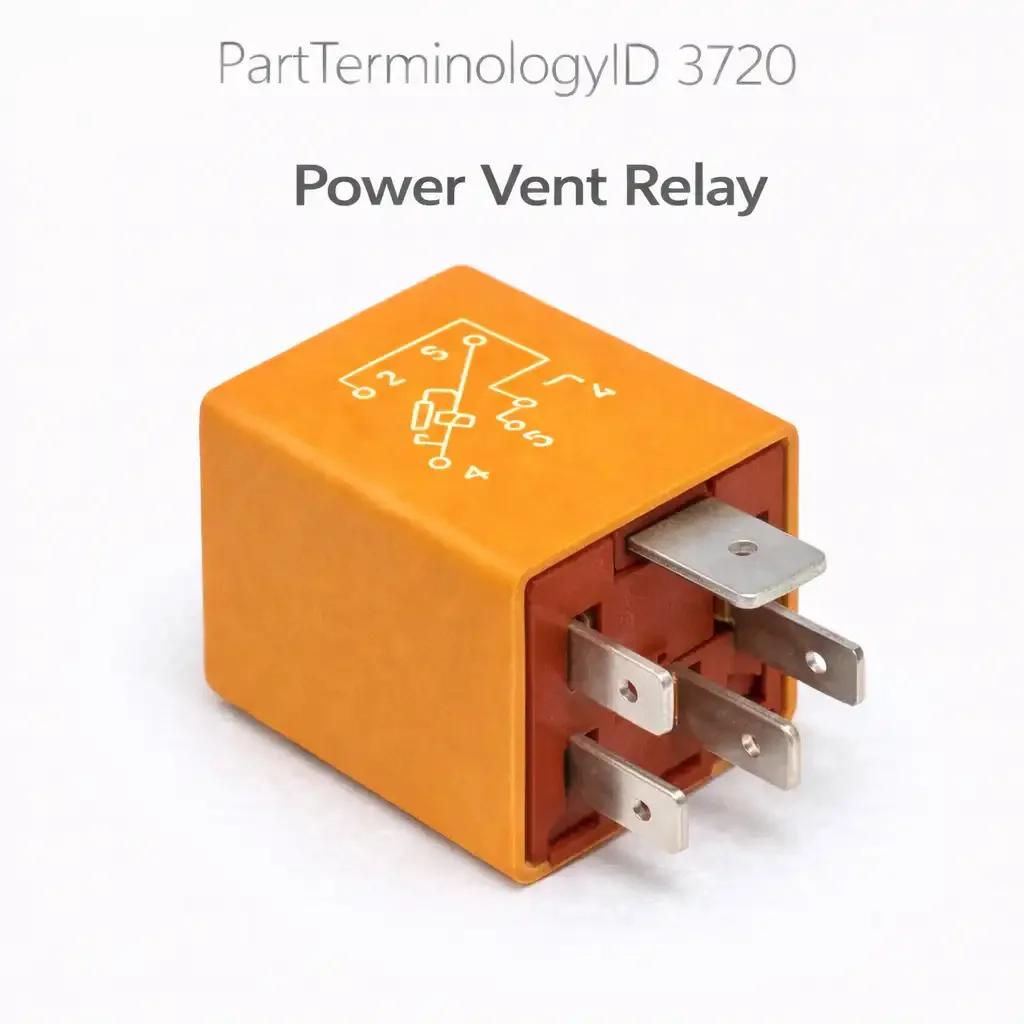
The Power Vent Relay, cataloged under PartTerminologyID 3720, is the relay that controls direct battery voltage delivery to the blower motor in a vehicle's heating, ventilation, and air conditioning system for high-speed operation. On the majority of OEM HVAC architectures, the blower motor's lower speed positions are controlled by a resistor pack or blower motor control module that drops voltage to the motor and limits its speed. The highest speed position, however, bypasses the resistor entirely and delivers full battery voltage directly to the motor through the power vent relay contacts. When the driver selects the highest fan speed setting, the HVAC control head sends a trigger signal to the power vent relay coil, the relay closes, and the blower motor receives unrestricted current and runs at maximum output.
The power vent relay is therefore not involved in any blower motor symptom that occurs at speeds one through three or four. A fault in this relay produces one specific and bounded symptom: the blower motor fails to operate at its highest speed setting, while lower speed selections continue to work normally through the resistor path. Any other HVAC airflow fault, including no blower operation at any speed, intermittent operation, or blower stuck on continuously, has a different component as its fault source. Understanding this boundary condition before the relay is diagnosed prevents the majority of returns in this category.
What the Relay Does
High-Speed Bypass Architecture
On most OEM blower motor circuits, the resistor pack is wired in series between the battery supply and the blower motor. Each tap on the resistor corresponds to a fan speed position, with more resistance producing lower voltage at the motor and therefore lower speed. When the fan speed selector is advanced to the highest position, the control circuit activates the power vent relay instead of routing the motor supply through any resistor element. The relay contacts connect the motor's supply terminal directly to battery voltage, bypassing the resistor completely. This delivers maximum current to the motor and produces maximum airflow.
The relay coil trigger is typically a ground-side signal from the HVAC control head, with the coil's supply voltage coming from an ignition-switched source. When the control head outputs the ground signal, the coil energizes, the contacts close, and battery voltage reaches the motor. When the fan speed is reduced below maximum, the control head removes the ground signal, the coil drops out, the relay contacts open, and the motor's supply is routed back through the resistor path for the selected lower speed. The relay does not carry current at any fan speed except maximum.
Max AC, Defrost, and Climate-Controlled High-Speed Commands
Beyond the manual highest-speed selection, the power vent relay also engages when certain automatic climate functions demand maximum airflow. On platforms with automatic climate control, Max AC mode commands the blower motor to the highest speed to maximize cabin cool-down rate. Rear defrost cycles on some platforms simultaneously command the front blower to high speed to maintain defroster effectiveness. On automatic climate systems where the control module manages blower speed based on cabin temperature differential, the relay may also engage when the requested cabin temperature is far from the actual temperature, causing the system to command full speed automatically even if the driver has not selected it.
A relay fault that prevents high-speed engagement can manifest during these automatic mode commands without the driver ever manually selecting the highest speed, which can confuse diagnosis if the buyer does not know that these modes route through the relay.
Thermal Load and Contact Wear
The blower motor at full speed draws more current than at any other operating condition, and that current passes through the power vent relay contacts. A blower motor that is drawing elevated current due to worn bearings, a partially obstructed squirrel cage, or a degraded brush assembly imposes higher than normal contact current on the relay. Over time, relay contacts carrying elevated current develop pitting and carbon deposits that increase contact resistance, cause intermittent engagement at high speed, or result in welded contacts that leave the motor running at full speed when the relay should have dropped out. Repeated high-speed relay failures on the same vehicle suggest that the blower motor itself is the underlying cause by drawing excessive current, and replacing the relay without addressing the motor current draw produces another relay failure.
Top Return Scenarios
Blower Motor Resistor Failure Misidentified as Power Vent Relay
The blower motor resistor failure is a far more common HVAC fault than power vent relay failure and produces a complementary symptom set: low to medium fan speeds do not work while high speed continues to operate normally. This is the exact opposite of power vent relay failure, in which high speed does not work and lower speeds remain functional. These two faults are occasionally confused by buyers who have partial airflow and are not certain which speed positions are affected. The diagnostic confirmation is straightforward: test each fan speed position. If speeds one through three are absent and speed four works, the resistor is the fault. If speeds one through three work and speed four does not, the relay is the fault. A buyer who has resistor failure and orders the relay will receive a functional relay that does not resolve the symptom.
Listing content that explicitly states the power vent relay affects only the highest speed setting, and that the resistor is the correct diagnosis when lower speeds are absent, prevents the largest single return category in this part type.
Total Blower Failure Sent to Power Vent Relay
A complete blower motor failure at all speeds, including high, has a different cause from a power vent relay fault. Total blower failure points to a blown HVAC fuse, a failed blower motor, a broken supply wire, or a failed blower motor control module on electronically controlled systems. The power vent relay is not in the supply path for speeds below maximum, so a relay that cannot close does not cause total blower loss. The diagnostic confirmation is the same: test each speed individually. Total failure at every speed is not a relay fault. The fuse is the first check for total blower failure, followed by direct motor testing with a jumper wire if the fuse is intact.
Blower Motor Ground Fault Causing Intermittent High-Speed Operation
A poor ground connection at the blower motor or at the HVAC housing ground point can cause the motor to operate weakly or intermittently even when the relay is closing correctly and delivering full battery voltage. The relay is functioning normally; the motor is not receiving adequate ground return to complete the circuit at full current. This symptom is often described as high speed working but sounding or feeling weaker than expected, or cutting out during operation. The diagnostic distinction is to measure voltage at both the motor's supply terminal and its ground terminal with the system at high speed. If supply voltage is at or near battery voltage and the motor is still underperforming, the ground path is compromised. Cleaning the motor ground connection resolves this without any relay replacement.
PWM and Blower Control Module Platforms Not Using a Discrete Relay
On modern HVAC platforms that use pulse width modulation to control blower motor speed, a dedicated blower speed control module replaces the resistor pack and the high-speed relay with a single solid-state module that can vary the motor's speed continuously from near zero to maximum. On these platforms, there is no discrete power vent relay in the traditional sense. The module controls all speed positions including maximum. A buyer whose vehicle uses a PWM blower control module and who orders a power vent relay after a high-speed failure has ordered a component that does not exist in their vehicle's circuit. The correct diagnosis for PWM platforms is the blower motor control module, not a relay.
ACES fitment data for the power vent relay must exclude platforms that have transitioned to PWM blower speed control. This is a model-year and trim-level dependent exclusion, because some manufacturers transitioned at different points in a vehicle's production run.
Welded Contacts from Elevated Motor Current
A blower motor with worn bearings or a debris-impacted squirrel cage draws more current than its rated load. The elevated current passes through the relay contacts, which are rated for normal motor current. Over time this produces contact pitting, arcing, and eventually contact welding, where the contacts fuse together and cannot open when the coil drops out. The symptom is a blower motor that stays running at high speed after the ignition is turned off, or that cannot be switched off at the highest speed setting even when the fan selector is moved to a lower position. Replacing the relay with welded contacts resolves the immediate symptom, but the blower motor's elevated current draw will weld the new relay's contacts again within a similar service interval. The motor should be direct-powered and its current draw measured before the relay is replaced on any application where the relay contacts show clear evidence of arcing or welding.
Listing Requirements
Every listing for PartTerminologyID 3720 should include:
ACES fitment data verified to year, make, model, engine, and HVAC system trim, specifically excluding model years and configurations that use PWM blower speed control modules in place of a discrete high-speed relay
A clear statement that this relay controls only the highest fan speed position, and that lower speed faults implicate the blower motor resistor, not this relay
A note that total blower failure at all speeds is not a relay symptom and points to the blower motor fuse, the motor itself, or the blower motor control module
A note that blower motor current draw should be verified before relay replacement when the returned relay shows contact arcing or welding, as elevated motor current is the underlying cause
A note that high-speed weakness or intermittency after relay replacement suggests a motor ground fault rather than a relay fault
Frequently Asked Questions
My blower works on speeds one through three but not on the highest setting. Is this the relay?
Yes, this is the symptom profile consistent with a failed power vent relay. The blower motor resistor routes the motor supply for lower speeds and is not affected by the relay. High speed routes through the relay and bypasses the resistor. Confirm the symptom by testing each speed position individually. If only the highest setting is absent and all others work normally, the power vent relay is the correct diagnosis. Before ordering, also check for a blown high-speed blower fuse on platforms where a separate fuse protects the relay's battery supply side.
My blower works on the highest setting but not on lower speeds. Is this the relay?
No. Lower speed failure with high speed still functional is the blower motor resistor failure symptom, not the power vent relay. The resistor governs the voltage-dropped lower speeds, and when it fails open, those positions lose the motor supply while the high-speed relay path remains unaffected. Order the blower motor resistor, not the power vent relay.
My blower doesn't work at any speed. Is this the relay?
No. The power vent relay does not affect lower speed positions. A failure at all speed positions points to a blown HVAC or blower motor fuse, a failed blower motor, a broken motor supply wire, or a failed blower motor control module on electronically controlled systems. Check the HVAC fuse first, then test the motor directly with a jumper wire to confirm whether the motor itself can run.
My blower stays on at high speed after I turn off the ignition. Could the relay be stuck closed?
Yes. Relay contacts that have welded together due to arcing from elevated motor current will prevent the contacts from opening when the coil drops out, keeping the motor running at high speed even with no coil trigger signal present. Replacing the relay resolves the immediate symptom, but verify the motor's current draw before finishing. If the motor is drawing more than its rated current, it is the underlying cause of the contact welding and will fail the new relay on the same schedule.
What Sellers Get Wrong
Listing the power vent relay as a remedy for any blower fault
The power vent relay controls one speed position only. Listings that position this relay as a repair for general blower motor problems, intermittent HVAC operation, or any complaint beyond missing high-speed function generate returns from buyers whose faults are in the resistor, the motor, the fuse, or the control module. The relay's single-speed scope must be the foundation of every listing description.
Not distinguishing relay failure from resistor failure in the symptom description
The resistor and the relay produce complementary failure symptoms that are mirror images of each other, and buyers who have not diagnosed carefully may not know which speed positions are affected. A listing that clearly states which fault corresponds to which symptom, relay failure removes high speed, resistor failure removes low-to-medium speeds, serves both buyers correctly by directing resistor fault buyers to the right part and preventing them from ordering the relay in error.
Omitting the PWM platform exclusion
Sellers who do not exclude PWM blower control module platforms from their ACES fitment data will receive orders from buyers whose vehicles do not have a discrete power vent relay at all. These buyers will find no relay socket to install the part into, or will install it into a multi-purpose socket that does not function as a high-speed blower relay. The PWM platform exclusion is not optional on any application where the manufacturer transitioned to module-controlled blower speed.
Cross-Sell Logic
Blower motor resistor (the correct repair when lower fan speeds are absent and high speed remains functional; this is the complementary failure mode and the more common HVAC blower fault compared to the power vent relay)
Blower motor (relevant when the motor is confirmed drawing elevated current as indicated by relay contact arcing or welding; a motor with worn bearings or a damaged squirrel cage produces the elevated current load that fails relay contacts prematurely)
HVAC fuse (the first check for total blower failure at all speeds; a blown HVAC fuse produces complete blower loss that is not caused by the power vent relay)
Blower motor control module (the correct repair on PWM platforms where a solid-state speed control module replaces both the resistor pack and the high-speed relay; module failure can produce any speed position failure pattern on those platforms)
HVAC control head (relevant when the relay coil is confirmed receiving correct battery supply voltage on the constant side but no trigger signal from the control head with the fan at the highest speed position; a failed control head output driver does not produce a trigger signal and the relay never closes)
Final Take
PartTerminologyID 3720 has a narrower diagnostic profile than almost any other HVAC relay in the catalog. It controls one speed position, produces one symptom when it fails, and is excluded from a growing population of vehicles that have transitioned to solid-state blower speed control. The entire return prevention argument rests on two points: buyers must know that the relay is only the correct repair when the highest speed is absent while all others work, and ACES fitment must exclude PWM platform applications where the relay does not exist.
The complementary resistor failure symptom is the most important diagnostic boundary to communicate in listing content. A buyer who has lower speed failure and orders the power vent relay has made a diagnostic error that the listing could have prevented. A listing that explicitly states which symptom belongs to the relay and which belongs to the resistor, in plain terms, converts a potential return into a buyer who orders the correct part, or a buyer who finds the relay for a second sale alongside the part they actually need. Both outcomes are better than a return.