
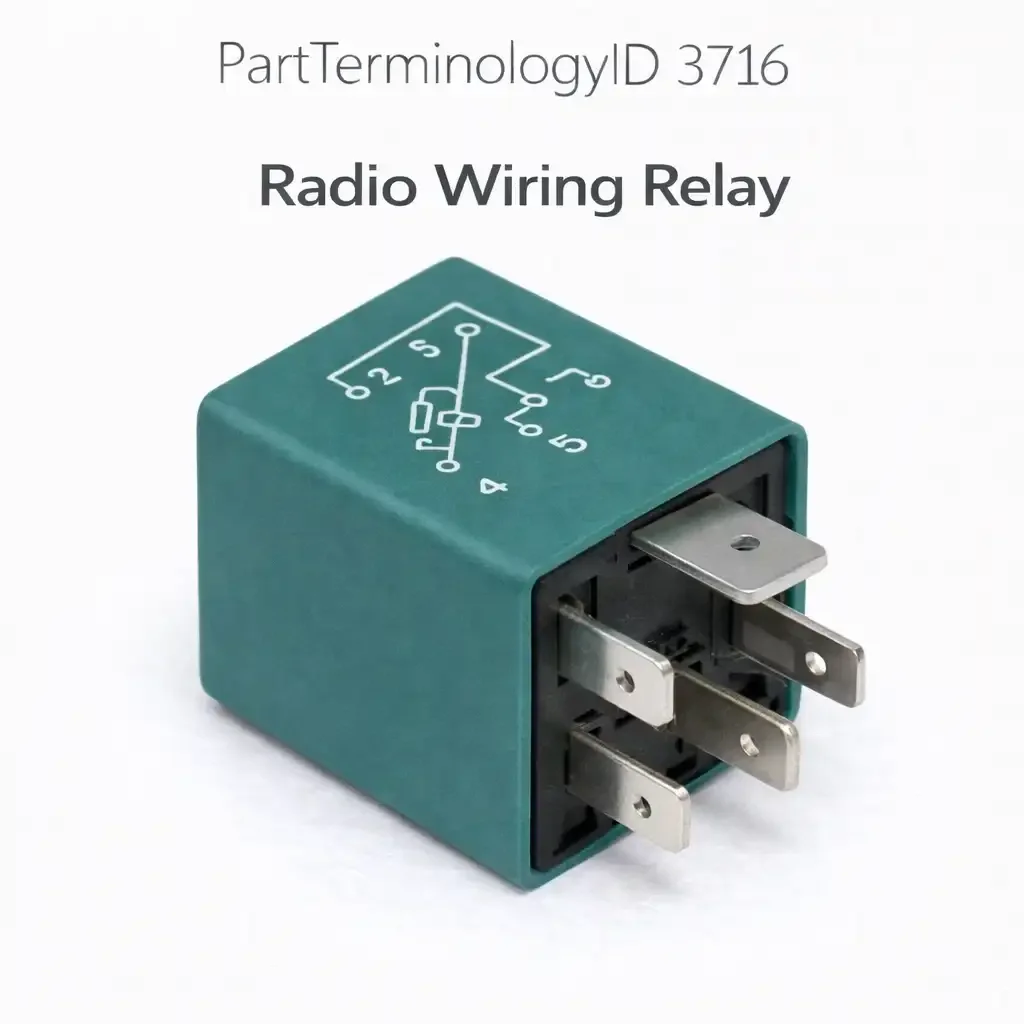
The Radio Wiring Relay, cataloged under PartTerminologyID 3716, is the relay that controls the ignition-switched power supply to the vehicle's radio or head unit. It sits between the battery and the radio's accessory power input, with its coil triggered by the ignition switch or the BCM, and its contacts delivering switched battery voltage to the radio's main supply terminal when the ignition is in the ACC or ON position. When the ignition is turned off, the relay drops out and removes power from the radio, preventing the head unit from drawing current while the vehicle is parked.
This relay is distinct from the audio amplifier supply relay and the speaker protection relay covered under other PartTerminologyIDs. The radio wiring relay's specific job is to control whether the head unit receives operating power at all. It does not directly control the speaker outputs, the amplifier, or any downstream audio components. A failed radio wiring relay produces a head unit that is completely dark and unresponsive, with no display, no illumination, and no response to any control input, because the head unit has no operating voltage. The same symptom is produced by a blown radio fuse, a failed ignition switch, and a broken wire in the ACC supply path, which means the diagnostic hierarchy before ordering this relay must account for each of those possibilities first.
What the Relay Does
Ignition-Switched Power Control
The radio wiring relay coil receives its trigger voltage from the ignition switch ACC or ON output, or from a BCM output that mirrors the ignition position. When the coil is energized, the relay contacts close and deliver battery voltage from the constant battery supply side to the radio's accessory power input terminal. This architecture keeps the ignition switch contacts from carrying the full current load of the radio's power supply. A head unit's main supply current can reach five to ten amperes or more under normal operation, and routing that current through the ignition switch's accessory contacts would eventually degrade or burn those contacts. The relay intercepts that load, allowing the ignition switch contacts to carry only the relay coil's control current, which is a fraction of an ampere.
On vehicles where the head unit is supplied with both a constant battery wire and an ACC-switched wire, the constant wire provides keep-alive voltage for the radio's clock and station memory when the ignition is off, and the ACC wire is the operating power that turns the radio on and off. The radio wiring relay governs the ACC-switched supply side. A relay failed open removes ACC operating power and leaves the radio unable to turn on, even though the constant memory wire remains live. A relay failed closed supplies ACC power continuously regardless of ignition position, which keeps the radio operational with the key out and creates a slow battery drain whenever the vehicle is parked.
BCM-Controlled Retained Accessory Power
On platforms equipped with Retained Accessory Power, the BCM keeps the radio wiring relay energized for a period after the ignition is turned off. This allows the radio to continue operating while the driver remains in the vehicle, closing windows, retrieving items, or completing a phone call. The BCM deactivates the relay when a door is opened, when an internal timer expires, or when the battery charge drops below a threshold. On these platforms, the radio wiring relay is not controlled by a simple ignition ACC output wire but by a BCM relay driver output that sequences the relay according to the RAP logic.
A BCM that has lost its RAP logic, a door ajar switch that is stuck in the open position, or a BCM that is commanding the relay off immediately can each produce what appears to be a relay fault. The radio shuts off the moment the ignition is turned off rather than continuing for the expected period, or the radio stays on well past the expected timeout period and requires a door opening to cut power. Neither symptom is caused by the relay hardware itself. The relay is functioning as commanded; the command source is the fault. Replacing the relay in either scenario does not change the behavior.
Ignition Switch as the Relay Coil Trigger
The radio wiring relay coil trigger comes from the ignition switch in the majority of non-BCM-controlled applications. The ignition switch's ACC contact carries this trigger voltage, and a worn or failing ignition switch can produce intermittent or absent trigger voltage at the relay coil terminal without producing any other obvious symptom. The radio cuts out randomly while driving, works sometimes but not others, or fails to power on after a key cycle even though the engine starts and all other systems are normal. These intermittent symptoms are characteristic of a failing ignition switch ACC contact rather than a failing relay. A relay with a failed coil produces a consistent open condition, not random intermittent behavior. Intermittent radio power loss that clears on its own is almost always upstream of the relay.
Top Return Scenarios
Blown Radio Fuse Misidentified as Relay Failure
The blown radio fuse is the most common cause of complete head unit power loss and the most common source of returns in this category. Both a blown fuse and a failed open relay produce an identical symptom: the head unit is completely dark and unresponsive with no display and no response to any control input. The fuse is the correct first check and takes under a minute with a test light or visual inspection. On most platforms the radio fuse is in the underdash fuse panel, labeled radio, audio, or head unit. If the fuse is blown, replacing the relay does not restore radio power, and the relay is returned unchanged. If the fuse is intact and the relay is confirmed failed, the relay is the correct repair. Listing content that states fuse verification as the explicit first step before relay diagnosis prevents the largest single return category in this part type.
Ignition Switch ACC Contact Failure
A worn ignition switch that has lost consistent contact on the ACC position produces intermittent or absent trigger voltage at the relay coil terminal. The relay cannot close if its coil is not receiving trigger voltage, and the radio will not power on. This symptom is often misread as a relay fault because the relay is the visible component in the ACC supply path, but the relay coil test distinguishes them. If the relay coil is receiving correct trigger voltage at its trigger terminal and the relay is not closing, the relay is the fault. If trigger voltage is absent or intermittent at the relay coil terminal with the ignition in ACC, the fault is upstream of the relay in the ignition switch or the wiring between the switch and the relay socket. Replacing the relay does not fix an ignition switch that is not producing ACC output.
Constant Battery Wire Loss Mistaken for ACC Relay Failure
On most head units, the constant battery wire and the ACC wire both must be present for the radio to operate normally. The constant wire powers the processor, clock, and memory; the ACC wire tells the radio to power up its display and audio output stages. If the constant battery wire has an open connection, a blown constant-power fuse, or a corroded terminal, the radio may appear completely dead even though the ACC wire and the radio wiring relay are both functioning correctly. A buyer who replaces the radio wiring relay without verifying both the ACC supply and the constant battery supply has not completed the diagnostic before ordering. The constant battery supply fuse is typically a separate fuse from the radio ACC fuse and is sometimes located in the underhood power distribution center rather than the underdash panel.
Aftermarket Radio Installation Bypassing the Factory Relay
On vehicles where an aftermarket head unit has been installed, the installer's wiring harness adapter may have bypassed the factory radio wiring relay entirely by tapping the ACC wire directly at the ignition switch harness or at another switched source in the fuse panel. If the vehicle later exhibits radio power issues and a buyer traces the fault to the radio wiring relay node in the fuse panel, they may find that the relay is not in the active circuit path for the aftermarket head unit. The relay may still be physically present and may even be functional, but the aftermarket installation is drawing its ACC power from a different source. Replacing the radio wiring relay has no effect in this scenario.
BCM RAP Logic Fault Appearing as Relay Behavior
On RAP-equipped platforms, a BCM that is not releasing the radio wiring relay at key-off causes the radio to stay on after the ignition is off and not shut down when expected, eventually draining the battery. A BCM that is deactivating the relay immediately at key-off causes the radio to cut out the moment the ignition is turned off with no RAP period. Both behaviors are caused by BCM command faults, door ajar switch faults, or BCM software issues, not by the relay itself. A buyer who replaces the relay because the radio stays on after key-off will return the relay unchanged. The correct diagnosis verifies whether the BCM is commanding the relay to stay energized by checking for BCM fault codes and testing the door ajar switch circuit before the relay is diagnosed.
Listing Requirements
Every listing for PartTerminologyID 3716 should include:
ACES fitment data verified to year, make, model, and trim, because radio wiring relay presence and circuit position vary between standard radio and premium audio system configurations on the same platform
A note that radio fuse verification is the required first diagnostic step before relay replacement, as a blown fuse produces the same total power loss symptom as a failed relay
A note that the constant battery supply wire and its fuse must be verified separately from the ACC supply, as a constant wire fault can produce symptoms identical to a relay fault
A note that ignition switch ACC contact failure is a more common cause of intermittent radio power loss than relay failure, and that coil trigger voltage must be confirmed present and stable at the relay socket before the relay is diagnosed
A note for RAP-equipped platforms that BCM command logic and door ajar switch circuit must be verified before the relay is replaced for stay-on or immediate-shutoff behavior
A note that aftermarket head unit installations may have bypassed the factory relay circuit and that the relay may not be in the active supply path on those vehicles
Frequently Asked Questions
My radio is completely dark with no display and no power. Is this the radio wiring relay?
Possibly, but the radio fuse is a more common cause of this symptom and must be checked first. Locate the radio fuse in the underdash fuse panel and verify it is intact. If the fuse is intact, check for ACC voltage at the radio harness connector's ACC terminal with the ignition in the ON or ACC position. If ACC voltage is absent, trace the supply path from the fuse socket to the relay output terminal. If the fuse is intact and the relay output terminal has no voltage with the relay coil energized, the relay contacts are open and the relay is the fault. If the relay coil terminal also has no trigger voltage with the ignition in ACC, the fault is in the ignition switch or the wiring between the switch and the relay, not the relay itself.
My radio stays on after I turn off the ignition and drains the battery. Could the relay be stuck closed?
On non-RAP vehicles, a relay with welded or stuck contacts that cannot open when the coil drops out will keep the radio powered after the ignition is off. This is a legitimate relay failure mode, though an uncommon one. On RAP-equipped vehicles, the BCM intentionally keeps the relay energized after ignition-off, and the radio staying on briefly is normal behavior. If the radio stays on indefinitely and does not shut off when a door is opened, the RAP fault is more likely in the BCM command logic or the door ajar switch circuit than in the relay. Verify RAP behavior against the expected shutoff conditions for the specific platform before concluding the relay has failed in the closed position.
I installed an aftermarket radio and now it has no power. Is the factory relay involved?
The aftermarket installation wiring harness adapter determines where the head unit's ACC power comes from. Some adapters pull ACC power through the factory relay circuit; others tap it from a different ignition-switched source in the factory harness. If the aftermarket radio has no power, verify all adapter connections first, confirm the adapter's ACC output wire has voltage with the ignition on, and confirm the head unit's ground wire is attached to clean bare metal chassis. If the adapter's ACC wire has no voltage, trace that wire back to its source and verify whether it passes through the factory relay node. If it does, then the relay is in the circuit and the relay diagnosis applies. If it does not, the factory relay is not involved.
My radio works sometimes but cuts out while driving. Is this an intermittent relay?
Intermittent behavior is more consistent with an ignition switch ACC contact fault than a relay fault. A relay coil either receives trigger voltage or it does not, and a relay contacts either carry current or they do not. True relay intermittency does occur with internal contact corrosion or a coil that is on the verge of an open, but it is less common than ignition switch contact wear, which produces exactly this symptom. Test the trigger voltage at the relay coil terminal while the radio is cutting out. If trigger voltage drops or disappears when the radio cuts out, the relay coil is not receiving its signal and the fault is upstream. If trigger voltage is present and stable when the radio cuts out, the relay contacts are the failure point and the relay is the correct repair.
What Sellers Get Wrong
Positioning the relay as the first repair for any dead radio
The radio fuse is a faster and cheaper check that produces the same no-power symptom when blown, and it is a more common fault than the relay. A listing that positions the relay as the first thing to check for a dead radio sends buyers to the wrong repair step and generates returns from buyers who find a blown fuse after the relay arrives. Listing content that explicitly names fuse verification before relay diagnosis serves buyers better and reduces the return rate in this category.
Not distinguishing between total power loss and intermittent power loss
Total power loss and intermittent power loss have different diagnostic hierarchies. Total loss points to the fuse, the relay, or the constant battery supply wire. Intermittent loss points to the ignition switch ACC contact, a connector with intermittent continuity, or a ground that loses contact under vibration. A listing that offers the radio wiring relay as the repair for intermittent power loss without noting that ignition switch diagnosis should come first will accumulate returns from buyers whose ignition switch was the fault.
Omitting the constant battery wire as a separate supply path
Buyers who are not experienced with head unit wiring often do not know that the radio has two supply inputs and that both must be present for the radio to power on normally. A listing that addresses only the ACC relay side without noting the separate constant battery supply leaves buyers without the full diagnostic picture. A buyer whose constant battery fuse is blown will replace the ACC relay and find no change in behavior, then return the relay when the actual fault was in the supply path the relay does not control.
Cross-Sell Logic
Radio fuse (the required first check before any relay diagnosis; a blown fuse produces identical total power loss and is a more common fault; the constant battery supply fuse is a separate component that must also be verified)
Ignition switch (the correct repair when relay coil trigger voltage is absent or intermittent at the relay socket with the ignition in ACC; ignition switch ACC contact wear is more common than radio wiring relay failure as a cause of radio power loss)
Head unit wiring harness or pigtail (relevant when the relay is confirmed functional and supply voltage is confirmed present at the relay output but the head unit still has no power; the harness connector at the head unit is the next point to check for an open or corroded terminal)
BCM (relevant on RAP platforms when the relay is confirmed functioning and the fault is in the BCM's command logic for the RAP relay driver circuit; a BCM that is not issuing the correct relay command at key-on or not releasing it at key-off is a BCM repair, not a relay repair)
Door ajar switch (relevant on RAP platforms when the radio stays on indefinitely after key-off; a door ajar switch that is stuck in the closed position prevents the BCM from receiving the door-open signal that triggers RAP timeout, keeping the relay energized continuously)
Final Take
PartTerminologyID 3716 is a supply relay for one of the most frequently used components in any vehicle, and the symptom it produces when it fails, a completely dark and unresponsive head unit, is shared by four or five other faults that are each more common than the relay itself. The radio fuse is the most common of those faults and the easiest to rule out. The ignition switch ACC contact is the most common cause of intermittent power loss that buyers attribute to the relay. The constant battery supply wire and fuse represent a separate supply path that buyers without head unit wiring experience do not know to check. And on RAP platforms, the BCM's command logic governs the relay in ways that the relay hardware cannot override.
The listing that prevents returns in this category is the one that names the fuse as the first check, separates total loss from intermittent loss as diagnostically different problems, identifies the ignition switch as the upstream fault source for intermittent symptoms, and notes the constant battery supply as a second supply path that must be verified independently. The relay is the correct repair only after those upstream causes are eliminated, and the listing's job is to make that elimination process visible to the buyer before the order is placed.