
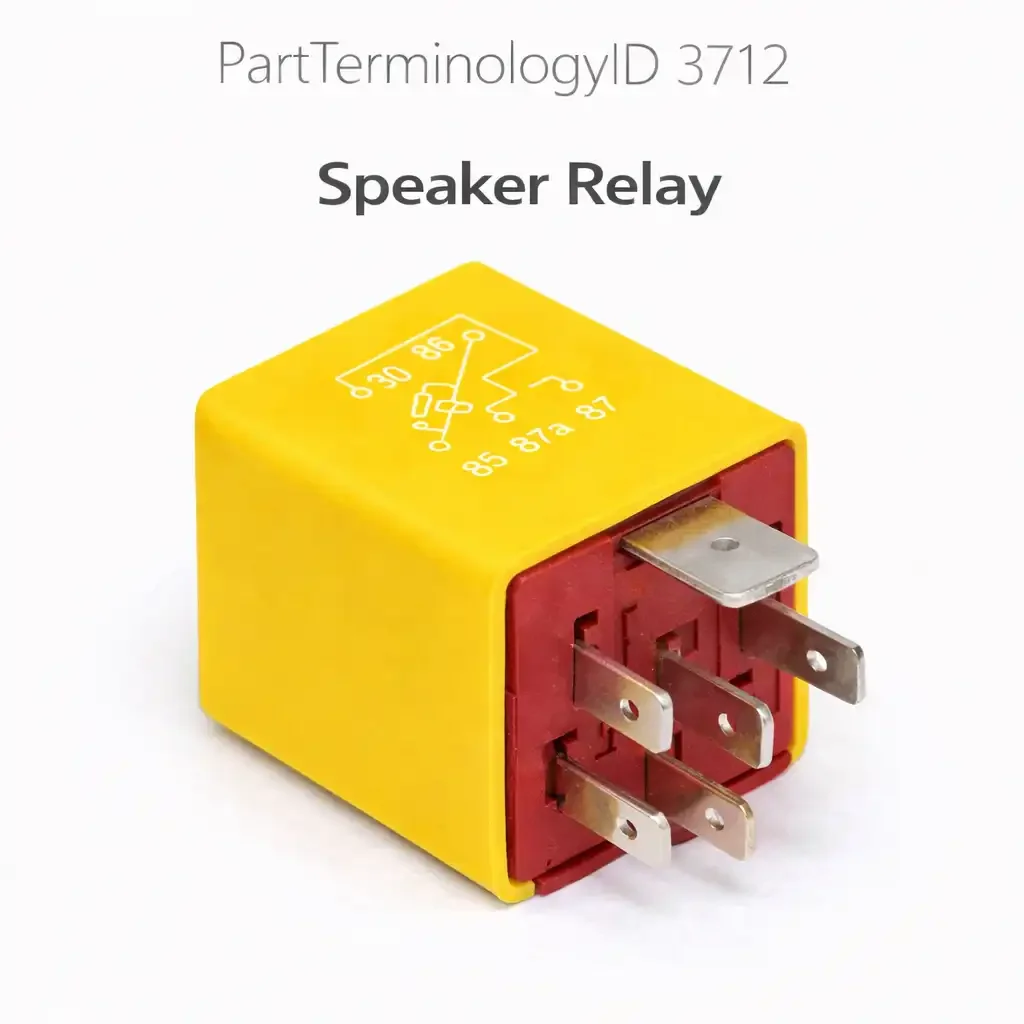
The Speaker Relay, cataloged under PartTerminologyID 3712, is the relay that controls the power supply or output connection for the vehicle's audio speaker circuit. In the OEM context, this relay appears in two primary architectures. On systems where the head unit drives the speakers directly without a separate amplifier, the speaker relay gates the ignition-switched supply voltage to the head unit's internal amplifier stage, ensuring that the speaker outputs are powered only when the ignition is on and cutting power cleanly when the ignition is turned off. On systems equipped with a factory-installed external amplifier, the speaker relay may control the supply voltage to the amplifier, or it may appear as a protection relay within the amplifier that connects and disconnects the speaker output lines during power-up and power-down sequences to prevent audible transients from reaching the speakers.
In either architecture, the relay's failure produces a recognizable symptom set: no audio output from some or all speakers, audio output only at certain times or in certain conditions, or audio present immediately when the ignition is switched but absent after a short delay, or the reverse. The particular symptom depends on whether the relay is normally open, normally closed, or a protection relay with a timed engagement delay built into its control circuit. Understanding which architecture applies to the specific application is the first step in distinguishing a relay fault from the broader population of audio system faults that produce the same no-sound complaint.
What the Relay Does
Supply Relay Function
On vehicles where the speaker relay controls ignition-switched power to the head unit or the audio amplifier, the relay coil is energized when the ignition is on, and the contacts close to deliver battery voltage to the audio system's supply terminals. When the ignition is turned off, the relay coil drops out and the contacts open, disconnecting the audio system from battery voltage. This prevents current draw from the audio system when the vehicle is parked, and it removes power from the speaker output stage cleanly rather than allowing the amplifier to produce output-stage noise as the power supply voltage decays.
A supply relay failed open produces a complete loss of audio system power. The head unit may have no display, no illumination, and no output, which is a symptom often misread as a blown fuse or a failed head unit. A relay failed closed keeps the audio system powered continuously regardless of ignition state, which can drain the vehicle battery over a long park period and in some cases causes audible noise from the audio system after the ignition is off as the amplifier runs without proper signal termination.
Protection and Mute Relay Function
On vehicles equipped with factory amplifiers, whether a discrete amplifier in the trunk or the cargo area or an amplifier integrated into the head unit, a protection relay is commonly used to connect the speaker output terminals of the amplifier to the speaker wiring after the amplifier's power supply has stabilized on startup. On many amplifier designs, the output stage produces a low-frequency transient or thump at the moment the power supply first charges and the output capacitors reach equilibrium. If the speakers are connected during this transient, the thump is audible and potentially damaging to speaker voice coils at repeated high volume. The protection relay introduces a delay of approximately one to several seconds between amplifier power application and speaker connection, holding the speaker lines open until the output stage is stable.
The same relay also disconnects the speaker lines before the amplifier's power supply begins to collapse on shutdown, preventing the reverse transient that occurs as the output stage output offset drifts when power is removed. On vehicles where a loud thump or pop is heard from the speakers when the ignition is turned off, the protection relay has either failed to disengage the speaker lines quickly enough or the relay's control circuit delay is not functioning correctly. On vehicles where no audio is produced until several seconds after ignition-on, the delay is functioning correctly, and a relay that connects immediately rather than after the appropriate delay may indicate a relay with welded contacts or a failed delay circuit.
BCM and Audio Module Integration
On modern platforms, the speaker relay coil trigger is often managed by the BCM, the audio control module, or the head unit's own internal logic rather than by a simple ignition-switched supply. The BCM may command the relay as part of a system-wide power management strategy that sequences audio system activation after other modules have initialized. On some platforms, the audio system has a retained accessory power feature that keeps the speaker relay energized for a period after the ignition is turned off, allowing audio playback to continue briefly. A relay that is installed on a platform with this feature but is not receiving the BCM retained power command will produce a symptom of audio cutting out immediately when the ignition is turned off rather than continuing for the expected period.
Top Return Scenarios
Head Unit or Amplifier Fuse as the First-Order Fault
A blown audio system fuse produces a complete loss of audio output that is diagnostically identical to a failed supply relay. Both remove power from the audio system entirely. The fuse is the first check in any audio system no-power diagnosis and takes thirty seconds to verify with a test light. A buyer who replaces the relay without checking the fuse first may find that the fuse was the fault and the relay was functional. Equally important: if the fuse blows again after replacement, there is an overcurrent fault in the audio circuit that caused the original blow, and simply replacing the relay does not resolve it.
On most platforms the audio system fuse is in the underhood power distribution center or the underdash fuse panel, and its label will reference radio, audio, or sound system. Listing content that names fuse verification as the required first step before relay diagnosis prevents this return category and demonstrates diagnostic competence to buyers who read listing content carefully before ordering.
No Sound Attributed to the Relay When the Speaker Wiring or Speaker Is the Fault
A broken speaker wire, a speaker connector that has pulled off its terminal at the door hinge area where flexing concentrates harness stress, or a blown speaker voice coil all produce a loss of sound from the affected speaker or speakers. On vehicles where all four speakers share a single supply relay, a speaker or wiring fault that affects all outputs simultaneously can appear to be a relay fault. The diagnostic distinction is that relay failure removes power from the amplifier or head unit entirely, while a speaker or wiring fault typically leaves the head unit functional with display, illumination, and response to controls, with no audio output.
The head unit's balance and fade controls are the fastest way to determine whether the fault is isolated to specific speakers or affects the entire audio output. A fault that affects only the left side speakers points to wiring or speakers on that side, not the supply relay. A fault that produces the same behavior on all channels regardless of balance and fade adjustments, combined with a head unit that appears fully functional otherwise, points to the supply path.
Factory Amplifier Failure Misidentified as Relay
On vehicles equipped with factory external amplifiers, a failed amplifier produces no audio output even when the supply relay is delivering correct voltage to the amplifier's power terminals. The amplifier fuse, amplifier internal protection circuits, or amplifier output stage failure all produce this symptom. The diagnostic step that distinguishes a failed amplifier from a failed relay is verifying supply voltage at the amplifier's power input terminals with the ignition on. If supply voltage is present and the amplifier produces no output, the amplifier is the fault and the relay is not. On premium factory audio systems such as Bose, Harman Kardon, JBL, and similar OEM-branded installations, the amplifier is a more expensive and more commonly failed component than the supply relay, and it is the more probable fault when audio is absent on systems that have factory-amplified output.
Ground Fault Producing Intermittent Audio Loss
A poor ground connection at the head unit chassis ground terminal, at the amplifier chassis ground, or at a speaker ground point produces intermittent audio loss that can be indistinguishable from an intermittent relay fault. Ground resistance introduces voltage drop under load, which can cause the amplifier to drop into protection mode or produce distorted output rather than clean audio. An intermittent ground fault is also temperature-sensitive, producing symptoms when the vehicle is hot and resolving when the vehicle cools, which appears to be an electrical fault in an underhood component. The relay is not typically temperature-sensitive in the same way; a relay coil resistance that increases with heat is a legitimate failure mode but a less common one than a corroded ground connection at a chassis attachment point.
The diagnostic test for ground faults is to measure voltage drop between the audio component's ground terminal and the battery negative post with the system operating. A reading above approximately 0.2 volts indicates a ground resistance fault. Cleaning the ground connection point resolves the fault without any relay or amplifier replacement.
Aftermarket Head Unit Installation Bypassing the Relay Circuit
On vehicles where an aftermarket head unit has been installed to replace the factory unit, the factory speaker relay's position in the power supply circuit may have been bypassed by the aftermarket installation wiring harness. The aftermarket harness adapter typically provides its own ignition-switched supply path directly to the head unit, bypassing the factory relay node entirely. A buyer whose vehicle has a previously installed aftermarket head unit and who is experiencing audio system no-power symptoms has a different diagnostic starting point than a buyer with a factory head unit. The factory relay may be physically present in the fuse panel but may no longer be in the active supply circuit for the aftermarket head unit.
Listing Requirements
Every listing for PartTerminologyID 3712 should include:
ACES fitment data verified to year, make, model, and audio system trim variant where applicable, because speaker relay presence varies between standard and premium audio system configurations on the same vehicle
A note identifying whether the relay in the listing is a supply relay, a mute or protection relay, or both functions in one component
A note that audio system fuse verification is the required first diagnostic step before relay replacement
A note that the head unit's balance and fade controls should be used to determine whether the fault is channel-specific or affects all outputs before the relay is diagnosed
A note that factory amplifier failure is a more common fault than supply relay failure on premium audio system applications
A note that aftermarket head unit installations may have bypassed the factory relay circuit and that the relay may not be in the active supply path on those applications
Frequently Asked Questions
My vehicle has no audio at all. The head unit powers on but no sound comes from any speaker. Could this be the relay?
Possibly. Complete loss of audio output with a functioning head unit display is consistent with a failed supply relay or protection relay that is not connecting the speaker lines, but it is also consistent with a blown audio system fuse, a failed external amplifier, a disconnected amplifier supply connector, or all speaker wires shorted together by a harness fault. Confirm the audio system fuse is intact first. Then use the head unit's balance and fade to verify whether the fault is total or channel-specific. If total, verify supply voltage at the amplifier's input terminals on amplified systems. If supply voltage is present and the amplifier has no output, the amplifier is the fault. If supply voltage is absent, trace the supply path from the fuse to the relay to the amplifier to find the open circuit.
My stereo produces a loud thump or pop from the speakers when the ignition is turned off. Is this the relay?
On amplified systems, turn-off thumps are typically associated with the protection relay failing to open the speaker lines quickly enough when the amplifier loses power. The relay's coil drop-out time may have lengthened due to contact wear or coil resistance change, or the protection relay control circuit's delay logic may have failed. On non-amplified factory head units, a turn-off pop is more likely caused by a capacitor in the head unit's output stage holding a charge that discharges through the speaker when power is removed, which is not a relay fault. The distinction is whether the vehicle has a discrete external amplifier. Turn-off pop in amplified systems has a relay-related diagnosis path; in non-amplified systems it generally does not.
I replaced the head unit with an aftermarket unit and now have no audio. Is the factory speaker relay involved?
Possibly not. Aftermarket head unit installations use a plug-in wiring harness adapter that is designed to interface the aftermarket unit's power and speaker connections to the factory harness. If the adapter supplies the head unit's ACC and battery power from ignition-switched and constant battery wires in the factory harness rather than through the factory relay node, the factory relay is no longer in the active circuit. No-audio symptoms after an aftermarket head unit installation are more likely related to the wiring adapter connections, speaker wire polarity, or head unit ground quality than to the factory relay. Verify all adapter connections and confirm the head unit's ground wire is attached to clean bare metal before diagnosing the relay.
What Sellers Get Wrong
Listing the speaker relay as the cause of any audio problem
The speaker relay produces a specific symptom: the entire audio output is absent or improperly timed, with the head unit otherwise appearing to function normally. Audio problems that affect specific channels, produce distortion at certain volumes, cause intermittent dropout during driving over bumps, or come and go with temperature are not relay symptoms. They are speaker wiring, amplifier, ground, or head unit symptoms. A listing that positions the relay as a general audio problem remedy does not accurately describe the relay's function and reaches buyers who have different faults and will return the relay unchanged.
Not differentiating supply relay from protection relay in listing content
A supply relay and a protection relay are both called speaker relays and both affect audio output when they fail, but they are different components in different circuit positions and they fail differently. A buyer who has a turn-off thump problem needs to understand whether the relay in the listing is the protection relay at the amplifier output or a supply relay earlier in the circuit. A listing that does not distinguish these functions leaves buyers unable to confirm they are ordering the correct component for their specific fault.
Omitting the premium audio system amplifier failure scenario
On vehicles equipped with factory Bose, Harman Kardon, JBL, and similar premium audio systems, the factory amplifier is a high-value component that fails more often than the relay that supplies it. A buyer on one of these platforms experiencing complete audio loss is more likely to need the amplifier than the relay. A listing that identifies the audio system variant the relay serves, and notes that amplifier supply voltage verification should precede relay replacement, serves the premium audio platform buyer much better than a listing that positions the relay as the probable fault for any audio outage.
Cross-Sell Logic
Audio system fuse (the first diagnostic check for any audio no-power fault; a blown fuse produces the same symptom as a failed supply relay and takes thirty seconds to verify before any relay is ordered)
Factory external amplifier (the correct repair when supply voltage is confirmed present at the amplifier's power terminal and the amplifier produces no output; amplifier failure is more common than relay failure on premium factory audio applications)
Speaker wiring harness and connectors (common fault source for channel-specific audio loss; door hinge areas concentrate harness flexing and produce broken wires that appear as relay symptoms when all door speakers on one side go silent simultaneously)
Head unit (relevant when the relay is confirmed delivering power normally but the head unit produces no audio output at any speaker channel; head unit internal amplifier failure, audio processor failure, or DSP malfunction produces total audio loss with a head unit that appears to be powered on and functioning)
BCM or audio control module (relevant on platforms where the relay coil is commanded by the BCM as part of a retained accessory power architecture; a BCM that is not issuing the relay command does not implicate the relay, and the listing note about BCM command verification should direct buyers with BCM command faults away from the relay)
Final Take
PartTerminologyID 3712 sits at the intersection of two distinct circuit architectures and two different relay functions, and that ambiguity is the primary return driver in this category. A buyer who does not know whether their vehicle uses a supply relay, a protection relay, or both may order the wrong relay for their specific fault. A buyer who knows their audio system has no power and skips the fuse check is likely to return a functional relay after finding the blown fuse that was the actual fault. A buyer on a premium audio system who attributes amplifier failure to the relay is returning a part that was delivering correct voltage to an amplifier that could not use it.
The listing that resolves these return scenarios is the one that explains what this relay specifically does in the circuit, makes fuse verification the stated first step, acknowledges the amplifier as the more likely fault on premium audio platforms, and distinguishes supply relay symptoms from protection relay symptoms and from channel-specific wiring faults. The speaker relay is not a high-diagnosis-difficulty part, but it exists in a symptom category, no audio, that is shared by a large population of faults that are more common than the relay itself. The listing's job is to narrow that population before the order is placed.