
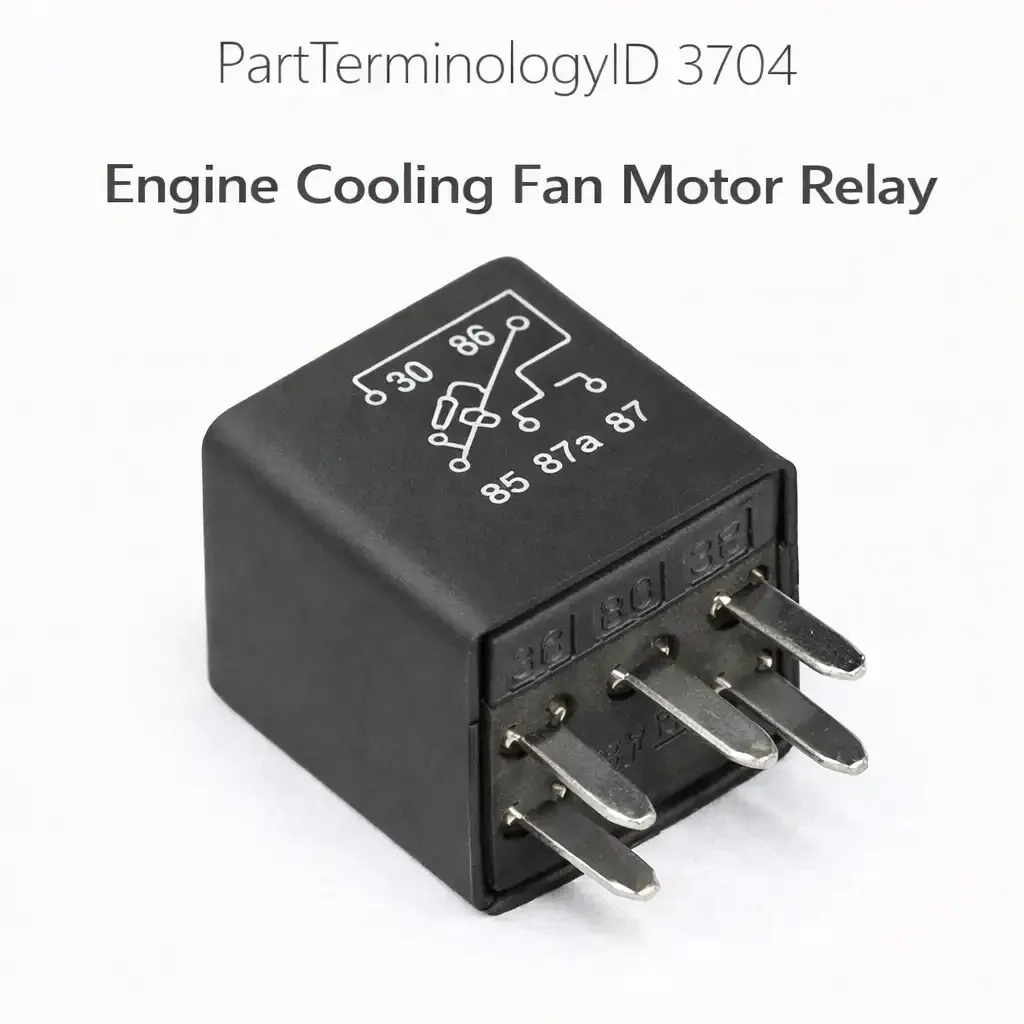
The Engine Cooling Fan Motor Relay, cataloged under PartTerminologyID 3704, controls the supply of battery voltage to the electric radiator cooling fan motor. When the engine reaches its operating temperature threshold, or when the air conditioning compressor is engaged, the ECM or PCM commands the relay coil to energize. The relay contacts close, connecting battery voltage directly to the fan motor, which draws the several amps required to spin the fan at the speed needed to pull air through the radiator. The relay separates the ECM's low-current coil command signal from the high-current motor supply, protecting the ECM from direct exposure to fan motor loads and allowing the control circuit to operate at signal-level voltages while the power circuit handles the full motor current.
Unlike most vehicle relays that operate infrequently, the cooling fan motor relay closes and opens repeatedly every drive cycle as the engine thermostat calls for cooling, as ambient temperatures and driving conditions vary, and as the air conditioning system cycles on and off. This high operating frequency, combined with the relatively high current draw of a fan motor, makes the relay contacts subject to more wear than the average vehicle relay. The relay is legitimately one of the most common failure points in the electric cooling fan circuit. That said, the symptom it produces when it fails, an engine that overheats or a fan that does not run, is also produced by a failed coolant temperature sensor, a stuck thermostat, a failed fan motor, and a loss of the ECM's relay command signal. The relay is not the only path to these symptoms, and the listing that serves buyers well distinguishes these possibilities before a relay order is placed.
What the Relay Does
Single-Fan and Dual-Fan Architectures
On vehicles equipped with a single electric cooling fan, the cooling fan motor relay is a straightforward switch. When the ECM commands the relay coil, the contacts close, the motor receives battery voltage, and the fan spins at its design speed. When the ECM opens the coil circuit, the contacts open, motor power is removed, and the fan stops. The relay's contact rating must be matched to the current draw of the specific fan motor on the application; undersized replacement relays will overheat at the motor's sustained current draw and fail earlier than the original.
On vehicles equipped with two fans or a single fan motor with two speed windings, the relay architecture is more complex and is one of the most common sources of misdiagnosis in this category. A common GM-era three-relay arrangement uses one low-speed relay whose contacts connect both fans in series. With the fans wired in series, voltage is divided between them and both run at reduced speed. A second and third relay are used for high-speed operation. When these relays close, they add a separate direct supply to the second fan and remove it from the series circuit, placing both fans in parallel where each receives full voltage and runs at full speed. On these platforms, a failed low-speed relay produces a fan that runs only at high speed or not at all depending on which relay failed, and a failed high-speed relay produces a fan that runs only at low speed. Ordering the correct relay for the specific speed function that has failed requires identifying which relay in the set has actually failed rather than replacing the entire set based on overheating symptoms alone.
ECM Relay Command Versus Temperature Switch Trigger
On most vehicles built from the mid-1990s forward, the fan relay coil is triggered by the ECM or PCM, which monitors coolant temperature through the engine coolant temperature sensor and activates the relay when temperature exceeds a programmed threshold. The ECM also activates the fan relay when the air conditioning system is engaged, because the condenser is in the airstream ahead of the radiator and the fan is needed to move air across it when the vehicle is stationary or moving slowly.
On older platforms and some simpler designs, the relay coil is triggered by a dedicated coolant temperature switch mounted in the engine block or radiator, which closes mechanically when coolant temperature reaches its calibrated threshold. On these platforms, the temperature switch is in the relay control circuit, and a failed or out-of-calibration switch can prevent the relay coil from energizing even when the relay itself is functional. The diagnostic difference between an ECM-commanded and temperature-switch-commanded circuit matters for the return scenario in which a replaced relay does not restore fan operation.
Relay Contact Current Load and Premature Failure
The fan motor relay contacts carry the full current draw of the fan motor every time the relay closes. Fan motors draw between approximately 8 and 25 amps depending on motor size, fan diameter, and blade design. Most ISO-format relays used in this position are rated at 30 amps, which provides adequate margin for a properly functioning motor. A fan motor that is beginning to fail mechanically, with worn brushes, degraded bushings, or bearing drag, draws higher than normal current. This elevated current through the relay contacts increases contact heating and arc energy each time the relay opens under load, accelerating contact pitting and oxidation. A pattern of repeated relay failures on the same application should prompt inspection of the fan motor's actual current draw before the next relay is installed, because the root cause is the motor rather than the relay.
Top Return Scenarios
Engine Coolant Temperature Sensor as the Upstream Fault
The ECM monitors the engine coolant temperature sensor to determine when to command the fan relay on. A sensor that is reading coolant temperature incorrectly, specifically one that is reading lower than actual temperature due to a drift in its resistance curve, causes the ECM to believe the engine is cooler than it is. The ECM never reaches the commanded relay activation threshold, the relay is never triggered, and the fan never runs. The engine overheats, the driver reports the fan is not running, and the most accessible conclusion is a bad relay.
The A/C engagement test is the single most useful quick filter in this diagnosis. If turning the A/C on causes the fan to run, the fan motor, relay power supply, relay contacts, and ECM relay command output are all confirmed functional. The A/C engagement command bypasses coolant temperature entirely as the fan activation signal. A fan that runs during A/C engagement but not during engine warm-up points to the coolant temperature sensor or its signal circuit as the fault, not the relay. A listing that describes this one test as the first step in diagnosis, before any component is ordered, resolves the largest single category of relay returns in this part number.
Thermostat Stuck Open Preventing Fan Trigger
A thermostat that is stuck in the open position allows coolant to circulate freely through the radiator at all times, even when the engine is cold. The engine never builds heat to the temperature threshold that commands the fan relay because the coolant is constantly being cooled by the radiator before it can accumulate heat. On ECM-controlled systems, the ECM monitors this indirectly through the coolant temperature sensor and may store a P0128 code, which indicates that coolant temperature is running below the thermostat's regulating temperature. A buyer who has an engine that never reaches normal operating temperature and whose fan never runs, with a stored P0128 or similar code, has a stuck-open thermostat, not a relay fault. No relay replacement resolves this scenario because the relay is not being commanded in the first place.
Fan Motor Failure Misidentified as Relay
A fan motor that has failed mechanically, with seized bearings, broken brushes, or an open armature winding, does not spin even when the relay closes and delivers full battery voltage to the motor terminals. The symptom from the driver's perspective is a fan that is not running. The relay is closing normally and delivering the correct voltage; the motor is not responding to it. The standard test for this scenario is to unplug the fan motor connector and apply direct battery voltage and ground with jumper wires. A motor that spins with direct power confirms the relay and supply circuit are functional. A motor that does not spin with direct power is failed regardless of relay condition. A buyer who skips this test, replaces the relay, and finds the fan still does not run is returning a relay that was functioning correctly.
Relay Socket Corrosion in High-Heat Underhood Locations
The cooling fan relay is mounted in the underhood power distribution center, which is located near the engine and subject to significant heat cycling over the vehicle's life. The relay socket terminals are exposed to this thermal environment and to moisture when it enters the underhood compartment. Over time, the socket terminal pins develop surface oxidation and the terminal retention clips lose tension, creating a high-resistance connection between the relay body pins and the socket. The relay coil receives insufficient voltage to fully energize, or the contact circuit develops a voltage drop that produces marginal fan operation. Cleaning the relay socket with electrical contact cleaner and checking pin tension before condemning the relay body itself resolves socket corrosion cases without requiring a new relay. A listing that acknowledges this failure mode prompts buyers to check the socket before ordering.
A/C Compressor Issues Causing Fan Complaints on AC-Triggered Circuits
On most platforms, the cooling fan runs whenever the A/C compressor is engaged, regardless of coolant temperature. A driver who reports that the fan is not running during A/C operation when the engine is cold may have an A/C compressor that is not engaging rather than a failed relay. If the compressor is not engaging, the ECM receives no A/C engagement signal and does not command the fan relay for the A/C activation path. The diagnosis in this case begins with the A/C system rather than the fan circuit. A relay ordered to restore A/C-triggered fan operation when the compressor is the actual fault returns as functionally unchanged.
Listing Requirements
Every listing for PartTerminologyID 3704 should include:
ACES fitment data verified to year, make, and model, with attention to applications using three-relay two-speed fan architectures where the low-speed and high-speed relay functions are separate part numbers
Contact current rating matched to the specific application's fan motor current specification; listings that substitute a lower-rated relay than the OEM specification risk premature contact failure in service
A note that the A/C engagement test is the fastest way to confirm relay and fan motor function before attributing overheating to the relay
A note that the engine coolant temperature sensor is the upstream control input and a failed sensor prevents relay command even with a functional relay
A note that direct power application to the fan motor connector confirms motor condition independently of the relay
A note that relay socket corrosion in the underhood power center is a common cause of marginal relay function and should be evaluated before relay body replacement
A note for dual-relay and three-relay applications specifying which speed function this relay controls
Frequently Asked Questions
My engine is overheating and the fan is not running. How do I know if the relay is the problem?
Start with the A/C engagement test. Turn the A/C on and observe whether the fan runs. If the fan runs with A/C on, the relay, fan motor, and relay power supply are confirmed functional, and the fault is in the temperature-triggered activation path, which points to the coolant temperature sensor or the ECM's relay command circuit. If the fan does not run with A/C on either, apply direct battery voltage and ground to the fan motor connector. If the fan spins with direct power, the motor is good and the relay, its supply fuse, or the ECM command signal is the fault. If the fan does not spin with direct power, the motor is failed and the relay is not the issue.
My fan runs constantly and will not shut off. Is this the relay?
A fan that runs continuously is a characteristic symptom of a relay with welded or stuck contacts. When relay contacts weld together from sustained high current or arcing at the moment of contact closure under high load, the relay cannot open and the motor receives power continuously. This drains the battery over time and can burn the fan motor from sustained operation. Confirm the diagnosis by removing the relay with the engine off. If the fan stops when the relay is pulled, the relay contacts were the cause. If the fan continues to run after the relay is removed, the motor is being supplied from another circuit or the relay socket has a wiring fault.
My vehicle has three fan relays. Which one should I replace?
Identify which symptom you have. On three-relay two-speed architectures, fans running only at high speed indicate a failed low-speed relay. Fans running only at low speed indicate a failed high-speed relay. Fans not running at all can indicate any relay in the set. The most efficient approach is to use a scan tool capable of commanding each relay individually to isolate which relay is not responding to its command before ordering. Replacing the full set without diagnosis ensures the failed relay is among the parts replaced but also adds unnecessary cost and does not establish which part actually failed.
What Sellers Get Wrong
Not accounting for multi-relay fan architectures in listing content
A listing that treats the cooling fan relay as a single component without addressing two-speed and dual-fan relay configurations reaches buyers who have multi-relay systems and are ordering the wrong relay for their specific speed fault. A fan that runs only at low speed has a failed high-speed relay. A fan that runs only at high speed has a failed low-speed relay. A listing that does not describe which speed function the relay controls gives buyers no basis for ordering the correct relay from a multi-relay application and generates returns when the ordered relay is not the one that failed.
Not naming the ECT sensor as the leading upstream fault
In the population of buyers experiencing overheating with a fan that is not running, the coolant temperature sensor produces this symptom at least as often as the relay. A listing that presents the relay as the primary suspect for a fan-not-running overheating complaint does not serve the portion of buyers whose sensor is feeding the ECM an incorrect temperature signal. Naming the A/C engagement test as the first diagnostic step, and the ECT sensor as the primary suspect when that test confirms the fan can run but is not running during engine warm-up, converts buyers who have already done some diagnosis into confirmed orders rather than speculative ones.
Omitting the fan motor direct-power test
The fan motor and the relay produce the same symptom when they fail: a fan that does not run. The two components are distinguished by applying direct power to the motor connector. A listing that does not mention this test enables buyers to replace the relay when the motor is the actual fault, then return the relay and potentially order a second part incorrectly as well. The direct-power test is two jumper wires and thirty seconds; including it in the listing as a required step before ordering establishes the population of buyers who have actually eliminated the motor as the fault.
Cross-Sell Logic
Engine coolant temperature sensor (the upstream input that triggers the relay command; a drifting or failed sensor prevents the ECM from commanding the relay even when the relay is functional, and it is the correct diagnosis when the fan runs with A/C on but not during engine warm-up)
Fan motor assembly (the load the relay serves; direct-power application test confirms motor condition before relay replacement, and repeated relay failures on the same application indicate elevated motor current draw from a mechanically worn motor)
Thermostat (a thermostat stuck open prevents the engine from reaching the temperature threshold that commands the relay; P0128 is the associated code and points to the thermostat before any relay diagnosis is appropriate)
Cooling fan fuse (the fuse protecting the relay power supply circuit; a blown fuse produces the same symptom as a failed relay contact and must be confirmed intact before relay replacement)
A/C pressure switch and compressor clutch relay (relevant when the complaint is that the fan does not run during A/C operation; if the A/C compressor is not engaging, the ECM receives no A/C command signal and does not trigger the fan relay through the A/C activation path)
Final Take
PartTerminologyID 3704 is one of the more legitimate relay replacement categories in the aftermarket. The cooling fan motor relay carries high current at high duty cycle, operates in a thermally demanding underhood environment, and its contacts degrade from normal arc wear over years of cycling. When the relay fails, the engine overheats, which is a symptom that creates urgency and motivates fast parts ordering. That urgency is the source of the return problem, because an overheating engine can also be produced by a failed coolant temperature sensor, a stuck-open thermostat, a failed fan motor, a relay socket corroded in place, or an A/C compressor that is not engaging. The buyer who identifies which of these is the actual fault before ordering keeps the relay. The buyer who orders the relay because the engine is hot and the fan is not running has roughly even odds.
The A/C engagement test is the pivot point. It either confirms the relay and motor are functional and redirects the diagnosis upstream to the sensor, or it confirms the motor is functional and points to the relay or its command circuit as the fault. A listing built around that one test, described plainly and placed prominently, produces a better-qualified buyer at the point of order. In a category where urgency drives purchasing behavior, the listing that slows buyers down long enough to run one test earns the sale and keeps the part in service.