
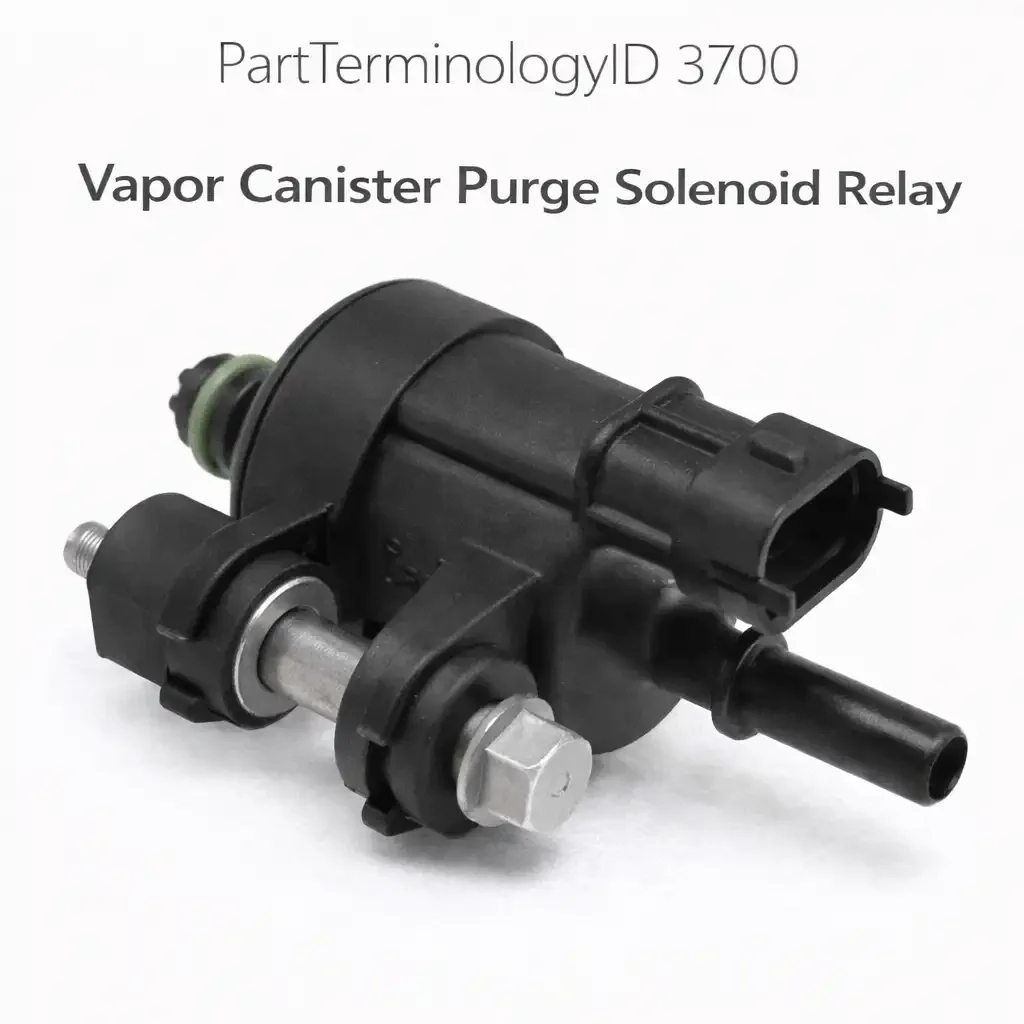
The Vapor Canister Purge Solenoid Relay, cataloged under PartTerminologyID 3700, supplies the ignition-switched battery voltage that powers the EVAP canister purge solenoid coil. On platforms where this relay is present, the relay output provides the B+ supply to one terminal of the purge solenoid. The PCM controls the solenoid by applying a duty-cycled ground signal to the solenoid's other terminal. When the PCM duty-cycles the ground on and off, the solenoid opens and closes proportionally, metering the flow of fuel vapor from the charcoal canister into the engine's intake manifold where it is burned during normal combustion. Without the relay supplying the solenoid's B+ feed, the PCM's ground command has nowhere to complete, and the solenoid cannot open regardless of how correctly the PCM is commanding it.
This relay architecture separates the high-current supply function from the PCM's control output, protecting the PCM's internal driver from handling direct battery current. The PCM manages the solenoid through a low-side ground driver, switching the ground path on and off at duty cycles that range from a few percent at light load to higher percentages under heavy fuel vapor demand. The relay sits upstream of this circuit, ensuring a clean, fuse-protected supply voltage is always available at the solenoid's power terminal when the ignition is on. Without the relay in the supply path, or with the relay replaced by a direct fused wire on platforms that use that architecture instead, the PCM's ground switching alone controls solenoid operation.
The primary diagnostic trouble code associated with a fault in the purge solenoid circuit is P0443, defined as Evaporative Emission System Purge Control Valve A Circuit Malfunction. Related codes include P0444 for an open circuit condition and P0445 for a shorted condition. These codes indicate a fault somewhere in the purge valve control circuit, which includes the solenoid itself, the wiring between the solenoid and the PCM, the connector at the solenoid, and the B+ supply path that this relay controls. P0443 does not specifically identify the relay as the fault source; it identifies the circuit as a whole.
What the Relay Does
B+ Supply Gating
The relay acts as an ignition-switched gate on the purge solenoid's power supply. When the ignition is turned on, the relay coil is energized and the relay closes, connecting battery voltage through the relay contacts to the solenoid's supply terminal. This supply is present continuously while the ignition is on, waiting for the PCM to begin duty-cycling the ground side of the solenoid circuit. The relay does not participate in the duty-cycle control of the solenoid; it is simply a static switch that enables the supply circuit. The PCM handles all timing, duty cycle percentage, and solenoid modulation through the ground driver on the other solenoid terminal.
This supply-gating function means that the relay fails in one of two ways with predictable outcomes. A relay failed open deprives the solenoid of its B+ supply, and the PCM's ground switching produces no circuit completion, causing the solenoid to remain closed at all times. Fuel vapor accumulates in the charcoal canister without being purged, the EVAP monitor cannot run its purge flow test, and the PCM stores P0443 or a related circuit fault code. A relay failed closed provides the supply continuously even with the ignition off, which keeps the solenoid coil energized through any PCM ground leak path, though this is a less common failure mode with fewer immediate consequences given the solenoid draws minimal current when unpowered.
EVAP System Operation Context
The EVAP system captures fuel vapor from the fuel tank and stores it in the charcoal canister while the engine is off. Once the engine is running and warmed up, the PCM opens the purge solenoid to draw the stored vapor into the intake manifold. The PCM modulates the duty cycle of the solenoid based on mass air flow sensor data, fuel trim values, engine coolant temperature, and intake air temperature, increasing the purge flow when the engine can absorb more vapor without disrupting the air/fuel ratio, and reducing it or closing the solenoid when conditions do not support purging. This continuous modulation means the purge solenoid cycles thousands of times over the life of the vehicle, and the relay contacts that supply its B+ experience corresponding thermal cycling from the solenoid's current draw.
The EVAP system self-diagnostic routine runs once per drive cycle after the fuel level, coolant temperature, and other preconditions are met. During this test, the PCM commands the purge solenoid fully open, observes the effect on fuel tank pressure through the fuel tank pressure sensor, and evaluates whether the canister purge flow meets calibration. If the relay has failed and the solenoid is not receiving its supply voltage, the solenoid remains closed during the diagnostic test, the PCM detects that the expected pressure change did not occur, and P0443 or a related code is stored. The EVAP monitor also fails to complete readiness, which can cause the vehicle to fail an emissions inspection if the monitor is in a not-ready state at the time of testing.
Platforms With and Without a Dedicated Relay
Not every EVAP purge solenoid circuit uses a dedicated relay. On some platforms the solenoid supply is taken directly from an ignition-switched fuse rather than through a relay contact. On these platforms, there is no vapor canister purge solenoid relay as a separately replaceable component; a blown fuse or wiring fault in the supply circuit produces the same symptom as a failed relay would on relay-equipped platforms. ACES fitment data must be built to identify the platforms where a standalone replaceable relay is present. A listing that does not discriminate between relay-equipped and direct-fused applications generates orders from buyers whose vehicles have no relay to replace.
Top Return Scenarios
Purge Solenoid as the Primary Fault
The purge solenoid itself is the most probable fault when P0443 is stored. The solenoid is a normally-closed electromechanical valve that opens under PCM ground command. Over time, the solenoid coil develops opens or shorts, the plunger sticks in a position due to carbon and varnish buildup from prolonged fuel vapor exposure, or the solenoid pintle seat deteriorates and the valve leaks when it should be closed. Any of these failures produces a circuit fault code or an EVAP system performance code depending on the failure mode, and the solenoid is far more frequently at fault than the relay that supplies its power.
The standard field test for the solenoid before ordering any component is to command it open with a bi-directional scan tool capable of EVAP actuation and listen for an audible click from the solenoid body. A solenoid that clicks when commanded is receiving power from the relay and completing the circuit through the PCM ground driver, which confirms both the relay and the PCM driver are functional. A solenoid that does not click requires further diagnosis to determine whether the supply voltage is absent, the PCM command is absent, or the solenoid coil has failed. Listing content that names this one-step test as the first verification procedure converts speculative relay orders into confirmed ones.
P0443 Attributed to the Relay Without Circuit Testing
P0443 describes a circuit fault, and any technician or owner who reads the code description and orders a relay has skipped the circuit test that would identify the specific fault. The circuit includes the solenoid, the wiring between the solenoid and the PCM ground driver, the connector at the solenoid, and the relay's B+ supply path. Wiring faults, specifically chafed or broken wires in the harness between the purge solenoid and the PCM, corroded connector terminals at the solenoid plug, and bent or pushed-out PCM connector pins, are common causes of P0443 that produce no code until the circuit resistance rises enough to trip the PCM's fault detection threshold. A relay that is confirmed supplying correct B+ to the solenoid power terminal eliminates the relay as the fault, and that test takes thirty seconds with a test light. Buyers who skipped it return the relay unchanged in function.
Fuel-Saturated Charcoal Canister Mimicking Supply Fault
A charcoal canister that has been saturated with liquid fuel, typically from repeated fuel tank overfilling that forces raw fuel into the vapor lines, can produce a condition where the purge solenoid opens normally but the expected purge flow is absent because the canister passages are blocked or restricted. The PCM's EVAP monitor detects the absence of expected vapor flow during the diagnostic test and may store a code implicating the solenoid circuit. A buyer who receives this diagnosis and orders a relay or solenoid without inspecting the canister and vapor lines will find that neither part resolves the code. Liquid-contaminated canisters require canister replacement, and the solenoid and relay are secondary to that repair.
Harness Damage Between Solenoid and PCM
The purge solenoid typically mounts in the engine bay near the intake manifold or charcoal canister, and the wiring harness runs from that location back to the PCM connector. This run passes through areas subject to heat cycling, vibration, and occasional contact with sharp edges at harness routing points. A chafed wire in this harness that shorts to ground produces P0443 or P0445 and appears as a circuit fault that could implicate any component in the loop. Testing the PCM's ground command signal with an oscilloscope or graphing multimeter confirms whether the PCM is issuing a proper duty cycle. If the duty cycle is present and correct at the PCM connector but absent or incorrect at the solenoid connector, the wiring between those two points requires inspection before any component is replaced.
Gas Cap Fault Generating EVAP Codes Alongside Relay Code
A loose or faulty gas cap is the most common cause of EVAP system codes in the P0440 to P0456 range. While a gas cap fault typically sets P0440 or P0442 rather than P0443, a buyer who has multiple EVAP codes and treats all of them as relay or solenoid faults without addressing the gas cap first will continue to see EVAP codes after replacing components. The gas cap test is the correct first step in any EVAP diagnosis, and a listing that notes this prevents buyers from building a return history by replacing components in the wrong order.
Listing Requirements
Every listing for PartTerminologyID 3700 should include:
ACES fitment data limited to platforms where a standalone, replaceable vapor canister purge solenoid relay is present in the circuit; platforms where the solenoid receives supply voltage directly from a fuse without a relay are not applicable
The relay coil voltage, contact rating, and body format for each fitted application
A note that P0443 is a circuit code implicating the entire purge solenoid control circuit, not specifically the relay, and that the relay is one component in that circuit alongside the solenoid, wiring, and PCM driver
A note that the purge solenoid must be confirmed present and receiving supply voltage before the relay is condemned, and that a bi-directional scan tool EVAP actuation test is the most efficient first diagnostic step
A note that wiring and connector faults between the solenoid and the PCM are common causes of P0443 and should be inspected before component replacement
A note that this relay supplies the solenoid's B+ terminal only; the PCM controls the solenoid through a separate duty-cycled ground driver on the solenoid's other terminal
Frequently Asked Questions
I have a P0443 code and replaced the purge solenoid, but the code came back. Could the relay be the cause?
It is possible, though less common than wiring and connector faults at this stage of diagnosis. With a confirmed new and functional solenoid installed, the remaining components in the circuit are the relay's B+ supply output, the wiring harness between the solenoid connector and the PCM connector, the connector at the solenoid, and the PCM's internal ground driver. Confirm that the solenoid's supply terminal is receiving battery voltage with the ignition on. If it is not, the relay or its supply fuse is the fault. If supply voltage is present, the fault is in the PCM ground driver circuit or the PCM itself.
Does this relay have any effect on engine drivability?
In most cases, no. A failed relay that causes the purge solenoid to remain closed prevents fuel vapor purging but does not affect the air/fuel ratio because no unmetered vapor is entering the intake. The EVAP monitor will not complete, the check engine light will illuminate with a P0443 code, and the vehicle may produce a stronger fuel odor from the unvented canister, but engine performance is typically unaffected. On vehicles where the purge solenoid has been stuck open for an extended period before a relay failure closes the circuit, there may be a brief improvement in idle quality when the relay fails and closes the solenoid, but this is not a common presentation.
My vehicle has multiple EVAP codes including P0443. Where should I start?
Start with the gas cap. A loose or faulty gas cap is the most common single cause of multiple simultaneous EVAP codes. Tighten or replace the cap, clear the codes, and run a full drive cycle before diagnosing any component. If codes return after a confirmed good gas cap, use a bi-directional scan tool to command the purge solenoid open and verify it clicks. A confirmed clicking solenoid eliminates the relay and solenoid from the diagnosis. A solenoid that does not click requires B+ supply voltage verification at the solenoid connector before the relay is ordered.
What Sellers Get Wrong
Positioning the relay as the first response to P0443
P0443 is generated by the PCM when its monitoring of the purge control circuit does not match the expected state. The three most common causes in order of frequency are a failed purge solenoid, a wiring or connector fault in the circuit, and a failed PCM driver. The relay is fourth. A listing that leads with the relay as the remedy for P0443 without any diagnostic hierarchy reaches the largest possible audience for the wrong reason and generates a high return rate from buyers who replaced the relay and still have P0443 because the solenoid, wiring, or PCM was actually at fault.
Not distinguishing the relay's role from the solenoid's role
The relay supplies the solenoid's B+ terminal. The PCM drives the solenoid by grounding the other terminal through a duty-cycled driver. These are two separate, diagnosable circuit nodes, and a buyer who conflates them cannot distinguish a relay fault from a PCM driver fault without knowing which side of the solenoid lacks proper signal. A listing that explains the two-terminal circuit architecture, B+ from the relay on one side and duty-cycled ground from the PCM on the other, gives buyers the vocabulary and test framework to find the actual fault before ordering parts.
Omitting the canister and vapor line inspection
P0443 and related EVAP codes are frequently chased through multiple solenoid and relay replacements on vehicles where the actual fault is a saturated charcoal canister or a collapsed vapor line that is blocking flow. On these vehicles, the electrical circuit is functioning correctly and the mechanical side of the EVAP system is causing the diagnostic failure. A listing note that EVAP system diagnosis requires both electrical circuit verification and mechanical inspection of the canister, hoses, and fuel cap prevents the category of buyer who has replaced every electrical component and still has the code.
Cross-Sell Logic
EVAP canister purge solenoid (the primary fault in the purge solenoid circuit, and the correct part to verify first through a scan tool actuation test before the relay is diagnosed)
EVAP canister vent solenoid (often diagnosed and replaced alongside the purge solenoid when multiple EVAP codes are present; the vent solenoid controls the canister's atmospheric port and is a separate component with its own failure mode)
Charcoal canister (required when the canister has been saturated with liquid fuel from tank overfilling, producing EVAP flow failure that persists after correct solenoid and relay function is confirmed)
Fuel cap (the first EVAP diagnostic step for any P044x code; a loose or faulty gas cap is the most common cause of EVAP system codes and should be addressed before any component replacement)
EVAP system fuse (the fuse protecting the relay coil circuit or the solenoid supply circuit; a blown fuse produces the same symptom as a failed relay and must be verified intact before relay diagnosis proceeds)
Final Take
PartTerminologyID 3700 occupies a specific and diagnosable position in the EVAP purge solenoid circuit, but it is not the most probable fault when P0443 appears. The purge solenoid is more likely to fail than the relay that supplies it. The wiring and connector circuit between the solenoid and the PCM is more likely to develop resistance faults than the relay contacts. The gas cap is more likely to be the root cause of multiple EVAP codes than any single electrical component. The relay is the correct repair when B+ supply voltage is absent at the solenoid's power terminal with the ignition on, and that test takes a single multimeter probe to confirm.
A listing that presents that test, names the solenoid and wiring as higher-probability faults, and explains the two-terminal circuit architecture reaches buyers who have done enough diagnosis to know they need the relay. Those buyers keep parts. Buyers who ordered the relay because they read P0443 and skipped the circuit test are the ones generating returns, and the listing is the most accessible place to interrupt that pattern before the order is placed.