
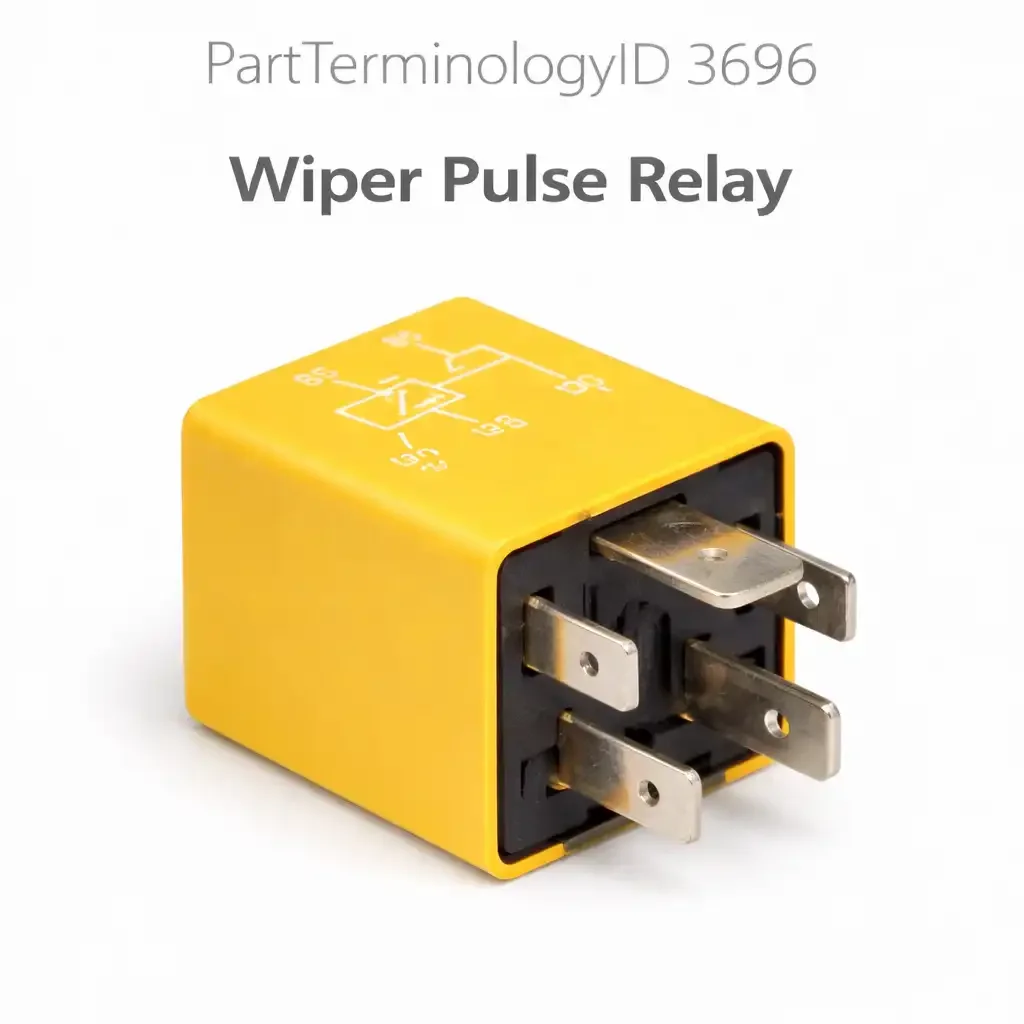
The Wiper Pulse Relay, cataloged under PartTerminologyID 3696, is the switching relay that delivers timed power pulses to the wiper motor's low-speed circuit, enabling the intermittent wiper function. When the driver selects an intermittent delay setting on the wiper stalk, the wiper control module or BCM determines the appropriate interval and repeatedly energizes the wiper pulse relay coil. Each time the relay closes, it sends a burst of current to the motor that initiates one wipe cycle. At the end of that cycle, the motor's internal park switch takes over, completes the return sweep, and holds the blades in the rest position until the next relay pulse arrives. The interval between pulses corresponds to the delay setting the driver selected, ranging from a brief hesitation on the shortest setting to several seconds on the longest.
This relay is architecturally distinct from the wiper motor on/off relay and the wiper high-speed relay that may share the same fuse panel. The on/off relay provides continuous low-speed motor power. The high-speed relay switches the motor from its low-speed winding to the high-speed winding. The pulse relay is used only during intermittent operation, which means its failure produces a specific and diagnostically useful symptom: wipers that operate normally on low and high continuous speeds but fail entirely or behave erratically on any intermittent setting. That symptom pattern is the primary diagnostic indicator that separates a wiper pulse relay fault from a wiper motor fault, a fuse failure, or a problem with the wiper stalk switch.
What the Relay Does
Pulse Generation and the Control Module Relationship
The wiper pulse relay does not generate the timing interval itself. On most modern platforms, the timing logic lives in the wiper control module or BCM, which monitors the driver's delay selection and issues the relay coil trigger signal at the appropriate moment. On older platforms, timing was handled by a dedicated intermittent wiper module or a transistor-based timer circuit in a standalone control box. On General Motors vehicles from the late 1980s through the 1990s, a pulse module mounted directly on or near the wiper motor contained the timing circuitry and the relay coil drive logic in one unit. The relay itself in all of these architectures is the final power switch that delivers current to the motor.
The wiper stalk provides the control input. Each delay position on the stalk corresponds to a different resistance value across the stalk's signal circuit. The wiper module reads that resistance, converts it to a time interval, and triggers the relay coil accordingly. A stalk that is worn internally can produce intermediate or inconsistent resistance readings, which causes the module to set incorrect intervals or to fail triggering the relay at all. This is a more common fault than relay failure in the intermittent function category, and the stalk is the correct first point of evaluation when intermittent operation is erratic or inconsistent across all delay settings.
Motor Park Switch Interaction
The wiper pulse relay works in coordination with the wiper motor's internal park switch to complete each sweep cycle cleanly. When the relay closes and delivers a power pulse to the motor, the motor begins its sweep. After a short period, the relay opens, cutting power to the motor's run circuit. The park switch, which is a separate set of contacts inside the motor assembly that closes when the motor reaches mid-stroke and remains closed until the blades reach the rest position, takes over at this point. It completes the circuit through an alternate path that allows the motor to finish its sweep and park the blades before stopping. This park switch circuit is independent of the relay and operates on a different set of motor contacts.
When the park switch fails, the wipers stop wherever they are when the relay opens rather than completing the sweep to the rest position. This produces a symptom of wipers that stop in random positions, which can be misdiagnosed as a relay problem. A key diagnostic indicator is that the failure affects all wiper positions: continuous low, continuous high, and intermittent operation are all affected if the park switch is bad, because the park function is shared across all modes. A relay failure, by contrast, affects only intermittent operation while leaving low and high continuous speeds intact.
BCM Integration on Modern Platforms
On platforms from approximately 2000 forward, the wiper pulse relay coil is driven by a BCM output rather than by a standalone intermittent module. The BCM receives the stalk signal, interprets it, and commands the relay at the calculated interval. This architecture allows the BCM to adapt the wiper interval based on vehicle speed on platforms with that feature, increasing wipe frequency at higher speeds and reducing it at low speeds automatically. When the wiper pulse relay is integrated into BCM-controlled wiper architectures, diagnosing intermittent function failure requires distinguishing between the relay, the BCM's relay command output, and the stalk signal that the BCM is receiving. A BCM that is not generating the relay command despite receiving a valid stalk signal is failing internally, and relay replacement does not address that fault.
On some platforms, the wiper relay function is managed entirely within the BCM or body electrical module through a solid-state output rather than an external relay. On these platforms, no wiper pulse relay exists as a separately replaceable component, and the module itself is the fault when intermittent function fails. ACES fitment data must be built to exclude these platforms, and listing content should direct buyers to verify their specific application uses a standalone, serviceable relay before ordering.
Top Return Scenarios
Wiper Stalk Switch as the Primary Fault
The multifunction switch, or wiper stalk, is the most common cause of intermittent wiper malfunction. The stalk uses a resistor network to signal the wiper module which delay interval the driver has selected. Over time, the contacts within the switch wear or oxidize, producing inconsistent resistance readings that the module misinterprets as an incorrect delay setting or no setting at all. On some platforms, a worn stalk contact causes the intermittent function to stop working entirely while leaving low and high continuous operation unaffected, which is exactly the symptom the relay produces when it fails.
The diagnostic distinction is that a failing stalk switch typically produces erratic behavior across the intermittent range, with some settings working and others not, or with inconsistent triggering at a single setting, while a failed relay typically produces a clean loss of the intermittent function at all settings. A buyer who has lost intermittent function at every delay setting and immediately orders a relay without testing the stalk or checking whether the BCM is commanding the relay has a meaningful probability of returning the part. Listing content that names stalk switch failure as the most common cause of this symptom and describes how to verify BCM relay command before ordering converts speculative buyers into confirmed ones.
Wiper Motor Park Switch Failure
A failed park switch inside the wiper motor produces blades that stop in random mid-windshield positions rather than returning to the rest position. On some platforms this symptom is intermittent in cold weather, occurring when the park switch contacts fail to close reliably at low temperature. The symptom can look superficially similar to relay problems in the sense that the wiper cycle is incomplete, but park switch failure affects continuous speeds as well as intermittent operation, because the park function is used at the end of every sweep regardless of which speed initiated it.
A buyer who replaces the wiper pulse relay to solve a park switch problem returns the relay unchanged in function because the intermittent pulse timing is unaffected. The park switch is internal to the wiper motor assembly on most platforms and requires motor replacement rather than isolated component repair. Listing content that describes the park switch failure pattern and how it differs from relay failure prevents this return category.
Relay Contact Oxidation Versus Complete Failure
The wiper pulse relay contacts are subjected to a higher number of switching cycles than most other vehicle relays because every intermittent wipe cycle requires one relay energize-and-release event. Over years of intermittent operation in moderate to heavy rainfall, the relay contacts accumulate oxidation from the repeated arcing that occurs each time the contacts open and close under load. This progressive contact oxidation causes intermittent wiper failure that is initially inconsistent, missing occasional cycles before becoming more frequent and eventually total.
On platforms where the relay is in a sealed underdash module or mounting pocket, contact corrosion between the relay body and its socket is a separate and common failure mechanism. The relay socket pins develop high-resistance connections that prevent the relay from energizing fully or consistently. Cleaning the relay socket with electrical contact cleaner and checking pin tension before condemning and replacing the relay body resolves socket corrosion cases without requiring a new relay. A listing that acknowledges this fault mode and the cleaning step it requires reduces returns from buyers who replaced a functioning relay after a socket cleaning would have resolved the fault.
BCM Relay Command Failure Misidentified as Relay
On BCM-controlled wiper systems, the BCM must issue a ground signal to the relay coil to close the relay. A BCM with a failed relay driver output for the wiper pulse circuit will not energize the relay regardless of relay condition. The symptom from the driver's perspective is identical to a failed relay: intermittent wipers inoperative. The diagnostic distinction requires measuring the relay coil trigger terminal with the ignition on and the stalk in an intermittent position. If the expected BCM ground command is not present at the coil trigger terminal, the BCM is not issuing the command and the relay is not the fault. Replacing the relay in this scenario returns an unmodified part because the new relay also does not energize when the BCM is not driving its coil.
Rain Sensor Fault on Auto Wiper Systems
On vehicles equipped with an automatic wiper system using a rain sensor, the intermittent wiper function operates in auto mode by using the rain sensor to modulate the BCM's relay command. A failed rain sensor, a displaced sensor gasket between the sensor and the windshield, or a dirty sensor that cannot read moisture correctly produces an apparent intermittent wiper failure in auto mode that is entirely unrelated to the relay. The wipers do not trigger in auto mode when the sensor is not reporting moisture to the BCM, which means the BCM never commands the relay. On these platforms, manually selecting an intermittent delay setting rather than using auto mode bypasses the sensor and commands the relay directly. If manual intermittent settings work but auto mode does not, the relay is confirmed functional and the rain sensor is the fault. Listing content that notes the rain sensor verification step for auto-wiper equipped platforms prevents returns from buyers who replaced the relay when the sensor was at fault.
Listing Requirements
Every listing for PartTerminologyID 3696 should include:
ACES fitment data verified to year, make, and model, with special attention to platforms where the wiper pulse relay function is internal to the BCM and no standalone relay is present
A note that this relay controls intermittent wiper operation only; wipers inoperative at all settings including low and high continuous speeds indicate a different fault, most likely a fuse or wiper motor failure
A note that the multifunction stalk switch is the most common cause of intermittent function loss on applicable platforms and should be tested before the relay is replaced
A note that the BCM relay command output should be verified present at the relay coil trigger terminal before replacing the relay on BCM-controlled systems
A note that the wiper motor park switch controls post-sweep blade return to rest position and its failure does not implicate the pulse relay
A note that on rain-sensor-equipped vehicles, auto mode failure with functional manual intermittent settings confirms the rain sensor rather than the relay as the fault
A statement that relay socket corrosion is a common cause of intermittent relay function failure and should be evaluated before relay body replacement
Frequently Asked Questions
My wipers work on low and high speeds but nothing happens when I select any intermittent setting. Is the relay the cause?
This symptom pattern is consistent with a failed wiper pulse relay, but it is also the primary symptom of a failed wiper stalk switch. The stalk is the more common fault. Before replacing the relay, check whether the relay is receiving its coil trigger signal from the BCM by probing the coil trigger terminal with the ignition on and the stalk in an intermittent position. If the BCM ground command is present and the relay is not closing, the relay is the fault. If the command is absent, the BCM or stalk signal to the BCM requires diagnosis before any relay replacement.
My wipers stop in the middle of the windshield instead of returning to the rest position. Is this the relay?
No. A relay failure prevents intermittent triggering but does not affect where the blades stop. Blades stopping mid-sweep are caused by a failed park switch inside the wiper motor assembly. The park switch is responsible for completing the wipe sweep and parking the blades after the relay opens. On most platforms the park switch is internal to the motor and requires motor assembly replacement rather than isolated component repair.
My wipers work fine manually but they used to trigger automatically in the rain. What happened?
Automatic rain-sensing wipers use a rain sensor mounted on the windshield to signal the BCM, which then commands the relay. A failed rain sensor, a misaligned sensor gasket, or a dirty sensor contact surface prevents the sensor from detecting moisture and signaling the BCM. The relay is not at fault. Verify that manual intermittent selections at the stalk trigger the wipers normally. If they do, the relay and BCM command path are working and the rain sensor is the fault.
What Sellers Get Wrong
Not distinguishing pulse relay symptoms from total wiper failure
A listing that broadly covers wiper failure without specifying which symptoms indicate relay involvement attracts buyers whose wipers are dead on all settings including low and high continuous. That buyer has a fuse, a wiper motor, or a wiper on/off relay fault, not a pulse relay fault. The wiper pulse relay has one diagnostic fingerprint: intermittent operation fails while continuous low and high speeds work normally. A listing built precisely around that symptom pattern reaches the correct buyer population and excludes the larger category of buyers who have different faults.
Not naming the stalk switch as the leading cause
On most platforms, the wiper stalk switch fails more frequently than the wiper pulse relay. A listing that presents the relay as the first-order fault for intermittent wiper failure without acknowledging the stalk produces a large population of orders from buyers who need a stalk switch rather than a relay. Naming the stalk as the primary suspect and describing the test that distinguishes stalk failure from relay failure, which is verifying BCM command signal at the relay coil trigger, converts buyers who have already tested correctly and confirmed the relay into orders that stay kept.
Omitting the rain sensor scenario
On vehicles built after approximately 2005, a significant share of the vehicle population has some form of automatic rain-sensing wiper function. For buyers on these platforms whose auto wiper function has stopped working, the relay is rarely the fault; the sensor is far more common. A listing that does not address this scenario does not serve these buyers, and a buyer who orders a relay to restore auto wiper function and finds the manual intermittent settings were already working has a clear return trigger. One sentence noting the rain sensor distinction resolves the majority of this return category.
Cross-Sell Logic
Wiper multifunction switch or combination switch (the most common cause of intermittent wiper malfunction, and the correct part to suggest when stalk contact wear is the diagnosed fault rather than relay failure)
Wiper motor assembly (required when the park switch is causing mid-screen blade stops, which is a symptom that can be confused with relay failure until the BCM command test confirms the relay is receiving its trigger signal normally)
Wiper fuse (the first check in any wiper diagnosis; a blown wiper fuse disables all wiper speeds and should be confirmed intact before any relay diagnosis proceeds)
Rain sensor (the correct repair when auto mode fails but manual intermittent settings work normally, confirming the relay and BCM command path are functional)
Wiper on/off relay (the relay that provides continuous low-speed motor power; its failure causes total wiper inoperability at all settings and is the more likely fault when the buyer reports no wiper operation at any switch position)
Final Take
PartTerminologyID 3696 sits at a diagnostic crossroads that generates more returns than most relay categories because the symptom it addresses, intermittent wiper malfunction, is the most commonly reported outcome of a worn wiper stalk switch rather than a failed relay. The relay is a legitimate fault in the intermittent wiper circuit, and it fails in a recognizable pattern. But the listing that serves buyers well is the one that describes the hierarchy clearly: stalk switch first, BCM command verification second, relay body third. A buyer who arrives at the relay purchase after working through that sequence ordered the right part. A buyer who ordered the relay because the intermittent function stopped working has a 50 percent or better chance of needing the stalk switch instead.
Building listing content around the BCM command test, the stalk switch as the primary suspect, and the park switch as the explanation for mid-screen stops produces a buyer population that has done the diagnosis before ordering. That population keeps parts. The population that has not done the diagnosis returns them. The listing is where the difference is made.