
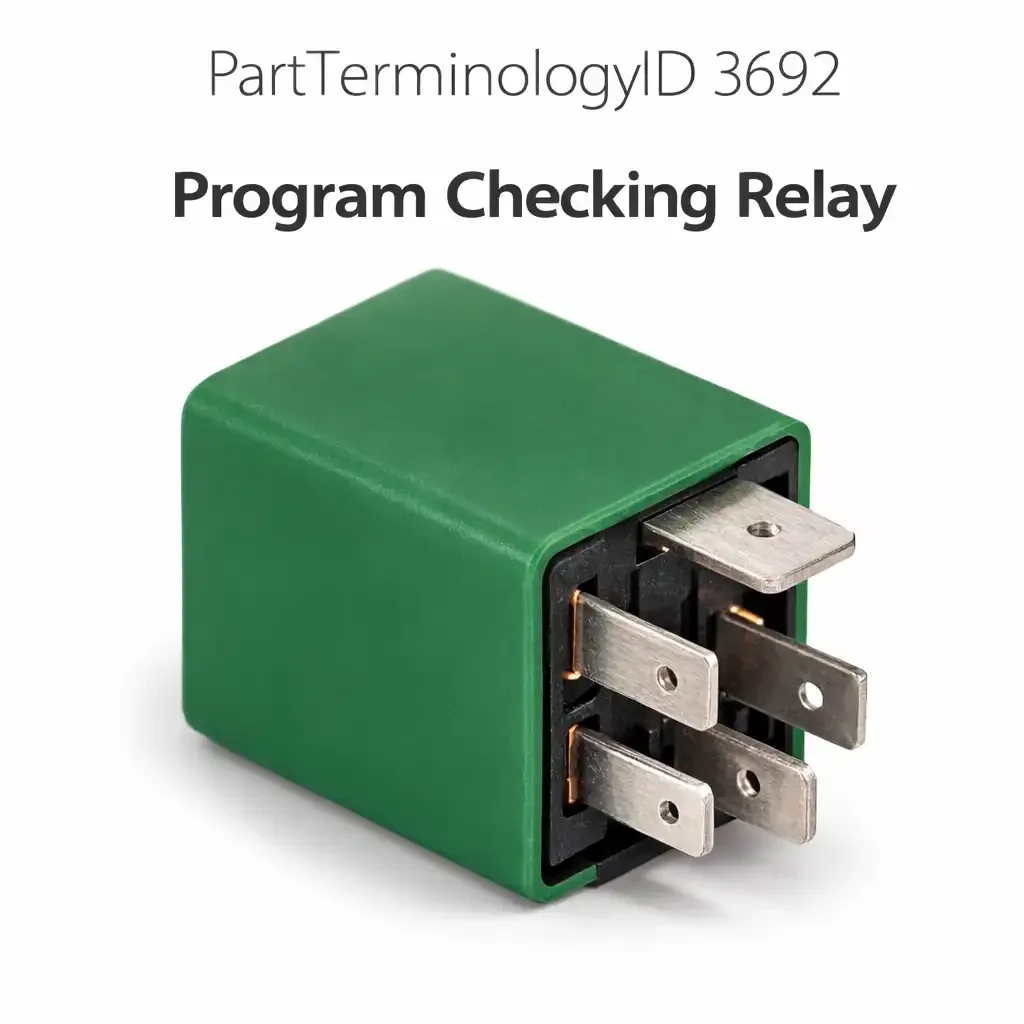
The Program Checking Relay, cataloged under PartTerminologyID 3692, is a dedicated relay that enables or gates the ECU self-diagnostic program-check mode on OBD-I and early OBD-II era vehicles. On platforms where this relay appears, energizing it shifts the engine control unit into an enhanced diagnostic state in which the module actively cycles its controlled outputs, such as the fuel pump, cooling fans, idle speed solenoid, and other actuators, so a technician can verify each output without driving the vehicle. The relay is distinct from the ECM power relay, which supplies the module's operating voltage in all conditions. The program checking relay supplies or enables a separate signal path or power feed that the ECU interprets as a command to enter its built-in test routine.
This relay architecture is most closely associated with Japanese domestic market and JDM-derived vehicles produced roughly from the mid-1980s through the mid-1990s, before standardized OBD-II scan tool access replaced manufacturer-specific diagnostic entry methods. On these platforms, the diagnostic check mode was typically activated by bridging dedicated connector terminals under the dash or in the engine compartment. On some applications, the program checking relay is wired into this same activation circuit, meaning relay failure prevents the technician from entering diagnostic mode even when the vehicle is otherwise running normally. On others, the relay gates power to circuits that are only active during the check mode sequence.
What the Relay Does
Check Mode Activation
On pre-OBD-II platforms, the ECU self-diagnostic routine was entered through a physical procedure rather than a scan tool command. Toyota's architecture used the TE1 and E1 terminals at the check connector for standard diagnostic code retrieval, and the TE2 and E1 combination for the enhanced Test Mode that raised the ECU's fault sensitivity threshold and enabled detection of starter signal circuit and air conditioning component faults not captured in normal operation. Subaru's architecture used a pair of green test mode connectors that, when joined together, caused the ECU to cycle the fuel pump, cooling fans, and all relay-controlled outputs in sequence.
On platforms where a program checking relay is part of this circuit, the relay acts as the electrical switch that either completes the check mode activation path or provides the supply voltage required for the check routine to run. Without it energizing correctly, the ECU does not receive the signal that initiates the sequence, and the vehicle behaves normally at key-on regardless of what the technician does at the diagnostic connector. The relay is not part of the vehicle's running or starting circuit; it serves no function during normal engine operation and its failure has no effect on drivability.
Diagnostic Output Cycling
Once in check mode on applicable platforms, the ECU steps through a sequence of output activations that allow the technician to verify relay coil actuation, solenoid function, fuel pump prime, and fan operation without starting the engine or driving the vehicle. This capability was particularly valuable on pre-OBD-II vehicles where real-time data stream access required dedicated factory scan tools. A working program checking relay was a prerequisite for this entire diagnostic workflow. Technicians who could not enter check mode on a vehicle they were attempting to diagnose were often working around a relay circuit problem before they could address the original fault.
ECU Reflash Power Path
On certain platforms, notably early Subaru EJ-series non-CAN-bus applications, the test mode connector circuit also provided the communication path used during ECU reflashing with aftermarket calibration tools. The program checking relay's circuit was part of the power and signal architecture that enabled the reflash session. On these applications, a failed relay circuit could prevent not only the diagnostic check mode but also any subsequent ECU programming procedure, making relay circuit diagnosis a prerequisite for calibration work.
Top Return Scenarios
Normal Drivability Masking the Fault
The program checking relay has no effect on how the vehicle starts, idles, or drives. An owner or installer who orders this relay because the vehicle was throwing a code, running rough, or failing to start has misidentified the fault. The relay's only function is to enable a technician-initiated diagnostic mode. It cannot cause a running problem, a no-start, a code, or any drivability symptom under any failure mode. A listing that clearly states the relay has no effect on running condition prevents the largest single source of return in this category, which is buyers who associated their symptom with a relay that has no operational role in producing it.
Wrong Relay for the Platform
The program checking relay circuit exists on a defined set of OBD-I era Japanese platforms. A buyer with an OBD-II vehicle from 1996 forward, on any make, has a vehicle where scan tool access replaced the program check mode architecture entirely. That vehicle has no program checking relay. A buyer with a domestic platform vehicle from any era has a vehicle where this relay function was never part of the design. ACES fitment data must be carefully defined to include only the specific years, makes, and models where this relay is present and replaceable, and listing content should reinforce that this is a platform-specific relay not applicable to most vehicles on the road.
Relay Circuit Fault Versus Connector Fault
When a technician is unable to enter check mode on an applicable platform, the most common cause is not a failed relay but a broken or corroded wire at the diagnostic connector terminal, a connector that has been pulled apart and not reseated, or oxidation on the connector terminals that prevents the activation signal from completing the circuit. On Subaru test mode circuits, the green connector pins are exposed to underdash humidity cycling over the vehicle's life and develop high-resistance corrosion that interrupts the activation signal without any relay involvement. On Toyota TE1/TE2 circuits, the check connector terminals corrode or the connector is damaged from repeated bridging. Cleaning the connector and verifying continuity through the activation wiring before condemning the relay reduces returns from buyers who replaced the relay while the connector remained the fault.
Aftermarket ECU Applications
On vehicles where the stock ECU has been replaced with a standalone ECU, the program checking relay circuit is typically unused and disconnected. Standalone ECUs from suppliers like Haltech do not use the OEM test mode architecture; their diagnostic and calibration interface is entirely over a USB or CAN connection to the tuning software. A buyer with a standalone ECU who orders a program checking relay because they cannot enter a diagnostic mode has a completely different diagnostic path, and the OEM relay is irrelevant to their situation. Listing content that notes the relay applies only to vehicles retaining the original ECU prevents this category of speculative order.
Confusion with ECM Power Relay
On platforms where both a PCM relay and a program checking relay appear in the same fuse panel, buyers searching for a relay related to ECU function may pull the program checking relay when they intended the PCM power relay, or vice versa. The two serve entirely different functions: the PCM relay provides the module's operational supply voltage and its failure causes a no-start, while the program checking relay has no effect on vehicle operation. A listing that clearly states what this relay does not do, which is supply the ECU's running power, avoids orders from buyers who need a PCM relay and are ordering the program checking relay based on proximity in the fuse panel.
Listing Requirements
Every listing for PartTerminologyID 3692 should include:
ACES fitment data restricted to OBD-I era vehicles on platforms where this relay is present and serviceable as a standalone component; OBD-II platforms from 1996 forward do not use this architecture
A clear statement that this relay has no effect on vehicle starting, running, or drivability under any failure mode, and that drivability symptoms are not caused by this relay
A note that this relay enables the ECU self-diagnostic program-check mode, which is a technician-initiated function distinct from normal engine operation
A note that check mode entry failure is more commonly caused by connector corrosion or broken wiring at the diagnostic terminals than by relay body failure, and that connector continuity should be verified before the relay is replaced
A note that this relay applies only to vehicles retaining the original OEM ECU; aftermarket standalone ECU installations do not use this relay or its circuit
A statement that this relay is not the ECM power relay and does not affect ECU supply voltage
Frequently Asked Questions
My check engine light is on and I can't read codes with my scanner. Is this relay the problem?
No. OBD-II vehicles from 1996 forward use a standardized scan tool port that operates independently of any program checking relay. If your scanner cannot communicate with the vehicle, the fault is in the OBD-II port, the CAN bus, a blown fuse protecting the diagnostic port circuit, or the ECU itself. The program checking relay is an OBD-I era component found only on specific Japanese platforms from the late 1980s through the mid-1990s. It is not present on OBD-II vehicles and replacing it will not resolve a scan tool communication issue on any platform.
My vehicle cranks but won't start. Could this relay be the cause?
No. The program checking relay enables the ECU diagnostic mode only. It has no role in the starting circuit, fuel delivery, or ignition system. A crank-no-start condition requires diagnosis of the ECM power supply, fuel pressure, crankshaft position sensor, and ignition system, none of which are connected to this relay.
I have a Subaru with test mode connectors and I can't get the fans and fuel pump to cycle when I plug them together. What should I check before ordering the relay?
Start with the test mode connectors themselves. The green test mode connectors are exposed to underdash humidity over years of use and their terminals corrode. Clean both halves of the connector with electrical contact cleaner, check the pins for tension and correct seating, and verify continuity between the connector terminals and the ECU pins using a wiring diagram. If continuity is good and the activation circuit reaches the relay coil, verify relay coil resistance and confirm the relay is receiving its coil trigger voltage. Only after confirming the activation circuit is intact and the relay is failing to energize should the relay body be ordered.
What Sellers Get Wrong
Listing it as a drivability repair part
The program checking relay is a service tool enabler, not a repair part in the conventional sense. A listing that positions it in search results for no-start, check engine light, or rough idle queries will generate orders from buyers who have none of the conditions this relay addresses. The relay does not fix codes, does not resolve running problems, and does not affect how the vehicle operates in any mode the owner will experience. Positioning it accurately as a tool that enables a technician-initiated diagnostic check mode, applicable only to specific OBD-I era platforms, produces legitimate orders and eliminates a large category of speculative ones.
Not distinguishing it from the ECM power relay
Both the program checking relay and the ECM power relay sit in the same fuse panel on applicable platforms and are functionally named with ECU-adjacent language. A listing that does not clearly separate their functions will attract buyers who need the ECM power relay for a no-start condition and are ordering the wrong part. The distinction must be stated directly: the program checking relay enables a technician mode and has no effect on starting; the ECM power relay supplies the module's operating voltage and its failure prevents starting. These are different relays serving different functions.
Missing the platform scope
This relay exists on a narrow band of OBD-I era vehicles. A listing with generic or missing fitment data will attract buyers across a much wider vehicle population than this relay actually serves, generating returns from every buyer whose vehicle doesn't have this circuit at all. Tight ACES fitment data is the primary return-prevention tool in this category, and listing content that reinforces the platform scope supports the data.
Cross-Sell Logic
ECM power relay or PCM relay (PartTerminologyID 3688), the relay that supplies the ECU's operating voltage, which is the more probable fault when a no-start accompanies diagnostic difficulty on OBD-I era platforms
Diagnostic connector or check connector, the connector that the technician bridges to initiate the check mode sequence, which is more commonly the fault than the relay when check mode entry fails
Oxygen sensor (the first component technicians typically evaluate after successful check mode entry on pre-OBD-II platforms, since O2 sensor codes were among the most common outputs of the self-diagnostic sequence)
ECU fuse (the fuse protecting the ECU power supply circuit, which should be verified intact any time the check mode sequence fails to respond, as a blown ECU fuse prevents check mode entry regardless of relay condition)
Final Take
PartTerminologyID 3692 is one of the narrower entries in the relay taxonomy: a platform-specific, function-specific component from an era of automotive diagnostics that predates standardized scan tool access. Its presence in a parts catalog is legitimate because the vehicles it served are still in use, and technicians restoring or maintaining OBD-I era Japanese platforms occasionally need to replace the component that makes the built-in check mode accessible. But the relay's narrow scope, its complete absence from drivability symptoms, and its close proximity in fuse panels to relays that do affect operation make it a high-return category when listed without precision.
A listing built around what this relay actually does, which is enable a technician mode, not a running mode, and what it does not do, which is affect starting, codes, or drivability, produces a buyer population that ordered it for the right reason. That is a small population, accurately targeted, and it is the only population that will keep the part.