
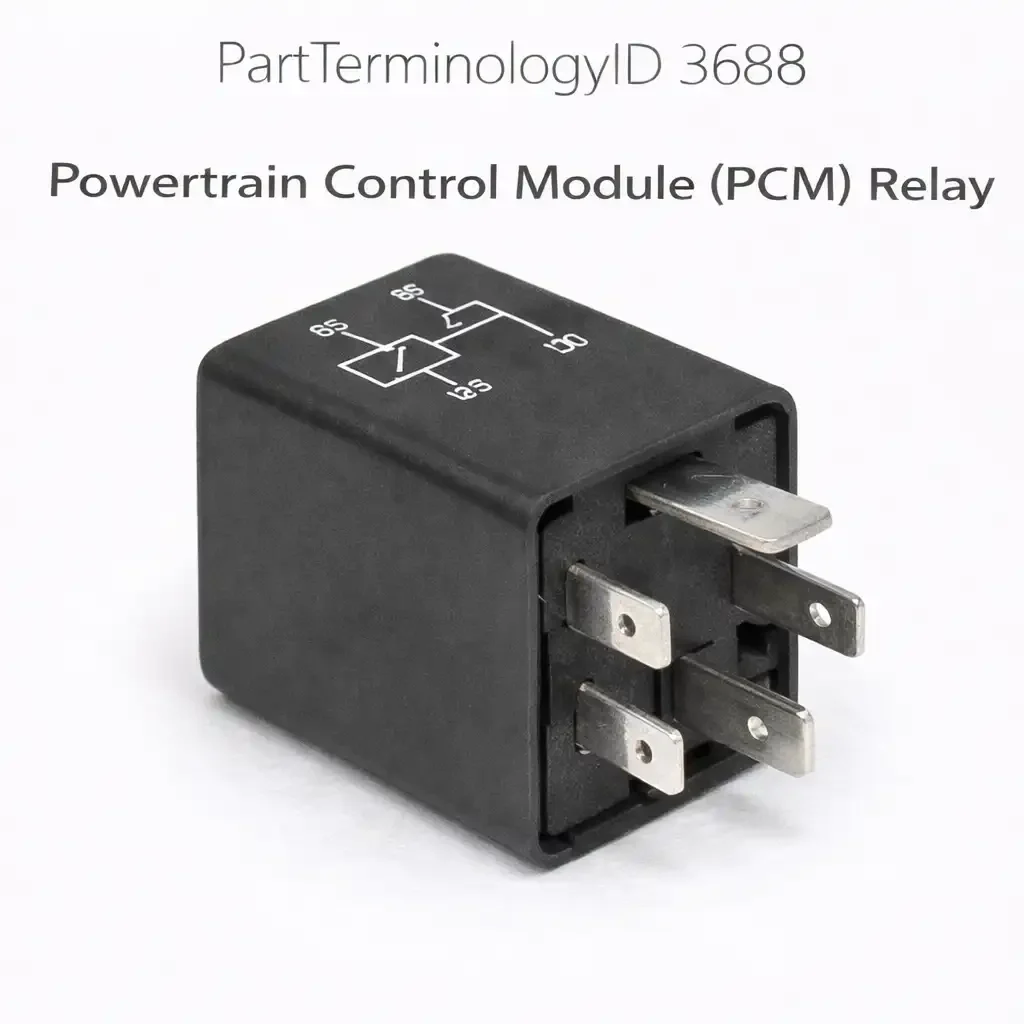
The Powertrain Control Module (PCM) Relay, cataloged under PartTerminologyID 3688, controls the ignition-switched power supply to the vehicle's engine management computer. When the ignition key is turned to the run position, the relay coil is energized and the relay closes, supplying battery voltage to the PCM's power input pins. The PCM then initializes, begins reading sensor inputs, and enables fuel injection, ignition timing, and all other engine management outputs. When the relay fails open, the PCM receives no power, and no engine management function operates regardless of what else in the vehicle is working. The result is a crank-no-start condition at minimum, and depending on the platform, a complete loss of dash activity and warning chimes at key-on.
A relay stuck closed rather than stuck open presents a different failure mode: the PCM continues to receive power even with the ignition off, which keeps the module active, draws continuous current from the battery, and can drain a healthy battery overnight. This failure mode is less dramatic in its immediate effect but can cause a pattern of unexplained battery drain that is misdiagnosed as a battery or alternator fault before the relay is identified as the cause.
The associated diagnostic trouble code for a fault in this circuit is P0685, ECM/PCM Power Relay Control Circuit Open, or P0689, ECM/PCM Power Relay Sense Circuit Low, depending on platform and how the fault is detected. These codes point to the relay circuit but do not confirm the relay body is the fault. The wiring, the relay socket, the PCM ground circuit, and the PCM's internal power management circuit all require evaluation before the relay is condemned.
What the Relay Does
PCM Supply Switching
The PCM requires a stable, clean supply voltage on multiple input pins to operate correctly. On most domestic platforms the PCM receives both a battery-direct keep-alive memory supply, which maintains learned fuel trims and adaptive data when the ignition is off, and a switched ignition supply through the PCM relay that powers the module's operating circuits. The relay controls the switched supply only. Loss of the relay output disables the operating circuits, but keep-alive memory supply and stored codes may remain accessible through the battery-direct pin depending on platform.
The relay coil trigger is typically an ignition-switched signal from the PCM fuse or from a BCM output, depending on platform architecture. On Ford platforms, the relay is commonly called the EEC relay and is located in the engine compartment power distribution box. On GM platforms it may be the ECM fuse relay. On Chrysler/FCA platforms it is often integrated into the TIPM (totally integrated power module). The relay format is typically a standard ISO mini or micro relay, interchangeable with other relays of the same format in the same fuse panel for diagnostic substitution purposes.
Interaction with Dependent Systems
Because the PCM controls fuel injection, ignition timing, idle speed, and emissions outputs, a failed PCM relay disables all of those functions simultaneously. The engine cranks on starter motor power but receives no injector pulse and no ignition trigger, so it does not fire. On platforms where the PCM also controls the fuel pump relay command, a failed PCM relay additionally prevents the fuel pump from running, which means no fuel pressure builds on the key-on prime cycle and the engine cannot start even if the ignition system were functional.
This multi-system shutdown from a single component failure is what makes the PCM relay a tempting diagnosis for any no-start. The symptoms are consistent with PCM relay failure but equally consistent with a failed crankshaft position sensor, a failed fuel pump, a failed ignition module, a low battery, or a failed PCM itself. The relay is the simplest and least expensive component in that list to verify, which gives it diagnostic priority, but it is not the most probable fault in every no-start scenario.
Top Return Scenarios
PCM Relay Fuse Failure
The PCM relay coil trigger circuit and the relay load circuit are both protected by fuses. A blown fuse on either leg produces the same no-start, no-power-to-PCM symptom as a failed relay. Buyers who pull the fuse panel cover, read the relay legend, pull the PCM relay, and swap a replacement without checking both associated fuses first will find that the new relay performs exactly the same as the old one if a fuse is the fault. Fuse verification is the correct first step in PCM relay diagnosis, and listing content that names it explicitly prevents this return category.
PCM Ground Circuit Fault
The PCM requires clean, low-resistance ground connections to operate correctly and to properly command the relay coil trigger circuit. A corroded or loose PCM ground strap produces voltage at the PCM power input pins but unstable or insufficient ground reference, which causes erratic module behavior, intermittent no-starts, and P0685 codes that point toward the relay circuit without the relay being at fault. A PCM that is logging P0685 on a vehicle where the relay coil is confirmed receiving its trigger signal and the relay is confirmed closing should prompt ground circuit inspection before relay replacement.
On the Ford Focus ST, field reports identify a loose PCM ground under the air box as the cause of relay circuit codes and apparent relay fault symptoms. Tightening the ground connection resolves the fault without any relay replacement. This class of fault produces returns from buyers who replaced a functioning relay because the code pointed to the relay circuit without distinguishing between the relay body and the circuit wiring and grounds.
Intermittent No-Start Misidentified as Relay Failure
A PCM relay that is failing intermittently produces an intermittent no-start: the vehicle starts and runs normally most of the time but fails to start occasionally for no apparent reason, with full crank but no fire or complete no-crank depending on platform. This symptom pattern is consistent with intermittent relay contact failure but is equally consistent with a failing crankshaft position sensor, an intermittent ignition switch output, or relay socket corrosion causing momentary contact loss.
Relay socket corrosion is a more common cause of intermittent relay-related symptoms than relay body failure on most platforms, because the socket pins are exposed to underhood temperature cycling and humidity while the relay body itself is relatively well protected. Cleaning the relay socket pins with electrical contact cleaner and checking for pin tension before replacing the relay body resolves this fault class without the cost of a new relay.
PCM Internal Power Circuit Fault Generating P0685
Modern PCMs contain an internal power management IC that monitors the module's supply voltage and can command the relay driver to remain open if a fault is detected internally. When this internal circuit fails, the PCM stores P0685 or a related code indicating a relay circuit fault, even though the external relay is functioning correctly and supplying the correct voltage. The module is essentially reporting its own internal fault as an external relay fault.
A buyer who sees P0685 and replaces the PCM relay without confirming that relay coil voltage, relay output voltage, and wiring continuity are all normal may be replacing a functional relay while a failed PCM internal circuit generates the same code again after the repair attempt. Confirming normal voltage on both sides of a closed relay before condemning the relay is the test that separates an external relay fault from an internal PCM fault.
Battery Drain Caused by Relay Stuck Closed
A PCM relay that has failed with its contacts stuck closed supplies the PCM continuously regardless of ignition state. The PCM remains active, consuming current overnight, and the battery is drained by morning. This fault presents as a repeated dead battery rather than a no-start, and it is frequently misdiagnosed as a battery or alternator problem through several replacement cycles before the relay is identified.
Diagnosing a stuck-closed relay requires measuring current draw with the ignition off and systematically removing fuses and relays until the draw drops to normal. A PCM relay that is stuck closed will show a reduction in current draw when it is removed, confirming it as the current drain source.
Listing Requirements
Every listing for PartTerminologyID 3688 should include:
ACES fitment data verified to year, make, and model, with attention to platform differences in relay location, because the PCM relay may be in the underhood fuse panel, the underdash fuse panel, or integrated into a TIPM on Chrysler platforms where it is not a standalone replaceable relay
The relay body format, coil voltage, and contact current rating for each application
A note that the PCM relay fuse must be confirmed intact before relay diagnosis, and that a blown fuse produces the same symptom as relay failure
A note that P0685 or P0689 codes indicate a circuit fault rather than confirmed relay body failure, and that wiring continuity, socket condition, PCM ground circuit, and relay coil trigger voltage all require verification before the relay is condemned
A note that battery drain with the ignition off can indicate a relay stuck closed rather than stuck open, and that current draw measurement with the relay removed confirms this fault mode
A statement that this relay is sold as a standalone component and does not include the PCM fuse, PCM ground strap, or PCM module
Frequently Asked Questions
My car cranks but won't start and I have a P0685 code. Is the relay the problem?
P0685 indicates a fault in the PCM relay control circuit, which includes the relay body, the relay socket, the wiring between the relay and the PCM, and the PCM's internal relay command circuit. Before ordering a relay, verify that the relay coil is receiving its ignition-switched trigger voltage at the coil pins with the key on. If it is, verify that the relay is closing by checking for output voltage on the relay's load terminal. If coil voltage is present and the relay is not closing, the relay coil has failed and replacement is indicated. If coil voltage is absent, the fault is upstream in the trigger circuit, not in the relay body. Also confirm the PCM fuse is intact before any relay diagnosis.
My battery keeps dying overnight. Could this be the PCM relay?
A relay stuck in the closed position is a legitimate cause of overnight battery drain. Pull the PCM relay with the ignition off and measure the current draw before and after removal. If the draw drops significantly when the relay is removed, the relay contacts are stuck closed and replacement is indicated. If the draw is unchanged, the relay is not the drain source and further diagnosis of other circuits is needed.
My PCM relay is in a TIPM on my Chrysler vehicle. Can I replace just the relay?
On FCA platforms with a Totally Integrated Power Module, the relay function is integrated into the TIPM circuit board rather than mounted as a standalone relay. A failed relay function in the TIPM typically requires TIPM replacement or rebuild rather than individual relay replacement. Buyers on TIPM-equipped platforms should verify whether their specific application uses a standalone PCM relay before ordering this part.
What Sellers Get Wrong
Presenting the relay as the primary no-start diagnosis
A listing that offers the PCM relay as the leading answer to a crank-no-start without directing buyers to verify fuse condition, coil trigger voltage, and relay output voltage first attracts buyers who have not confirmed the relay is at fault. No-start diagnosis is a multi-cause problem, and the PCM relay is one item in a short list that includes the fuse, the crankshaft position sensor, the fuel pump, and the PCM itself. A listing that acknowledges this and provides the one test that distinguishes a relay fault from everything else, coil voltage present but relay not closing, produces better-prepared buyers.
Not addressing the stuck-closed failure mode
Most listing content for PCM relays focuses entirely on the stuck-open failure that causes a no-start, while the stuck-closed failure that causes battery drain is equally common and produces a completely different symptom. A buyer whose vehicle starts and runs normally but whose battery repeatedly goes dead is not going to find useful diagnostic guidance in a listing that only describes crank-no-start scenarios. Addressing both failure modes in the same listing serves the full range of buyers who legitimately need this relay.
Omitting the P0685 circuit interpretation
A buyer who sees P0685, searches for the meaning of the code, finds that it refers to the PCM relay circuit, and orders the relay is following reasonable logic. But P0685 is a circuit code, not a component code, and the circuit includes wiring and grounds as well as the relay body. A listing that acknowledges the code but directs buyers to verify voltage on both relay terminals before installation converts a potentially speculative order into a confirmed one.
Cross-Sell Logic
PCM fuse or ECM fuse (the first check in any PCM relay diagnosis, confirmed intact before any relay testing proceeds)
PCM ground strap or engine ground strap (a loose or corroded PCM ground produces relay circuit codes and intermittent module faults without relay failure, and is the correct repair when relay output voltage is confirmed normal but P0685 persists)
Crankshaft position sensor (the most common cause of crank-no-start when the PCM relay and fuel system are confirmed functional, and a frequent no-start fault that is misidentified as a PCM relay problem before testing separates them)
Ignition switch (the component that supplies the relay coil trigger signal, and a failed ignition switch output to the relay coil produces the same symptom as a failed relay coil without the relay being at fault)
Battery (a weak battery that cannot sustain voltage during cranking causes the PCM to lose its supply threshold and can produce apparent PCM relay symptoms, and battery condition should be verified as part of any no-start diagnosis)
Final Take
PartTerminologyID 3688 covers a relay that sits at the top of the engine management power hierarchy, which gives it outsized diagnostic significance in any no-start or P0685 scenario. The relay is worth checking early because it is inexpensive, accessible, and its failure mode is easy to confirm with a test light or multimeter. But its position in the diagnostic hierarchy does not make it the most probable fault in a no-start, and listing content that acknowledges the fuse, the circuit wiring, and the PCM ground as equally important evaluation points gives buyers a path to the correct repair rather than a path to a relay that may not be the problem.
The buyer who reads a P0685 code, confirms relay coil trigger voltage is present, confirms the relay is not closing, and orders this relay has done legitimate diagnosis. That buyer keeps the part. Building listing content that produces more of those buyers and fewer of the buyers who ordered a relay before testing the circuit is the return-prevention work that matters in this category.