
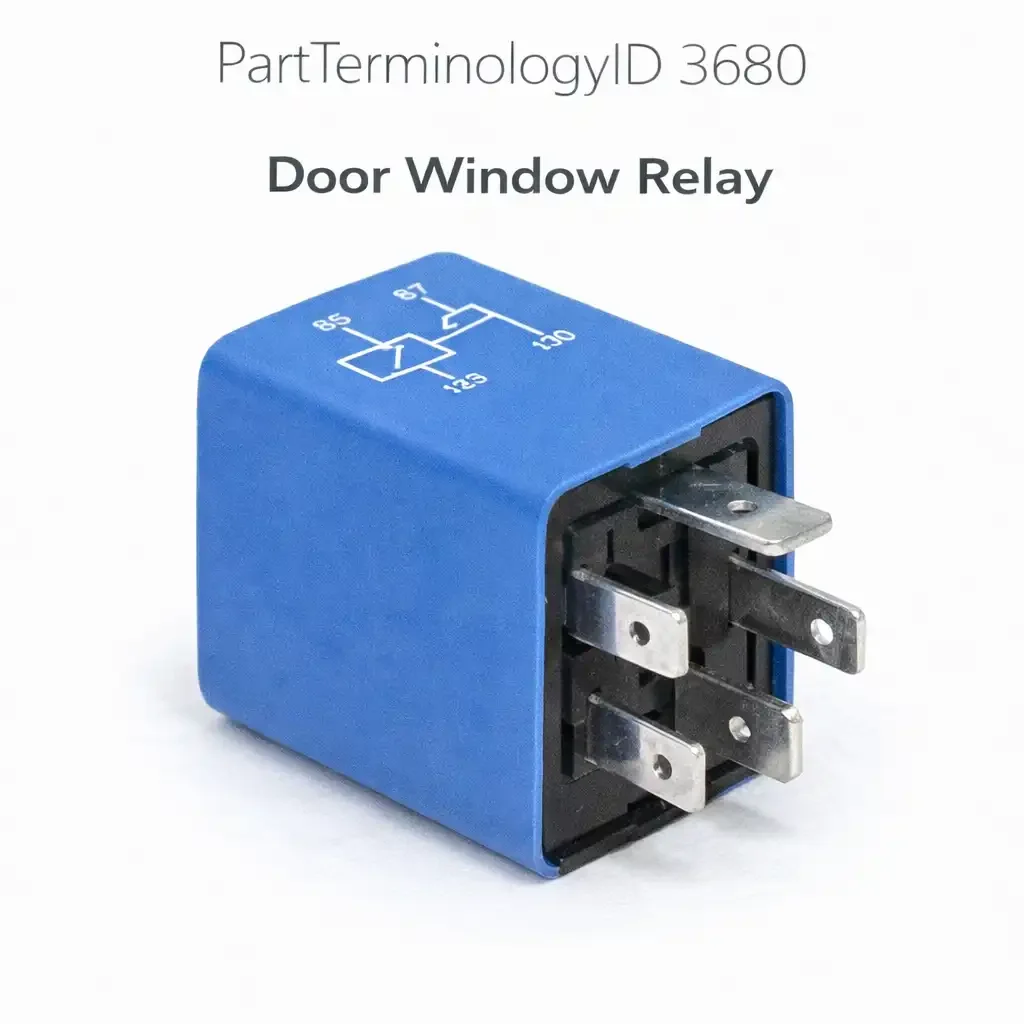
The Door Window Relay, cataloged under PartTerminologyID 3680, supplies switched power to the power window circuit on vehicles where window motor operation is gated through a dedicated relay rather than supplied directly through a fuse to the master switch. The relay coil is typically energized by an ignition-switched or accessory-switched signal, so the windows only operate when the ignition is in the appropriate position. When the relay fails open, all power windows lose function simultaneously because the entire window circuit is starved of supply voltage upstream of every switch and motor.
The relay's position in the circuit makes it a natural suspect any time all windows stop working at once, but it is also one of two components that cause that symptom, the other being the window fuse. The diagnostic approach is short: check the fuse first, then verify the relay coil is receiving its trigger signal and the relay is closing, then confirm supply voltage is reaching the master switch. A single window that stops working while all others function normally is never a relay fault, and listing content that clarifies this reduces speculative orders from buyers whose switch, motor, or regulator is the actual problem.
What the Relay Does
Common Supply Gating
On platforms that include a door window relay, the relay sits between the fused battery or accessory supply and the common power feed to the window switch assembly. Every window switch in the vehicle, both the master switch on the driver door and the individual switches at each passenger position, receives its supply voltage through this single relay. When the relay is closed, all switches have supply voltage and all windows can be operated. When the relay is open, no switch has supply voltage and no window moves regardless of switch condition.
This single-relay architecture explains the all-windows-fail symptom that legitimately implicates the door window relay. A fault that affects only one switch position, only one motor, or only one direction of travel cannot be a supply relay fault, because the relay does not distinguish between individual windows or directions. The relay either passes voltage to the entire window circuit or it does not.
On platforms where the window circuit is supplied directly through the fuse without a relay, a total window loss fault points only to the fuse and the supply wiring rather than a relay. Not every vehicle has a door window relay, and buyers should verify their platform includes one before ordering. The vehicle's fuse and relay box legend identifies whether a dedicated window relay is present.
Window Lock-Out Function Context
Many vehicles with a door window relay also have a window lock-out switch at the driver master switch panel that disables all passenger window switches while leaving the driver's window operational. When the lock-out is engaged, the passenger window switches receive no signal path to the motors even though the relay and master switch supply are both functioning. A buyer whose passenger windows stopped working after someone pressed the lock-out button on the master switch will find that replacing the relay has no effect, because the relay is not involved in the lock-out function.
The lock-out condition is the most common cause of passengers windows stopping while the driver's window continues to work. Checking the lock-out switch state is the first diagnostic step whenever passenger windows fail while the driver's window does not.
Top Return Scenarios
Blown Fuse Misidentified as Relay Failure
A blown window fuse produces identical symptoms to a failed door window relay: all windows stop working simultaneously with no motor sound. The fuse is faster to check and less expensive to replace than the relay, and it is a more common failure point in a window circuit that sees regular use and occasional overcurrent from a stalled or binding motor. Despite this, buyers frequently order the relay before checking the fuse.
A blown window fuse also signals an overcurrent event that should be investigated before replacing either the fuse or the relay. A window motor that is stalling against frozen glass, binding against a failed regulator, or developing winding degradation draws excessive current and can blow the fuse repeatedly if the motor condition is not addressed. Installing a new relay and a new fuse on a circuit where the motor is drawing excess current will restore window operation temporarily until the next overcurrent event blows the fuse again.
Single Window Failure Misidentified as Relay Failure
A single window that fails while all other windows continue to function normally cannot be a door window relay fault. The relay supplies all windows from a common feed. If any other window is working, the relay is closed and supply voltage is present at the master switch. The fault on a single-window failure is almost always the individual window switch, the window motor, the regulator, or the wiring between the door switch and the motor.
Single-window failures are the most common power window complaint category, and the window switch is the most probable fault source within that category. Switch contacts degrade from wear and contamination, particularly on the driver's master switch panel where the most frequent use occurs. A buyer who orders a door window relay for a single failed window has not identified the fault correctly and will return the relay when it has no effect.
Passenger Window Lock-Out Not Checked
The window lock-out function at the driver master switch disables all passenger window switches while the relay and master switch supply remain active. A vehicle where all passenger windows fail simultaneously while the driver's window continues working is almost certainly in window lock-out mode rather than experiencing a relay fault. The lock-out indicator, if present, confirms this immediately. Even without an indicator, pressing the lock-out button a second time typically restores passenger window function.
This is a particularly common scenario when a vehicle has recently been used by a different driver, when the master switch panel has been cleaned, or when children have been pressing buttons in the rear seat area. A buyer whose passenger windows stopped working after any of these events should check the lock-out switch before diagnosing any other component.
Door Jamb Wiring Harness Break
Window circuit wiring that runs between the door and the door jamb passes through a flex zone that is stressed by repeated door opening and closing cycles. Over time, individual wires in this bundle can develop breaks or short circuits from fatigue. A broken wire in the door jamb harness on the driver's door can disrupt the supply path from the relay to the master switch, causing total window failure that looks exactly like a relay fault.
The distinction between a harness break and a relay failure is found at the master switch supply terminal. If supply voltage is present at the relay load terminal in the fuse panel but absent at the switch supply terminal in the door, the fault is in the wiring between the two points, not in the relay. A buyer who replaces the relay without tracing the supply voltage from the relay to the switch will find no improvement if a harness break is the fault.
Relay Not Present on the Platform
On many vehicles, the power window circuit is supplied directly through a fuse with no relay in the circuit at all. The switch handles motor switching directly or through internal relay contacts that are part of the switch assembly. On these platforms, there is no door window relay to replace, and a buyer who orders one has misidentified the circuit architecture of their vehicle. Buyers on these platforms experience total window failure from a blown fuse, a failed master switch, or a BCM output fault rather than a relay fault.
Verifying that the vehicle's fuse and relay box legend includes a dedicated window relay before ordering is a straightforward step that eliminates this return category completely.
Listing Requirements
Every listing for PartTerminologyID 3680 should include:
ACES fitment data verified to year, make, model, and body style, with a note that this relay is not present on all power window applications and buyers should confirm their vehicle includes a dedicated window relay before ordering
The relay body format, pin count, coil voltage, and contact current rating for each application
A clear statement that the relay is implicated only by total loss of all power windows simultaneously, and that a single window failure, partial window failure, or passenger-only failure does not indicate relay fault
A note that the window fuse is the first check before relay diagnosis, and that a blown fuse indicates an overcurrent event that should be investigated before replacing the relay
A note that the window lock-out switch at the driver master panel should be checked before any electrical diagnosis when passenger windows fail while the driver window continues to operate
A statement that this relay is sold as a standalone component and does not include the window motor, window regulator, master switch, or window circuit fuse
Frequently Asked Questions
All my power windows stopped working at the same time. Is the relay the problem?
Total simultaneous window failure is consistent with either a blown fuse or a failed relay. Check the window fuse first, as it is the more common fault and the fastest check. If the fuse is intact, verify that the relay coil is receiving its trigger voltage with the ignition on. If the trigger is present and the relay does not close, the relay has failed and replacement is indicated. If the relay closes but windows still do not work, the fault is downstream of the relay in the master switch supply wiring.
Only my passenger windows stopped working. My driver window still works. Is this the relay?
Passenger windows working while the driver window does not is almost certainly the window lock-out function at the driver master switch panel rather than a relay fault. The relay supplies all windows including the driver window. If the driver window works, the relay is functional. Check the lock-out switch position at the master panel before diagnosing any other component.
My windows worked yesterday and stopped today without any obvious cause. Should I replace the relay?
A sudden onset total window failure should prompt a fuse check before any other action. A motor that stalled or drew excess current during the last use cycle may have blown the fuse. If the fuse is intact and the relay is not clicking when the ignition is on, the relay coil has likely failed. If the relay clicks but no windows move, trace supply voltage from the relay output to the master switch to identify whether a harness break or connector fault is interrupting the circuit between them.
What Sellers Get Wrong
Not distinguishing total loss from single-window failure
The most common mistake in window relay listings is presenting the relay as a potential fix for any window that stops working. Single-window failures are the majority of all power window complaints, and the relay is not the fault in any single-window failure scenario. A listing that positions the relay as relevant to any window problem attracts a large volume of buyers whose switch, motor, or regulator is the actual fault. Specifying in the description that the relay applies only to total simultaneous window failure directs the correct buyers and repels the incorrect ones.
Omitting the fuse check
A window relay listing that does not name the fuse as the first diagnostic step accepts the return rate from buyers who replaced the relay on a blown-fuse fault. The fuse check is faster, cheaper, and more likely to identify the actual problem than the relay swap, and every listing that omits it is leaving buyers without the most useful piece of diagnostic guidance in the category.
Not mentioning the lock-out switch
The window lock-out check is specific to this relay category and directly addresses the most common misdiagnosis scenario for passenger window failures. A listing that includes one sentence about the lock-out switch prevents a category of orders from buyers who will return the relay immediately when the lock-out button resolves their complaint.
Cross-Sell Logic
Window fuse or circuit breaker (the first check before relay diagnosis and the more common fault source for total window loss, particularly after a binding or stalling motor has drawn excess current)
Window motor or window regulator motor (the most common fault for a single failed window, and the component most likely to have caused a blown window fuse by drawing excess current)
Window regulator (the mechanical component most frequently at fault when a window moves slowly, makes grinding noise, or falls inside the door, often misidentified as a motor failure)
Master switch or power window switch (the most common fault for a single window failure when the motor and regulator are confirmed functional, and a common cause of all-windows failure when the switch internal relay contacts have failed)
Door jamb wiring harness or flex section repair kit (the correct replacement when voltage is confirmed leaving the relay but absent at the master switch due to a broken wire in the door-to-body flex zone)
Final Take
PartTerminologyID 3680 is a straightforward supply relay in a circuit where the diagnostic profile for relay failure is specific and easy to identify: all windows fail simultaneously with a good fuse and a confirmed absent relay output. Every other window complaint pattern points elsewhere, and listing content that communicates this clearly earns accurate orders and avoids the returns that come from buyers who have not matched their symptom to the correct component.
The two sentences with the most return-prevention value in any door window relay listing are the fuse check instruction and the lock-out switch reminder. Together they address the two most common reasons buyers order a window relay and return it unchanged. A listing that includes both is doing its job.