
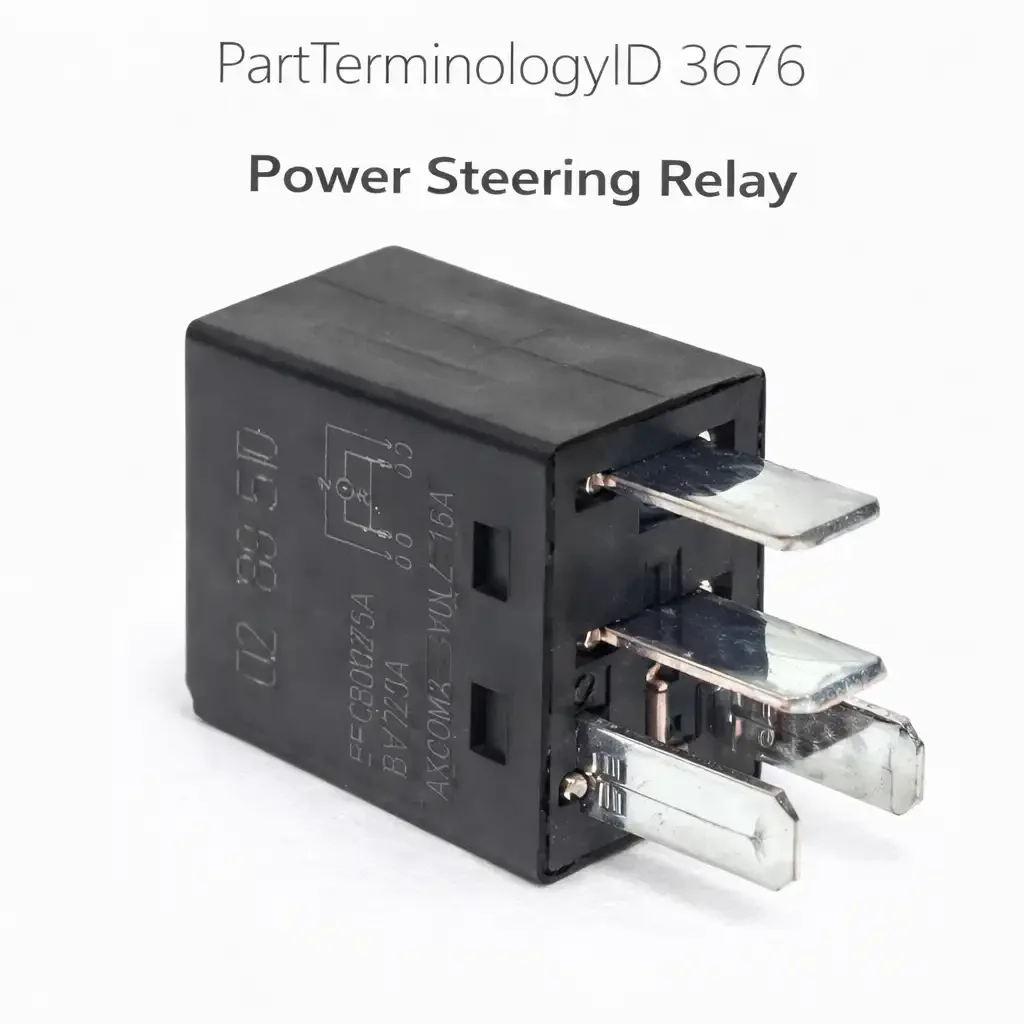
The Power Steering Relay, cataloged under PartTerminologyID 3676, controls the main power supply to the electric motor that provides steering assistance. Depending on the platform, that motor is either an electro-hydraulic pump motor that drives a conventional hydraulic power steering rack, or an electric assist motor that is part of a column-mounted or rack-mounted EPS assembly. In both cases the relay is the switched gate between the battery supply and the steering motor circuit, and a failed relay produces a loss of power assist that makes the steering wheel feel heavy and unresponsive, particularly at low speeds and during parking maneuvers.
The diagnostic weight of this relay differs significantly between the two architectures it serves. On electro-hydraulic power steering platforms, the relay is a standalone component in the engine bay fuse and relay panel, it handles the full pump motor current load, and it is a legitimate first-order replacement target after the fuse is confirmed good. On fully electric EPS platforms, the relay is frequently integrated inside the EPS control module rather than mounted as a standalone fuse panel component, and steering assist loss on these platforms points far more commonly to the torque sensor, the EPS control unit, voltage supply conditions, or wiring harness faults than to the relay itself. A buyer who understands which architecture their vehicle uses, and what the relay's position in that architecture is, can reach the correct diagnosis without purchasing components they do not need.
What the Relay Does
Electro-Hydraulic Power Steering Applications
Electro-hydraulic power steering (EHPS) replaces the engine-driven belt and pulley that powers a traditional hydraulic power steering pump with a self-contained electric motor and pump assembly. The steering rack itself remains a conventional hydraulic unit with the same hoses, seals, and fluid as a belt-driven system. The electric pump motor runs continuously at idle speeds and adjusts its output under ECU control to match steering load, which is why some EHPS systems run the motor at reduced voltage during highway driving and full voltage during parking. The power steering relay supplies battery voltage to this pump motor on a switched circuit, so the pump only runs when the ignition is on and the relay is closed.
Because the EHPS pump motor draws substantial current, typically in the range of 20 to 60 amps depending on platform and load, the relay in this circuit is a high-current component. The pump supply circuit is protected by a dedicated high-amperage fuse, often 40 to 80 amps, which is entirely separate from the relay and the relay fuse. On Toyota MR2 and early Prius platforms, on some Honda and Acura models that used EHPS before transitioning to full EPS, and on various European platforms including early Mini Cooper and VW/Audi applications that used electric pump systems, the power steering relay sits in the engine bay relay block and is a removable ISO-format or platform-specific relay that can be replaced without removing any surrounding components.
Full Electric Power Steering Applications
On column-mounted and rack-and-pinion EPS systems such as those used in the Honda Fit, Civic, and S2000, early GM applications including the Chevrolet Cobalt and Malibu, Ford Mustang from 2005 onward, and the majority of mainstream vehicles produced after the mid-2000s, the relay architecture shifts. The EPS control module contains internal relay components, specifically a power relay and a fail-safe relay in Honda's architecture, that are part of the module's circuit board rather than standalone components in the fuse panel. The power relay closes to supply the FET bridge that drives the assist motor, and the fail-safe relay closes as a secondary confirmation of normal system status. If the EPS control unit detects a fault in any monitored circuit, it opens both relays to remove assist, and the EPS warning light illuminates.
On these platforms, the power steering relay in the fuse panel, when one is present at all, functions as a main supply relay to the EPS control module rather than a direct motor power relay. A failed module supply relay starves the EPS module of its operating voltage, the module cannot function, and steering assist is lost. However, the control module, the torque sensor, and the voltage supply to the module are all more probable fault sources on full EPS systems than the supply relay itself.
Safety Architecture and Fail-Safe Behavior
Both EHPS and full EPS systems are designed to fail in a predictable way that preserves directional control. When power assist is lost, whether from relay failure, module fault, sensor fault, or voltage dropout, the steering reverts to manual operation. The wheel remains mechanically connected to the rack and the vehicle can be steered, but the effort required increases substantially, especially at low speeds. Drivers who have not experienced this condition before sometimes describe the wheel as locked, but it is not locked. It is simply unassisted.
This fail-safe behavior means that a complete and sudden loss of power assist is the symptom profile for relay failure, not an intermittent assist or a one-direction assist problem. An EPS system that provides assist in one direction but not the other, that provides reduced assist at certain speeds, or that illuminates the EPS warning with no apparent change in steering feel is almost never a relay fault. These symptoms point to sensor, module, or calibration issues within the EPS control system.
Top Return Scenarios
Fuse Failure Misidentified as Relay Failure
The power steering circuit fuse is the single most important component to verify before replacing any relay in this circuit, and it is the component most commonly skipped by buyers who reach the relay order first. On EHPS platforms the pump motor fuse is typically a high-amperage element, 40 to 80 amps depending on platform, located in the main underhood fuse block. On full EPS platforms there is typically a dedicated EPS fuse in the 15 to 30 amp range that protects the module supply. A blown fuse produces identical steering loss symptoms to a failed relay. With the fuse blown, the relay has no supply voltage on its load side and cannot restore assist no matter how functional it is.
A blown power steering fuse also signals an overcurrent event somewhere in the circuit. On EHPS systems this most commonly means the pump motor has stalled, developed a winding fault, or drawn excessive current during a cold-start condition. Replacing the fuse and relay without identifying and resolving the overcurrent source means the new fuse will blow again. A blown EPS fuse on a full EPS platform less commonly indicates pump motor overcurrent and more commonly indicates a wiring short or module fault. In either case, the relay is not the diagnostic starting point when a fuse has blown.
EPS Control Module Fault on Full EPS Platforms
The EPS control module is the highest-probability fault for total steering assist loss on full electric power steering platforms, and it is the component most commonly misidentified as a relay fault by buyers who order the relay first. The module contains the torque sensor interface, the motor driver circuit, the internal power relay, and the internal fail-safe relay. When the module fails due to internal circuit failure, water ingress, voltage transient damage, or software fault, it cannot provide assist regardless of the condition of the supply relay in the fuse panel.
Buyers on full EPS platforms who order the power steering relay and find that it does not restore assist have typically encountered a module fault. The relay they replaced was functional before and after the repair attempt because the supply relay in the fuse panel is not the failing component. On Honda platforms, the Honda service manual directs the technician to check the EPS power relay supply voltage and the EPS indicator circuit before condemning the control unit, which means the relay is checked early in the diagnostic tree, but it is checked by testing rather than by replacement.
Torque Sensor Fault Setting Fail-Safe Mode
On full EPS systems, the torque sensor on the steering column or rack detects the torsional force the driver is applying to the wheel and provides the primary input the EPS module uses to calculate how much assist to apply. A torque sensor that has failed or drifted out of calibration causes the module to enter fail-safe mode and disable assist. The EPS warning light illuminates and the steering becomes heavy, which is the same symptom as a relay failure, but the fault is in the sensor rather than the relay.
Torque sensor faults are documented failure points on Honda Accord, Acura TL, and Kia platforms, among others. Honda issued an extended warranty on torque sensor-related EPS failures on certain 2013 and 2014 Accord models specifically because this was a recognized and recurring fault. Buyers who experience total assist loss with an EPS warning light and order a power steering relay on these platforms without first reading the stored DTC codes are very likely addressing the wrong component. The DTC code on a torque sensor fault identifies the sensor as the fault source clearly and specifically, and the relay replacement will not affect a stored torque sensor code.
Low Voltage Disabling the EPS System
EPS assist is current-intensive, particularly during low-speed turns and parking maneuvers. Many EPS control systems monitor battery voltage and disable assist when voltage drops below a threshold, typically in the range of 8 to 9 volts, to protect the motor driver from operation outside its safe voltage range. GM issued a recall on full-size trucks and SUVs after identifying that low-voltage conditions during demanding low-speed turns caused temporary EPS shutdowns, because the voltage temporarily dropped below the assist enable threshold.
A vehicle with a weak battery, a high-resistance battery terminal connection, or an alternator that is not maintaining adequate voltage can experience intermittent EPS shutdowns that look like relay faults but are actually voltage-related. The relay is functioning correctly; the module is disabling assist in response to a legitimate voltage condition. Testing charging system output and battery condition before ordering any EPS component eliminates this fault class. A buyer whose EPS drops out during parking but works fine at speed may be experiencing exactly this condition rather than a relay fault.
EHPS Pump Motor Failure Presenting as Relay Fault
On electro-hydraulic platforms, a pump motor that has developed internal winding failure will not run even with a functioning relay supplying it. The symptom is identical to relay failure: the pump does not run, no hydraulic pressure is developed, and the steering feels like a manually-operated hydraulic rack. The relay can be confirmed functional by checking for voltage on both sides of the closed relay contacts, but a buyer who replaces the relay without this test may find that voltage is now confirmed on both sides and the pump still does not run, because the motor is the fault.
EHPS pump motor failures are particularly common on high-mileage examples of early Toyota hybrid and Prius platforms, and on any EHPS system where the motor has experienced thermal stress from extended low-speed operation. The pump motor and pump assembly are typically replaced as a unit on these platforms because separating the motor from the hydraulic pump assembly for individual motor replacement is not practical on most vehicles.
Listing Requirements
Every listing for PartTerminologyID 3676 should include:
ACES fitment data verified to year, make, model, and steering system type, with a clear distinction between EHPS applications where the relay is a standalone fuse panel component and full EPS applications where the relay may be integrated into the EPS control module
The relay body format, coil voltage, and contact current rating for each application, noting that EHPS relay contact ratings must be appropriate for pump motor inrush current which can significantly exceed steady-state pump current
A note that the power steering fuse is the first diagnostic check before relay replacement on both EHPS and full EPS platforms, and that a blown fuse indicates an overcurrent event that must be identified before replacing the relay
A note that total assist loss with an EPS warning light on full EPS platforms should prompt DTC code retrieval before relay replacement, because the torque sensor, EPS control module, and voltage supply are higher-probability fault sources
A note that EHPS pump motor failure produces identical symptoms to relay failure and that voltage presence on both relay contacts with no pump operation indicates motor fault rather than relay fault
A statement that this relay is sold as a standalone component and does not include the EPS control module, torque sensor, EHPS pump assembly, or power steering fuse
Frequently Asked Questions
My power steering stopped working and the EPS light is on. Is the relay the problem?
An illuminated EPS warning light means the EPS control module has detected a fault and has disabled assist as a safety measure. The module sets and stores a DTC code that identifies the fault source. Retrieving that code is the correct first step because it will identify whether the fault is in the relay circuit, the torque sensor, the motor driver, the module itself, or the voltage supply. A relay fault shows up as a supply voltage fault code for the EPS module supply circuit. A torque sensor fault, motor fault, or module internal fault shows up as a code specific to that component. Replacing the relay without reading the code first is guessing at the right answer in a circuit that will tell you the answer precisely if you ask it.
My steering is heavy but the EPS light is not on. Is this the relay?
Heavy steering without an EPS warning light is less likely to be a relay fault and more likely to be a mechanical issue in the steering gear or column, a torque sensor calibration drift that has not yet crossed the threshold for a fault code, or on EHPS platforms, an early-stage pump performance reduction. A relay failure on a full EPS platform will almost always illuminate the EPS warning light because the module will detect the loss of its supply and set a fault. On EHPS platforms, a partially degraded pump motor can provide reduced assist without triggering a warning. Check the EHPS fluid level first on hydraulic systems, then evaluate pump pressure if the fluid level is correct.
How do I know if my vehicle uses EHPS or full EPS?
EHPS systems have power steering fluid and a reservoir. If your vehicle has a power steering fluid reservoir, a hydraulic rack with high-pressure hose connections, and an electric motor and pump assembly rather than a belt-driven pump, it is an EHPS system. Full EPS systems have no power steering fluid reservoir anywhere in the engine bay, and the steering column or rack will have an electric motor and harness connector directly on it. Any vehicle with no power steering fluid whatsoever is a full EPS platform.
What Sellers Get Wrong
Not distinguishing EHPS from full EPS in listing content
A listing that treats the power steering relay as a universal component for any vehicle experiencing steering assist loss without identifying the architecture it serves will attract returns from full EPS buyers whose fault is in the module, sensor, or voltage supply. The relay's role and its probability as a fault source are fundamentally different between EHPS and full EPS platforms, and listing content that does not acknowledge this difference does not give buyers the information they need to order the right component.
Presenting relay replacement as the answer to an EPS warning light
An EPS warning light is the module reporting a fault it has detected. The fault could be in the relay supply circuit, but it is more commonly in the torque sensor, motor driver, or module itself. A listing that positions the relay as the solution for an EPS warning light without mentioning DTC code retrieval as the correct first step will generate orders from buyers who have not yet identified the fault source. A significant fraction of those orders will be returned when the relay replacement does not extinguish the EPS light.
Omitting the current rating context for EHPS applications
EHPS pump motors can draw 60 amps or more under high steering load conditions. A relay whose contact rating is insufficient for the pump inrush current will fail prematurely or fail immediately after installation. Listing content that does not specify the contact current rating for EHPS applications leaves buyers without the information they need to confirm the relay they are ordering is rated for the pump load in their specific application.
Not addressing the fuse as the first diagnostic check
Every power steering relay listing that does not identify the power steering fuse as the first check accepts the return rate from buyers who replaced a relay on a blown-fuse fault. The fuse is always faster and less expensive to check than the relay, and on EHPS platforms a blown high-amperage fuse is not a routine event that resolves by itself. Listing content that names the fuse check explicitly sends better-prepared buyers who have already confirmed the fuse is good before they order.
Cross-Sell Logic
Power steering fuse or fusible link (the first check before any relay diagnosis on both EHPS and full EPS platforms, and a blown high-amperage fuse on an EHPS system indicates an overcurrent event that requires identification before any replacement)
EPS control module or EPS control unit (the highest-probability fault for total assist loss on full electric power steering platforms, and the component that the stored DTC code most commonly implicates when the EPS warning light is on)
Torque sensor or steering torque sensor (a documented high-failure item on Honda, Acura, and Kia EPS platforms, and the component that DTC codes most commonly identify as the fault source when the EPS warning light illuminates without relay supply circuit codes)
EHPS pump or power steering pump assembly (the component most commonly at fault on electro-hydraulic platforms when the relay is confirmed functional but the pump does not run, and the correct replacement when EHPS pump motor winding failure is the root cause)
Battery or battery terminal service (a weak battery or high-resistance terminal connection that allows voltage to drop below the EPS assist enable threshold can cause intermittent assist loss that mimics relay failure, and charging system health is the correct first check for intermittent EPS dropouts)
Power steering fluid (relevant to EHPS platforms where low fluid level can cause pump cavitation and reduced assist, and required whenever EHPS pump or hose components are replaced)
Final Take
PartTerminologyID 3676 covers a relay that serves two genuinely different roles depending on the power steering architecture in the vehicle. On EHPS platforms it is a high-current, standalone pump motor switch that is a legitimate first-order replacement target after the fuse is confirmed intact. On full EPS platforms it is typically a module supply relay whose failure is less probable than the module, torque sensor, or voltage supply faults that account for the majority of EPS assist loss on modern vehicles.
The single most valuable diagnostic step a buyer on either platform can take before ordering is to confirm the fuse. On EHPS platforms that check takes thirty seconds and eliminates the most common mistake in the category. On full EPS platforms the equally valuable step is reading the stored DTC code, which will identify the fault source with specificity that no amount of relay replacement can match. A listing that communicates both steps clearly, and that acknowledges the architectural difference between EHPS and full EPS, is doing the work that reduces returns before they start. Power steering assist loss is a safety-relevant symptom, and buyers in this category deserve listing content that helps them fix their vehicle, not content that helps them guess at parts.