
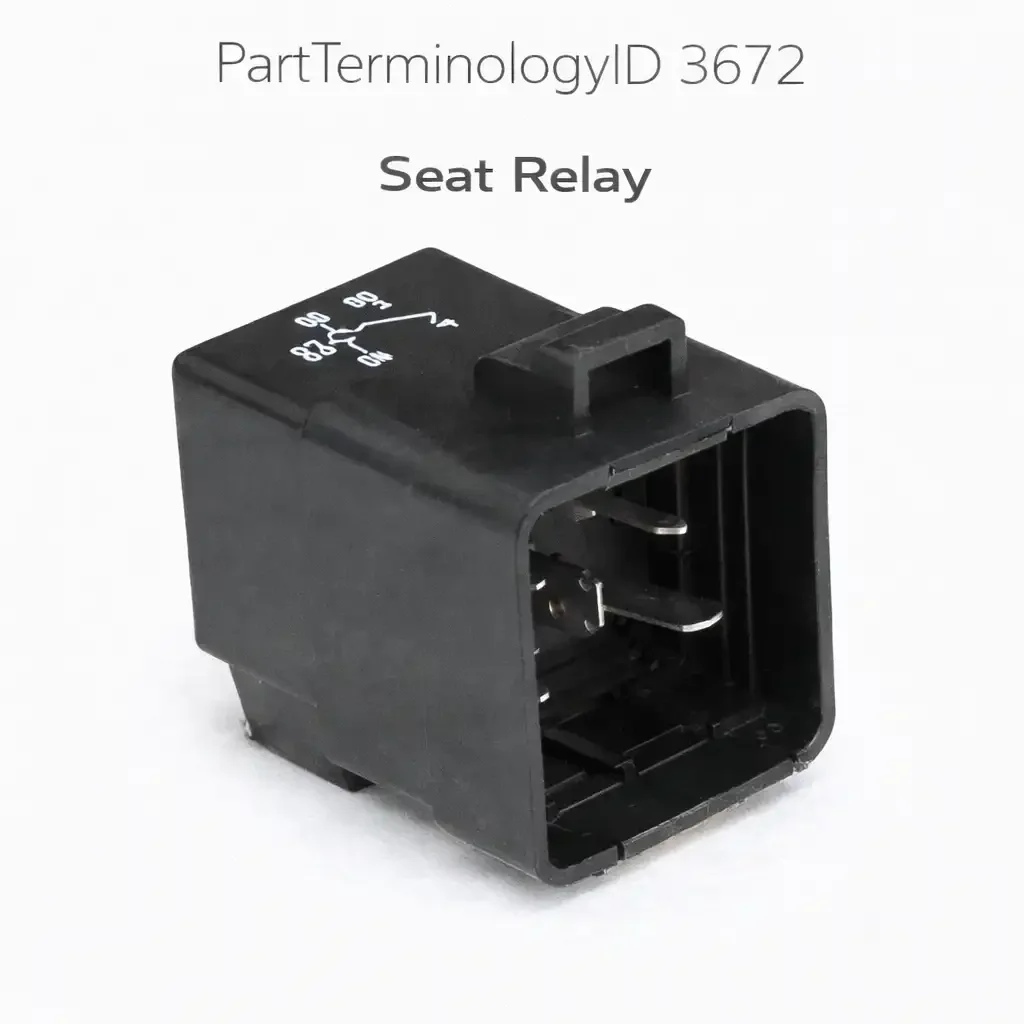
The Seat Relay, cataloged under PartTerminologyID 3672, supplies or gates the main power feed to the power seat circuit on vehicles where seat motor operation is controlled through a dedicated relay rather than switched directly through the seat adjustment switches or a seat control module. The relay coil is typically energized by an ignition-switched or accessory-switched signal, meaning the seat motors receive power only when the ignition is in the run or accessory position. When the relay fails open, the seat loses all function in every direction simultaneously, because the entire seat motor circuit is starved of its supply voltage upstream of the switches and motors.
The Seat Relay is a circuit-level supply relay, not a motor-direction relay. It does not reverse polarity to drive a motor in two directions. It does not control individual adjustments such as fore-aft, height, recline, or lumbar independently. Its job is to allow or prevent current from reaching the seat circuit at all. A vehicle where one seat adjustment works and another does not is almost never a seat relay problem. A vehicle where the entire seat is completely dead with no response in any direction is the diagnostic profile that legitimately implicates this relay.
What the Relay Does
Main Power Gating
On platforms that use a seat relay, the relay sits between the fused battery or accessory supply and the upstream feed point of the seat adjustment switch assembly. When the ignition is in the correct position and the relay coil receives its trigger signal, the relay closes and supplies voltage to the seat switch. The switch then routes that voltage to the appropriate motor in the correct polarity for the requested movement. If the relay is open, the switch receives no supply voltage, and no motor can run regardless of switch condition.
This architecture appears most commonly on vehicles where the OEM engineers wanted to prevent seat operation with the ignition fully off, while still allowing operation in the accessory position. It also provides a single point of overcurrent protection upstream of the multiple motor circuits, and it keeps high-current motor loads off the ignition switch contacts. On the Chrysler Crossfire, for example, a single seat relay in the dashboard fuse panel controls the power supply for both front power seats, and a failed relay results in total loss of seat adjustment on both sides simultaneously.
On platforms with more than one seat relay, the relay for the driver seat and the relay for the passenger seat are typically separate components. Total loss of one seat with the other unaffected points to the relay, fuse, or wiring for the affected seat. Total loss of both seats simultaneously on a dual-relay platform points to a shared fuse or a shared power feed rather than both relays failing at once.
Relationship to the Seat Switch and Seat Motors
The seat adjustment switches on most power seat systems are relatively high-current components by switch standards, because they pass motor current directly. On simple two-way and four-way systems without a seat control module, the switch routes battery voltage in one polarity to run the motor forward, and reverses polarity to run it backward. These switches are rated for the motor current and are considerably heavier duty than a typical lighting switch. The seat relay upstream of the switch does not carry motor current in all configurations; on some platforms it carries only the supply leg to the switch, and on others it carries the full motor current.
On vehicles with a seat control module or memory seat module, the seat relay relationship to the circuit changes. The module may have internal relays that handle motor direction switching, with the seat relay providing supply voltage to the module. A failed seat relay on a memory seat platform starves the module of its supply, and the module cannot command any motor movement. The symptom is the same as relay failure on a simple circuit, but the seat relay is now one component in a more complex architecture.
Ignition Interlock Function
Many seat relay applications exist specifically to interlock seat operation with ignition state. The relay coil is connected to an ignition-switched or accessory-switched feed, meaning the relay only closes when the key is in the appropriate position. This prevents the seat from being adjusted when the vehicle is fully off, which avoids battery drain from an accidentally held seat switch, and prevents children or passengers from operating the seats without the driver's awareness. On these platforms, a seat that was working with the ignition on but now does not respond at all should be checked for ignition switch output voltage at the relay coil circuit before the relay is condemned, because loss of the coil trigger signal produces identical symptoms to a failed relay coil.
Top Return Scenarios
Blown Fuse Misidentified as Relay Failure
The seat relay fuse and the seat relay occupy adjacent positions in the diagnostic hierarchy, and buyers frequently skip the fuse check and order the relay. On most platforms, the power seat circuit is protected by a 20 to 30 amp fuse or a resettable circuit breaker. If the fuse is blown, the relay has no supply voltage on its load side, and seat operation is totally lost regardless of relay condition. If the circuit breaker has tripped and reset itself, the seat may have been intermittently inoperative before failing completely.
A blown seat fuse points to an overcurrent event in the seat motor circuit, which most commonly means a seat motor that has stalled against a mechanical obstruction, a seat motor with failing winding resistance drawing excess current, or a short circuit in the harness under the seat. Replacing the relay on a blown-fuse fault accomplishes nothing. The new relay will function exactly the same as the old one because the fuse protects the load side of the relay, and if the fuse is blown, neither the old relay nor the new one can supply the seat circuit. Listing content that directs buyers to check the fuse before ordering the relay prevents this return category almost entirely.
Seat Switch Failure Presenting as Total Loss
A seat adjustment switch that has failed with all of its contacts open produces the same symptom as a failed seat relay: the seat does not move in any direction. Buyers who encounter this symptom and research the seat circuit learn that a relay is in the circuit, conclude the relay is the fault, and order it without testing the switch. The relay is replaced, the switch is still open, and the seat still does not move.
On simple power seat circuits without a seat control module, the switch is the more common failure point by a significant margin compared to the relay. Switch contacts corrode, especially on seats that are adjusted infrequently and on vehicles in humid climates. The switch mechanism can develop internal failures from wear or contamination. Testing the switch by checking for supply voltage at the switch input with the ignition on and the relay installed, and then checking for output voltage at the switch output while holding the adjustment button, separates switch failure from relay failure with two multimeter probe placements.
Harness Damage Under the Seat
The wiring harness that runs to a power seat travels across the floor and through a flexible section at the seat mounting rail, where it is exposed to mechanical stress from seat adjustment movement, foot traffic, and vacuum cleaner damage. Chafed insulation in this harness creates intermittent and permanent short circuits that blow fuses and can present as total seat loss. Water intrusion under the seat from wet boots, spilled drinks, and flooded floor areas corrodes connector pins and causes open circuits in the harness.
A buyer whose seat stopped working after a specific event such as heavy rain, a drink spill, or a long period of non-use is more likely dealing with a harness or connector problem than a relay failure. A relay does not corrode from water intrusion in its circuit. It fails from contact wear or coil degradation, which typically occurs gradually rather than suddenly after a moisture event. A sudden onset seat failure that correlates with a moisture event should prompt inspection of the under-seat harness and connectors before the relay is ordered.
Memory Seat Module Fault on Equipped Vehicles
On vehicles with memory seat systems, the seat relay supplies the control module rather than the switch directly. A failed memory seat module on these platforms produces total seat loss because the module controls all motor outputs, and a module that has lost power, lost ground, or developed an internal fault cannot command any movement. The relay on these platforms is healthy and supplying voltage to the module, but the module is not producing outputs.
Buyers with memory seat systems who experience total seat loss frequently encounter the seat relay in their research and order it as the most accessible and affordable component in the circuit. When the relay replacement does not restore function, they return it and move on to the module, which was the actual fault. Listing content that distinguishes between simple seat circuits and memory seat circuit architectures, and identifies the module as the first suspect on memory seat platforms, reduces this return category.
Intermittent Fault Caused by Relay Socket Corrosion
A relay that functions correctly when probed on the bench but produces intermittent seat operation in the vehicle is almost never a relay coil or contact failure. It is a relay socket contact problem. The relay socket pins in the fuse block or relay panel develop corrosion and fretting over time, especially in vehicles that experience temperature cycling and humidity exposure. The relay body seats in the socket loosely enough that vibration causes momentary loss of contact, and the seat adjustment works sometimes and fails at others.
Cleaning the relay socket terminals with electrical contact cleaner and a small pick, or applying dielectric grease to the relay pins, resolves this class of fault without replacing the relay. A buyer who replaces the relay but reuses a corroded socket will find that the new relay performs identically to the old one because the fault was in the socket rather than the relay. Listing content that acknowledges socket corrosion as a common cause of intermittent seat relay symptoms protects the buyer from an unnecessary purchase.
Listing Requirements
Every listing for PartTerminologyID 3672 should include:
ACES fitment data verified to year, make, model, body style, and seat equipment level, because the seat relay is not present on all power seat applications and is absent on vehicles where seat switches carry motor current directly or where seat control modules handle all switching internally
The relay body format, pin count, coil voltage, and contact current rating for each application, because a seat relay that does not physically fit the relay socket or whose contact rating does not match the seat motor load will fail prematurely or not seat correctly
A note that total loss of all seat adjustments simultaneously is the correct diagnostic profile for this relay, and that partial seat loss or single-function failure in one direction is not consistent with supply relay failure
A note that the seat fuse or circuit breaker is the first check before relay diagnosis, and that a blown fuse indicates a downstream overcurrent fault that must be located before replacing any relay
A note that switch testing for supply voltage in and signal out separates switch failure from relay failure before the relay is ordered
A statement that this relay is sold as a standalone component and does not include the seat adjustment switch, seat control module, seat motors, or seat harness
Frequently Asked Questions
My power seat is completely dead. Does that mean the relay has failed?
Total seat loss is consistent with relay failure, but it is equally consistent with a blown fuse, an open seat switch, a failed seat control module on memory seat platforms, or an open circuit in the seat harness. Verify that the fuse is intact before doing anything else. If the fuse is good, check for supply voltage at the relay load terminal with the relay installed and the ignition on. If supply voltage is absent at the load terminal but present at the relay supply terminal, and the relay coil is receiving its trigger signal, the relay has failed open and replacement is indicated. If supply voltage is present at the load terminal but the seat does not move, the fault is downstream of the relay.
My seat worked intermittently for a few weeks and then stopped completely. Is this the relay?
Intermittent progression to total failure is more commonly associated with switch contact degradation, seat motor winding resistance increase, or relay socket corrosion than with relay coil or contact failure. Check the relay socket terminals for corrosion before replacing the relay body. If the socket is clean and the relay is not clicking when the ignition is on and the trigger circuit is energized, the relay coil has likely failed and replacement is warranted. If the relay clicks but the seat does not move, the switch or motor is the fault.
Both my front seats stopped working at the same time. Do I need two relays?
Simultaneous total loss of both front seats is more likely caused by a single shared fuse or a common power feed failure than by both seat relays failing simultaneously. Check the fuse that protects the seat circuit first. On platforms like the Chrysler Crossfire where a single relay supplies both seats, one relay replacement covers both seats. On platforms where each seat has its own relay, simultaneous relay failure in both is improbable, and a shared upstream fault is the correct starting point for diagnosis.
What Sellers Get Wrong
Listing the relay as the solution to any dead seat
A listing that positions the seat relay as the answer to any power seat that does not work without qualifying the specific symptom profile drives orders from buyers whose fault is in the fuse, switch, motor, or harness. The seat relay is implicated only when total seat loss is present with a good fuse and a confirmed relay coil trigger signal that is not producing relay closure. A listing that describes this diagnostic profile accurately attracts buyers who have done the work and confirmed the relay is the fault, which is the buyer who will keep the part.
Not distinguishing simple circuits from memory seat circuits
A seat relay listing that does not acknowledge the difference between a simple switch-to-motor circuit and a memory seat module circuit will attract buyers on memory seat platforms whose module is the fault. The relay on a memory seat platform is not the probable fault for total seat loss. The module is. A listing that acknowledges this distinction and directs memory seat platform buyers to verify module function before ordering the relay prevents the return before it happens.
Omitting the fuse check as the first diagnostic step
The seat fuse check is the single most valuable sentence in a seat relay listing description. A blown fuse is more common than a failed relay and costs nothing to verify. Every listing that does not mention fuse verification as the first diagnostic step accepts the return rate from buyers who replaced a relay on a blown-fuse fault.
Not addressing socket corrosion for intermittent complaints
Intermittent seat operation is the symptom profile most commonly associated with relay socket contact degradation rather than relay failure. A listing that does not distinguish between intermittent and total-loss profiles, and does not acknowledge socket corrosion as a cause of intermittent symptoms, will see returns from buyers with corroded sockets who replaced the relay body and found no improvement.
Cross-Sell Logic
Seat adjustment switch (the most common cause of total seat loss on simple power seat circuits without a control module, and the component that should be tested for supply and output voltage before the relay is ordered)
Seat motor or seat track motor (the most common cause of a blown seat fuse, a single-function seat failure, or a seat that moves slowly and weakly in one or both directions)
Seat control module or memory seat module (the primary fault suspect for total seat loss on memory seat platforms, where the relay supplies the module rather than the switch directly)
Seat fuse or circuit breaker (the first check before any relay diagnosis, and a blown seat fuse indicates a downstream overcurrent fault that requires identification before any replacement)
Under-seat wiring harness or pigtail (the component most vulnerable to flex-zone chafing, moisture damage, and vacuum cleaner contact, and the correct replacement when a harness short has caused repeated fuse failure)
Relay socket or relay base (the replacement when socket pin corrosion is identified as the cause of intermittent relay contact, rather than relay body failure)
Final Take
PartTerminologyID 3672 covers a straightforward component in a circuit that is frequently misdiagnosed from the symptom end rather than the electrical end. The seat relay is a supply gate. When it fails, everything downstream of it stops working at once. That symptom profile is clear and specific, and a buyer who has confirmed a good fuse, verified that the relay coil is receiving its trigger signal, and found that the relay is not closing has done legitimate diagnosis that leads to a legitimate relay order.
The return exposure in this category comes almost entirely from the fuse skip and the switch skip. Buyers who see a dead seat, find a relay in the circuit, and order the relay without checking the fuse or the switch are the majority of the returns in this category. Listing content that names both checks explicitly and explains what each result means transforms a speculative order into a confirmed one. That is a small investment in description copy that pays back at the return counter repeatedly.
The memory seat platform distinction is secondary but worth including, because memory seat buyers who expect a relay to fix a module fault will return promptly and leave a frustrated review. Acknowledging the architecture difference in the listing shows technical competence and sets accurate expectations. Buyers who read that copy and realize they are on a memory seat platform will appreciate the guidance and redirect their diagnosis before placing an order they will regret