
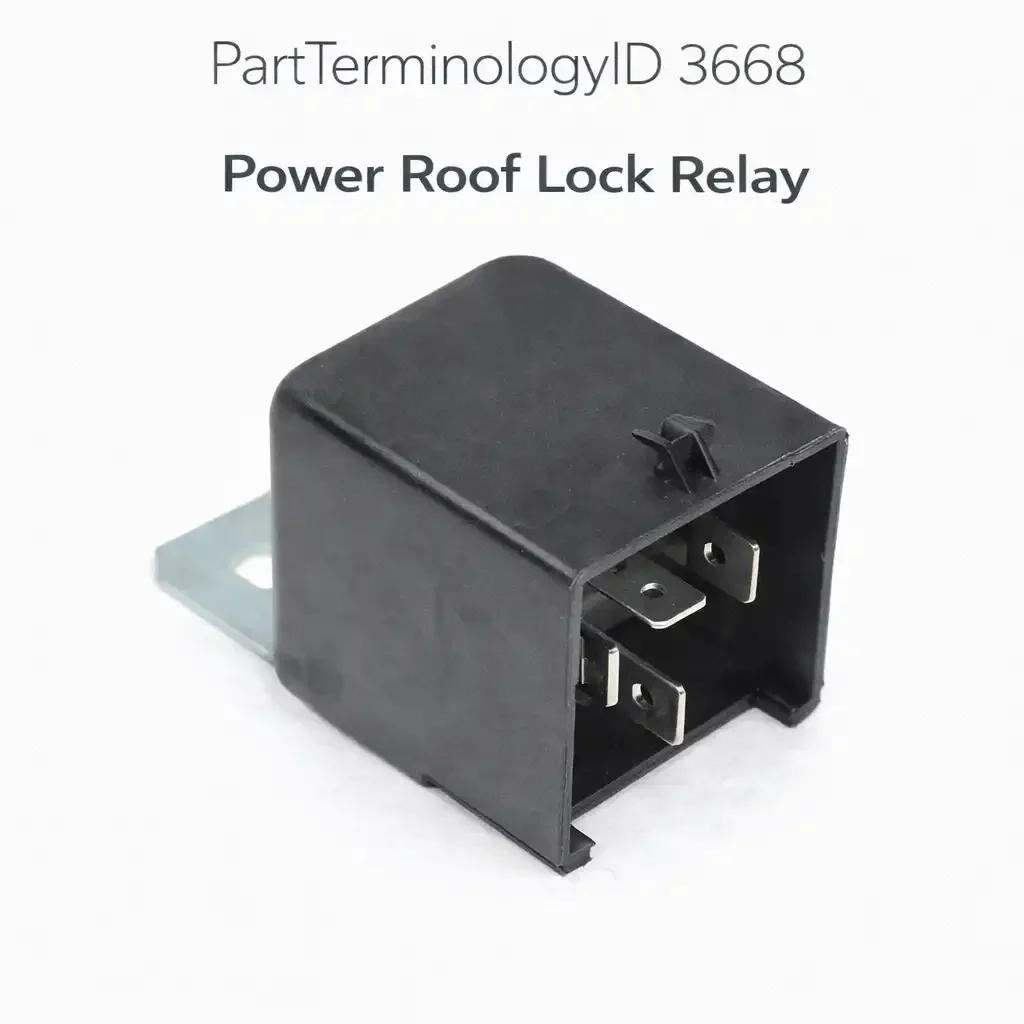
The Power Roof Lock Relay, cataloged under PartTerminologyID 3668, controls the electric motor that drives the header latch mechanism on power convertible top systems. When a convertible top reaches the closed position against the windshield header, the roof lock relay energizes the header latch motor, which extends the latch hardware to mechanically engage the striker on the windshield frame and pull the roof bow tight against the header seal. The reverse sequence occurs when the driver initiates the top-open cycle: the relay energizes the motor in the opposite direction, retracting the latch to release the roof bow before the top fold mechanism begins to move. If the latch does not fully engage or fully release before the convertible top module proceeds to the next step, the module halts the entire cycle and sets a fault.
This relay is specific to vehicles with motorized header latch systems, meaning convertibles where the windshield header latch opens and closes under power rather than by manual lever or T-handle. These applications include the Chrysler Sebring and 200 convertible from the mid-2000s through the early 2010s, the Ford Mustang convertible across several generations where the Smart Junction Box commands top-related relays, the MINI R52 convertible, the BMW Z4 (E85/E86/E89), the VW New Beetle convertible, and other European and domestic convertibles that integrate electric latching into their power top sequences.
The relay's position in the circuit makes it an easy target for speculation when the top halts mid-cycle, because buyers see the fault and know there is a relay involved somewhere. The harder diagnostic truth is that the relay is the smallest probability fault in a mid-cycle halt. The header latch motor, the latch position switch, the control module, and the harness flex zone wiring are all more common failure points, and all of them produce symptoms that look identical to a relay failure without relay testing to separate them.
What the Relay Does
Latch Motor Power Switching
The header latch motor is a small reversible DC motor, identical in principle to a door lock actuator, window regulator motor, or seat track motor. It runs in one direction to extend the latch into the engaged position, and in the opposite direction to retract the latch for release. The power roof lock relay, or the relay pair associated with this circuit, handles the polarity switching that enables this bidirectional operation in the same way the door lock relay handles it for door lock actuators.
On Chrysler Sebring and 200 convertible applications, the header latch motor is mounted in the header panel above the windshield, typically behind the sun visor trim. It drives a gear mechanism that extends and retracts latch hooks on both sides of the header simultaneously through a rod linkage. The relay that powers this motor is part of the power top control module circuit and is commanded by the convertible top module (CTM) after it confirms that all prerequisite conditions are met: windows down, tonneau position correct, vehicle speed below threshold, and the prior sequence step completed.
On Ford Mustang convertible applications, the top raise and top lower relays are mounted in the Smart Junction Box (SJB) or Bussed Electrical Center (BEC), and they control the motor/pump assembly that drives all top movements including the header latch. The latch switch feeds back to the SJB to confirm latch state before the SJB allows or halts the next sequence step.
On MINI R52 convertible applications, a dedicated roof locking mechanism relay, part number 61361388911, sits in the fuse and relay panel and supplies the latch actuator motor that runs independently of the main hydraulic roof motor. On BMW Z4 platforms, the latch-related relays are part of the convertible top module architecture and the module coordinates sequencing through position sensor feedback.
Sequencing and Safety Logic
What distinguishes the power roof lock relay from most other relay categories is that its command is never a simple switch press. The relay coil is not triggered by the driver pressing the top switch directly. Instead, the convertible top module or SJB evaluates a sequence of sensor states and only issues the relay command when all prerequisite inputs are in the correct state. The sequence for opening a typical power top with an electric header latch looks roughly like this: driver presses open switch, module confirms vehicle speed below threshold, module commands windows to lower, module receives confirmation from window position sensors that windows are fully down, module commands header latch relay to energize, header latch motor extends to release, module receives confirmation from latch position switch that latch is fully released, module proceeds to command top fold actuator.
If the latch position switch does not confirm release, the module does not issue the fold command, the top halts, and the driver sees a fault indicator. The relay may have energized perfectly. The motor may have run completely. The latch may have moved but the latch position switch may have failed to detect the movement, or the latch may have moved partially because the motor is weak or the gear mechanism is worn. In any of these scenarios, the fault display and halted top sequence are identical from the driver's perspective, but only one of them implicates the relay.
Relationship to the Full Convertible Top Circuit
The power roof lock relay is one component in a circuit that also includes the convertible top pump relay or motor relay, the tonneau cover relay, the window lower relay, and various position switches and sensors. A fault in any of these components can prevent the top from completing its cycle. The sequence-based logic that the top module uses means that a fault anywhere upstream in the sequence prevents all downstream steps from occurring. A failed window lower relay that prevents the windows from descending will prevent the top module from ever issuing the latch release command, because the latch step does not begin until the window step is confirmed complete. A buyer who observes that the top halts before the header latch moves and orders a power roof lock relay has not necessarily identified the correct fault: the fault may be in the window circuit that should have completed before the latch relay was commanded.
Top Return Scenarios
Header Latch Motor Failure Misidentified as Relay
The header latch motor is the highest-probability fault in the power roof lock circuit across the platforms where this relay is cataloged. On Chrysler Sebring and 200 convertibles, the header latch motor is a documented high-failure component. The motor drives a plastic gear mechanism that degrades with age and use, and the motor windings can develop high resistance over time, causing the motor to run slowly and incompletely. When the motor does not extend the latch far enough to trigger the latch position switch, the convertible top module halts the sequence and reports a latch fault. The relay has likely energized correctly. The motor received power and ran. But the motor is too weak to complete the travel.
Buyers who observe the fault code, research the latch circuit, and learn there is a relay involved frequently order the relay before confirming whether the motor received power and ran during the failed attempt. On Sebring platforms specifically, field experience from technicians and owners alike points strongly to the header latch motor as the primary fault, and the relay as the secondary check once the motor is confirmed functional. A buyer who replaces the relay on a Sebring with a weak header latch motor will find that the relay was not the fault.
Latch Position Switch Failure
Every motorized header latch system includes at least one position switch that confirms the latch has fully engaged or fully released. The convertible top module requires a confirmed signal from this switch before it will proceed to the next sequence step. A latch position switch that has failed, corroded, or shifted out of alignment will not send its confirmation, the module will halt the sequence, and the top will stop mid-cycle.
Latch position switch failure is a far more common fault than relay failure on these systems. On the VW New Beetle convertible, field reports consistently identify the F202 limit switch at the right side header latch as the most common cause of a top that halts during the latch or unlatch step. On Chrysler convertible platforms, the header latch limit switch is the first component the service manual directs the technician to evaluate after fuse and code confirmation. On Ford Mustang convertibles, the latch switch state is a prerequisite input that the SJB reads before issuing top movement commands. In all of these cases, replacing the relay without confirming the latch position switch state and wiring will not resolve a limit switch fault.
Upstream Sequence Fault Preventing Latch Command
On all platform architectures that use sequenced top operation, a fault in any prior step prevents the relay from ever receiving its command. The most common upstream fault that prevents the power roof lock relay from being commanded is a failed or improperly initialized rear window. Ford Mustang convertible platforms require the rear windows to be fully down before the SJB will issue top movement commands. A rear window motor that has failed, a rear window that lost its initialization after a battery disconnect, or a rear window position sensor that is not reading correctly will prevent the SJB from issuing any top commands, including the latch relay command. The top appears completely inoperative. No relays click. Nothing moves.
Buyers who observe total top inoperability and order the power roof lock relay because it is the latch-specific component have not diagnosed which step in the sequence has failed. Checking the sequence from the first step — windows, then latch, then top fold — and identifying which step first fails to produce the expected result is the diagnostic approach that locates the actual fault.
Water Ingress into Control Module or Position Switches
Convertible tops by definition separate from the vehicle body, and the control electronics and position switches in the top circuit are often located in areas that are exposed to water intrusion from a leaking top seal, a clogged drain, or a failed grommet in the trunk or header panel. The convertible top module, position switches, and wiring connectors in the trunk and door pillar areas are all documented water ingress failure points on BMW Z4, MINI R52, Chrysler Sebring, and Ford Mustang platforms.
Water in the module can cause it to send incorrect commands or no commands. Water in position switch connectors causes intermittent or permanent loss of latch position confirmation. Water tracking along harness wires can cause short circuits that set fault codes for latch circuits even when the latch motor and relay are both functional. A buyer experiencing intermittent top operation that worsened after a rain event, or a top that stopped working after the vehicle was washed or parked in standing water, is very likely dealing with water damage to the module or switches rather than relay failure.
Battery Voltage Loss and Module Initialization
Many convertible top modules lose their position calibration after a battery disconnect or a low-voltage event. The module uses position memory to know where the top components are in their travel range, and a lost calibration causes the module to halt cycles because it cannot confirm the starting position. On MINI R52 and BMW Z4 platforms, a battery disconnect requires a specific reinitialization procedure before the top will operate correctly. On Ford Mustang platforms, the rear window motors require reinitialization after a battery disconnect for the SJB to recognize their position.
A buyer whose top stopped working after a battery replacement or after the vehicle sat for an extended period and the battery discharged may be experiencing an initialization fault rather than a hardware failure. Attempting the manufacturer's module reset or top reinitialization procedure before ordering any parts eliminates this class of fault. The relay is not involved in initialization and replacing it will have no effect on an initialization fault.
Listing Requirements
Every listing for PartTerminologyID 3668 should include:
ACES fitment data verified to year, make, model, and body style, noting that this relay applies only to convertible vehicles with motorized electric header latch systems and does not apply to manual latch convertibles or vehicles with manually-operated T-handle or lever latch releases
A description distinguishing this relay from the convertible top raise and lower relays, because buyers frequently confuse these components when the top halts mid-cycle
The relay body format, coil voltage, and contact current rating for each application, because the header latch motor's current draw must be within the relay's contact rating
A note that the header latch motor is the primary fault source for top halt at the latch step, and that the relay should not be ordered without confirming that the motor is receiving coil trigger voltage but not energizing
A note that latch position switch failure halts the top sequence without relay fault, and that switch state should be verified before the relay is ordered
A note that module reinitialization after battery events may restore top function without any parts replacement
A statement that this relay is sold as a standalone component and does not include the header latch motor, latch position switch, convertible top module, or wiring harness
Frequently Asked Questions
My convertible top stops before the header latch releases when I try to open it. Is the relay the problem?
The top halts at the latch step most commonly because the latch position switch is not confirming latch release, because the latch motor is too weak to complete its travel, or because the relay is not receiving its command from the module. Check whether the relay coil is receiving a trigger signal from the module when the top switch is pressed. If the trigger is present and the relay does not click, the relay coil may have failed. If the trigger is absent, the fault is in the module or the upstream sequence step that prevented the module from issuing the latch command. If the relay clicks but the latch does not move, the motor is the fault or the latch mechanism is mechanically binding.
My top worked yesterday and stopped today. The fault code mentions the header latch. Should I replace the relay?
Intermittent faults on convertible top systems most commonly point to latch position switch contact degradation, water-affected wiring connectors, or a header latch motor that has developed marginal resistance. A relay that fails intermittently is rare compared to these mechanical and sensor causes. Read the fault code to identify which specific step in the latch sequence is failing, check the latch position switch state with a scan tool or by probing the switch signal wire, and inspect the header area for water intrusion before ordering a relay.
My battery was disconnected and now the top won't work at all. Do I need a relay?
Battery disconnection commonly causes loss of module calibration and window initialization on many convertible platforms. Attempt the manufacturer's reinitialization procedure for both the top module and any power windows before diagnosing hardware. On MINI R52 and BMW Z4 platforms this is a documented requirement. On Ford Mustang platforms, rear window reinitialization is required. The relay is unaffected by battery disconnection and replacing it will not restore function if the fault is initialization loss.
What Sellers Get Wrong
Not distinguishing this relay from the top raise and lower relays
The convertible top circuit typically includes multiple relays: one or two for the hydraulic pump or main motor direction, one for the tonneau cover, and one or more for the header latch mechanism. A listing that does not clearly identify which relay in the top circuit it covers will attract buyers whose fault is in the raise or lower relay rather than the latch relay, and vice versa. Buyers who cannot tell from the listing description which relay they are purchasing will order based on guess and return when the guess is wrong.
Presenting the relay as the solution to any top halt fault
A listing that offers the power roof lock relay as the answer to a top that halts at the latch step, without distinguishing between relay fault, motor fault, switch fault, and module fault, drives speculative orders from buyers whose motor or limit switch is the actual problem. The header latch motor on Chrysler Sebring and 200 convertibles is a documented high-failure item that is widely discussed in owner communities. A listing that acknowledges this and directs buyers to confirm motor function before ordering the relay earns trust and reduces returns.
Not acknowledging water ingress as a fault pathway
Convertible top systems are uniquely vulnerable to water intrusion. Listing content that presents the relay in isolation without acknowledging that water damage to the control module, position switches, and harness connectors is a common cause of top faults on these platforms misses the context buyers need. A buyer with water in their top module trunk housing is not going to fix the problem with a relay.
Omitting the sequencing context
The most important piece of diagnostic context for this relay is that the relay is not commanded by the driver's switch press. It is commanded by the control module only after upstream sequence steps are confirmed complete. Listing content that does not explain this leaves buyers without the understanding they need to determine whether the fault is in the relay itself, the upstream sequence, or the module. That confusion produces speculative relay orders that are returned when they fail to restore function.
Cross-Sell Logic
Header latch motor (the highest-probability fault for a top that halts at the latch step on Chrysler Sebring and 200 convertible platforms, and a common failure item on other platforms with motorized header latch systems)
Latch position switch or header latch limit switch (the component that confirms latch state to the control module and the most common cause of a top that halts because the module does not receive latch confirmation, even when the motor and relay have both functioned correctly)
Convertible top module or folding top control module (the logic controller that sequences the entire top operation and issues relay commands; module failure from water ingress or age is a documented fault on MINI R52, BMW Z4, and Chrysler Sebring platforms)
Rear window motor or window regulator motor (on platforms that require windows down as a prerequisite for top operation, a failed rear window motor prevents the module from issuing any top commands including the latch relay command)
Top circuit fuse (the fastest and least expensive component to verify before any relay diagnosis on the power top circuit)
Top seal kit or header seal (water intrusion through failed header seals causes damage to the header latch motor, latch position switches, and wiring connectors in the header area; addressing the water path alongside hardware replacement prevents recurrence)
Final Take
PartTerminologyID 3668 covers one of the more diagnostically complex relay categories in the body electrical catalog. The power roof lock relay is a real and replaceable component, but it exists inside a sequenced, sensor-gated circuit where faults in the motor, the position switch, the harness, the module, or the upstream sequence all produce the same observed symptom as a failed relay: a top that halts at the latch step and throws a latch-related fault code.
On the platforms where this relay is most commonly ordered — Chrysler Sebring and 200 convertibles in particular — the header latch motor is the dominant fault by a significant margin. The motor wears, weakens, and eventually fails to complete its travel. The limit switch that confirms latch engagement is the second most common fault. The relay is a legitimate but secondary fault source, and a buyer who reaches the relay order after confirming that the relay coil trigger is present but the relay is not energizing has done the work that separates their fault from the more common ones.
Sellers who invest in listing content that explains the sequencing architecture, identifies the header latch motor as the primary fault, and gives buyers the one test that separates relay fault from everything else will see dramatically lower return rates than sellers who present this relay as a general top-halt solution. The convertible top buyer population is determined and has often already spent significant money on incorrect diagnoses. A listing that respects that experience with honest diagnostic guidance earns the sale and keeps it.