
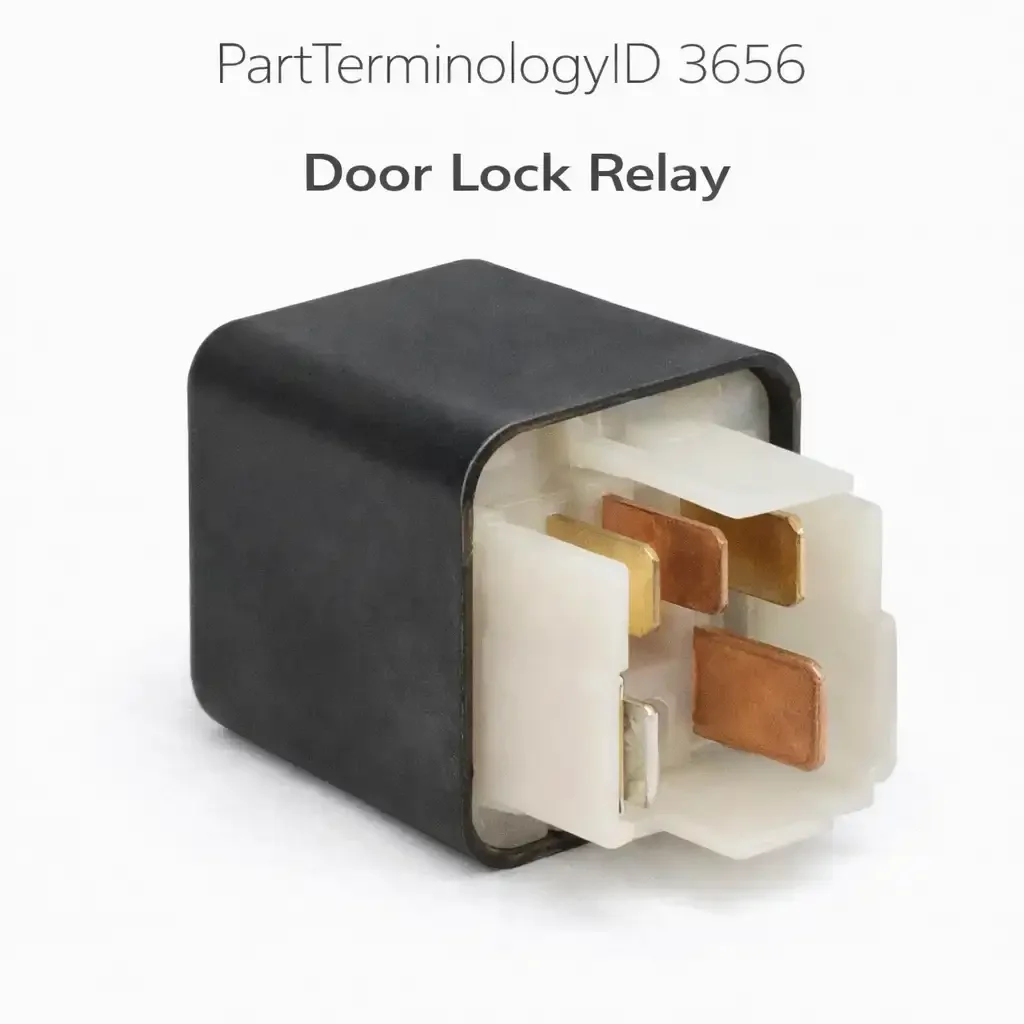
The Door Lock Relay, cataloged under PartTerminologyID 3656, is the electromechanical switching component that supplies power to the door lock actuator motors in a power door lock system. Its defining function is enabling polarity reversal across the actuator: because a door lock actuator motor must run in two directions — one to lock, one to unlock — the door lock circuit requires a switching arrangement that can reverse which wire carries positive voltage and which carries ground. Two relays working in opposition accomplish this. The lock relay energizes to apply positive voltage to one side of the actuator and ground the other, driving the motor in the lock direction. The unlock relay does the opposite. At rest, with neither relay energized, both sides of the actuator sit at ground through the normally closed contacts of both relays, and the motor holds its last position.
This two-relay polarity reversal architecture is one of the most widely implemented relay circuit designs in the passenger vehicle fleet. It appears on vehicles from the late 1970s through the present day, though the architecture of who controls the relay coils has changed substantially across model generations. On older direct-switch systems, the door lock switch itself provides coil voltage or ground to the relay directly. On BCM-controlled systems, the switch sends a signal to the Body Control Module, and the BCM grounds the appropriate relay coil through an internal transistor driver. On the most recent platforms, the relays themselves may be integrated directly into the BCM or the interior junction box, making the relay a non-serviceable portion of a module assembly rather than a standalone replacement component.
Understanding this evolution is the single most important thing a seller in this category can communicate to buyers, because it determines whether a standalone door lock relay is even the right part for the vehicle. A buyer on a 2015 model year vehicle whose door locks have stopped working does not need a relay from a fuse block position. They need a BCM diagnosis or a junction box assembly.
What the Relay Does
Polarity Reversal for Bidirectional Motor Control
A door lock actuator motor is a small reversible DC motor. Apply positive voltage to wire A and ground to wire B, and the motor shaft turns in one direction, driving the lock linkage to the locked position. Reverse the polarity — positive to wire B and ground to wire A — and the shaft turns in the opposite direction, driving the linkage to the unlocked position. This polarity reversal is what the two-relay door lock circuit accomplishes.
In the resting state, both relay coils are de-energized. On each relay, the motor actuator wire connected at terminal 30 passes through to terminal 87a, the normally closed contact, which is tied to ground. Both motor wires are grounded, and no current flows through the motor because both sides of the circuit have the same potential. When the lock relay energizes, its contacts switch from the normally closed ground connection to the normally open contact, which connects the motor's lock-side wire to battery positive. The motor now has battery positive on one side and ground (through the still-resting unlock relay's normally closed contact) on the other. Current flows, the motor runs in the lock direction, and the linkage moves. When the operator releases the switch, the relay de-energizes, both sides return to ground, and the motor stops. The unlock relay works identically in the opposite direction.
This arrangement means the relays are energized only momentarily during each lock or unlock event. They are not under continuous load, which is why door lock relay failure from normal duty cycle wear is far less common than buyers typically assume when their locks stop working.
Who Commands the Relay
The relay coil's command source has changed across vehicle generations, and this is the most practically significant architectural distinction for diagnosis and parts sourcing.
On older vehicles — broadly, those produced before the mid-1990s — a dedicated door lock switch supplies voltage or ground directly to the relay coils. In positive-trigger systems, the switch sends a momentary positive pulse to the coil, which energizes the relay with that pulse as the supply and a chassis ground completing the coil circuit. In negative-trigger systems, the switch sends a momentary ground pulse to the coil, which energizes the relay with a constant positive supply and the switch-provided ground completing the circuit. Either way, the switch is a direct electrical actor in the relay coil circuit, and diagnosing the relay requires checking whether the switch is providing its trigger signal before concluding the relay has failed.
On BCM-controlled systems, which became predominant across domestic and import platforms through the late 1990s and 2000s, the door lock switch no longer directly energizes the relay. Instead, the switch sends a voltage-divided signal to the BCM — often a reference voltage pulled down through resistors of specific values to distinguish lock from unlock inputs — and the BCM interprets that signal and commands the relay by grounding its coil through an internal transistor driver. The relay coil supply voltage still comes from the fuse block, but the ground path runs through the BCM. This means a relay that receives no coil ground signal is not necessarily a failed relay: the BCM may not be commanding it, because the BCM is not receiving a valid switch input, or because the BCM itself has a fault.
On the newest platforms, the relays are integrated as micro-relay elements within the BCM housing or the interior fuse and junction box. In these cases, PartTerminologyID 3656 as a standalone part does not apply, and the repair path requires either module replacement or, where available, junction box relay board service.
Actuator Symmetry and Individual Door Faults
On most BCM platforms, the relay circuit is shared across all doors. The lock relay's output reaches all door actuators in parallel. When the lock relay energizes, all actuators receive the same lock-direction pulse simultaneously. Individual door faults, where one door's lock does not respond while the others work normally, therefore do not implicate the relay. If the relay were the fault, all doors would be affected equally. A single non-functioning door points to a fault between the relay output and that door's actuator: the wiring harness in the door jamb flex zone, the actuator itself, or the actuator connector.
Some BCM configurations add a separate driver unlock relay for the driver's door that allows the keyless entry system to unlock only the driver's door on the first press and all doors on the second. On these platforms, the driver's door may fail to unlock from the key fob while all other doors respond normally, which does indicate a relay fault specific to the driver's unlock relay rather than the global lock relay.
Top Return Scenarios
All Locks Dead: Fuse Ruled Out Too Quickly
The most common configuration that produces a total door lock failure is a blown fuse upstream of the relay supply circuit. Before the relay coil can energize, it must have supply voltage at its coil supply terminal. Before the relay contacts can supply the actuators, the contacts must have battery voltage at terminal 30. Both of these paths are fused. A blown door lock fuse produces a symptom that is electrically identical to a failed relay: no actuator response from any door. The fuse is in the fuse block, the relay is also in the fuse block, and buyers often remove the relay to inspect it while leaving the fuse unchecked.
A fuse is a thirty-second verification that eliminates the relay from consideration for free. Confirming fuse integrity before any other diagnostic step prevents the most common return in this category: a buyer who replaces the relay, finds the fuse was the fault, and returns the relay unused.
Single Door Failure Misrouted to Relay
A buyer whose driver's door lock does not respond, while all other doors respond normally, has identified a fault that the relay cannot explain. The lock relay's output reaches all actuators simultaneously. If three doors lock and unlock correctly, the relay is confirmed functional for the lock direction. If three doors unlock correctly, the unlock relay is confirmed functional. The single unresponsive door has a fault in the wiring between the relay output and that actuator, in the actuator itself, or in that door's actuator connector.
The most common fault location for a single door that has stopped responding after working previously is the door jamb wiring harness. This harness passes through a rubber bellows or grommet at the door hinge, and the individual wires within it flex every time the door is opened or closed. Over years of operation, the wires fatigue at the bend point and develop internal opens or intermittent contacts. The symptom is a door lock that works sometimes, stops working after the door has been opened and closed a certain number of times, or works only when the door is held at a particular angle. None of these symptoms are consistent with relay failure.
Buyers who have pulled the door panel, observed that the actuator appears to function when bridged directly with a jumper wire, and concluded the relay must not be supplying power to that door have actually confirmed that the actuator is good and that the fault is in the wiring between the relay and the actuator. This narrows the fault to the harness, not the relay.
BCM Command Absent on BCM-Controlled Platforms
On vehicles where the BCM commands the relay coil ground, a relay that receives no coil ground signal will never energize regardless of its own condition. A buyer who observes no relay clicking and no actuator response, pulls the relay and bench-tests it by applying 12 volts to the coil terminals and sees the contacts change state, has confirmed the relay is functional. The relay was never energizing because the BCM was not providing the coil ground.
The next diagnostic question is why the BCM is not commanding the relay. If the BCM is not receiving a valid input from the door lock switch, the switch or its signal circuit is the fault. On BCM systems that use a reference voltage signal, the BCM applies a small voltage to the switch circuit and monitors the voltage level: zero volts means lock, a specific mid-range voltage through a resistor means unlock, and the reference voltage returned intact means no switch input. A failed switch, a corroded switch connector, or a broken wire in the switch signal circuit will prevent the BCM from seeing a switch input and therefore prevent the BCM from commanding the relay.
If the BCM is receiving valid switch inputs, visible in scan tool live data when the switch is operated, but still not commanding the relay coil, the BCM's internal transistor driver for the relay coil circuit has failed. This is a BCM fault, not a relay fault. Replacing the relay in this scenario produces no change because the replacement relay also receives no coil ground from the BCM.
Relay Confirmed Functional, Actuator Blamed on Relay
A buyer who applies power and ground to the actuator connector directly and observes no actuator movement has identified actuator failure. A buyer who applies power and ground to the actuator and observes it responding has confirmed the actuator works and the fault is in the circuit that should be supplying it. Neither finding implicates the relay directly without a relay coil trigger test confirming whether the relay is receiving its command signal.
Door lock actuator failure is the most common single-component fault in a power door lock system. The actuator motor and gear assembly cycles every time a door is locked or unlocked, through thousands of operations over a vehicle's life. Actuator failure is significantly more frequent than relay failure, and a buyer who skips actuator testing and orders a relay based on a non-functioning door lock is more likely to have the actuator at fault than the relay.
Aftermarket Alarm or Remote Start Installation Interference
Aftermarket remote start and alarm systems connect into the door lock relay circuit to enable keyless entry and automatic locking functions. Installers typically splice into the relay coil trigger wires or connect to the relay's output wires to tap lock and unlock signals. A poorly executed installation can introduce ground faults in the relay circuit, short the relay coil trigger to a wrong potential, or create a path that prevents the relay from de-energizing properly. A buyer whose door locks stopped working or began behaving erratically after an alarm or remote start installation has a strong diagnostic signal pointing to the installation rather than to the relay.
Disconnecting the aftermarket module and testing whether door lock function returns to normal separates an installation problem from a relay or BCM fault. If locks return to normal with the aftermarket module disconnected, the installation wiring is the fault. The relay in this scenario is not the fault and replacing it will not help.
Listing Requirements
Every listing for PartTerminologyID 3656 should include:
ACES fitment data verified to year, make, model, and body style, distinguishing between applications that use a fuse block-mounted standalone relay, applications where the relay is integrated into the BCM or junction box and not a standalone serviceable component, and applications where the relay is mounted in or near the door
A clear statement that the door lock system uses two relays for full lock and unlock function, and a description of which relay the listing covers: the lock relay, the unlock relay, or a matched pair
The relay body format, coil voltage, coil trigger type (positive-triggered or negative-triggered), and contact current rating for each application, because door lock systems use both positive-pulse and negative-pulse trigger architectures and a buyer ordering the wrong trigger type will find the relay does not respond to the switch in their vehicle
A note that single-door failures do not implicate the relay, since the relay supplies all doors simultaneously
A note that confirming fuse integrity and relay coil trigger signal presence are the two tests that must precede any relay order
A note that on BCM-controlled platforms, absent relay operation with a confirmed-functional relay indicates a BCM fault or switch signal circuit fault rather than a relay fault
A statement that this relay is sold as a standalone component and does not include the door lock actuator, BCM, switch assembly, or wiring harness
Frequently Asked Questions
My door locks stopped working on all doors at the same time. Is the relay the problem?
Total failure across all doors points first to the fuse. A blown fuse produces identical symptoms to a failed relay and is confirmed or eliminated in seconds. Check the fuse before pulling the relay. If the fuse is intact, check whether the relay coil is receiving its trigger signal when the lock or unlock switch is pressed. If no trigger signal is present, the fault is in the switch, the switch signal circuit, or the BCM. If a trigger signal is present and the relay does not click and energize, the relay coil is likely failed and relay replacement is appropriate.
My driver's door won't lock from the switch or fob, but all other doors work. Do I need a relay?
If the other doors respond correctly, the lock and unlock relays are confirmed functional. A single door failure points to the harness in that door's jamb, the actuator in that door, or the actuator connector. Start by checking the harness at the door hinge flex point for broken wires, then confirm actuator function by applying power and ground directly to the actuator terminals. The relay is not the appropriate first order for this complaint.
My locks worked from the fob but now neither the fob nor the door switch works. What changed?
A loss of response to both the fob and the switch simultaneously, when both worked before, suggests a fuse or a BCM fault. The fob communicates through the BCM or a dedicated keyless entry module, and the door switch also signals through the BCM on most modern platforms. If both inputs now produce no response, the BCM's relay command output or its power supply may have failed, or the relay supply fuse has blown. Check the fuse, then use a scan tool to confirm whether the BCM is receiving switch inputs and issuing relay commands.
Can I test the relay before installing it?
Yes. Apply 12 volts to the coil terminals and check for continuity change across the contact terminals with a test light or multimeter. The relay should click audibly and the normally open contact should show continuity when the coil is energized. If the relay clicks on the bench but does not respond in the vehicle, the fault is in the trigger circuit that should be energizing the coil, not in the relay itself.
Are the lock relay and unlock relay the same part?
On many applications, the lock relay and unlock relay are identical components mounted in adjacent fuse block positions. Either can fail independently. Before ordering, determine which direction has failed: if locks work but unlocks do not, the unlock relay is the fault. If neither direction works and the fuse is intact, both relays may need evaluation, or the fault may be in the coil trigger circuit upstream of both relays.
What Sellers Get Wrong
Not distinguishing standalone relay applications from integrated relay platforms
Late-model vehicles frequently integrate the door lock relay elements into the BCM or interior junction box rather than providing them as standalone fuse block components. A listing that applies PartTerminologyID 3656 to these platforms generates orders from buyers who pull their fuse block looking for a removable relay that does not exist as a separate component. When no standalone relay is found, the buyer either returns the relay immediately or installs it incorrectly in an unrelated fuse block position and is confused when it has no effect. Verifying at the application level whether the platform uses a standalone relay or an integrated relay, and restricting listings to standalone relay applications, prevents this class of fitment error entirely.
Listing only one relay when the system requires two
The door lock system requires both a lock relay and an unlock relay for complete function. A listing that covers only the lock direction may attract buyers whose unlock direction has failed, and vice versa. Where applications use a matched pair, listing the pair together or clearly identifying which directional relay the single listing covers prevents the buyer from ordering one relay when they need the other, finding that their specific failure mode is not corrected, and returning the relay.
No mention of fuse and trigger signal verification
A listing that presents the door lock relay as the solution to any door lock failure without directing buyers to check the fuse and relay coil trigger signal first generates returns from buyers whose fuse was blown or whose switch circuit was the fault. These returns require no relay at all to correct. A single sentence directing buyers to check the fuse and confirm coil trigger voltage before ordering eliminates the largest single source of returns in this category.
Omitting trigger polarity from the listing
Door lock relay circuits operate on either positive-trigger or negative-trigger coil architectures depending on the platform. A relay ordered for a positive-trigger application installed in a negative-trigger application will not respond to the switch, even if everything else in the circuit is functional. The coil trigger architecture should be specified in the listing for every application, especially for sellers who stock both types without distinguishing them clearly in the catalog.
Ignoring door jamb harness as the primary single-door fault source
A listing that does not acknowledge the door jamb harness as the most common cause of single-door failure will attract buyers who have correctly isolated the fault to one door but have not yet identified the harness break as the cause. These buyers order the relay because it is the most visible switching component they know of, install it, observe no change, and return it. Including a note that single-door failures almost never implicate the relay and are most commonly caused by broken wires in the door hinge harness saves these returns and builds credibility with buyers who are troubleshooting methodically.
Cross-Sell Logic
Door lock actuator (the highest-probability fault for a single non-functioning door after the harness flex zone has been ruled out, and a frequent co-failure on high-mileage vehicles where the actuator gear train has worn out)
Door jamb wiring harness or body-to-door pigtail (the correct replacement for broken wires in the door hinge flex zone, which is the most common cause of a single door failing to respond after the relay and fuse have been confirmed good)
Door lock switch (the component that initiates all door lock function and the fault source when the relay coil receives no trigger, on platforms where the switch provides the trigger directly)
BCM or body control module (on BCM-controlled platforms, a BCM whose internal transistor driver has failed will not command the relay regardless of switch input; BCM evaluation follows confirmed-functional relay and confirmed-present switch signal)
Relay fuse (the first component to verify before the relay, and a separate part that is faster and less expensive to rule out)
Door lock relay pair (on applications where both the lock and unlock relay are the same component and failure of one suggests the other may follow, listing the pair together gives buyers a complete system restoration option)
Final Take
PartTerminologyID 3656 occupies a high-volume position in the relay catalog because power door lock failure is among the most frequently reported convenience complaints across the entire vehicle fleet. The relay is a real failure mode, and it is a legitimate part to stock and list. The diagnostic problem is that relay failure is far less common than the other failure modes that produce the same symptom: blown fuses, broken harness wires in the door jamb flex zone, failed actuators, absent BCM command signals, and aftermarket alarm wiring interference. A buyer who replaces the relay without working through these other fault sources first is unlikely to have found their fault.
The most important thing a door lock relay listing can do is give the buyer enough diagnostic clarity to know, before ordering, that the relay is actually their problem. That means prompting them to check the fuse, confirm the relay coil trigger is present when the switch is pressed, and rule out single-door harness or actuator faults. Buyers who arrive at the relay order after completing those steps have confirmed the relay is their fault. They install the replacement, their doors lock, and they do not return the part.
The listing that generates those buyers also needs to be honest about platform architecture. On older vehicles with fuse block-mounted standalone relays, PartTerminologyID 3656 is the right starting point. On modern vehicles where the relay is a micro-element inside the BCM or junction box, the standalone relay listing does not apply. Fitment data that acknowledges this distinction keeps buyers on the right path and keeps return rates manageable in a category that is otherwise prone to speculation-based ordering.