
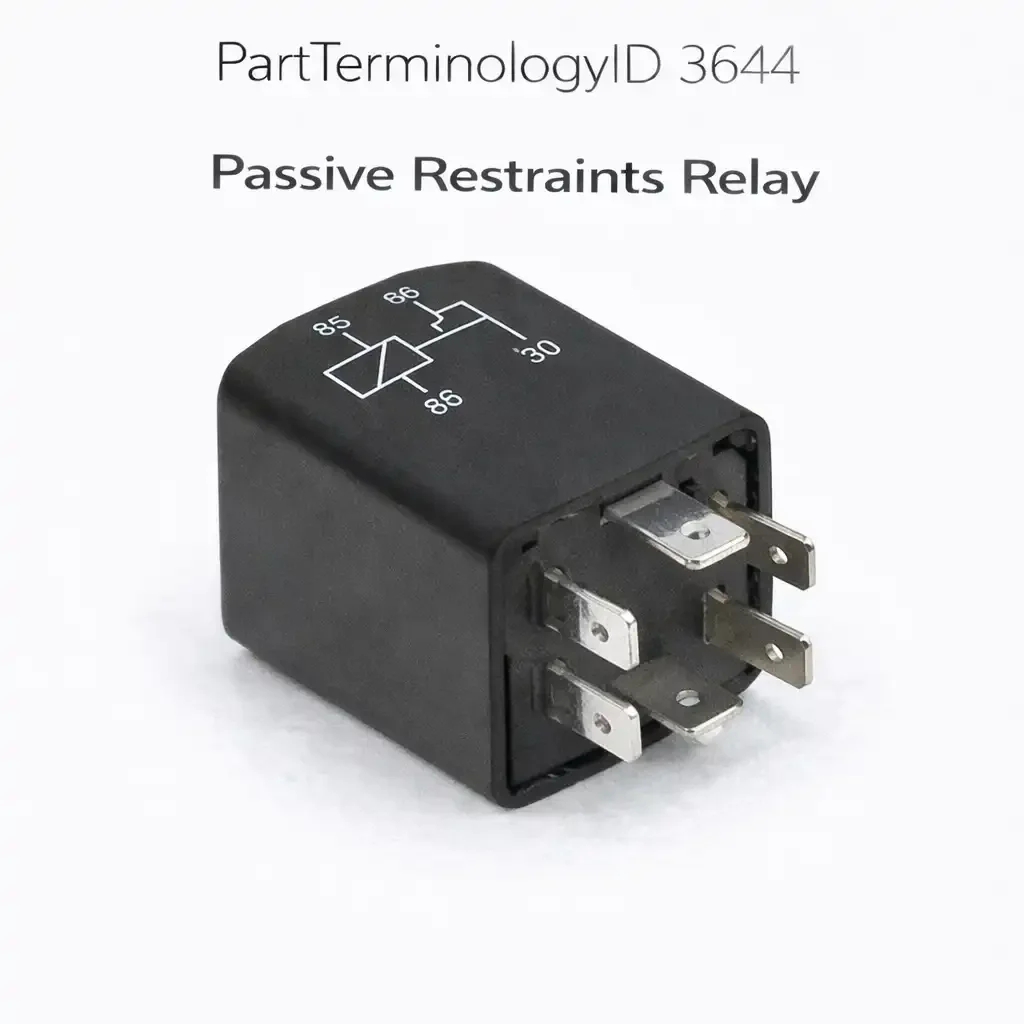
The Passive Restraints Relay, cataloged under PartTerminologyID 3644, is a motor control relay used in vehicles equipped with motorized automatic seatbelt systems. These systems were installed on a wide range of domestic and import passenger vehicles between approximately 1987 and 1994, during the window when federal passive restraint rules required occupant protection that could be provided by automatic belts rather than airbags. The relay supplies switched power to the seatbelt drive motor and, on platforms that use a dedicated relay rather than an integrated passive restraint module, controls which direction the motor runs based on whether the door has been opened or closed.
PartTerminologyID 3644 covers a narrow vehicle population. Motorized automatic seatbelts were largely eliminated from new vehicles by 1995, when driver airbags became mandatory and most manufacturers stopped equipping vehicles with belt motor systems. The vehicles this relay serves are now 30 years old or older, which has direct implications for diagnosis: the relay itself is rarely the fault. Wiring harness degradation, connector corrosion, door ajar switch failure, and track limit switch failure are far more common causes of inoperative automatic seatbelt systems on these vehicles than relay failure.
What the Relay Does
Motor Power Switching
The passive restraints relay supplies ignition-switched power to the seatbelt drive motor that moves the shoulder belt anchor along the roof rail track. On systems with a motorized shoulder belt, the motor runs in one direction to move the anchor forward when the door opens, allowing the occupant to enter or exit without ducking under the belt, and in the opposite direction to move the anchor rearward when the door closes, bringing the shoulder belt across the occupant's torso into the restrained position.
The relay is positioned in the power path between the ignition-switched supply fuse and the motor. When the relay contacts are open, no power reaches the motor and the belt stays in its current position. When the relay is energized, power flows to the motor and the anchor moves. On platforms that use a dedicated passive restraints relay alongside a separate control module, the module interprets the door ajar switch state and commands the relay accordingly. On simpler platforms, the relay may be controlled more directly from the door ajar switch circuit without a separate logic module.
Direction Control Architecture
A seatbelt motor that runs in two directions requires two relays or a relay with a more complex switching arrangement. On many platforms, two separate relays handle motor direction: one relay energizes to run the motor in the forward direction, moving the anchor to the open position, and a second relay energizes to run the motor in the return direction. Only one relay is active at a time. PartTerminologyID 3644 may refer to either the full relay set for the passive restraint motor circuit or a specific directional relay within that circuit, depending on how the vehicle manufacturer structured the part application.
On Ford Thunderbird and Mercury Cougar platforms from the late 1980s and early 1990s, a dedicated Passive Restraint Module mounted in the trunk coordinates the door ajar switch inputs for both the driver and passenger sides and commands the respective belt motors. The relays in this circuit work in conjunction with that module. On Honda Accord and Honda Civic platforms from the same era, the seatbelt relay may be mounted near the fuse block under the dash or within the door-mounted rail assembly itself, and the circuit includes limit switches at both ends of the track that cut motor power when the anchor reaches either travel extreme.
Ignition and Door Ajar Inputs
The passive restraint system activates on ignition-on events with door state change. When the ignition is switched on with the door already closed, the belt moves to the restrained position if it is not already there. When the door is opened with the ignition on, the belt retracts to the open position. When the door closes, the belt returns to the restrained position. The relay is the switching element that carries the motor current once the control logic determines that motor movement is appropriate. If the control logic does not receive a valid door state signal, or if the ignition supply to the relay coil is absent, the relay will not energize and the belt will not move.
Top Return Scenarios
Door Ajar Switch Failure Misidentified as Relay
The door ajar switch is the input that tells the passive restraint control circuit whether the door is open or closed. Without a valid door state signal, the system does not know when to move the belt and the motor stays still. The door ajar switch is a mechanical contact that is opened and closed every time the door is operated, making it one of the highest-cycle components in the passive restraint circuit. On 30-year-old vehicles, door ajar switch contacts are frequently corroded, worn, or misaligned from door hinge sag.
The symptom of a failed door ajar switch is a belt that does not move at all, or one that moves at unexpected times, such as moving to the open position without the door being opened. A buyer who observes that the belt does not move assumes the relay has failed and orders a replacement. The relay is installed. The door ajar switch is still providing no valid signal, or a false signal. The belt still does not move correctly. The relay is returned. Confirming that the door ajar switch provides a correct signal state change when the door is opened and closed, before ordering a relay, separates this fault from a relay fault.
Track Limit Switch Failure
Each end of the motorized belt track has a limit switch that cuts motor power when the belt anchor reaches its travel extreme. When the forward limit switch opens, the motor stops and the belt rests in the open position. When the rearward limit switch opens, the motor stops and the belt rests in the restrained position. A failed limit switch can produce several symptoms depending on which switch is affected and how it fails.
If a limit switch fails open, the motor may never receive the signal to stop, causing it to run against the mechanical stop and eventually stall the motor or blow a fuse. If a limit switch fails closed, it may prevent the circuit from recognizing that the anchor has reached that end of the track. Some buyers interpret a belt that runs to one end of the track and stops but refuses to return as a relay fault, reasoning that the relay responsible for the return direction is not functioning. If the return direction relay receives no coil trigger because the limit switch that initiates the return command is failed, replacing the relay will not change the outcome. The limit switch is the fault.
Passive Restraint Module Failure
On platforms that use a dedicated Passive Restraint Module, the module receives door ajar switch inputs and commands the directional relays. A failed module may stop commanding either relay, stop commanding one directional relay, or command relays at the wrong time. A belt that worked previously and suddenly stops moving on a platform with a known-good relay and a known-good door ajar switch has likely experienced module failure.
On Ford Thunderbird and Mercury Cougar platforms, replacing the Passive Restraint Module with a used unit from a salvage vehicle is a documented repair because new modules are no longer available. The relay itself is significantly easier and less expensive to replace than the module, which leads to buyers ordering the relay first in hope that it is the fault. When the relay replacement does not restore function, the module is the fault that should have been diagnosed first. Bench-testing the relay independently before installation, by applying coil voltage and checking for contact continuity, confirms relay function and eliminates it from the fault list before the module is considered.
Age-Related Connector Corrosion
At 30 or more years old, the wiring harness connectors on passive restraint systems are frequently corroded at the relay socket, at the door ajar switch connector, at the motor connector, and at any inline connectors in the belt track harness. Corroded connectors can produce high resistance that prevents the relay coil from receiving enough voltage to energize, prevents the motor from receiving enough current to run, or creates intermittent signal loss in the door ajar switch circuit.
A buyer who notices that a belt operates intermittently, or that it began failing after the vehicle sat unused for an extended period, is likely dealing with connector corrosion rather than a failed relay. Cleaning the relay socket terminals and all connectors in the passive restraint circuit harness before ordering replacement parts resolves a significant portion of intermittent belt complaints on these vehicles without any parts replacement at all.
Listing Requirements
Every listing for PartTerminologyID 3644 should include:
ACES fitment data verified to year, make, model, and body style, noting that passive restraint relay applications are almost entirely confined to the 1987 to 1994 model years
A clear description stating that this relay serves the motorized automatic seatbelt system, so buyers on vehicles with manual belts or airbag-only passive restraint do not order incorrectly
The relay body format, pin count, and coil voltage for each application
A note that the door ajar switch and track limit switches are higher-probability fault sources than the relay on these aged vehicles
A note that the Passive Restraint Module, where present, should be evaluated when relay replacement does not restore function
A statement that connector corrosion in the harness is a common cause of intermittent belt operation on vehicles of this age and should be addressed before parts replacement
A statement that this relay is sold as a standalone component and does not include the Passive Restraint Module, belt track assembly, door ajar switch, or wiring harness
Frequently Asked Questions
My automatic seatbelt stopped moving. Is the relay the most likely fault?
On a vehicle this age, no. The door ajar switch is the highest-probability fault because it cycles every time the door is used and is exposed to the door jamb environment for decades. The track limit switches at both ends of the belt rail are the next most likely fault. Harness connector corrosion is also common. The relay itself is a stationary component with sealed contacts and is less prone to age-related failure than the mechanical switches and connectors in the system. Check fuse condition, door ajar switch signal, and connector cleanliness before ordering a relay.
The belt moves to the open position when the door opens, but it won't return when the door closes. Does that mean the return-direction relay failed?
Possibly, but the more likely cause is that the return-direction coil trigger is not reaching the relay. If the door ajar switch is providing a correct closed-door signal and the Passive Restraint Module is not issuing the return command, the module is the fault. If the module is issuing the command but no trigger voltage reaches the relay coil, the fault is in the wiring between the module and the relay coil terminal. Confirming that trigger voltage is present at the relay coil when the door is closed is the step that determines whether the relay or the upstream trigger circuit is the fault.
Can I test the relay off the vehicle before installation?
Yes. Apply 12 volts to the coil terminals and check for contact continuity change with a test light or multimeter. A functional relay will click audibly and the contacts will show continuity change between the energized and de-energized states. This bench test confirms whether the relay is operational before it is installed in a circuit where other fault sources may prevent it from functioning even if it is good.
What Sellers Get Wrong
Applying this relay to vehicles with airbag-only passive restraint systems
By the early 1990s, many manufacturers were satisfying the passive restraint requirement with driver airbags rather than motorized belts. A buyer on a 1992 vehicle that came with an airbag and manual belts does not have a passive restraints relay in their vehicle at all. Fitment data that is sloppy at the body style or trim level will pull in these buyers. Motorized belt applications need to be confirmed at the trim and option level, not just at the year, make, and model level, because the same model year vehicle was often available in both airbag and motorized belt configurations.
Not acknowledging the age of the vehicle population
Listing content that presents the passive restraints relay as a routine replacement part without acknowledging that the vehicles it serves are 30 or more years old misses the diagnostic context these buyers actually need. These buyers are often troubleshooting a system that no mechanic under 40 has ever worked on, with a circuit that no scan tool will read codes for, on a vehicle that has been sitting in a driveway for years. The listing that acknowledges this context and directs buyers toward the actual high-probability fault sources earns trust and reduces returns from buyers who replaced the relay and found the door switch or module was the fault.
Cross-Sell Logic
Door ajar switch (the highest-probability fault source for a belt that does not move, given the mechanical duty cycle and age of these vehicles)
Track limit switches (both ends of the motorized belt rail, relevant when the belt moves in one direction only or runs against the mechanical stop)
Passive Restraint Module (the logic controller that commands directional relays on Ford Thunderbird, Mercury Cougar, and other platforms with a dedicated control module in the circuit)
Fuse and relay socket cleaning kit (corrosion at the relay socket terminals and harness connectors is a documented cause of intermittent belt operation on aged vehicles and is often resolved without parts replacement)
Seatbelt track assembly (on platforms where the entire motorized rail assembly is the replacement unit rather than individual circuit components)
Final Take
PartTerminologyID 3644 serves one of the narrowest vehicle populations in the relay catalog: a specific window of 1987 to 1994 passenger cars equipped with motorized automatic shoulder belt systems. These vehicles are now well into collector and survival territory, and the buyers looking for this part are often troubleshooting a system they have never worked on before, on a vehicle that has sat long enough for every connector in the passive restraint harness to develop corrosion.
The relay is a legitimate fault source, but it is not the first place to look. The door ajar switch, the track limit switches, the Passive Restraint Module, and the wiring harness connectors are all more probable fault sources on a vehicle of this age. A listing that acknowledges this honestly, walks the buyer through what to check first, and helps them confirm relay fault before ordering will generate far fewer returns than one that simply presents the relay as the solution to any belt-related complaint. The buyer who orders this relay already knowing the relay is the confirmed fault is the buyer the listing needs to attract.