
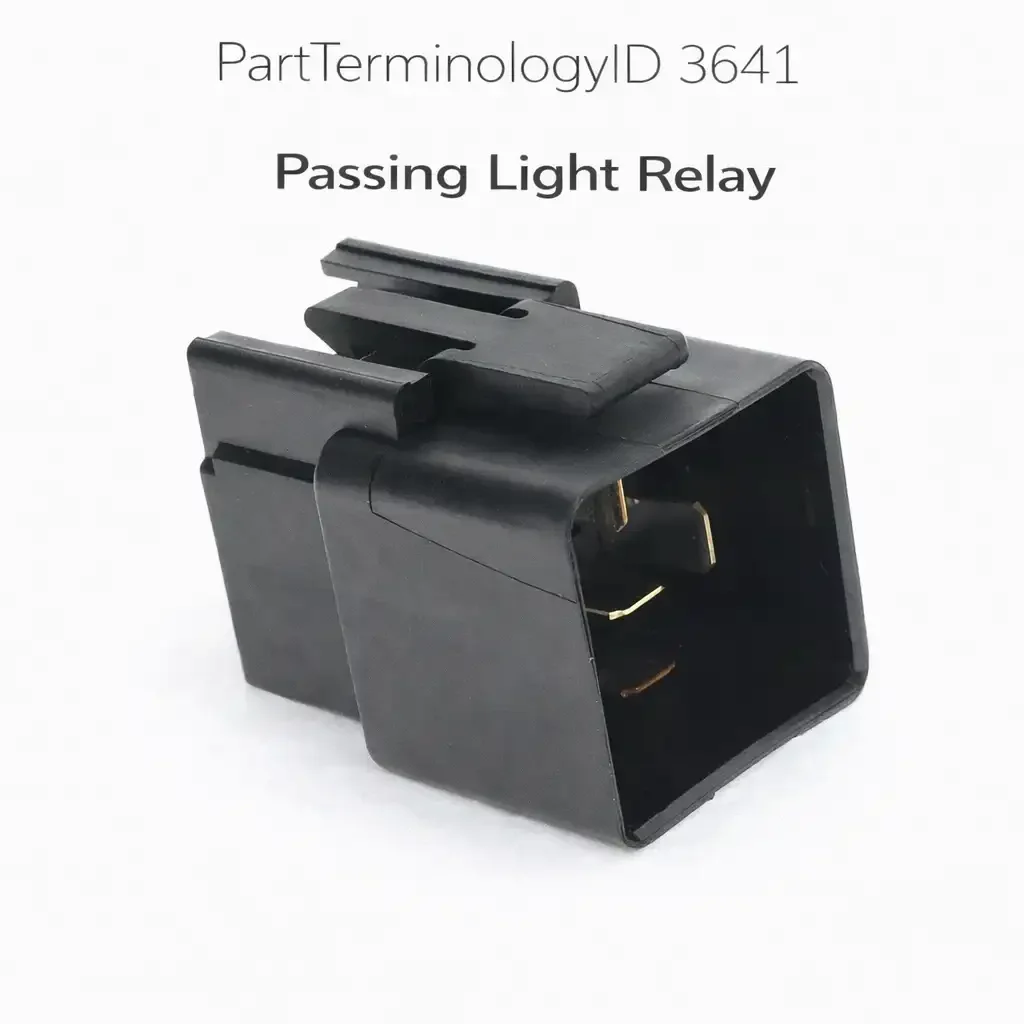
The Passing Light Relay, cataloged under PartTerminologyID 3641, controls the momentary high beam activation commonly known as flash-to-pass. When the driver briefly pulls the turn signal stalk toward the steering wheel, the passing light circuit activates the high beam headlamps for as long as the stalk is held, then returns the headlamps to their previous state when the stalk is released. This function operates independently of whether the headlamp switch is in the on position: on most platforms a driver can flash high beams in daylight with the headlamp switch off because the passing light circuit has its own supply path separate from the normal headlamp on/off circuit.
On platforms that use a dedicated passing light relay, the relay sits in the fuse block and provides the high current switching that the stalk switch's momentary contact cannot safely handle directly. The stalk switch's flash-to-pass contact is a low-current signal path, and the relay converts that signal into a high-current supply to the headlamp high beam filaments. On BCM-equipped platforms, the stalk's momentary contact sends a signal to the BCM, and the BCM commands either the high beam relay or a dedicated passing light relay to energize for the duration of the stalk input. On older direct-switch platforms without a BCM, a separate dedicated passing relay may exist alongside the main high beam relay to handle the momentary-only circuit.
What the Relay Does
Momentary High Beam Supply
The passing light relay's function is identical in principle to any other lamp supply relay: its contacts close when the coil is energized, supply voltage reaches the high beam filaments, and the lamps illuminate. What distinguishes it from the high beam relay is the trigger architecture. The high beam relay's coil is triggered by a latched switch position, meaning the driver moves the stalk to the high beam position and it stays there until deliberately moved back. The passing light relay's coil is triggered by a momentary contact that is active only while the stalk is physically held in the flash-to-pass position. The moment the driver releases the stalk, the trigger disappears and the relay de-energizes.
On platforms where the passing light circuit shares the high beam relay rather than using a dedicated relay, the high beam relay receives two separate trigger paths: one from the latched high beam switch position and one from the momentary flash-to-pass contact. Either path can energize the relay, but they originate from different switch contacts inside the stalk assembly. This means a fault that disables flash-to-pass without affecting normal high beam operation almost always indicates a failed momentary contact inside the stalk rather than a relay fault, because the relay itself is demonstrably functional when high beams latch on normally.
Circuit Architecture Variations
On GM platforms from the late 1990s through the mid-2000s, the BCM receives the flash-to-pass input as a momentary ground signal from the dimmer switch stalk and responds by commanding the high beam relay coil for the duration of that input. The relay itself may be the same physical component as the high beam relay, with the BCM managing which trigger condition it responds to. On Ford platforms from the same era, the combination switch provides a momentary high signal to the BCM in flash-to-pass mode, and the BCM's response energizes the appropriate relay.
On older platforms without a BCM, a dedicated passing relay may occupy its own fuse block position and receive its coil trigger directly from the flash-to-pass contact in the stalk assembly. These platforms have independent relay circuits for latched high beams and momentary passing lamps, and a fault in one does not affect the other. A buyer on one of these platforms who finds that flash-to-pass works but latched high beams do not, or vice versa, has a fault in the specific circuit that is absent, not a fault in the shared components.
Relationship to High Beam Relay
On platforms that use a single relay for both latched high beams and flash-to-pass, the relay itself is not the first diagnostic target when flash-to-pass stops working while latched high beams continue to function normally. The relay is clearly operational in that scenario because it is correctly responding to one of its two trigger paths. The fault is in the momentary contact path that is absent, which is the flash-to-pass contact inside the stalk switch assembly. Replacing the relay when the stalk contact is the fault will have no effect, and the relay will be returned.
On platforms with a dedicated passing light relay, the absence of flash-to-pass function while other headlamp functions remain normal is a more relevant indicator of relay fault, but even on these platforms the stalk's momentary contact is the higher-probability fault because the relay coil and contacts experience significantly less thermal and mechanical stress than the frequently-actuated stalk switch.
Top Return Scenarios
Stalk Switch Contact Failure Misidentified as Relay
The flash-to-pass function requires a momentary contact inside the combination switch or turn signal stalk to close briefly when the stalk is pulled toward the driver. This contact is actuated every time a driver flashes their high beams, which on some vehicles can be dozens of times per day in urban traffic. The contact experiences mechanical wear, heat cycling from the switch housing, and contamination from humidity and dust. Over time it develops increased resistance or stops closing reliably. Flash-to-pass becomes intermittent, then stops working entirely.
The driver notices that flash-to-pass is gone but regular high beams work fine. Without understanding that the two functions use different switch contacts inside the stalk, the buyer concludes the passing light relay has failed. The relay is ordered and replaced. The stalk's momentary contact is still worn out. Flash-to-pass still does not work. The relay is returned. Confirming whether the relay coil receives its trigger signal when the stalk is pulled, by probing the coil trigger terminal with a test light, identifies whether the fault is in the trigger path or in the relay before any parts are ordered.
BCM Command Absent Due to Software or Communication Fault
On BCM-equipped platforms, flash-to-pass function requires the BCM to receive the stalk input signal, interpret it as a flash-to-pass command, and issue the relay coil trigger. A BCM that has experienced a software fault, a lost configuration parameter, or a communication fault on the data bus may stop issuing the flash-to-pass command even when the stalk input is present and the relay is functional. The relay never energizes because the BCM never commands it, not because the relay has failed.
Confirming whether the BCM is receiving the stalk input and issuing the relay command requires a scan tool that can monitor the BCM's input data stream and output commands in real time. If the BCM acknowledges the stalk input but does not issue the relay command, the BCM is the fault. If the BCM does not acknowledge the stalk input, the fault is in the stalk signal circuit between the switch and the BCM. If the BCM issues the relay command but the relay does not energize, the relay coil or its trigger wiring is the fault.
Flash-to-Pass Working, Latched High Beams Not — Relay Ordered Incorrectly
A buyer whose latched high beams have failed but whose flash-to-pass function still works has a fault in the latched high beam trigger circuit, not in the relay. On platforms where the passing light relay and the high beam relay are the same component, the relay is demonstrably functional because flash-to-pass is working. On platforms with separate relays, the high beam relay has failed while the passing light relay remains functional. In either scenario, ordering a passing light relay (PartTerminologyID 3641) when the fault is in the high beam circuit will not resolve the complaint. The buyer should be directed toward the high beam relay or the latched high beam switch position, not toward the passing light relay.
Listing Requirements
Every listing for PartTerminologyID 3641 should include:
ACES fitment data verified at the year, make, model, and headlamp system type level, including whether the platform uses a dedicated passing light relay or routes the flash-to-pass function through the high beam relay
A clear statement that this relay controls the momentary flash-to-pass function, not the latched high beam circuit, so buyers with latched high beam failures are directed to the correct component
The relay body format, pin count, and coil voltage for each application
A note that flash-to-pass failure with functioning latched high beams almost always indicates a stalk switch contact fault rather than a relay fault
A note that confirming relay coil trigger signal is present when the stalk is pulled, before ordering, separates a relay fault from a stalk switch fault
A statement that this relay is sold as a standalone component and does not include the combination switch, stalk assembly, BCM, or wiring harness
Frequently Asked Questions
My high beams work fine when I flip the stalk to high, but flash-to-pass stopped working. Is the relay the problem?
If latched high beams operate normally, the high beam relay and its supply circuit are confirmed functional. Flash-to-pass failure in isolation almost always means the momentary contact inside the combination switch stalk has worn out or corroded. That contact is a separate switch path from the latched high beam contact, and it fails more frequently because it is actuated every time a driver flashes the high beams. Replacing the relay in this scenario will have no effect. The combination switch or stalk assembly is the appropriate replacement.
How do I confirm the relay is the fault before ordering?
With the ignition on and the stalk pulled to the flash-to-pass position, probe the relay coil's trigger terminal with a test light or voltmeter. If the trigger signal is present and the relay does not click and the lamps do not illuminate, the relay coil is the fault. If no trigger signal reaches the coil when the stalk is pulled, the fault is upstream in the stalk switch contact, the BCM, or the wiring between them.
What Sellers Get Wrong
Not distinguishing this relay from the high beam relay in listing content
On platforms where both functions share one physical relay, listing the passing light relay and the high beam relay under separate PartTerminologyIDs without explaining the relationship creates buyer confusion. A buyer who needs a high beam relay and finds the passing light relay listed for their fitment may order the wrong PartTerminologyID. Describing the circuit function clearly, including whether this relay handles flash-to-pass only or both functions, prevents this mismatch.
Omitting the stalk switch as the primary fault source
A listing that presents the passing light relay as the solution to any flash-to-pass complaint without mentioning that the stalk's momentary contact is the higher-probability fault generates relay orders from buyers whose stalks have worn out. Those buyers replace the relay, find the new relay also fails to restore flash-to-pass because the stalk contact is still open, and return the relay. Including a single sentence noting that stalk contact wear is the most common cause of isolated flash-to-pass failure saves these returns.
Cross-Sell Logic
Combination switch or turn signal stalk assembly (the component containing the flash-to-pass momentary contact, and the highest-probability fault when flash-to-pass fails in isolation while other headlamp and turn signal functions remain normal)
High beam relay (on platforms where a dedicated passing light relay exists alongside a separate high beam relay, both components are in the headlamp circuit and may be worth evaluating together when diagnosing headlamp system faults)
BCM or body control module (on BCM-equipped platforms, a BCM fault that prevents flash-to-pass command issuance is the fault path when the stalk signal is confirmed present but the relay receives no trigger)
Headlamp relay fuse (a blown coil supply fuse produces the same no-energize symptom as a failed relay coil at a fraction of the cost; confirming the fuse before ordering the relay is the appropriate first step)
Final Take
PartTerminologyID 3641 is a narrow but diagnostically interesting relay category because the symptom that drives buyers to order it, flash-to-pass not working, is almost never caused by the relay. The flash-to-pass circuit runs through a momentary switch contact that is actuated far more often than any relay coil is energized, and that contact wears out. On platforms where flash-to-pass shares the high beam relay, a functioning high beam circuit is direct evidence that the relay is not the fault. On platforms with a dedicated passing light relay, the stalk contact is still the higher-probability failure.
The listing that performs best in this category is the one that tells buyers to check whether latched high beams work before ordering, explains what a functioning latched high beam circuit tells them about relay condition, and directs buyers with isolated flash-to-pass failure toward the combination switch first. That guidance produces buyers who receive the relay and actually need it, rather than buyers who return it because a worn stalk contact was the fault all along.