
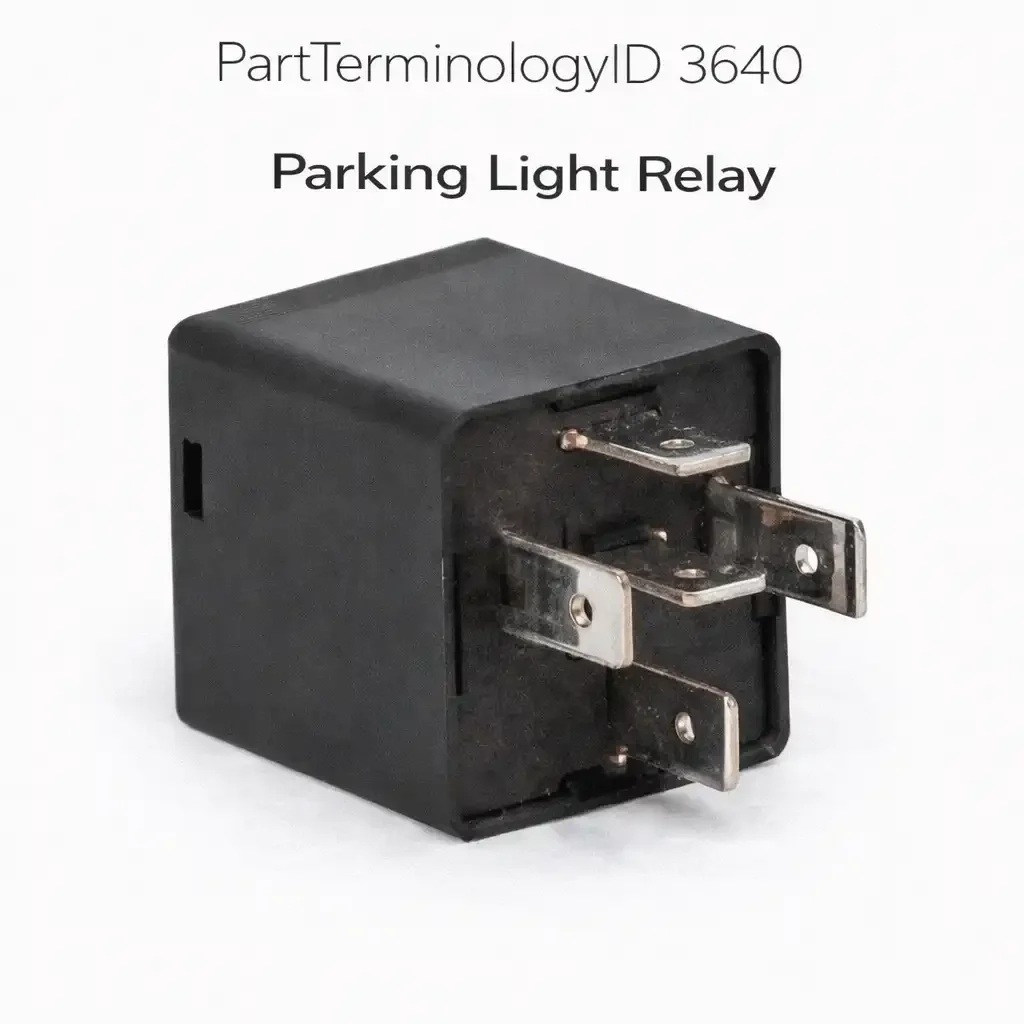
The Parking Light Relay, cataloged under PartTerminologyID 3640, supplies battery voltage to the parking lamp circuit when the driver activates the parking or headlamp switch. Its load encompasses the front parking lamps, rear tail lamps, side marker lamps, and license plate lamps, all of which operate as a coordinated circuit whenever the driver selects the parking lamp position on the headlamp switch. On earlier platforms where the headlamp switch directly routes current through the circuit, the relay amplifies the switch's output current capacity and protects the switch contacts from the full lamp circuit current draw. On BCM-equipped platforms from the mid-1990s onward, the headlamp switch provides only a signal input to the BCM, and the BCM provides the relay coil ground to energize the relay and light the parking lamps. In the BCM architecture, the relay is the only high-current switching component in the parking lamp supply path, and it feeds all downstream lamp fuses and bulbs from a single set of contacts.
The parking light relay is one of the most frequently encountered relay failures in the exterior lighting category because of its load characteristics. It switches battery voltage to a circuit that may include eight or more lamp positions across the full perimeter of the vehicle, drawing current through long wiring runs susceptible to corrosion at lamp sockets and ground points. A single corroded tail lamp socket developing a partial short to ground, or a single incorrect-wattage bulb installed in a parking lamp position, can stress the relay contacts beyond their rating over time. Understanding this relationship between downstream load health and relay longevity is fundamental to accurate diagnosis in this category. Buyers who understand the full circuit before ordering install the relay successfully and do not return it. Buyers who receive only a part number will replace the relay, discover the downstream fault that caused it to fail is still present, and send it back.
What the Relay Does
BCM-Controlled Park Lamp Circuit
On the large majority of vehicles covered by this PartTerminologyID from the mid-1990s onward, the parking light relay sits in the body fuse block or rear electrical center and occupies a labeled position identified in the owner's manual fuse index. The relay coil receives a constant battery supply on one terminal and a BCM-controlled ground on the other. The BCM energizes the relay by providing the coil ground when it receives the park lamp ON command from the headlamp switch. The relay's normally-open contacts then close and supply battery voltage to a set of downstream fuses, each of which protects an individual lamp circuit segment: front park lamps, left rear tail lamp, right rear tail lamp, and license plate lamps may each have their own dedicated fuse downstream of the relay.
This architecture has a diagnostic implication that generates a significant volume of returns in this category: because the headlamp switch is not directly wired to the lamp circuit, a failed headlamp switch that does not send its command signal to the BCM produces the same symptom as a failed relay. The driver turns the switch to the parking lamp position, nothing illuminates, and the relay is the first thing examined because it is the closest high-current component to the lamps. The relay is replaced, the headlamp switch fault persists, the BCM still receives no command, and the new relay also does not energize. Confirming that the relay coil ground terminal receives its BCM trigger before ordering the relay separates a relay fault from a headlamp switch or BCM fault, and that single diagnostic step eliminates the most common return scenario in this category.
On most BCM-equipped platforms the relay coil supply terminal receives battery voltage constantly, waiting for the BCM to complete the ground side of the coil circuit. This design allows the BCM to control the relay with very low current through its output driver. The relay exists precisely because the BCM's output driver cannot directly switch the several amps of combined current that all parking lamps draw simultaneously.
Older Direct-Switch Applications
On earlier applications where the headlamp switch routes current directly rather than through a BCM, the switch provides battery voltage or a ground to the relay coil rather than a signal to a control module. The relay coil energizes whenever the switch is in the park position and the switch's internal contacts are closed, and the relay contacts supply the lamp circuit. On these platforms the switch is the trigger source as well as the first component to check when the relay does not energize: a failed headlamp switch or a fault in the wiring between the switch and the relay coil terminal prevents relay energization regardless of relay condition.
On some older domestic and import platforms, parking lights also function as part of the daytime running lamp circuit, the remote keyless entry confirmation flash circuit, or the turn signal integration circuit. On these platforms the parking light relay may receive trigger inputs from more than one source, and a failure that affects parking lamps in one operating mode but not another points toward the specific trigger source that is absent rather than toward the relay itself. A buyer whose parking lamps fail to flash when the remote key fob is pressed but illuminate normally when the switch is in the park position has a remote entry system fault, not a relay fault. A buyer whose parking lamps illuminate in park position but do not activate as daytime running lamps has a DRL circuit or module fault. In both cases the relay is functioning correctly for the circuit inputs it is receiving, and replacing it would accomplish nothing.
Downstream Fuse Architecture
Most applications route the relay's output through a set of individual fuses before reaching the lamp sockets. This means a blown downstream fuse disables only the lamp circuit segment it protects rather than all park lamps simultaneously. A vehicle with functioning front park lamps but no rear tail lamps has a blown rear lamp fuse rather than a failed relay. A vehicle with functioning rear tail lamps but no front park lamps has a blown front park lamp fuse. A vehicle with no park lamps at all has either a failed relay, a blown upstream fuse that supplies the relay's load terminal, or a coil trigger fault. The symptom pattern, whether all parking lamps are absent or only a subset, is the first diagnostic indicator of whether the relay is the fault or whether the fault is downstream of the relay in one of the individual lamp fuses.
On platforms with a rear-mounted electrical center, the relay and its downstream fuses are typically located in the same box, which makes the relationship between them visible once the fuse block cover is removed. On platforms where the relay is in an underhood fuse block and the downstream lamp fuses are in a separate interior fuse panel, buyers are sometimes unaware that the circuit is split across two locations. A listing that notes where both the relay and the downstream fuses are located for a given platform helps buyers check both before ordering replacement parts.
Contact Rating and Lamp Load Significance
The relay's contact current rating is matched to the anticipated maximum current draw of all parking lamp positions it supplies. On a mid-size domestic sedan with standard incandescent bulbs, the combined front parking lamps, rear tail lamps, side markers, and license plate lamps may draw five to eight amps in normal operation. If the actual load exceeds the rated current because of incorrect-wattage bulbs, downstream shorts, or aftermarket lighting tapped into the parking lamp circuit, the contacts operate outside their rated range on every switching cycle. Over thousands of cycles, the contact surface erodes, intermittent operation develops, and the relay eventually fails completely.
A relay that lasted ten years before failing reached the end of normal contact life. A relay that failed within two years on a well-maintained vehicle was likely subjected to overcurrent, and the downstream circuit should be audited before the replacement is installed.
Top Return Scenarios
Headlamp Switch Fault Misidentified as Relay
The most common misdiagnosis in this category on BCM-equipped platforms is a headlamp switch that has failed to send its command signal to the BCM. The driver turns the switch to the parking lamp position, the BCM receives no command, the relay coil is never triggered, and all parking lamps remain dark. The symptom is visually identical to a failed relay. The buyer replaces the relay, the BCM still receives no switch command, the relay still does not energize, and the relay is returned.
On BCM-equipped platforms, confirming relay coil trigger signal before ordering is straightforward. The relay coil's control terminal should show a ground signal from the BCM when the headlamp switch is in the park position. A test light at that terminal while operating the switch confirms whether the BCM is providing its trigger. If the test light illuminates at the coil control terminal when the switch is placed in the park position, the BCM is providing its trigger and the relay should energize. If the test light does not illuminate, the BCM is not providing the trigger and the fault is upstream of the relay. The next step is to confirm whether the BCM is receiving the park lamp command from the headlamp switch by checking the switch signal circuit at the BCM connector or at the switch itself. On direct-switch platforms, the relay coil supply terminal should show battery voltage when the switch is in the park position. If it does not, the fault is in the switch or the wiring between the switch and the relay.
Downstream Short Causes Relay Contact Failure
A partial short to ground in the wiring downstream of the relay, often caused by a corroded lamp socket, chafed wiring near a grommet or body panel edge, a lamp base corroded into contact with the socket housing, or water intrusion at a rear lamp assembly connector, draws excessive current through the relay contacts each time the parking lamps are activated. Over time this current surge pits and erodes the relay contacts. The driver begins to experience intermittent parking lamp operation, which eventually becomes complete failure when the contacts pit through. The relay is replaced, but the downstream short remains. The new relay also experiences accelerated contact wear if the short is not found and repaired first.
When a parking light relay failure is confirmed, inspecting all lamp sockets for corrosion and socket-to-housing shorts before installing the replacement prevents premature failure of the new component. The most common short locations are rear lamp assemblies on trucks and SUVs, where water enters through cracked lens seals, and front park lamp sockets where road debris has damaged the lens housing. If the downstream fuses blow when the replacement relay first energizes, a short is still present and must be located before the replacement relay is put into service.
Wrong-Wattage Bulbs in Downstream Positions
Parking lamp sockets accept physically compatible bulb bases across a range of wattage ratings, and incorrect-wattage bulbs are commonly installed during routine lamp replacement. A 21-watt bulb in a socket designed for a 5-watt parking lamp draws more than four times the intended current through that circuit segment. Across multiple positions with incorrect bulbs, the cumulative current through the relay contacts can exceed its rating on every activation cycle.
The relay contacts fail from this overcurrent stress over months or a year or two rather than immediately, so the connection between the bulb replacement and the relay failure is rarely apparent to the driver. The relay is replaced without addressing the bulb wattage, and the new relay fails prematurely for the same reason. Checking that all bulbs match the vehicle's specification before installing the replacement relay is a preventive step that costs nothing and directly extends service life.
Blown Downstream Fuse Misidentified as Relay
When one segment of the parking lamp circuit fails because a downstream fuse has blown, a buyer who is not familiar with the relay-and-fuse architecture may conclude the relay has failed rather than checking the individual lamp fuses first. The right rear tail lamps go dark, the buyer opens the fuse block and sees the parking lamp relay, replaces it, finds the rear tail lamps are still dark because the blown segment fuse was never replaced, and returns the relay.
The diagnostic rule is worth stating explicitly in every listing for this category: if some parking lamps work and others do not, the fault is in the circuit segment whose lamps are dark, not in the relay that supplies all segments from a common output. A blown fuse in that segment, a failed bulb in every socket in that segment, a ground fault at the lamp ground splice for that segment, or a break in the wiring feeding that segment are all more likely than a relay fault that selectively disables only one circuit branch. The relay is the appropriate diagnostic target only when all parking lamps fail simultaneously and all downstream fuses are confirmed intact.
BCM Output Driver Fault
On platforms where the BCM provides the relay coil ground, a BCM output driver that has failed open produces the same symptom as a failed relay coil. The relay never energizes because its coil ground is never provided, and all parking lamps are dark. This is a lower-probability failure compared to headlamp switch faults and relay contact failures, but it is genuinely possible on high-mileage vehicles where the BCM has experienced prolonged exposure to voltage spikes from alternator regulation faults, ignition surges, or jump-starting events.
Confirming the BCM fault requires more than confirming that the relay coil trigger is absent. It also requires confirming that the headlamp switch is providing its command signal to the BCM correctly. If the switch is confirmed functional and the BCM still does not provide the relay coil ground when the park lamp command is received, the BCM output driver is the most likely remaining fault. BCM replacement is an expensive step that should only be pursued after the relay, its coil fuse, the headlamp switch, and all relevant wiring have been confirmed as functional. On many platforms, a scan tool connected to the BCM data stream can confirm whether the BCM is acknowledging the park lamp command from the switch, which is the most efficient way to distinguish a BCM fault from a switch fault before committing to either replacement.
Intermittent Operation from Relay Socket Corrosion
A relay whose coil and contacts are fully functional on the bench may perform intermittently in the vehicle if the relay socket terminals have developed corrosion or reduced contact spring tension from age and thermal cycling. The relay blade terminals make contact with the socket terminals under spring pressure, and if that spring pressure is insufficient or the contact surfaces are oxidized, the circuit develops intermittent resistance that causes the lamps to flicker, dim, or fail to illuminate on certain switching events. The driver replaces the relay with a new one, the new relay's blades make better initial contact in the corroded socket, and the lamps work for a period before the socket corrosion again produces intermittent contact.
Cleaning the relay socket terminals with electrical contact cleaner before installing the replacement relay, and confirming that the socket's contact spring clips grip the relay blade terminals firmly when the relay is installed, prevents this failure mode. On vehicles in high-humidity climates or in regions that use road salt, dielectric grease applied to the relay terminals at installation slows subsequent corrosion and extends both relay and socket service life.
Listing Requirements
Every listing for PartTerminologyID 3640 should include:
ACES fitment data verified at the year, make, model, and body style level, with attention to whether the target platform uses a BCM-controlled relay architecture or a direct headlamp switch circuit
Relay body format, pin count, contact current rating, and coil voltage confirmed for each application
The relay's fuse block location designation for each application, including whether the relay is in an underhood fuse block, a rear electrical center, or a body fuse panel, and whether the downstream lamp fuses are in a separate location
A note that all parking lamps failing simultaneously points toward the relay, its supply fuse, or its coil trigger circuit, while only a subset of lamps failing points toward a downstream fuse or a specific lamp circuit fault
A note that the relay coil trigger signal should be confirmed present at the control terminal before ordering the relay on BCM-equipped platforms
A note that downstream lamp sockets and bulb wattage should be inspected before installing the replacement relay to avoid premature contact wear on the replacement
A note that a trailer wiring harness short can stress the relay contacts in the same way a lamp socket short does, and that the trailer harness should be disconnected when diagnosing intermittent relay performance on tow-equipped vehicles
A statement that this relay is sold as a standalone component and does not include the headlamp switch, BCM, downstream lamp fuses, bulbs, lamp sockets, or wiring harness
Frequently Asked Questions
All my parking lights stopped working at once. I checked the fuses and they are fine. Is this the relay?
If all parking lamps failed simultaneously and all individual downstream fuses are intact, the relay is a reasonable diagnostic target. Before ordering, confirm whether the relay coil is receiving its trigger signal when the headlamp switch is in the park position. On BCM-equipped platforms, probing the relay coil's control terminal with a test light or voltmeter while the switch is operated shows whether the BCM is commanding the relay. If the trigger signal is absent, the fault is upstream of the relay in the switch or BCM circuit. If the trigger signal is present and the relay does not click when the switch is operated, the relay coil or its supply fuse is the fault. Replacing the supply fuse first, if it is blown, costs significantly less than the relay and should be confirmed before ordering the relay itself.
My parking lights work fine when I use the headlamp switch, but they don't flash when I lock my car with the key fob. Is the relay faulty?
Parking lamp flash on key fob lock is typically controlled by the BCM or the remote entry module issuing a momentary relay energization command through a separate control path from the headlamp switch command. If the lamps function normally in the headlamp switch position but not in response to the key fob, the relay is functional in the primary circuit. The fault is in the remote entry system's connection to the relay coil control circuit, in the remote entry module itself, or in the remote receiver. Replacing the relay will not restore the key fob flash function because the relay is not the fault in this scenario.
Can a shorted lamp socket damage the relay?
Yes. A lamp socket that is shorting the bulb base to the socket housing or to the vehicle body creates a low-resistance path to ground that draws more current through the relay contacts than the circuit is designed to carry. Each switching event under this condition stresses the contact surfaces with a current surge above the relay's rated capacity. Over time the contacts develop pitting and resistance, producing intermittent lamp operation that eventually becomes a complete failure. Repairing or replacing corroded or shorted lamp sockets before installing the replacement relay is the appropriate corrective step to prevent a repeat failure. If the downstream fuse blows when the new relay first energizes, a short is still present in the circuit and must be located before the replacement relay is put into service.
My parking lights stay on after I turn the headlamp switch off. What causes this?
Parking lamps that remain on after the switch is turned off have one of two causes. On BCM-equipped platforms, the BCM is continuing to command the relay even though the switch input indicates the lamps should be off. This can result from a headlamp switch that is stuck in the park position internally, a wiring fault that is maintaining the switch command signal at the BCM input, or a BCM software fault that is latching the output. On direct-switch platforms, the relay coil is still receiving its trigger signal after the switch is turned off, which points to a switch with failed internal contacts that are not opening when the switch is moved to the off position. On either platform, disconnecting the headlamp switch connector and observing whether the lamps extinguish confirms whether the switch signal is the fault. A relay that has failed with its contacts welded closed would also keep the lamps on regardless of switch position, but contact welding from the external supply side is a much less common failure mode than a stuck-on switch signal.
My vehicle has LED parking lamps installed. Should I expect relay failures to be less common?
LED parking lamps draw significantly less current than incandescent bulbs across most lamp positions. A standard 5-watt incandescent parking lamp draws approximately 0.4 amps at 12 volts. An equivalent LED replacement may draw 0.1 amps or less. Across eight lamp positions, the difference in relay contact current can be three amps or more. This reduced load does extend relay contact life by reducing the current stress on each switching cycle. However, some vehicles use a light-out detection circuit that monitors the current draw from the parking lamp circuit. If the total current drops below the circuit's minimum detection threshold because LED bulbs draw too little current, the system may log a lamp fault code or illuminate a warning indicator even though all the lamps are actually functioning. Confirming compatibility with the vehicle's lamp monitoring circuit before committing to a full LED conversion in the parking lamp positions prevents this complication.
What Sellers Get Wrong
Not explaining the BCM-mediated circuit architecture
A listing that describes the parking light relay as simply a component that turns the parking lights on when the switch is operated does not explain that on most post-1995 vehicles the switch does not directly control the relay at all. The switch sends a signal to the BCM, the BCM decides whether to command the relay, and the relay supplies the lamps. A buyer on a BCM-equipped platform who replaces the relay after a headlamp switch failure will return the relay when the new relay also fails to energize because the switch is still not sending its command to the BCM. Explaining this architecture in the listing, even in a single sentence, gives buyers the context to check whether the coil trigger signal is present before assuming the relay is the fault. That context prevents the most common return in this category and costs nothing to add.
Omitting downstream short and bulb wattage as root causes of relay contact failure
A relay that fails after a relatively short service life on a vehicle that otherwise seems well-maintained has almost always been subjected to overcurrent from a downstream fault. The downstream faults that cause this, corroded lamp sockets developing partial shorts, incorrect-wattage bulbs installed in replacement positions, and aftermarket accessories tapped into the parking lamp circuit without independent fusing, are all undiscovered at the time the relay is ordered because they do not announce themselves with blown fuses or dark lamps. They stress the relay contacts quietly, over months or years, until the contacts fail. Listings that do not mention these root causes miss the opportunity to give buyers the diagnostic information that prevents the new relay from failing for the same reason the original one did.
Treating all parking lamp faults as relay faults
A listing that presents the parking light relay as the solution to any parking lamp complaint, including complaints that are clearly segment-specific failures indicating a downstream fuse or individual lamp fault, trains buyers to order a relay when they need a fuse or a bulb. The buyer returns the relay and carries the impression that the catalog's guidance is unreliable. Listing content that clearly maps symptom patterns to their most likely causes, including the specific symptom patterns that do not indicate a relay fault, builds buyer confidence and reduces the volume of speculative relay orders that generate returns.
Not addressing relay socket condition
Relay socket corrosion is a common cause of both intermittent relay performance and premature failure of replacement relays, particularly on older vehicles in humid or salt-exposure environments. A listing that does not mention relay socket inspection and cleaning as a pre-installation step misses the most common reason a replacement relay performs no better than the one it replaced. Buyers who install a new relay into a corroded socket without cleaning it first will see the same intermittent behavior return within weeks and will attribute it to the replacement relay rather than to the uncleaned socket.
Cross-Sell Logic
Headlamp or parking lamp switch (the component that initiates the park lamp command to the BCM, and the appropriate diagnosis target when the relay coil receives no trigger signal despite the switch being operated; on BCM-equipped platforms this switch is the highest-probability fault when all parking lamps fail simultaneously without prior intermittent behavior)
Downstream park lamp fuses (the set of individual fuses fed by the relay output that protect individual lamp circuit segments; a blown downstream fuse produces a partial lamp failure that does not require relay replacement and is confirmed by checking each fuse position while the relay is known to be energizing correctly)
Parking lamp and tail lamp bulbs (confirming correct wattage across all positions in the parking lamp circuit before relay replacement prevents overcurrent damage to the new relay from incorrect-wattage substitutions; this check costs nothing and takes under five minutes at the lamp sockets)
Lamp socket or bulb holder (corroded or shorting lamp sockets are the most common source of the downstream overcurrent that erodes relay contacts over time; inspecting and replacing corroded sockets at the time of relay replacement is the most effective way to prevent premature failure of the new component, particularly on rear lamp assemblies where water intrusion through cracked lens seals is common on older trucks and SUVs)
Body control module (on BCM-equipped platforms, a BCM output driver that has failed open produces the same symptom as a failed relay and should be considered only after the relay, headlamp switch, coil supply fuse, and all relevant wiring have been confirmed as functional; BCM replacement should follow documented diagnostic evidence, not symptom pattern alone, because the BCM's output driver fault and a failed relay produce identical external symptoms)
Trailer wiring harness or trailer connector (on vehicles with a towing package, the trailer park lamp circuit branches from the parking light relay output through its own fuse; a short in the trailer harness, trailer connector socket, or connected trailer wiring stresses the relay contacts in the same way a lamp socket short does; disconnecting the trailer harness before diagnosing intermittent or failed parking lamp relay performance is an important first step on tow-equipped vehicles, and many towing-package trucks present to the parts counter with parking lamp relay failures that are actually trailer harness short faults)
Final Take
PartTerminologyID 3640 covers one of the highest-transaction relay positions in the exterior lighting category. The relay is a genuine, common failure on high-mileage vehicles, and it is also one of the most frequently wrong-ordered relays in the catalog because the symptom it produces when it fails is identical to the symptom produced by a failed headlamp switch, a blown upstream supply fuse, or a BCM output driver that stopped providing the relay coil ground. Each of these faults produces exactly what the driver sees: darkness where there should be light. The relay gets pulled first because it is visible, accessible, and inexpensive. Whether it is actually the fault depends entirely on whether the buyer has confirmed the relay coil is receiving its trigger signal, the supply fuse is intact, and no downstream short is waiting to destroy the replacement's contacts within a year.
A listing that delivers that diagnostic sequence changes buyer behavior in a measurable way. The buyer who confirms the coil trigger signal before ordering either confirms the relay is the right part or correctly identifies that the headlamp switch is the fault. The buyer who checks lamp sockets before installing the new relay becomes a buyer whose replacement lasts a decade rather than a year. The difference between a category with a high return rate and one with a low return rate is often a single paragraph of circuit context placed where the buyer reads it, before the order is placed. That paragraph costs nothing to write and prevents the most expensive outcome in this category: a relay returned because the downstream fault that destroyed the original was never found.