
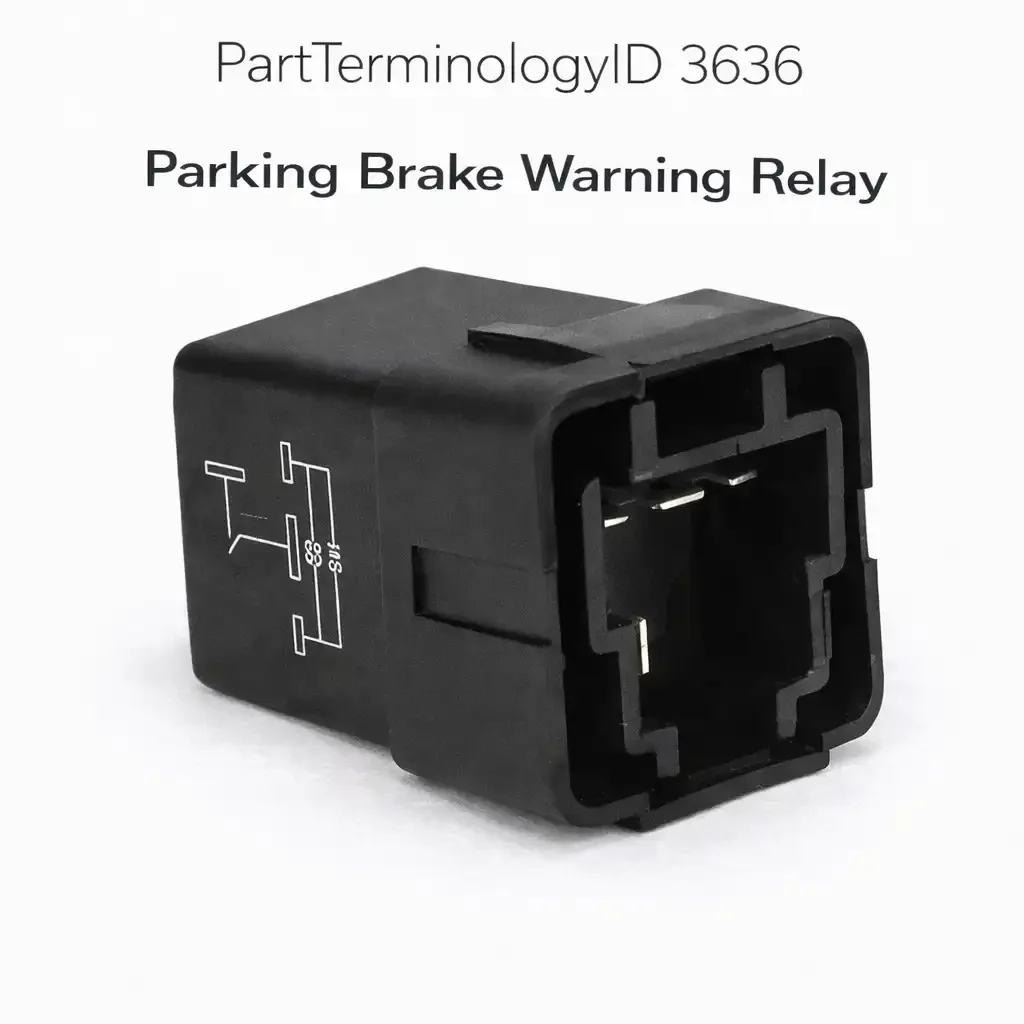
The Parking Brake Warning Relay, cataloged under PartTerminologyID 3636, supplies switched ignition voltage to the parking brake warning lamp circuit on applications where the manufacturer routes that supply through a dedicated relay rather than directly from a fused ignition circuit. Its function is straightforward: when the ignition is on and the relay is energized, the warning lamp circuit has power available. When the parking brake position switch detects that the brake is applied, it completes the lamp ground path and the warning lamp illuminates to alert the driver. The relay is the supply-side component in this circuit. It does not detect brake position, interpret brake status, or make any determination about whether the warning should be shown. It simply ensures that the lamp has a supply voltage whenever the ignition is active.
On most platforms this relay is a standard ISO-format relay in the fuse block, identified by a position label related to warning lamps, instrument cluster supplies, or brake circuits depending on the manufacturer's labeling convention. On some platforms the warning lamp supply is folded into a broader instrument panel or body control relay rather than occupying a dedicated position. Buyers in this category are typically responding to a parking brake warning lamp that is permanently on when the brake is released, permanently off when the brake is applied, or stuck in one state regardless of ignition position. All three of those symptoms have more likely causes than the relay, and a listing that helps buyers understand which component in the circuit is actually responsible for each symptom produces better diagnostic outcomes and fewer unwarranted returns.
What the Relay Does
Warning Lamp Supply Circuit
The parking brake warning lamp in the instrument cluster requires both a supply voltage and a ground path to illuminate. On most conventional parking brake warning circuits, the lamp receives its supply from the ignition-switched circuit through a fuse and, on platforms that use this relay, through the relay's load contacts. The ground path is completed by the parking brake position switch, which closes when the parking brake pedal or lever is applied and opens when the brake is fully released. When both conditions are met simultaneously, supply voltage present through the relay and ground path completed through the position switch, current flows through the lamp filament and the lamp illuminates.
The relay's contribution to this circuit is the same as any warning lamp supply relay: it allows the circuit to be powered from the ignition switch through a low-current relay coil trigger rather than routing ignition current directly through the warning lamp supply fuse and switch contacts. On most applications this is a normally-open relay whose contacts close when the ignition is on, which means the relay must be energized and its contacts must be closed for the warning lamp to have the ability to illuminate at all. A relay that fails open, or whose fuse has blown, produces a warning lamp that cannot illuminate under any condition: the brake can be applied and the position switch can be closed, but with no supply voltage through the relay the lamp circuit is incomplete and the lamp stays dark.
Integration with Position Switch and Instrument Cluster
On older and simpler platforms, the parking brake warning circuit is a direct electrical path from the supply through the relay, through the lamp filament, and through the position switch to ground. The instrument cluster contains the lamp as a physical bulb, and the circuit's behavior is entirely determined by the relay's contact state and the position switch's contact state. On these platforms, the relay is a meaningful diagnostic target because its failure directly and completely disables the warning lamp supply.
On more modern platforms, the instrument cluster contains LEDs driven by transistor outputs from the cluster control circuit or from the BCM or TCM, and the parking brake warning indicator is controlled by a software-driven output rather than by a direct supply-through-lamp-to-ground circuit. On these platforms, a dedicated parking brake warning relay in the older sense may not exist, and the position switch provides a signal input to the cluster or to the BCM rather than completing a direct lamp ground path. Buyers on these platforms who search for a parking brake warning relay in the aftermarket catalog may find limited or no fitment coverage for their specific vehicle, which is consistent with the circuit architecture rather than a catalog error.
Relationship to Brake Fluid Level Warning
On many platforms, the parking brake warning lamp does double duty: it illuminates both when the parking brake position switch detects that the brake is applied and when the brake fluid level sensor detects insufficient fluid in the master cylinder reservoir. Both conditions use the same lamp and the same supply circuit. This means that a parking brake warning lamp that illuminates when the brake is fully released may not indicate a brake position switch fault or a relay fault at all: it may indicate low brake fluid, a failed brake fluid level sensor, or a wiring fault in the fluid level sensor circuit. Buyers who do not check brake fluid level and sensor function before ordering electrical components for the warning lamp circuit generate returns that could have been avoided with a 30-second visual inspection of the master cylinder reservoir.
Top Return Scenarios
Position Switch Fault Misidentified as Relay
The parking brake position switch is the component that completes the lamp ground path when the brake is applied. A switch that has failed closed, meaning it remains in the applied position even when the brake is released, produces a warning lamp that stays on permanently regardless of brake position. This is the most common parking brake warning lamp complaint and the most commonly misdiagnosed one. A buyer who sees a permanently illuminated parking brake warning light, assumes the relay has failed closed and is permanently supplying the lamp, and orders a relay replacement will find that installing a new relay has no effect because the supply side was never the fault. The position switch is stuck in the applied position and the lamp illuminates regardless of which relay is in the circuit.
Distinguishing a failed-closed position switch from a relay fault before ordering: if disconnecting the parking brake position switch connector causes the warning lamp to go out immediately, the fault is in the position switch or in the wiring between the switch and the lamp ground terminal. The relay is not the fault. If the lamp stays on even after the position switch connector is disconnected, the fault is either a wiring short to ground downstream of the switch in the lamp circuit, or a cluster control circuit fault on platforms with electronic lamp control.
Brake Fluid Level Sensor Fault Attributed to Relay
As described above, the parking brake warning lamp on most platforms also responds to the brake fluid level sensor in the master cylinder reservoir. A fluid level sensor whose float has become stuck in the low-fluid position, or whose internal contacts have corroded closed, sends a continuous low-fluid warning through the same lamp that would otherwise indicate an engaged parking brake. The driver sees a parking brake warning lamp that stays on when the brake is released and concludes the warning circuit has a fault. If the buyer focuses on the electrical components of the parking brake position switch circuit, including the relay, without first checking brake fluid level and sensor function, neither the relay replacement nor the position switch replacement will resolve the fault.
Confirming that brake fluid is at the correct level in the master cylinder reservoir before any electrical diagnosis of the warning lamp circuit is the appropriate first step. If fluid level is correct and the lamp still illuminates with the brake released and the position switch disconnected, the fluid level sensor circuit is the next diagnostic target.
Relay Ordered for Platform Where Circuit Is BCM-Controlled
On vehicles where the instrument cluster's warning lamps are controlled by the BCM or by internal cluster logic rather than by direct supply-through-lamp circuits, there may be no standalone parking brake warning relay in the fuse block. The BCM receives the position switch input as a digital signal and commands the cluster to illuminate the appropriate indicator through a data bus message. A buyer on one of these platforms who searches for and orders a parking brake warning relay based on their symptom, a warning lamp that stays on when the brake is released, will not find a relay to replace because the circuit architecture does not use one. The appropriate diagnostic path is reading the BCM's data stream to confirm what signal it is receiving from the position switch, and comparing that to the actual brake position.
Listings that identify the specific platforms covered by the relay and clearly note that not all vehicles use a dedicated relay for this function help buyers on BCM-controlled platforms understand why their lookup returns limited or no fitment results.
Lamp Failure Confused with Relay Failure
On the opposite end from a permanently illuminated lamp, a parking brake warning lamp that does not illuminate at all when the brake is applied can indicate a burned-out lamp bulb, a failed relay, a blown fuse, a failed position switch that does not close when the brake is applied, or a broken wire in the lamp circuit. On platforms with physical bulbs, a burned-out bulb is the highest-probability single-component fault for this symptom and costs significantly less than a relay to replace. Buyers who order a relay for a non-illuminating warning lamp without first confirming whether the bulb is intact will find that a burned-out bulb was the fault and the relay was not needed.
The ignition-on bulb test that most vehicles perform when the key is first turned to the Run position is the simplest way to confirm whether the lamp can illuminate at all. If the warning lamp does not illuminate during the bulb test, the fault is in the lamp, its fuse, or the supply circuit including the relay, rather than in the position switch or the brake system.
Listing Requirements
Every listing for PartTerminologyID 3636 should include:
ACES fitment data verified at the year, make, model, and trim level, with attention to whether the target application uses a direct supply-through-lamp circuit or a BCM-controlled cluster lamp architecture
A clear statement that this relay supplies the warning lamp circuit and does not detect brake position, control brake function, or interact with the parking brake mechanism itself
The relay body format, pin count, and coil voltage for each application
A note that a warning lamp which stays on when the brake is released most commonly indicates a failed-closed position switch or a brake fluid level sensor fault rather than a relay fault
A note that confirming brake fluid level is the appropriate first step before any electrical diagnosis of this warning lamp circuit
A statement that this relay is sold as a standalone component and does not include the parking brake position switch, brake fluid level sensor, instrument cluster, or wiring harness
Frequently Asked Questions
My parking brake light stays on even after I release the brake. Is the relay stuck closed?
A relay that fails closed would supply the lamp circuit continuously, but the lamp would still only illuminate if the ground path through the position switch is also complete. If the lamp stays on with the brake fully released, the more likely explanation is a position switch that has failed in the closed position, wiring that is shorting the lamp circuit to ground somewhere between the switch and the lamp terminal, or a brake fluid level sensor that is signaling low fluid through the same lamp. Disconnecting the position switch connector while the ignition is on is the quickest way to determine whether the switch is the fault: if the lamp goes out when the switch is disconnected, the switch or its wiring is completing the ground path unintentionally.
My parking brake light doesn't come on at all, even when the brake is applied. What should I check first?
Confirm whether the lamp illuminates during the ignition-on bulb test. If it does not illuminate during the bulb test, the fault is in the lamp, its fuse, or the supply circuit. Check the fuse first, then the relay if the fuse is intact. If the lamp illuminates during the bulb test but does not illuminate when the brake is applied, the fault is in the position switch circuit: the switch is not closing when the brake is applied, or the wiring between the switch and the lamp ground terminal has an open circuit.
What Sellers Get Wrong
Not explaining that the relay controls lamp supply, not brake engagement
A listing that describes this relay only as a "parking brake relay" without clarifying that it serves the warning lamp circuit, rather than the parking brake engagement mechanism or release system, creates ambiguity for buyers who are also looking at parking brake release relays (PartTerminologyID 3632) or other brake-adjacent relays. A buyer who needs a warning lamp supply relay and receives one will be satisfied. A buyer who needed a release relay and ordered this one based on an ambiguous listing description will not. The circuit function must be stated clearly in the title and description.
Omitting the brake fluid level sensor connection from diagnostic guidance
The brake fluid level warning and the parking brake engagement warning share the same indicator lamp on most domestic and import platforms from the 1980s through the 2000s. A listing that only discusses the parking brake position switch as the relevant input to this circuit and does not mention the brake fluid level sensor as an equally likely cause of an always-on warning lamp leaves buyers without the most important first-step diagnostic check: look in the reservoir. Buyers who skip this step and proceed directly to electrical component replacement generate returns that cost both the buyer and the seller.
Cross-Sell Logic
Parking brake position switch (the component that completes the lamp ground path when the brake is applied, and the most common cause of a permanently illuminated or permanently dark parking brake warning lamp; testing the switch before ordering the relay is the diagnostic step most likely to identify the actual fault)
Brake fluid level sensor or float switch (the secondary input that shares the warning lamp on most platforms; a failed level sensor produces the same symptom as a failed-closed position switch and should be confirmed functional before any electrical component replacement)
Instrument cluster warning lamp bulb (on platforms with physical bulbs, a burned-out bulb is the first component to verify when the lamp fails to illuminate during the ignition-on bulb test)
Fuse for warning lamp circuit (a blown fuse in the relay output branch produces the same symptom as a failed open relay and costs less than a relay to replace; checking the fuse before the relay is the appropriate diagnostic sequence)
Parking brake cables and mechanism (if the warning lamp illuminates at highway speed with no brake applied, the parking brake may not be fully releasing due to a seized cable or binding mechanism, which keeps the position switch closed; the lamp and relay are functioning correctly in that scenario and the mechanical system is the fault)
Parking brake release relay, PartTerminologyID 3632 (on platforms equipped with automatic parking brake release systems, the release relay and the warning relay serve adjacent circuit functions and are often replaced together when the parking brake system is being comprehensively serviced)
Final Take
PartTerminologyID 3636 covers one of the simplest relay functions in the vehicle: supplying the warning lamp circuit with the voltage it needs to illuminate when the position switch closes. The relay's simplicity is also why it is rarely the actual fault. A circuit with a switched supply, a lamp, and a position switch has three meaningful failure points, and the relay is the lowest-probability failure among them. The position switch fails far more often. The lamp bulb fails far more often. The brake fluid level sensor, which feeds the same lamp on most platforms, fails with regularity and is almost always overlooked.
Listings in this category create value not by positioning the relay as a likely fault, but by giving buyers the diagnostic framework to identify what the lamp symptom actually means before any parts are ordered. A buyer who checks brake fluid first, then checks the position switch by disconnecting it, and only orders the relay after confirming supply voltage is absent at the lamp terminal is a buyer who receives the relay and installs it successfully. That is the buyer worth serving, and the listing that gives them that sequence earns the order.