
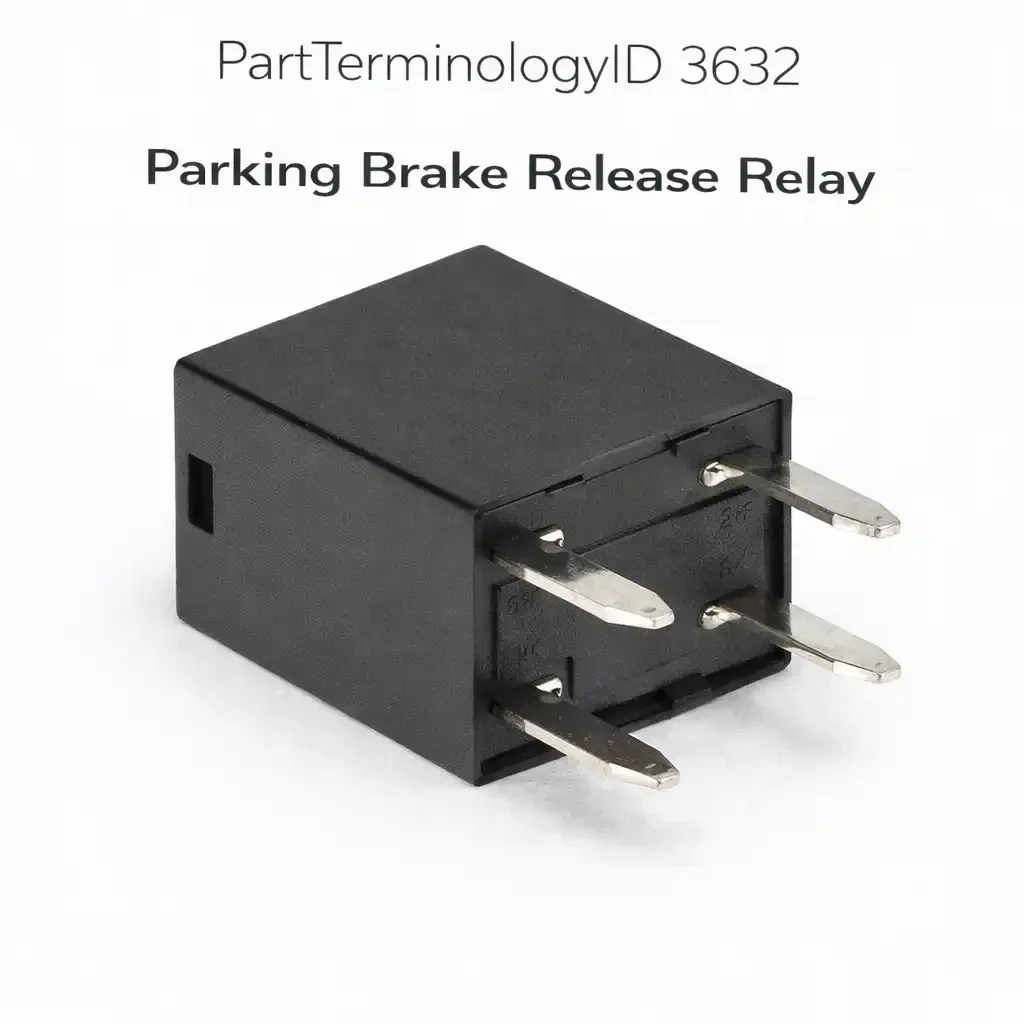
The Parking Brake Release Relay, cataloged under PartTerminologyID 3632, is the switching relay that enables automatic release of a vehicle's parking brake when the driver shifts the transmission out of a stationary position and into a drive range. On the platforms that use this relay, the parking brake is designed to release itself without driver intervention: the driver sets the brake, starts the vehicle, shifts into Drive or Reverse, and the parking brake releases automatically as the transmission position is detected. The relay is the component that receives the transmission range signal or a related trigger and commands the electric release actuator to retract the brake mechanism. Without a functional relay, the automatic release does not occur and the brake remains engaged when the driver begins to pull away, either dragging against the rear brakes or preventing departure entirely if the actuator circuit never opens.
This relay application is associated primarily with domestic vehicles from the 1970s through the 1990s that were equipped with automatic-release electric parking brake systems, as well as some commercial and fleet applications where hands-free parking brake management was a design objective. The application is narrower than many relay categories in the aftermarket catalog and the fitment data reflects that. Buyers in this category are typically working on specific older domestic platforms and need accurate platform-level verification before ordering because relay design, actuator voltage, and circuit architecture vary considerably across the applications that share this PartTerminologyID.
What the Relay Does
Automatic Parking Brake Release Circuit
Vehicles equipped with an automatic parking brake release system use an electric actuator, sometimes called a release motor or release solenoid, to retract the parking brake when the driver shifts out of Park. The actuator receives its command from the relay, which monitors the transmission range selector position through one or more circuit inputs. On most applications in this category, the relay coil receives a trigger signal when the transmission range selector leaves the Park or Neutral position and enters a drive range. When that trigger is received, the relay's contacts close and supply the actuator with the voltage and current it needs to release the parking brake cable tension or to retract the brake mechanism.
The relay sits in the vehicle's circuit between the ignition-switched power supply, the transmission range signal, and the release actuator. On some platforms the relay coil is triggered directly by a contact inside the transmission range selector assembly, which grounds the coil when Drive or Reverse is selected. On other platforms the trigger comes from a column-mounted switch or a floor-shifter-mounted switch that changes state as the selector passes through its range positions. The specific trigger architecture determines which component to inspect first when automatic release stops working, and that architecture varies enough across platforms that buyers should identify their specific circuit before concluding the relay is the fault.
Release Actuator Motor Circuit
The release actuator is the high-current load that the relay switches. Actuator motors draw significantly more current than relay coil circuits and must be powered through relay contacts rather than directly through the trigger switch. The relay's contact rating must be adequate for the actuator's current draw: an undersized relay or one with pitted, worn contacts from prior high-current switching will fail to supply adequate voltage to the actuator, producing weak or incomplete parking brake release even when the relay energizes. This makes relay contact condition a relevant diagnostic factor independent of whether the relay coil and trigger circuit are functional.
On most applications, the relay's contacts also control the direction of release actuation. Some release actuator designs use a single-direction motor that retracts the brake and then holds position until the next park cycle, while others use a bidirectional circuit that requires the relay to also control a return signal when the brake is next applied. The circuit architecture for the specific application determines whether a simple normally-open relay is appropriate or whether the application uses a more complex relay arrangement to manage both release and re-engagement.
Integration with Transmission Range Signal
The transmission range signal that triggers the relay coil is the same signal that feeds the backup lamp circuit and, on many of these platforms, the neutral safety switch circuit as well. A fault in the transmission range selector switch or in the wiring between the selector and the relay affects all three circuits simultaneously. A buyer who finds that their automatic parking brake release has stopped working at the same time their reverse lights stopped working has a transmission range selector fault that is almost certainly upstream of the relay. The relay is not the fault in that scenario, and replacing the relay will not restore either function.
Confirming that the relay's coil trigger terminal receives its signal when the transmission is shifted to the appropriate range, before ordering the relay, separates a failed relay from a failed trigger source. On most of these applications, the trigger can be confirmed with a test light at the relay coil terminal while the ignition is on and the transmission selector is moved through its range positions.
Top Return Scenarios
Actuator Fault Misidentified as Relay
The release actuator motor is a higher-failure-rate component than the relay on most of these applications. Actuator motors experience carbon brush wear, commutator corrosion, and winding degradation from decades of exposure to underbody conditions. A failed actuator motor draws no current when the relay correctly energizes and supplies it, which means the parking brake does not release even though the relay is functioning exactly as designed. The buyer hears no actuator movement, concludes the relay is not doing its job, replaces the relay, and finds the new relay also produces no movement because the actuator is the fault.
Distinguishing a relay fault from an actuator fault before ordering requires checking for voltage at the actuator's power terminal when the relay should be energized. If the relay contacts are closing and delivering voltage to the actuator connector but the actuator does not run, the fault is in the actuator motor, its wiring, or its ground path. If voltage does not appear at the actuator connector when the relay should be energized, the relay contacts, the relay fuse, or the wiring between the relay and the actuator is the fault.
Transmission Range Switch Fault Upstream of Relay
As described above, the trigger signal that energizes the relay coil typically comes from the transmission range selector switch. A worn or corroded range selector switch may lose contact in Drive or Reverse while still making contact in Park and Neutral, which means the relay does not receive its trigger signal even though the selector has moved to the appropriate position. The symptom is an automatic release system that stopped working, which the buyer attributes to the relay. The relay is replaced, the range selector fault persists, and the new relay also does not energize when Drive is selected.
Testing the trigger signal at the relay coil terminal with a test light or voltmeter while operating the transmission range selector identifies whether the fault is in the relay or in the trigger source. If the trigger signal appears at the relay coil terminal as expected but the relay does not energize, the relay coil or its fuse is the fault. If no trigger signal appears at the coil terminal when Drive is selected, the fault is in the transmission range selector circuit upstream of the relay.
Parking Brake Mechanism Binding Interpreted as Relay Fault
On vehicles with cable-operated automatic-release parking brakes, a seized or corroded cable, a sticking brake pedal return mechanism, or worn pivot hardware can prevent the parking brake from releasing even when the actuator motor runs and the relay correctly supplies it. The driver perceives a parking brake that will not release and concludes the electrical release system has failed. If the actuator motor can be heard running but the brake pedal or cable does not retract, the mechanical components are the fault. Replacing the relay in this scenario has no effect on the mechanical binding, and the relay is returned.
Listening for actuator motor operation when the transmission is shifted to Drive is a useful preliminary check. If the actuator runs but the brake does not release, the fault is mechanical. If neither the actuator nor the brake responds when Drive is selected, electrical diagnosis is appropriate.
Relay Ordered for Wrong Application
The parking brake release relay fitment spans a range of domestic platforms with different relay bodies, coil voltages, contact ratings, and terminal configurations. A relay sourced for one platform that physically fits the relay socket of another platform but has different contact ratings or a different terminal pinout may appear to install correctly but either fail to function or deliver inadequate current to the actuator. Because these applications are older platforms where catalog data is sometimes sparse or aggregated at too broad a level, incorrect fitment from an insufficiently specific lookup is a meaningful return driver in this category. Platform-level verification that includes the specific transmission type, the parking brake system type, and where possible a cross-reference to the OEM relay part number is the appropriate level of fitment confirmation for orders in this category.
Listing Requirements
Every listing for PartTerminologyID 3632 should include:
ACES fitment data verified at the year, make, model, and transmission type level, with particular attention to whether the automatic parking brake release feature was standard or optional on the target platform
Relay body format, pin count, contact rating, and coil voltage confirmed for each application
A description of what triggers the relay coil on the target application, including whether the trigger comes from the transmission range selector, a column-mounted switch, or another source
A note that the actuator motor should be tested for function before ordering the relay by confirming voltage at the actuator connector when the relay should be energized
A note that a simultaneous loss of reverse lights and automatic parking brake release points toward a transmission range selector fault upstream of the relay
A statement that the relay is sold as a standalone component and does not include the release actuator, parking brake cable, transmission range selector switch, or wiring harness
Frequently Asked Questions
My parking brake releases if I pull the handle manually but not automatically when I shift to Drive. Is this definitely the relay?
Not necessarily. Manual release by handle confirms that the parking brake mechanical system can release when actuated, which eliminates a seized cable or stuck mechanism as the cause. The remaining possibilities for no automatic release are the relay, the relay's trigger signal from the transmission range selector, the actuator motor, the wiring between the relay and the actuator, and the fuse protecting the actuator circuit. Testing for voltage at the actuator connector when Drive is selected narrows the fault to either the relay and its supply circuit or the actuator and its ground circuit.
Can I test the relay on the bench before installing it?
Yes. The relay coil can be energized with a 12-volt supply across the coil terminals, and the contact set can be tested with a continuity tester or voltmeter across the load terminals before and after energizing the coil. A relay whose coil energizes and whose contacts close under bench test may still fail intermittently in the vehicle if the relay socket contacts are corroded or if the actuator load current exceeds the relay's contact rating. Bench testing confirms basic relay function but does not replicate installed conditions, so cleaning the relay socket terminals and verifying the actuator's current draw remain appropriate steps after confirming the relay passes a bench test.
What Sellers Get Wrong
Not confirming whether automatic release was standard or optional on the target platform
On some domestic platforms, automatic parking brake release was an optional feature tied to specific trim levels or option packages. A listing that assigns the parking brake release relay to all configurations of a given year and model, including configurations where the feature was not installed, will generate orders from buyers whose vehicles were not built with the feature. Those buyers will find that neither the relay nor a socket for it exists in their vehicle and will return the relay. Confirming whether the feature was standard, optional, or absent on each specific configuration within the ACES fitment data prevents this category of return.
Listing without actuator compatibility information
The relay and the release actuator must be electrically compatible. A relay whose contact rating is correct for one actuator's current draw may be marginal for a higher-draw actuator fitted to a different application on the same vehicle line. Including the actuator compatibility context in the listing, even briefly, helps buyers confirm that the relay they are ordering matches the actuator already installed in their vehicle. This is particularly relevant on older platforms where aftermarket actuator replacements may not match the OEM current draw specification exactly.
Cross-Sell Logic
Parking brake release actuator or motor (the direct load that the relay switches, and the higher-failure-rate component on most of these platforms due to age, underbody exposure, and motor brush wear; confirming actuator function before ordering the relay prevents the most common misdiagnosis in this category)
Transmission range selector switch (the trigger source for the relay coil on most applications, and the appropriate replacement when the automatic release fault coincides with a reverse light fault, since both circuits typically share the same trigger switch)
Parking brake cable (a seized cable prevents release even when the relay and actuator are functional; confirming cable freedom of movement eliminates this mechanical fault before electrical diagnosis begins)
Relay socket or connector terminals (corrosion at the relay socket is a frequent cause of intermittent relay function on older platforms where the socket has been exposed to decades of moisture and temperature cycling)
Parking brake pedal return spring or mechanism (a sticking or binding pedal mechanism can prevent full retraction even when the actuator delivers adequate force; inspecting the pedal pivot and return spring is appropriate when the actuator runs but the brake does not fully release)
Fuse for actuator circuit (a blown fuse between the relay output and the actuator produces the same symptom as a failed relay and is the lowest-cost item to check in the circuit before ordering the relay)
Final Take
PartTerminologyID 3632 covers a specific automatic release function that was a convenience feature on its platforms rather than a safety-critical braking component, but its failure produces a symptom, a parking brake that stays engaged when the driver pulls away, that feels urgent in the moment and can lead to brake wear if the driver does not recognize what is happening. The buyer who orders a relay for this category is usually working on an older vehicle where the platform knowledge needed for accurate diagnosis is not widely available and where catalog data quality is more variable than on later applications.
Getting the fitment right at the platform level and giving buyers the diagnostic sequence that distinguishes the relay from the actuator and from the transmission range selector switch are the two most valuable things a listing in this category can do. A buyer who orders a relay, receives the correct part, confirms it is actually the fault through basic circuit testing, and installs it successfully becomes a repeat customer. A buyer who orders a relay, installs it without verifying the actuator or the trigger source, and finds the automatic release still does not work returns the relay and loses confidence in the catalog. The difference between those two outcomes is almost entirely determined by the diagnostic guidance in the listing.