
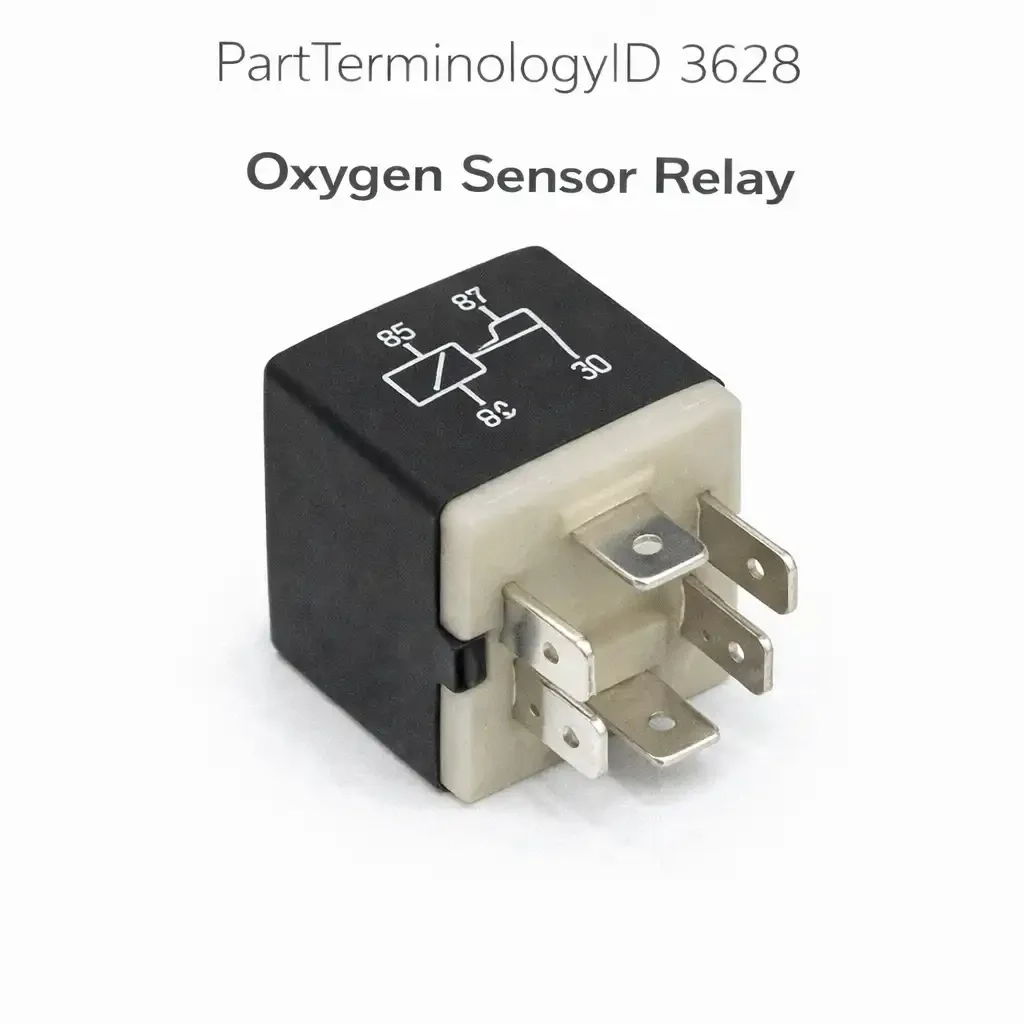
The Oxygen Sensor Relay, cataloged under PartTerminologyID 3628, supplies switched ignition or battery-referenced voltage to the oxygen sensor signal circuit on applications where the manufacturer routes that supply through a dedicated relay rather than through a direct fused circuit from the main power distribution center. Its role is to provide a stable, clean voltage reference to the sensor's signal and ground circuit infrastructure so that the PCM can read the sensor's output voltage accurately. On platforms that use this relay, the PCM cannot accurately interpret oxygen sensor output without the relay's supply being present, which means a failed relay produces sensor fault codes that will not clear regardless of how many sensors the buyer installs.
This PartTerminologyID is frequently confused with PartTerminologyID 3532, the Oxygen Sensor Heater Relay, which controls power to the internal heating element inside the sensor rather than to the sensor's signal circuit. The two relays serve different circuit functions, occupy different positions in the fuse block on most platforms, and produce different fault code signatures when they fail. A buyer who orders the wrong relay based on a misread parts catalog or a misidentified fuse block label will receive the correct part for the wrong circuit and return it. Precise fitment data and a clear description of which circuit function this relay serves are the most important things a listing in this category can provide.
What the Relay Does
Signal Circuit Power Supply
Oxygen sensors generate their own output voltage through an electrochemical reaction between exhaust gas oxygen content and atmospheric oxygen reference at the sensor's internal reference cell. That output voltage, which ranges from approximately 0.1 volts under lean conditions to approximately 0.9 volts under rich conditions on a conventional zirconia narrowband sensor, is what the PCM monitors to manage closed-loop fuel trim. The sensor's signal circuit requires a stable voltage reference at the PCM's sensor supply terminal and a clean signal ground return path to produce an accurate reading. On platforms where the manufacturer routes the sensor supply voltage through a relay rather than directly from a fused ignition circuit, the Oxygen Sensor Relay is the component that establishes that supply.
When the relay is energized with the ignition on, its contacts close and complete the supply circuit to the sensor signal infrastructure. The PCM sees the sensor's electrochemical voltage output on the signal wire and uses it to calculate fuel delivery corrections in closed-loop operation. When the relay fails open or loses its coil trigger signal, the supply circuit is interrupted. The PCM either sees a fixed mid-range voltage that indicates an open circuit sensor, or it sees no signal at all, and it sets a sensor fault code. On platforms where a single relay supplies multiple sensors, the fault codes for all sensors on the affected circuit appear simultaneously, which is one of the diagnostic signatures that points toward the relay rather than toward individual sensor failures.
Relay Position in the Circuit
The relay coil receives switched ignition voltage from the fuse block and a PCM-controlled ground signal, or alternatively a direct chassis ground, depending on the platform architecture. On platforms where the PCM controls the relay coil ground, the PCM can disable the oxygen sensor supply circuit under specific conditions, such as during a cold start period before the sensors are expected to be active, or during certain diagnostic routines. On platforms where the coil ground is a direct chassis connection, the relay energizes whenever ignition voltage is present at the coil supply terminal with no PCM mediation.
The relay's load contacts supply voltage to one or more oxygen sensors through a fused branch circuit. The fuse in this branch is sized for the sensor signal circuit current draw and is separate from the heater circuit fuse on platforms that use a dedicated heater relay as well. On some platforms, particularly domestic V8 and V6 applications from the late 1990s and early 2000s, the oxygen sensor relay and the powertrain relay are the same physical component, with the relay's output feeding both the oxygen sensor supply circuit and other engine management loads through separate fuses. On those platforms, the relay is not labeled as an oxygen sensor relay in the fuse block but is the component that must be functioning for the sensor supply circuit to be active.
Relationship to the Heater Relay
PartTerminologyID 3532, the Oxygen Sensor Heater Relay, controls the supply to the internal heating element inside the sensor. The heater brings the sensor's ceramic element up to operating temperature within the first 30 to 60 seconds of engine operation so that closed-loop fuel control can begin before exhaust heat alone would warm the sensor. The heater circuit is a high-current circuit relative to the signal circuit: a typical four-wire heated oxygen sensor draws 10 to 15 watts through its heater element, which at 12 volts represents close to 1 amp per sensor, and on a V8 with four sensors the heater relay may be switching 4 or more amps total.
The signal circuit that the Oxygen Sensor Relay (3628) supports is a much lower-current circuit. The sensor's signal output is a millivolt-level electrochemical voltage that the PCM reads on a high-impedance input. The supply that the signal circuit relay provides is primarily a reference voltage and ground infrastructure rather than a high-current power delivery function. This functional difference is why both relays can coexist on the same platform in different positions in the fuse block, and why their failure modes produce different code signatures: a failed heater relay produces heater circuit fault codes such as P0030, P0036, P0050, or P0056, while a failed signal circuit relay produces sensor signal fault codes such as P0131, P0132, P0137, P0138, or sensor circuit open and range codes depending on what the PCM observes when the supply is absent.
Top Return Scenarios
Sensor Replaced Before Relay Was Diagnosed
The most common sequence that produces a return in this category is a buyer who receives multiple oxygen sensor fault codes, replaces the sensors indicated by those codes, finds the codes return after clearing them, and eventually identifies the relay as a potential cause. By the time the relay is ordered, the buyer has already spent money on sensors that were not the fault and may be skeptical that a relay is actually the problem. If the relay also does not resolve the fault because the wiring between the relay and the sensor connectors has a break or a corroded splice, the relay comes back as well.
The correct diagnostic sequence on any application where multiple oxygen sensor codes appear simultaneously, or where sensor codes reappear immediately after installing a new sensor, is to verify that the sensor's supply voltage is present at the connector before ordering replacement sensors. A voltmeter at the sensor's supply terminal with the ignition on confirms whether the relay is doing its job. If supply voltage is absent at the connector, tracing backward to the relay output terminal and then to the fuse confirms where the circuit is open. If the relay output has voltage but the sensor connector does not, the fault is in the wiring between them.
Heater Relay Ordered Instead of Signal Relay
On platforms that use both a heater relay and a signal circuit relay, the two are sometimes confused in aftermarket catalog lookup. The heater relay is often more prominently documented because heater circuit codes are more common and the heater relay's load current makes it a more typical relay failure candidate. A buyer who looks up O2 sensor relay, sees the heater relay listed prominently, and orders it when the actual fault is in the signal circuit relay will receive a part that does not address the fault. The heater relay installs without incident and the signal circuit codes persist.
Listings that clearly state whether the relay in question serves the heater circuit, the signal circuit, or both, help buyers order the correct component. Listings that include the fault code signatures associated with a failed relay give buyers a way to confirm which relay their codes point toward before ordering.
PCM Ground Driver Fault Attributed to Relay
On platforms where the PCM provides the relay coil ground, a PCM output driver that has failed open will prevent the relay from energizing even if the relay itself is functional. The symptom is identical to a failed relay: no supply voltage at the sensor connector, sensor fault codes, and no closed-loop fuel control. The buyer replaces the relay, the coil still has no ground because the PCM driver is the fault, and the new relay also does not energize. The relay is returned as non-functional.
Confirming that the relay coil's trigger terminal receives its ground signal before ordering the relay separates a failed relay from a failed PCM driver. Probing the coil ground terminal with a test light while the ignition is on and the enabling conditions are met shows whether the PCM is providing the trigger. If the test light illuminates at the coil ground terminal, the PCM is providing its trigger and the relay should energize. If the test light does not illuminate, the fault is in the PCM driver circuit upstream of the relay.
Corroded Relay Socket Contacts
The oxygen sensor relay socket, like most relay sockets in the engine bay fuse block, is subject to moisture intrusion and corrosion over time. A relay whose contacts appear functional on the bench but fails intermittently in the vehicle is often producing marginal contact resistance at the socket terminals rather than a failed relay coil or contact set. The relay clicks when the coil energizes but the load circuit has enough resistance at the socket contact that the supply voltage drops below the level needed for reliable sensor circuit operation. The sensor produces erratic output or intermittent codes rather than a fixed fault code, the buyer replaces the relay, the socket contacts are not cleaned, and the intermittent fault returns.
Inspecting and cleaning the relay socket terminals with electrical contact cleaner before installing the replacement relay, and verifying that the socket contact spring tension is sufficient to grip the relay blade terminals firmly, prevents this return. If the socket terminals show significant pitting or deformation, the socket or the fuse block connector housing may need replacement rather than just the relay.
Listing Requirements
Every listing for PartTerminologyID 3628 should include:
ACES fitment data confirmed at the year, make, model, and engine level, with attention to platforms where the oxygen sensor relay function is folded into a powertrain or engine management relay rather than labeled as a dedicated oxygen sensor relay
A clear statement that this relay serves the oxygen sensor signal circuit supply, not the oxygen sensor heater circuit, to prevent confusion with PartTerminologyID 3532
The relay body format, pin count, and coil voltage for each application
The fault code signatures associated with relay failure on the target platform, including whether a single relay failure produces codes for multiple sensors simultaneously
A note that sensor supply voltage should be verified at the sensor connector before ordering the relay, and that coil trigger signal should be verified at the relay socket before ordering the relay
A statement that this relay is sold as a standalone component and does not include oxygen sensors, wiring harness, or heater relay
Frequently Asked Questions
I replaced my oxygen sensor and the same code came right back. Could the relay be the cause?
If the code reappeared immediately after clearing it with a new sensor installed, the fault is almost certainly not in the sensor. A code that returns immediately after sensor replacement indicates either a circuit fault upstream of the sensor, such as a failed relay or a wiring fault, or a PCM input driver fault. Confirming that the sensor's supply voltage is present at the connector with the ignition on is the next diagnostic step. If supply voltage is absent, checking the relay and its fuse is appropriate. If supply voltage is present and the code still returns, the fault is likely in the PCM's signal interpretation circuit or the sensor ground path.
My V8 has codes for all four oxygen sensors at the same time. Is this the relay?
Simultaneous codes across multiple sensors is one of the clearest indicators that the fault is in the shared supply circuit rather than in the individual sensors. A relay that supplies all four sensors through a common circuit produces fault codes on all sensors when it fails, because all of them lose their supply simultaneously. Replacing all four sensors when the actual fault is a failed relay or a blown fuse in the relay's output circuit is the most expensive misdiagnosis in this category. Verifying supply voltage at one sensor connector before ordering any parts confirms whether the shared supply circuit is intact.
What is the difference between the oxygen sensor relay and the powertrain relay on my vehicle?
On some platforms, particularly domestic V6 and V8 applications from the late 1990s and early 2000s, the relay that supplies the oxygen sensor circuit is the same physical component as the powertrain relay. Its output feeds the oxygen sensor supply fuse as one of several loads. On these platforms, a failed powertrain relay produces oxygen sensor codes along with faults in other systems that share its output. On platforms with a dedicated oxygen sensor relay, only the oxygen sensor supply circuit is affected when that relay fails. The service manual wiring diagram for the target vehicle identifies which relay supplies the sensor circuit and which other loads share its output.
What Sellers Get Wrong
Confusing this relay with the heater relay in catalog data
PartTerminologyID 3532 and PartTerminologyID 3628 cover different relays serving different circuits on platforms that use both. Catalog data that assigns the same part number to both PartTerminologyIDs, or that does not specify which circuit the relay serves in the product description, creates buyer confusion that results in wrong-relay returns. Verifying which PartTerminologyID each part number belongs to and stating the circuit function clearly in the listing title and description prevents this category of return.
Not flagging platforms where the relay function is shared with another relay
On platforms where the oxygen sensor supply circuit is one output among several from a powertrain or engine management relay, the listing should note that the relay serves multiple circuit functions. A buyer who orders a relay expecting a dedicated oxygen sensor relay labeled as such in the fuse block will be confused when the replacement relay they receive matches the powertrain relay position rather than a position labeled for oxygen sensors. Platform-specific notes that identify the relay's fuse block position designation for each application help buyers confirm they are installing the relay in the correct socket.
Cross-Sell Logic
Oxygen sensor (the component downstream of the relay whose signal circuit the relay supplies; confirming that sensor supply voltage is present before ordering a sensor prevents misdiagnosis, but a sensor that has been contaminated by the condition that caused the relay failure may require replacement as well once the relay is restored)
Oxygen sensor heater relay, PartTerminologyID 3532 (on platforms that use both relays, a buyer diagnosing heater circuit codes should confirm they are ordering the heater relay rather than the signal relay; including a note about the companion relay in the listing helps buyers who need both understand the circuit architecture)
Relay socket or fuse block connector (corrosion at the relay socket contacts is a common cause of intermittent relay function and can cause premature failure of replacement relays if not addressed before installation)
Oxygen sensor supply fuse (the fuse in the relay's output branch circuit is the first component to check before the relay itself; a blown fuse produces the same symptom as a failed relay and costs significantly less to replace; listing the fuse specification for each application helps buyers rule out the fuse before ordering the relay)
Wiring harness repair kit or pigtail connector (a broken or corroded wire between the relay socket and the sensor connector produces the same symptom as a failed relay; buyers who confirm relay output voltage is present but sensor supply is absent need a wiring repair rather than a relay)
PCM or engine control module (on platforms where the PCM provides the relay coil ground, a failed PCM output driver is the alternative diagnosis when the relay coil receives no trigger; this is an expensive replacement that should only be considered after the relay, fuse, and wiring have been confirmed as functional)
Final Take
PartTerminologyID 3628 occupies a narrow but consequential position in the oxygen sensor circuit: it is the component that must be functioning before any oxygen sensor on the circuit can report an accurate reading to the PCM, yet it is often the last component a buyer considers when sensor fault codes appear. The sensors get replaced first, then the fuses, and the relay is ordered only after those replacements fail to clear the codes. A listing that moves relay diagnosis earlier in the buyer's decision process, by explaining what the relay does, what fault code pattern its failure produces, and how to confirm the fault before ordering, compresses that diagnostic sequence and reduces the return rate that results from buyers working through the circuit in the wrong order.
The distinction between this relay and the heater relay is the other axis where listings can add genuine value. Buyers who understand that their heater circuit codes point toward PartTerminologyID 3532 and their signal circuit codes point toward PartTerminologyID 3628 will order the correct relay the first time. Listings that explain the difference, state the circuit served, and connect specific code ranges to the correct relay give buyers that understanding at the point of purchase, which is where it matters most.