
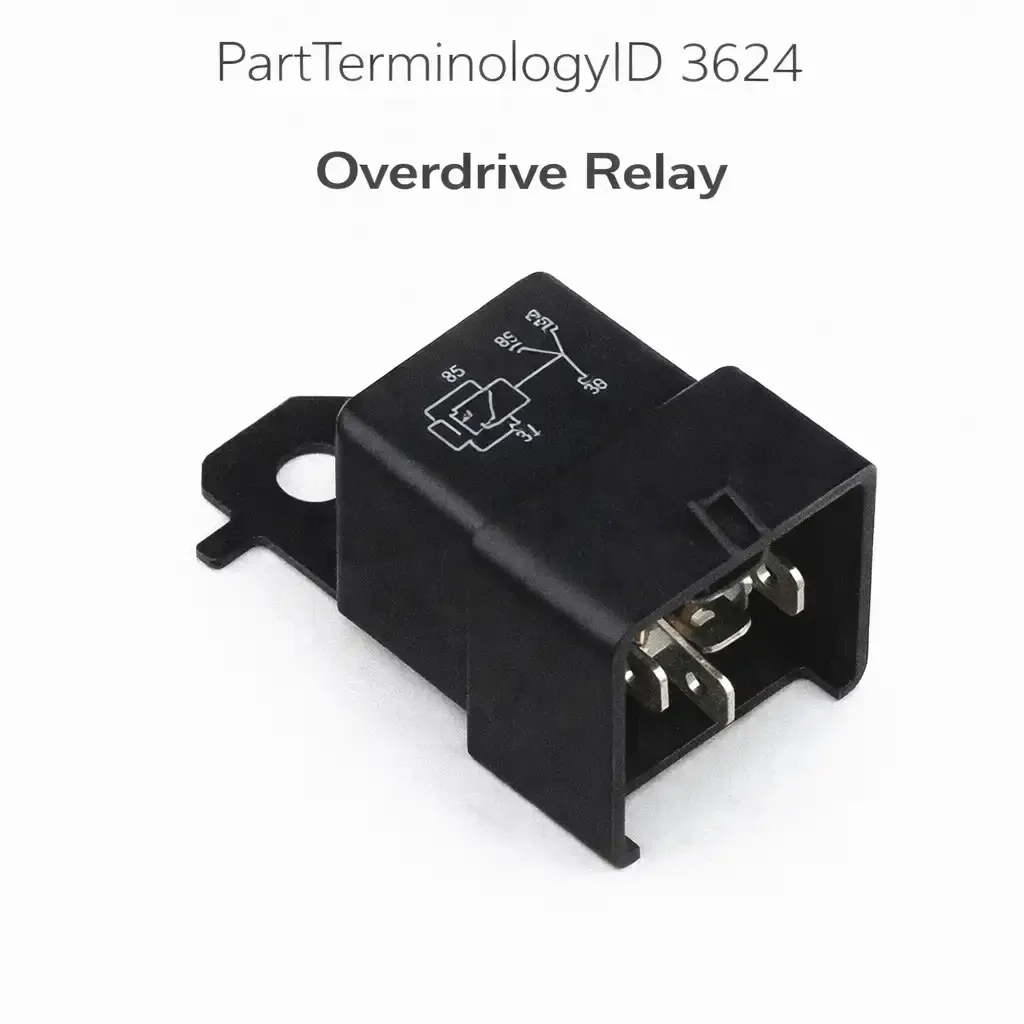
The Overdrive Relay, cataloged under PartTerminologyID 3624, is the electromechanical relay that controls the electrical signal enabling or disabling overdrive engagement in a vehicle's transmission. Its specific function depends on the transmission architecture of the target vehicle, and that architecture varies considerably across the applications this PartTerminologyID covers. On vehicles with a separately mounted electromechanical overdrive unit attached behind the main gearbox, such as the Borg-Warner overdrive fitted to many domestic trucks and imported cars from the mid-twentieth century, the relay sits on a firewall-mounted bracket and responds to a governor-generated ground signal at road speed to switch power to the overdrive solenoid. On later automatic transmission vehicles from the 1980s and 1990s, the overdrive relay sits in the fuse block or relay panel and passes the driver's overdrive enable command, filtered through coolant temperature and PCM logic, to the transmission's overdrive solenoid valve circuit.
Both application types use a relay for the same underlying reason: the overdrive enable command originates as a low-current signal from a driver-operated switch, a transmission governor, a PCM output, or a coolant temperature circuit, and the relay amplifies that signal to a level capable of driving the overdrive solenoid. The solenoid requires more current than the controlling circuit can safely supply directly, making the relay's current isolation and amplification function essential to the circuit's correct operation. Understanding which application type a given listing covers determines the correct diagnostic approach, the relevant failure modes, and the cross-sell items that will matter to the buyer.
What the Relay Does
Electromechanical Overdrive Applications
On vehicles equipped with a Borg-Warner or Laycock de Normanville overdrive unit bolted behind the main gearbox, the overdrive relay is a discrete component mounted on the firewall or inner fender. The relay coil receives switched ignition voltage from one terminal and a speed-sensitive ground signal from the transmission's mechanical governor from another. The governor is driven by the transmission's output shaft or speedometer gear and contains centrifugal weights that close an internal contact to ground at a calibrated road speed, typically around 28 mph depending on the specific application. When that ground closes at the programmed speed and the driver has enabled the overdrive with the in-cab control, the relay coil energizes and the relay contacts close. The closed contacts supply battery voltage through the kickdown switch to the overdrive solenoid, which engages the planetary gear set that adds the overdrive ratio behind the gearbox.
The kickdown switch is wired in series with the relay output on most of these applications. When the driver depresses the accelerator fully, the kickdown switch opens and interrupts the solenoid supply, dropping the transmission out of overdrive immediately to allow maximum acceleration. The relay does not control the kickdown function directly; it simply provides the switched supply that the kickdown switch and solenoid circuit require.
This electromechanical overdrive relay application is specific to classic and vintage platforms. Volvo 200 series vehicles with the M46 gearbox, domestic Ford and Mercury vehicles from the 1950s through 1970s with Borg-Warner overdrive, and similar applications from the same era represent the primary fitment applications in this category. These relays are platform-specific, often sourced through specialty suppliers, and may require the buyer to identify their relay by both part number and the specific overdrive unit designation because multiple relay variants were used across the same basic platform.
Automatic Transmission Overdrive Applications
On vehicles with electronically controlled automatic transmissions from the 1980s and 1990s, the overdrive relay serves a different but functionally parallel role. The relay sits in the under-dash or underhood fuse block and passes the overdrive enable command from the driver's O/D switch through a set of protective conditions before reaching the transmission's overdrive solenoid circuit. These protective conditions are built into the relay circuit rather than into software on many of these earlier platforms: the relay coil circuit may be routed through a coolant temperature switch that prevents the relay from energizing until the engine reaches operating temperature, ensuring the transmission does not shift into overdrive during a cold start when fluid viscosity and clutch engagement characteristics are not optimal for the overdrive gear.
Toyota truck and 4Runner platforms from the mid-1980s through the early 1990s, Ford F-Series trucks with AOD and AODE transmissions, and other domestic and import platforms from the same era used overdrive relay configurations of this type. The relay is often identified in service documentation as the "transmission relay" or "O/D relay" and occupies a labeled position in the fuse block. When the relay is functional and all enabling conditions are met, it closes its contacts and supplies the overdrive solenoid with the voltage needed to hold the transmission in overdrive during highway cruising. When any enabling condition is absent, such as insufficient coolant temperature, a PCM command to inhibit overdrive, or the driver pressing the O/D cancel button, the relay coil loses its trigger and the contacts open, dropping the transmission out of overdrive.
Symptoms of Relay Failure
A relay that fails open produces an overdrive that never engages. The transmission operates normally through all lower gears but will not shift into the highest overdrive gear at highway speeds. Engine RPM at cruise speed is higher than it should be, fuel economy suffers noticeably, and the transmission may feel as though it is searching for a gear that is not available. On platforms with an O/D OFF indicator lamp, this lamp may illuminate or flash, depending on whether the TCM or PCM detects the absence of overdrive engagement and flags it as a fault.
A relay that fails closed causes the transmission to enter overdrive regardless of vehicle speed, engine temperature, or driver command. At low speeds this produces an underpowered, lugging sensation because the transmission is in too tall a gear for the speed and load. The O/D cancel button becomes ineffective. On platforms with cold-start overdrive inhibit logic built into the relay circuit, a failed-closed relay bypasses that protection and allows overdrive engagement during cold operation, potentially stressing clutch packs before fluid is fully warmed.
Top Return Scenarios
Coolant Temperature Enabling Circuit Mistaken for Relay Failure
On automatic transmission platforms where the relay coil circuit passes through a coolant temperature switch, a failed temperature switch that remains open prevents the relay from energizing even when the driver's O/D switch is on and the engine is fully warm. The symptom is identical to a failed relay: no overdrive engagement regardless of speed or driver input. The buyer replaces the relay, the relay was never the fault, and the new relay also will not energize because the temperature switch is still open. The relay comes back.
Confirming whether the relay coil is receiving its trigger signal before ordering the relay prevents this return. Probing the coil trigger terminal with a voltmeter or test light while the engine is fully warm and the O/D switch is on confirms whether the temperature switch is passing the enable signal. If no trigger signal is present with the engine warm, the fault is in the enabling circuit upstream of the relay. If the trigger signal is present but the relay does not click, the relay itself is the fault.
Solenoid Fault Misdiagnosed as Relay
The overdrive solenoid inside the transmission is the load that the relay powers. A solenoid whose winding has failed open draws no current and produces no engagement even when the relay correctly supplies voltage to the solenoid circuit. A solenoid whose winding has shorted draws excessive current and may cause the relay contacts to pit and eventually fail. In either case, the symptom points toward the relay before the solenoid is tested. A buyer who replaces the relay without testing the solenoid resistance will find the new relay also fails to produce overdrive engagement if the solenoid winding is open, or finds the new relay fails prematurely if the solenoid is shorted.
Testing solenoid resistance at the solenoid connector terminals before ordering the relay confirms whether the solenoid load is within specification. Solenoid resistance values vary by platform but are typically documented in the service manual. A reading of infinite resistance indicates an open winding. A reading of near zero ohms indicates a short. Either condition requires solenoid replacement rather than relay replacement.
Governor Circuit Fault on Mechanical Overdrive Applications
On Borg-Warner overdrive applications, the relay coil's ground signal comes from the transmission governor's centrifugal weight mechanism. Corrosion or a break in the wire between the governor and the relay coil terminal prevents the relay from receiving its ground trigger at speed, which means the relay never energizes and the overdrive solenoid never receives power. The symptom is an overdrive that will not engage above the expected road speed. The buyer replaces the relay, the governor wire fault persists, the new relay also fails to energize, and the relay is returned.
On these platforms, the diagnostic sequence documented in service literature is to ground the governor wire at the relay terminal manually while the ignition is on and listen for the relay's click. If the relay clicks when the wire is manually grounded but did not click during normal operation above the governor trigger speed, the fault is in the governor itself or in the wiring between the governor and the relay terminal, not in the relay.
Listing Requirements
Every listing for PartTerminologyID 3624 should include:
ACES fitment data confirmed at the year, make, model, and transmission type level, with a note distinguishing electromechanical overdrive applications from automatic transmission O/D relay applications since the diagnostic approach differs significantly
Body format, pin count, and coil voltage stated for each application
OEM and aftermarket cross-reference part numbers verified for each platform
A brief description of the enabling conditions that must be met for the relay to energize on the target application, including any coolant temperature switch, PCM command, or speed-dependent trigger that is part of the relay coil circuit
A note that the solenoid's resistance should be verified before ordering the relay on automatic transmission applications
A note that the governor wire circuit should be tested before ordering the relay on electromechanical overdrive applications
A statement that the relay is sold as a standalone component and does not include the overdrive solenoid, temperature switch, governor, kickdown switch, or wiring harness
Frequently Asked Questions
My overdrive stopped working after the engine warmed up. Could this be the relay?
On platforms with a coolant temperature enabling circuit in the overdrive relay coil path, the relay should energize more reliably as the engine warms, not less. An overdrive that stops working after warm-up more likely points to a thermally sensitive fault in the solenoid winding, the relay contacts, or the wiring harness that develops resistance as components expand under heat. On automatic transmission platforms without temperature-based enabling logic, intermittent overdrive loss after warm-up may also result from transmission fluid degradation that affects solenoid valve operation independent of the relay. Checking whether the relay clicks and supplies voltage to the solenoid circuit when the fault is active, rather than only when cold, distinguishes a relay contact fault from a solenoid or fluid issue.
Can I bypass the overdrive relay temporarily to confirm the solenoid is working?
Yes, with appropriate caution. On most applications, the relay's load terminals can be temporarily bridged to supply the solenoid directly from the fused circuit, bypassing the relay's switching function. If overdrive engages with the relay bypassed, the solenoid is functional and the relay is likely the fault. If overdrive does not engage with the relay bypassed, the fault is either in the solenoid, the wiring between the relay socket and the solenoid, or the solenoid power supply fuse. On platforms with coolant temperature protection or PCM overdrive inhibit logic built into the relay coil circuit, bypassing the relay also bypasses those protections, so the bypass should only be used for a brief diagnostic confirmation and must not be left in place for vehicle operation.
What Sellers Get Wrong
Not distinguishing electromechanical from electronic overdrive applications in fitment data
The Borg-Warner and Laycock overdrive relay for a 1975 Volvo 240 and the Toyota automatic transmission O/D relay for a 1988 pickup truck share the same PartTerminologyID but serve different circuit architectures, mount in different locations, and are diagnosed through completely different procedures. A listing that aggregates both application types without clearly identifying which type each fitment covers creates diagnostic confusion for buyers who may apply the wrong troubleshooting steps to their vehicle. Platform-specific fitment notes that identify the overdrive architecture type for each application give buyers the context they need to approach diagnosis correctly.
Omitting the enabling condition description
The overdrive relay on many platforms does not simply respond to the driver pressing a button. It responds to a driver button press that has been validated by coolant temperature, vehicle speed, and in some cases a PCM authorization signal. A buyer who replaces the relay and then cannot get overdrive to engage because the enabling conditions are not being met will return the relay as defective. A listing that identifies the enabling conditions for each application, even briefly, helps buyers understand why the relay may not energize and steers them toward testing those conditions before ordering.
Cross-Sell Logic
Overdrive solenoid or solenoid pack (the solenoid is the load the relay controls and is the appropriate next diagnostic target when the relay is confirmed functional but overdrive still does not engage; solenoid resistance should be tested before ordering the relay to rule out a shorted or open solenoid that caused the relay's preceding failure)
Coolant temperature switch for overdrive circuit (on platforms where the relay coil is routed through a temperature switch, a failed switch that prevents relay energization with a warm engine is the most common cause of no-overdrive complaints on those platforms and the most commonly overlooked fault before relay replacement)
Transmission governor assembly (on mechanical overdrive applications, a governor that fails to produce a ground signal at the trigger speed prevents relay energization regardless of relay condition)
Kickdown switch (on Borg-Warner overdrive applications, the kickdown switch is wired in series with the relay output; a failed open kickdown switch prevents solenoid supply regardless of relay operation)
O/D cancel switch or selector switch (a failed driver-operated O/D switch that does not send its enable signal to the relay coil will prevent the relay from energizing; testing the switch output before ordering the relay confirms whether the fault is in the enabling command or in the relay itself)
Transmission fluid and filter (overdrive engagement problems on automatic transmission platforms are frequently caused by degraded fluid or a clogged filter affecting solenoid valve operation independent of the relay; confirming fluid condition and level is an appropriate first step before any electrical diagnosis)
Final Take
PartTerminologyID 3624 spans two distinct overdrive control architectures separated by decades of transmission engineering evolution, and that breadth is what makes precise listing content the central challenge in this category. A seller who understands the difference between a firewall-mounted Borg-Warner overdrive relay responding to a centrifugal governor ground and a fuse-block O/D relay on a 1980s automatic transmission responding to a temperature-gated PCM signal will build fitment data that serves both buyer populations correctly and diagnostic guidance that gives each population a path to confirming the relay is actually the fault before ordering.
The relay in this circuit is rarely the first thing to fail. The enabling conditions it depends on, whether a governor wire, a temperature switch, a driver-operated button, or a PCM authorization signal, fail more often. The solenoid it powers fails from contaminated fluid and thermal cycling at rates that exceed most relay failures. Getting buyers to test those upstream and downstream components before ordering the relay is the most valuable thing a listing in this category can do, both for the buyer whose vehicle it helps and for the seller whose return rate it reduces.