
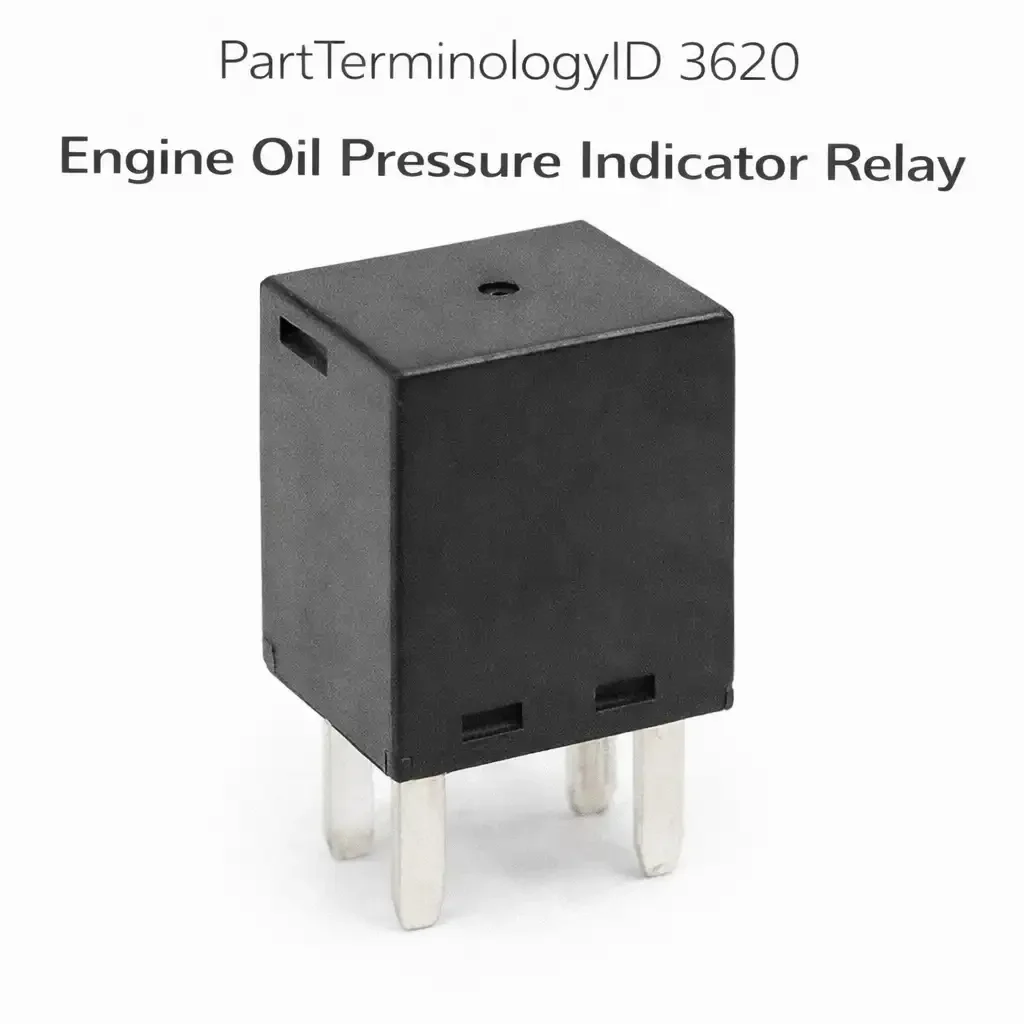
The Engine Oil Pressure Indicator Relay, cataloged under PartTerminologyID 3620, is the relay that interfaces between the engine's oil pressure switch and the low oil pressure warning lamp on the instrument panel. On platforms where this relay is present, it buffers the pressure switch signal from the indicator lamp circuit, allowing a low-current switch output to activate a relay-controlled warning path rather than powering the lamp directly. When engine oil pressure falls below the oil pressure switch's calibrated threshold, typically between four and ten psi depending on the application, the switch closes, the relay coil receives its trigger signal, the relay contacts close, and the warning lamp illuminates on the instrument panel. When adequate oil pressure is restored or maintained, the switch opens, the relay de-energizes, and the warning lamp extinguishes.
The distinction between this relay and the Engine Oil Level Relay (PartTerminologyID 3616) is the underlying sensor it responds to. The oil level relay governs the circuit for the oil quantity sensor in the oil pan, which monitors how much oil is present. The oil pressure indicator relay governs the circuit for the oil pressure switch on the engine block or oil filter housing, which monitors whether the oil circulation system is generating sufficient pressure to lubricate the engine's moving parts. Low oil pressure is the more immediately dangerous condition: a driver who receives no low oil pressure warning and continues operating the engine can cause catastrophic internal engine damage within minutes. This urgency gives the oil pressure indicator relay circuit a safety significance that demands particular care in diagnosis, listing accuracy, and buyer guidance.
What the Relay Does
The Oil Pressure Switch and Circuit Architecture
The oil pressure switch is threaded into the engine block, cylinder head, or oil filter housing at a point where it contacts the main oil gallery. Internally, it contains a diaphragm or piston that responds to oil pressure. When engine oil pressure is at or above the switch's set point, the pressure acts against the diaphragm and holds the switch contacts open. When pressure drops below the set point, the diaphragm relaxes and spring force closes the switch contacts. Because the switch is closed at zero pressure and opens under normal operating pressure, the warning lamp circuit is designed to be active when the switch is closed and inactive when the switch is open. This means the warning lamp illuminates when the engine is off, before oil pressure has been established, and extinguishes shortly after the engine starts and oil pressure builds.
On vehicles that use an intermediate relay in this circuit rather than connecting the oil pressure switch directly to the warning lamp, the relay coil receives a signal derived from the oil pressure switch's contact state. When the switch is closed at low or zero pressure, the coil completes its circuit and the relay energizes. The relay contacts close and complete the warning lamp circuit. When the switch opens under normal oil pressure, the relay coil loses its signal, de-energizes, and the relay contacts open, extinguishing the lamp. On some architectures the signal polarity is reversed and the relay de-energizes in the warning state, using normally-closed contacts to complete the lamp circuit at rest.
Why a Relay Is Used in This Circuit
On earlier and simpler vehicle electrical architectures, the oil pressure switch was wired directly in series with the warning lamp, grounding the lamp through the switch body to the engine block. This simple series circuit required no relay. On platforms where the oil pressure indicator relay exists as a separately cataloged component, the relay is typically present because the circuit architecture routes the oil pressure switch signal through a relay for one of several reasons: to allow the switch's low-current output to control a higher-current warning circuit, to interface the pressure switch signal with multiple downstream circuits simultaneously such as both the warning lamp and an engine protection shutdown circuit, to allow the BCM or instrument cluster to monitor the relay state as a digital input, or to insert a time delay into the warning lamp activation to prevent nuisance activations during engine cranking before oil pressure has fully built.
On some European platforms from the 1980s and 1990s, notably several Volkswagen and other German-market vehicles, a dedicated oil pressure warning relay is present in the fuse block to coordinate the oil pressure switch input with the instrument cluster's warning lamp output and with an audible buzzer circuit. These relay positions are well-documented in platform-specific service literature and represent the bulk of the discrete aftermarket catalog applications for PartTerminologyID 3620.
Failure Modes and Their Consequences
A relay that fails open in this circuit produces a warning lamp that never illuminates, even under genuine low oil pressure conditions. This is the most dangerous failure mode. A driver whose oil pressure drops due to a failing oil pump, a serious oil leak, or bearing failure receives no warning from the instrument panel and may continue driving until the engine suffers irreparable damage. An oil pressure indicator relay that has failed open must be treated as a critical safety fault, not an inconvenience.
A relay that has failed closed, or whose contacts are welded shut, produces a warning lamp that illuminates continuously regardless of actual engine oil pressure. This is the nuisance failure mode: the driver sees the warning lamp, shuts the engine off, and begins investigating, but the engine may be perfectly healthy. A welded-contact relay produces genuine concern and appropriate driver caution, even though the engine is not in danger. It is still wrong and must be corrected, but the consequence is a false alarm rather than a missed genuine emergency.
Top Return Scenarios
Oil Pressure Switch Fault Misdiagnosed as Relay
The oil pressure switch is threaded into the engine block and is exposed to heat, vibration, and oil contamination continuously throughout the engine's service life. Switch failures are substantially more common than relay failures in this circuit. A switch that has developed high internal resistance, a stuck diaphragm, or a corroded contact set either fails to open when pressure builds (producing a permanently illuminated lamp) or fails to close when pressure drops (producing no warning under genuine low pressure). In either case, the symptom can lead a buyer to suspect the relay rather than the switch.
Before ordering this relay, the buyer should test the oil pressure switch first. With the engine off and no oil pressure, the switch should show continuity across its terminals or between its terminal and the switch body for ground. With the engine running and oil pressure established, the switch should show an open circuit. If the switch fails either of these continuity checks, the switch is the fault and relay replacement will not restore correct circuit behavior. Listing content that explicitly describes this two-state switch test steers buyers toward the more commonly needed component and prevents relay returns from buyers whose fault is in the switch.
No-Warning Symptom Discovered During Inspection, Not by a Failure Event
A significant proportion of buyers ordering this relay have discovered that their oil pressure warning lamp does not illuminate during the ignition-on prove-out sequence that precedes engine cranking. On most vehicles, all warning lamps should illuminate briefly when the ignition is turned to Run before the engine starts, confirming the bulbs are functional. An oil pressure lamp that does not illuminate during this prove-out may indicate a burned-out bulb, a wiring open, a failed relay, or a failed switch that is stuck open rather than defaulting to closed. Before ordering the relay, the buyer should confirm the warning lamp bulb is functional by either substituting a known-good bulb or using a test light to confirm the lamp socket is receiving power and completing a ground through the circuit. A failed bulb is the simplest fault and the cheapest fix.
Relay Replaced, Warning Lamp Still On, Engine Assumed Healthy
A buyer experiencing a continuously illuminated oil pressure warning lamp replaces the relay, discovers the lamp is still on, and returns the relay as defective. In many of these cases the lamp remains on because the oil pressure switch is the actual fault, not the relay. In a smaller number of cases, the lamp remains on because the engine genuinely has low oil pressure due to a mechanical problem: low oil level, a failing oil pump, sludged oil passages, or worn bearings. Replacing an electrical component in the warning circuit and assuming the fault is cleared without verifying actual engine oil pressure is a diagnostic error that can have serious consequences. Every listing for PartTerminologyID 3620 should include a clear instruction that verifying actual oil pressure with a mechanical gauge is the correct first step when this warning lamp activates, before any electrical component is ordered or replaced.
Listing Requirements
Every listing for PartTerminologyID 3620 should include:
ACES fitment data confirmed against OEM wiring documentation that identifies a discrete engine oil pressure indicator relay position for the specific vehicle, since most platforms connect the oil pressure switch directly to the lamp or module without an intermediate relay
Body format, pin count, coil voltage, and contact rating stated for each application
Contact configuration stated as normally-open or normally-closed, since this determines the failure mode direction
OEM and verified aftermarket cross-reference numbers
A prominent instruction that verifying actual engine oil pressure with a mechanical oil pressure gauge is the mandatory first diagnostic step before any electrical component ordering or replacement
A note that the oil pressure switch is the more frequently failing component in this circuit and should be tested before ordering the relay
A clear statement that a non-illuminating oil pressure warning lamp is a safety-critical condition and that the vehicle should not be operated until the warning system is confirmed functional
A statement that the relay is sold as a standalone component and does not include the oil pressure switch, warning lamp bulb, or associated wiring pigtail
Frequently Asked Questions
My oil pressure warning lamp stays on after the engine warms up. Is this the relay?
The lamp staying on with the engine running indicates that the oil pressure switch contacts are remaining closed despite the engine being at operating pressure. Before suspecting the relay, verify actual engine oil pressure with a mechanical gauge teed into the oil pressure port. If the gauge confirms normal pressure, the oil pressure switch is likely the fault: its contacts are stuck closed and are not opening when pressure builds. If the mechanical gauge confirms genuinely low pressure, the engine has a mechanical oil pressure problem that must be addressed before any further operation. Replacing the relay in either of these scenarios does not correct the underlying fault.
My oil pressure warning lamp does not come on at all, even with the ignition in the Run position before starting. What should I check first?
Start with the warning lamp bulb. Confirm the bulb socket is receiving voltage with the ignition in Run and that the circuit path to ground through the oil pressure switch is intact by grounding the switch wire directly at the engine connector and observing whether the lamp illuminates. If the lamp does not illuminate when the switch wire is grounded, the fault is in the lamp, the socket, or the wiring between the lamp and the ignition supply. If the lamp illuminates when grounded manually but not through the switch, the oil pressure switch is stuck open and is not providing the ground path it should when the engine is off. If the lamp and switch both check out but the relay is not passing the switch signal to the lamp circuit, the relay coil or contacts have failed open.
What Sellers Get Wrong
Not leading with the mechanical pressure verification instruction
Every listing in this category that does not prominently instruct buyers to verify actual oil pressure with a mechanical gauge before ordering electrical components is contributing to a diagnostic pathway that can end with engine damage. A buyer who replaces the relay, discovers the warning lamp still illuminates, and continues to look for an electrical fault rather than accepting that the engine has a real low-pressure condition may destroy an engine that a simple dipstick check and mechanical gauge test would have saved. The mechanical verification instruction is not optional guidance in this category. It is the mandatory first step that belongs at the top of every listing description.
Applying fitment data to platforms where no discrete relay exists
The majority of vehicles on the road connect the oil pressure switch directly to the instrument cluster warning lamp circuit without any intermediate relay. Applying fitment data for PartTerminologyID 3620 broadly across vehicle platforms without confirming from OEM wiring documentation that a discrete relay position exists for each application will generate orders from buyers on switch-direct architectures who receive a relay they cannot install. These returns are entirely preventable with platform-specific fitment research.
Cross-Sell Logic
Engine oil pressure switch (the switch is the component most commonly at fault when the warning lamp malfunctions with a healthy engine; it should be tested before ordering this relay and is the appropriate replacement when the switch fails continuity testing in either the open or closed engine state)
Mechanical oil pressure gauge or test kit (verifying actual engine oil pressure is the mandatory first step in any oil pressure warning lamp diagnosis; a mechanical gauge that tees into the oil pressure port gives a definitive answer about whether the engine has a real pressure problem before any electrical component is ordered)
Warning lamp bulb (a failed bulb in the oil pressure indicator circuit eliminates the driver's warning system entirely; bulb condition should be confirmed as part of any prove-out sequence diagnosis)
Engine oil and filter (low oil level is the most common cause of genuinely low oil pressure; confirming oil level and condition is the first physical check before any electrical or mechanical pressure diagnosis proceeds)
Oil pump (when a mechanical oil pressure gauge confirms genuinely low engine oil pressure with adequate oil level and clean oil passages, the oil pump is the most likely mechanical fault causing the pressure deficiency that triggered the warning system)
Final Take
PartTerminologyID 3620 governs a circuit with immediate engine protection consequences. Unlike most relay categories where a failed part produces an inconvenience, a failed oil pressure indicator relay that prevents the warning lamp from activating under genuine low pressure conditions removes the driver's only electrical warning before catastrophic engine damage occurs. That asymmetry between the cost of the relay and the cost of the consequence it helps prevent defines the correct approach for every listing in this category: mechanical verification first, switch testing second, relay replacement only after both upstream causes are eliminated. Sellers who build that diagnostic sequence into their listing content earn the trust of technically competent buyers and prevent the returns that come from buyers who replaced the relay when the fault was a five-dollar switch or a quart of oil.