
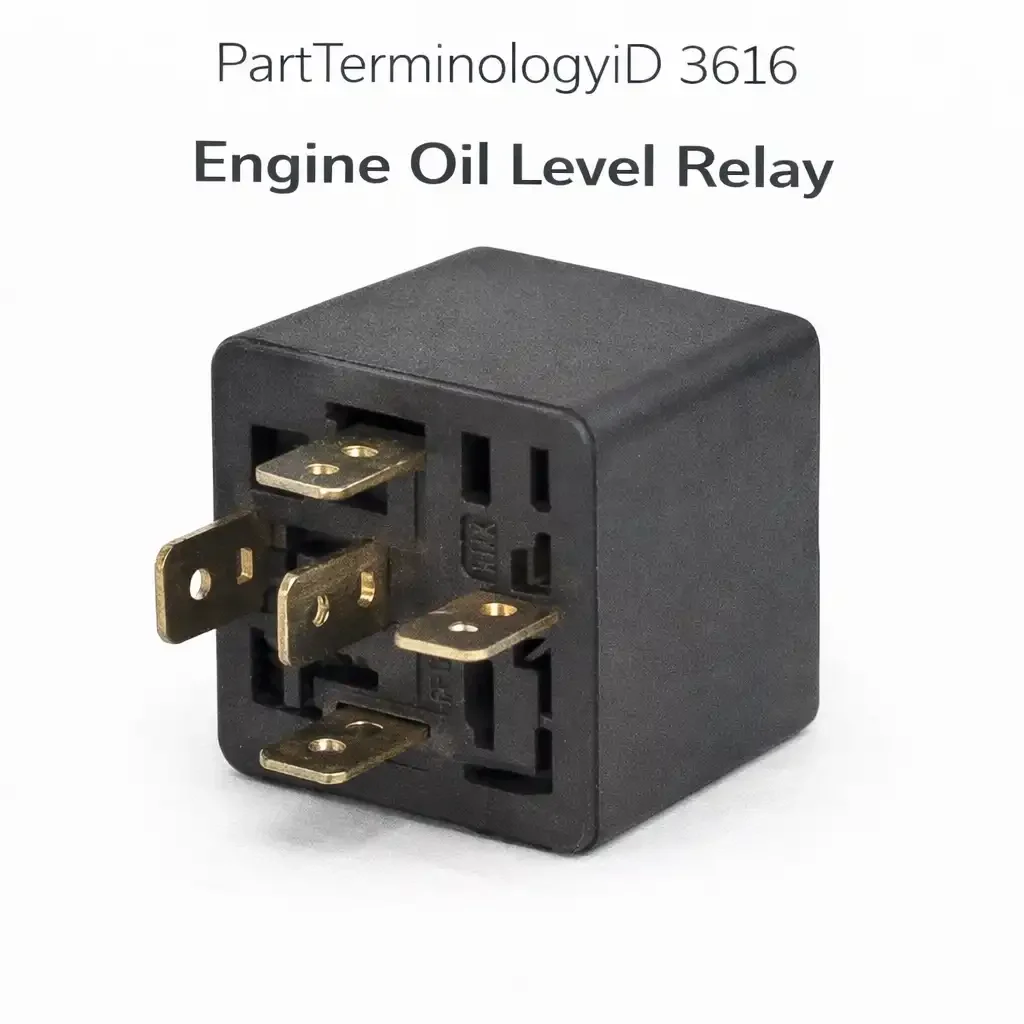
The Engine Oil Level Relay, cataloged under PartTerminologyID 3616, is the relay that responds to the oil level sensor signal in the engine crankcase and activates the low oil level warning circuit when the sensor detects that oil has dropped below an acceptable threshold. Its position in the circuit places it between the oil level sensor, which monitors the quantity of oil in the oil pan, and the warning lamp or instrument cluster indicator that alerts the driver. When the sensor signals a low oil condition, the relay coil receives its trigger, the relay contacts close, and the warning circuit is completed, illuminating the low oil level indicator on the instrument panel. When the oil level is adequate, the sensor holds the relay coil in its de-energized state, the relay contacts remain open, and the warning lamp stays off.
PartTerminologyID 3616 is a platform-specific category, appearing on vehicles where the OEM electrical architecture uses an intermediate relay to buffer the oil level sensor signal from the warning lamp or control module. Not every vehicle that has an oil level sensor uses a discrete, externally replaceable relay in this circuit. Many platforms route the oil level sensor output directly to a BCM or PCM input pin, where the module software evaluates the signal and activates the warning lamp through the instrument cluster without any relay in the path at all. Others route the sensor signal directly to the warning lamp in series, with no relay involved. The relay-based architecture that makes this PartTerminologyID relevant is more common on platforms from the 1980s through the early 2000s that used simpler, hardware-relay-driven warning circuits rather than software-managed indicator logic.
What the Relay Does
Oil Level Sensing and the Warning Circuit
The oil level sensor is mounted in the oil pan or lower crankcase, typically at a position that corresponds to the minimum acceptable oil level for safe engine operation. Sensor designs vary by manufacturer and model year. Simple float-based sensors use a buoyant element that rises and falls with the oil surface. When the oil drops below the sensor's trigger point, the float descends and a set of contacts either opens or closes depending on the circuit's normally-open or normally-closed design. More advanced resistive or ultrasonic sensor designs measure oil level electronically and transmit a continuous signal that a module interprets against a programmed threshold.
On platforms that use a relay-based warning circuit, the sensor's output in a low-oil condition either provides a ground path that completes the relay coil circuit, or breaks a ground path that was holding the relay coil de-energized, depending on how the circuit is designed. In the most common arrangement for relay-based architectures, the oil level sensor provides the relay coil's ground connection only when oil level is adequate. When the oil drops below the threshold, the sensor's float-operated contacts open, removing the coil ground, and the relay drops out. A normally-closed relay design in this circuit then closes its normally-closed contact path and completes the warning lamp circuit, illuminating the indicator. In this arrangement, a failed relay or an open in the coil ground path produces the same warning lamp activation as an actual low oil condition, because the relay defaults to its energized-warning state when the coil loses ground.
On other platforms, the circuit works in the opposite direction: the sensor sends a positive trigger or ground signal to the relay coil when low oil is detected, the relay energizes, and the normally-open contacts close to complete the warning lamp circuit. In this arrangement, a failed open relay or an open in the sensor signal path produces no warning even when oil is genuinely low, which is a more dangerous failure mode.
Understanding which circuit architecture applies to the target vehicle is the first step in diagnosing whether the relay is the fault and whether its failure is producing a nuisance warning or a suppressed warning.
What Happens When the Relay Fails
The relay's failure mode determines the symptom. A relay that fails open produces either a permanently illuminated oil level warning lamp, if the circuit design relies on the relay to suppress the warning when oil is adequate, or a permanently extinguished warning lamp, if the circuit relies on the relay to complete the warning path when the sensor triggers. A relay whose contacts have welded closed produces the opposite symptom from an open failure: whichever state the contacts were stuck in becomes permanent regardless of what the oil level sensor is reporting.
In all cases, the first diagnostic step before ordering a relay is to confirm the actual engine oil level on the dipstick. A legitimately low oil level is the most common cause of the warning lamp activating and must be ruled out before any electrical diagnosis begins. An illuminated oil level warning lamp with adequate oil on the dipstick indicates either a failed sensor, a wiring fault in the sensor circuit, or a relay fault. The relay is typically the easiest component to access and test first in the circuit, but it is not the most common fault. The oil level sensor itself fails more frequently than the relay, particularly in high-heat environments near the oil pan where thermal stress, oil contamination, and vibration accelerate sensor degradation.
Top Return Scenarios
Low Oil Level Not Checked Before Ordering
The most avoidable return in this category is a buyer who orders a relay because the oil level warning lamp is on, installs the relay, and discovers the warning lamp remains illuminated because the engine genuinely needs oil. Adding oil resolves the warning. The relay is returned as unnecessary. Every listing for PartTerminologyID 3616 should include a prominent first step: check the engine oil level on the dipstick before ordering any electrical component for this circuit. If the dipstick confirms the oil is at or above the minimum mark, proceed with electrical diagnosis. If the dipstick shows the oil is low, add oil to the correct level and observe whether the warning lamp extinguishes after the engine reaches operating temperature and the sensor has had time to confirm the level.
Oil Level Sensor Fault Misdiagnosed as Relay
The oil level sensor is the component most frequently at fault when the warning circuit malfunctions with adequate oil in the crankcase. The sensor is exposed to engine heat, oil contamination, sludge buildup, and vibration in the oil pan environment, all of which degrade sensor contacts and electrical components over time. A failed sensor that permanently reports low oil, or one that intermittently loses its signal due to corrosion at its connector, produces a warning lamp pattern that is identical from the driver's perspective to a relay fault. Replacing the relay without testing the sensor first is a likely path to a relay return and an unchanged symptom.
The test that distinguishes a sensor fault from a relay fault depends on the circuit architecture, but in most cases it involves unplugging the sensor connector and observing whether the warning lamp extinguishes or remains illuminated. If unplugging the sensor changes the lamp's state, the sensor or its wiring is in the circuit that controls the relay coil. If unplugging the sensor has no effect on the lamp, the relay's contacts may be stuck in the closed position independent of the sensor signal. Listing content that describes this one-step sensor connector test steers buyers toward confirming whether the fault is in the sensor path or the relay itself before ordering.
Wiring Fault Between Sensor and Relay Coil
An open or high-resistance fault in the wiring between the oil level sensor and the relay coil terminal produces the same symptom as a failed relay coil in circuits where the sensor provides the coil ground. The relay coil receives no ground, the relay drops to its default state, and the warning circuit activates. Replacing the relay does not restore the coil ground path because the wiring fault is upstream of the relay. The replacement relay exhibits the same behavior as the original, and the buyer returns it.
Before concluding the relay is at fault, the coil ground terminal should be probed with a voltmeter or test light to confirm whether a ground signal is present from the sensor when oil level is adequate. If no ground is present with adequate oil and the sensor connector is intact, the fault is either the sensor or the wiring between sensor and relay rather than the relay itself.
Listing Requirements
Every listing for PartTerminologyID 3616 should include:
ACES fitment data confirmed against OEM wiring documentation that identifies a discrete engine oil level relay in the fuse block or relay panel for the specific vehicle variant, noting that many platforms route the oil level sensor signal directly to a module input and do not use a separate relay
Body format, pin count, coil voltage, and contact rating stated for each application
Whether the relay is normally-open or normally-closed in the warning circuit, since this determines the failure mode direction and affects the diagnostic approach
OEM and applicable aftermarket cross-reference part numbers where verified
A first-step instruction directing buyers to verify actual engine oil level on the dipstick before ordering any electrical component for this circuit
A note that the oil level sensor itself is the more common failure point in this circuit and that sensor function should be tested before concluding the relay is at fault
A clear statement that the relay is sold as a standalone component and does not include the oil level sensor, oil level sensor connector pigtail, or warning lamp bulb
Frequently Asked Questions
My low oil level warning lamp is on but the dipstick shows adequate oil. Is this relay the problem?
Possibly, but the sensor is more likely the fault. With adequate oil confirmed on the dipstick, the next step is to test the sensor. Unplug the oil level sensor connector and observe whether the warning lamp extinguishes or changes state. If the lamp behavior changes, the sensor or its wiring is the active element in the circuit. If unplugging the sensor has no effect, a relay with stuck closed contacts may be responsible. In either case, performing this test before ordering a relay confirms whether the relay is actually in the fault path.
Can I test the relay on the bench before installing it?
Yes. Remove the relay from its socket and apply twelve volts to the coil positive terminal and a ground to the coil ground terminal. Listen for a click confirming coil and armature function. Then test continuity across the load contact terminals with and without coil power applied to confirm the contacts are opening and closing as expected. For a normally-open relay, continuity should be absent without coil power and present with coil power. For a normally-closed relay, continuity should be present without coil power and absent with coil power. If the relay passes the bench test, the fault is in the circuit around the relay rather than in the relay itself.
What Sellers Get Wrong
Not differentiating normally-open from normally-closed configurations
The engine oil level relay's contact configuration determines the direction of its failure mode, and the two configurations are not interchangeable. A normally-open relay installed in a position that requires normally-closed contacts will reverse the circuit's logic, producing a warning lamp that is permanently off regardless of oil level, which eliminates the driver's low oil protection entirely. Listings that do not specify contact configuration for each application risk sending normally-open relays to applications requiring normally-closed contacts and vice versa. This is one of the few relay return scenarios where the installed part is not only incorrect but actively reduces vehicle safety.
Applying the listing to sensor-direct or module-controlled platforms
Including vehicles whose oil level warning circuit feeds directly from sensor to module input, without an intermediate relay, in the fitment data for this relay will generate orders for a part that does not exist in those vehicles' circuits. The buyer searches for the relay, cannot find a socket for it in the fuse block, and returns the part. Fitment data must be derived from OEM wiring documentation that confirms a discrete relay position rather than from symptom matching alone.
Cross-Sell Logic
Engine oil level sensor (the sensor is the component most frequently at fault in this circuit and should be the primary diagnostic focus when the warning lamp illuminates with adequate oil on the dipstick; replacing the sensor resolves the majority of nuisance warning lamp activations in this circuit)
Engine oil level sensor connector pigtail (corrosion or damaged terminals at the sensor connector interrupt the signal path between sensor and relay coil, producing a relay behavior that does not reflect the sensor's actual output; a replacement pigtail restores the sensor connection without requiring sensor replacement)
Warning lamp bulb (a burned-out warning lamp bulb in the oil level indicator circuit means the driver receives no warning even when the relay correctly activates the circuit; confirming the bulb is intact before concluding the warning system is inoperative prevents misdiagnosis of an upstream relay or sensor fault)
Engine oil and filter (the actual oil level is the first thing to check and the most common cause of a legitimately activated warning lamp; including the correct oil specification for the target vehicle in the listing cross-sell logic serves buyers who discover their oil is genuinely low)
Final Take
PartTerminologyID 3616 governs a safety-adjacent circuit: the system that warns a driver before oil deprivation causes engine damage. The relay's role is narrow, the circuit is simple, and the relay itself is rarely the primary fault. Most buyers who arrive at this relay have an illuminated warning lamp and a working engine; the relay is their next guess after confirming the oil level seems acceptable. The seller who leads with the dipstick check instruction, explains the sensor-first diagnostic sequence, and provides accurate normally-open versus normally-closed configuration data for each application will reduce returns, build buyer confidence, and keep their cross-sell path to the more commonly needed oil level sensor in front of buyers who need it.