
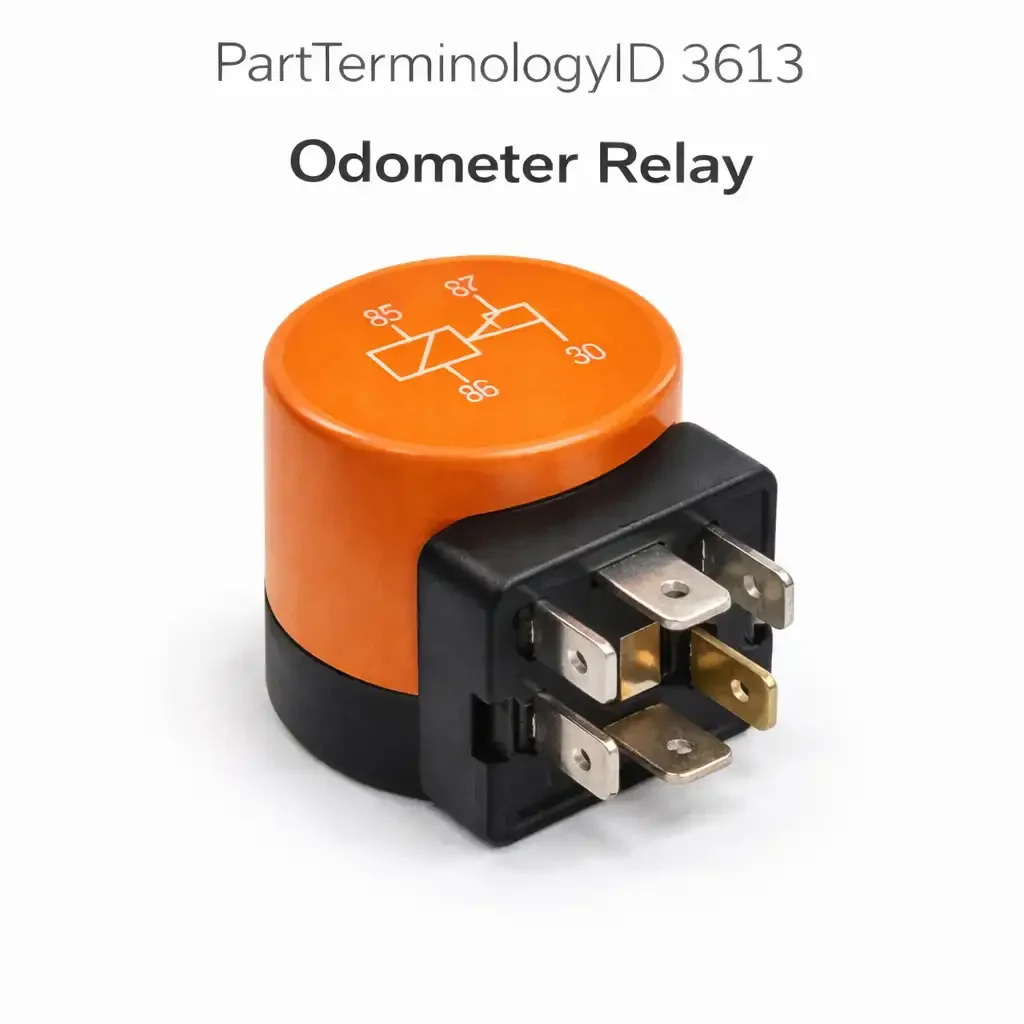
The Odometer Relay, cataloged under PartTerminologyID 3613, is the relay that supplies switched power to the odometer display circuit within the instrument cluster. On vehicles where the instrument cluster's internal circuitry separates the odometer's power supply from the broader cluster supply, this relay provides the ignition-switched voltage that energizes the odometer's display module, memory write circuitry, or vacuum fluorescent display driver. When the relay functions correctly, the odometer illuminates with ignition-on, counts distance as the vehicle moves, and retains its accumulated mileage in non-volatile memory between ignition cycles. When the relay fails open, the odometer display goes dark or stops counting while the rest of the instrument cluster may continue to operate normally, since other cluster sub-circuits draw power through separate paths.
PartTerminologyID 3613 is a narrow category. Not every vehicle platform uses a discrete, separately replaceable relay to power the odometer circuit specifically. On many modern vehicles, the entire instrument cluster draws power through a single ignition-switched supply, and the odometer operates from that shared supply without a dedicated relay. The relay-specific architecture that makes this PartTerminologyID relevant tends to appear on platforms from the late 1980s through the 2000s that used modular instrument cluster designs with sub-circuit switching, where individual display or driver circuits within the cluster had their own relay-controlled power paths to reduce parasitic draw, manage display sequencing, or allow individual sub-circuit replacement without replacing the entire cluster assembly.
What the Relay Does
The odometer relay's coil receives an ignition-switched trigger that energizes the relay when the ignition is turned to the run position. The relay contacts close and supply battery voltage to the odometer circuit's power input terminal. The odometer display driver activates, the accumulated mileage stored in the cluster's non-volatile memory is read and displayed, and the vehicle speed sensor input begins incrementing the count as the vehicle moves. When the ignition is turned off, the relay de-energizes, the contacts open, and the odometer display circuit loses power. The current mileage total is written to non-volatile memory before the display circuit fully powers down, preserving the odometer reading across ignition cycles.
On platforms where the odometer relay also powers the trip meter reset circuitry or the odometer's external communications interface with the BCM or PCM, relay failure can affect not only the odometer display but also any module function that depends on receiving a vehicle speed or distance signal from the instrument cluster. If the BCM uses the instrument cluster as the source for accumulated mileage data and the cluster cannot receive power to its odometer sub-circuit, distance-based service reminders, fuel economy calculations, and other interval-based functions may be disrupted alongside the visible display failure.
Top Return Scenarios
Instrument Cluster Fault Misdiagnosed as Relay
The most common return for PartTerminologyID 3613 is a buyer whose odometer display is inoperative due to a printed circuit board fault within the instrument cluster itself, a failed odometer display driver IC, a cracked solder joint on the cluster PCB, or a failed odometer memory chip, and who replaces the relay without confirming that the relay's output terminal is actually delivering voltage to the cluster. If the relay is functioning correctly but the cluster's internal circuitry has failed, relay replacement does not restore the display. The buyer receives a correct relay, installs it, the odometer remains dark, and the relay is returned as defective. The actual fault is inside the cluster, which typically requires either a cluster-specific repair or a complete cluster replacement.
Before ordering this relay, the buyer should confirm with a voltmeter that the relay's output terminal is not delivering voltage to the cluster connector with the ignition on. If voltage is present at the cluster connector but the odometer remains dark, the fault is inside the cluster and relay replacement will not help.
Fuse Fault Bypassed by Relay Replacement
A blown fuse in the circuit that supplies the relay's load terminal produces an odometer failure symptom identical to a failed relay. The buyer identifies the relay as the suspect, replaces it, and discovers the odometer is still inoperative because the replacement relay also has no voltage available at its load terminal. Listing content that directs the buyer to confirm fuse condition before ordering prevents this scenario.
Listing Requirements
Every listing for PartTerminologyID 3613 should include:
ACES fitment data at the year, make, model, and trim level, confirmed against OEM wiring documentation that identifies a discrete odometer relay position in the fuse block or relay center for that specific vehicle variant
Body format, pin count, coil voltage, and contact rating stated explicitly
OEM and aftermarket cross-reference numbers where verified
A note advising buyers to confirm the relay's output terminal is not delivering voltage to the instrument cluster connector before ordering, to rule out an upstream fuse fault and distinguish a relay failure from an internal cluster failure
A clear statement that this relay powers the odometer display circuit within the cluster and is not the instrument cluster assembly itself
What Sellers Get Wrong
Applying the listing to vehicles without a discrete odometer relay
The most significant cataloging error in this category is including vehicles whose odometer circuit draws power through the instrument cluster's main supply relay rather than through a dedicated odometer relay. On these platforms, there is no discrete part matching PartTerminologyID 3613 in the electrical architecture, and a buyer who orders a relay for one of these vehicles receives a part their vehicle does not use. Fitment data must be built from OEM wiring diagrams that confirm a separately switched, relay-controlled odometer power circuit rather than assumed from symptom description alone.
Cross-Sell Logic
Instrument cluster fuse (the fuse in the odometer relay load circuit is the first thing to check when the display is dark; it is the most common cause of the symptom and is less expensive to verify and replace than the relay)
Instrument cluster assembly (if the relay output voltage is confirmed present at the cluster connector but the odometer remains inoperative, the fault is internal to the cluster; a replacement or refurbished cluster is the appropriate next step)
Instrument cluster printed circuit board (on platforms where the cluster PCB is sold separately from the cluster housing, a failed PCB that has developed cracked solder joints at the odometer driver circuit can be repaired or replaced without replacing the full cluster)
Final Take
PartTerminologyID 3613 serves a narrow, platform-specific role in the instrument cluster power distribution architecture. Its symptom, a dark or non-counting odometer display, overlaps with internal cluster failures that are far more common than relay failures in this circuit. The seller who builds fitment data carefully against OEM wiring documentation, warns buyers to verify relay output voltage before ordering, and includes a clear cross-sell path to the instrument cluster for buyers whose fault is internal to the cluster will minimize returns and establish credibility in a category where misdiagnosis is the rule rather than the exception.