
Neutral Safety Switch Relay (PartTerminologyID 3612): Diagnosis, Return Prevention and Listing Guide
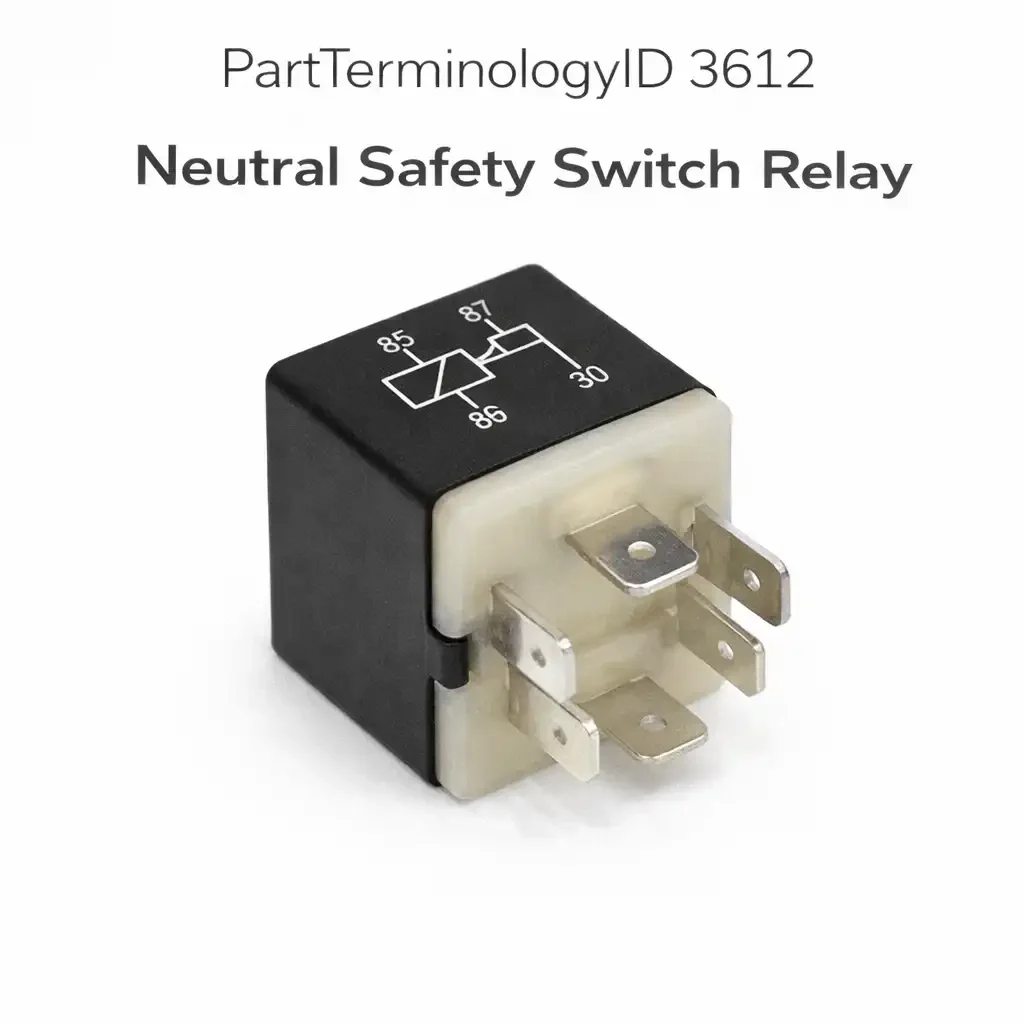
The Neutral Safety Switch Relay, cataloged under PartTerminologyID 3612, is the electromechanical relay that sits between the transmission's park/neutral position signal and the starter solenoid circuit on automatic transmission vehicles. Its purpose is straightforward and safety-critical: it allows the starter motor to engage only when the transmission is confirmed to be in Park or Neutral. When the gear selector is in any driven gear position, the relay's coil circuit remains open, the relay contacts stay open, and no current reaches the starter solenoid regardless of whether the ignition switch is turned to the start position. The vehicle cannot be cranked in gear. When the transmission is correctly placed in Park or Neutral, the park/neutral switch completes the coil ground path, the relay energizes, its contacts close, and the ignition start signal passes through to the starter solenoid.
PartTerminologyID 3612 is specific to the relay component in this circuit, not to the park/neutral switch itself or to the starter. Understanding that distinction matters for sellers and buyers: the neutral safety switch relay is a fuse block or underhood relay center component that can be accessed and replaced independently of the transmission-mounted switch that supplies its control signal. On many platforms the relay is a standard ISO plug-in relay housed in the engine compartment fuse block, making it one of the more accessible components in an otherwise complex starting interlock circuit. On some platforms the relay function is integrated into the starter relay, the ignition relay, or controlled directly by the PCM, which means that not every automatic transmission vehicle will have a discrete, separately replaceable neutral safety switch relay. Fitment data accuracy and circuit architecture understanding are essential for sellers in this category.
What the Relay Does
The Starting Interlock Circuit
The neutral safety switch relay is one of several series elements in the starter control circuit. On a conventional automatic transmission vehicle, the ignition switch in the start position sends a switched voltage signal toward the starter solenoid's S terminal. That path passes through a relay whose coil is controlled by the park/neutral position switch on the transmission. When the transmission is in Park or Neutral, the park/neutral switch completes a ground path for the relay coil. The relay energizes, its normally-open contacts close, and the start signal voltage passes through the relay contacts and continues to the starter solenoid. The solenoid receives current, its plunger engages the flywheel ring gear, and the starter motor cranks the engine.
When the transmission is in any forward or reverse gear, the park/neutral switch breaks the relay coil's ground path. The relay coil cannot complete its circuit. The relay stays de-energized, the contacts remain open, and no start signal reaches the solenoid regardless of whether the driver has turned the ignition to Start. The starter motor is effectively disconnected from the starting circuit by the relay's open contacts. This interlock prevents engine cranking while the transmission is under load, which would cause the vehicle to lurch forward or backward as soon as the starter engaged the drivetrain.
On older vehicle architectures, this relay function was accomplished with simple mechanical switches and no relay in the circuit at all. A direct switch completed or interrupted the start circuit based on gear position. On more modern electronic architectures, the park/neutral position information flows to the PCM or TCM as a sensor signal, and the module decides whether to energize the starter relay based on that input along with other conditions such as brake pedal depression and ignition key authentication. In these modern architectures there may be no discrete neutral safety switch relay of the traditional type; the starter relay is commanded by the module and the module enforces the park/neutral condition in software rather than through a hardware relay interlock.
PartTerminologyID 3612 applies to the relay hardware used in architectures where a discrete relay performs the park/neutral interlock function in the starting circuit. Sellers must understand which architecture a given vehicle uses before listing this relay against a particular application.
Relay Position and Circuit Variants
The neutral safety switch relay typically occupies a dedicated, labeled position in the engine compartment fuse block or power distribution center. On some platforms it shares a common relay socket format with other fuse block relays, making it a plug-and-play replacement that requires no tools beyond pulling the old relay and seating the new one. On other platforms, the relay is mounted separately on a bracket near the battery or starter, connected by a pigtail harness rather than a fuse block socket.
The coil trigger arrangement varies across platforms. On some vehicles, the coil receives a switched positive from the ignition start circuit, and the park/neutral switch provides the ground path. On others, the coil positive is a continuous battery supply and the ignition start signal is fed through the park/neutral switch before reaching the coil ground. And on a third architecture type, the relay coil is driven by a module output pin, with the module having already validated the park/neutral switch input before deciding to ground the coil. Each of these arrangements produces a different diagnostic approach when the circuit fails, and a different set of symptoms when the relay itself is at fault versus when an upstream or downstream component has failed.
What Happens When the Relay Fails
A neutral safety switch relay fails in two possible directions: it fails open, or it fails closed. A relay that fails open presents as a no-crank condition in Park and Neutral that cannot be explained by a dead battery, failed starter, or open ignition switch. The transmission is in the correct gear position, the park/neutral switch is sending its signal, but the relay contacts are not closing. The vehicle will not crank in any gear or position. A relay that fails closed presents a different and more dangerous symptom: the vehicle can be cranked in any gear position, because the relay contacts are permanently connected regardless of the coil's energization state. A relay that has welded contacts due to contact arcing, or that has a mechanically stuck armature, can produce this always-closed failure mode.
The always-closed failure is a safety hazard. A vehicle that can be cranked in Drive or Reverse will lurch in the direction of the selected gear the moment the starter engages the drivetrain. This symptom requires immediate attention and should not be temporarily tolerated. Sellers whose listings describe this relay should note both failure modes clearly, both to serve buyers who are dealing with a no-crank symptom and to serve buyers who are dealing with the more urgent always-cranks symptom that indicates a failed closed relay.
Top Return Scenarios
Correct Relay, Wrong Circuit Architecture
The most avoidable return in this category results from a buyer applying a discrete neutral safety switch relay to a vehicle whose starting interlock is handled by the PCM or a body control module rather than by a standalone relay in the fuse block. On module-controlled platforms, the relay position labeled in the fuse block diagram as a starter relay or crank relay may receive its energization decision from the module, with the park/neutral switch input feeding a module pin rather than the relay coil directly. Replacing a relay on this type of platform does not address a starting failure caused by the module failing to send the starter command, by the park/neutral switch failing to send its input to the module, or by a wiring fault between the module and the relay coil. The buyer replaces the relay, the vehicle still does not crank, and the relay is returned as defective.
The listing's role in preventing this return is to help the buyer understand whether their vehicle uses a traditional relay-in-series architecture or a module-controlled starter architecture. Where the vehicle's architecture uses a module-controlled starter, a brief note in the listing that the relay receives its ground signal from the module rather than directly from the park/neutral switch steers the buyer toward verifying the module's output signal before attributing the no-crank symptom to the relay.
Park/Neutral Switch Fault Blamed on the Relay
The second most common return results from a buyer who has a park/neutral switch fault and diagnoses it as a relay fault. If the park/neutral switch on the transmission has failed open, is misadjusted, or has a wiring fault between the switch and the relay coil, the relay coil receives no ground signal and the relay cannot energize. The symptom is identical to a failed relay: no crank in Park or Neutral. The buyer replaces the relay, the relay is not the fault, the vehicle still does not crank, and the relay comes back.
The diagnostic step that distinguishes a failed relay from a failed park/neutral switch is straightforward: apply a direct ground to the relay coil's ground terminal while the ignition is in Start and check whether the relay clicks and the starter engages. If the relay clicks when ground is applied directly but would not energize under normal operation, the relay is functioning correctly and the fault is in the circuit that supplies the coil ground, which leads back to the park/neutral switch, the wiring between the switch and the relay, or a module output that is failing to command the ground. A listing that includes this single diagnostic step in its description prevents a significant proportion of park/neutral switch faults from resulting in relay returns.
Always-Cranks Symptom Without Welded Relay
A buyer experiencing a vehicle that cranks in gear may identify the neutral safety switch relay as the suspect and order a replacement. If the relay's contacts are welded shut due to contact arcing from a sustained overcurrent event in the starting circuit, a replacement relay is appropriate. However, if the always-cranks symptom results from a failed park/neutral switch that is permanently grounding the relay coil regardless of gear position, or from a wiring short that is permanently grounding the relay coil circuit, the relay itself is functioning correctly in the energized state and replacing it will not resolve the symptom. The replacement relay will also present as always-energized because the coil ground fault is still present.
This scenario is less common than the no-crank return but produces a confusing outcome: the buyer installs a new relay, the vehicle still cranks in any gear, and the relay is returned as defective. Listing content that describes how to distinguish a welded relay from a persistently-grounded coil circuit, by checking whether the relay coil ground terminal is receiving a ground signal regardless of gear position, helps buyers identify whether the relay or the circuit upstream of the relay is the actual fault.
Ignition or Starter Fault Misdiagnosed as Relay
No-crank conditions are frequently attributed to the neutral safety switch relay when the actual fault is elsewhere in the starting circuit. A failed starter solenoid, a failed ignition switch that is not sending the start signal, a blown fuse in the crank circuit, or an open in the wiring between the relay output and the starter solenoid all produce a no-crank symptom that is diagnostically identical to a failed relay from the driver's seat. Buyers who arrive at the relay as the suspect through process of elimination and who have not verified voltage at the relay's load output terminal will sometimes replace the relay and discover the circuit still does not function because the fault was downstream of the relay.
Listing Requirements
To meet minimum catalog accuracy standards for PartTerminologyID 3612, sellers should confirm and include the following:
ACES vehicle fitment data verified at the year, make, model, sub-model, and transmission type level, with a note confirming that the listing applies only to automatic transmission vehicles and that manual transmission vehicles use a clutch safety switch rather than a neutral safety switch relay
Confirmation that the target vehicle uses a discrete neutral safety switch relay rather than module-controlled starter logic, with a note identifying where the relay is located: fuse block position number, underhood relay bracket, or other location
Physical body format, pin count, coil voltage, and contact rating stated, with body format confirmed against the OEM relay socket type
OEM part number cross-reference and applicable aftermarket part numbers where verified
Explicit statement that this relay is part of the starting interlock circuit and that replacement should only proceed after the park/neutral switch function, relevant fuses, and wiring continuity have been verified
A brief symptom guide distinguishing the failed-open symptom from the failed-closed symptom, to help buyers identify which failure mode they are addressing
A clear statement that the relay is sold as a standalone component and does not include the park/neutral switch, transmission range sensor, pigtail harness, or starter
Frequently Asked Questions
How do I confirm that the neutral safety switch relay is actually at fault before ordering?
The two-step test is most reliable. First, with the transmission in Park and the ignition turned to Start, use a test light or voltmeter to check for a ground signal at the relay coil's ground terminal. If the park/neutral switch is functioning and the wiring is intact, you should see a ground at that terminal. If the ground is absent, the fault is upstream of the relay: the park/neutral switch, the wiring between the switch and the relay, or a module output that is failing to provide the ground. If the ground is confirmed at the coil terminal but the relay does not click and the starter does not crank, the relay coil has failed open and relay replacement is appropriate. Second, remove the relay from its socket and test it on the bench: apply 12V to the coil positive terminal and a ground to the coil ground terminal and listen for a click. If no click occurs, the coil is open and the relay has failed. If a click occurs, the coil is functional and the fault may be at the relay contacts or at a point in the circuit other than the relay.
My vehicle cranks in every gear position. Is this the relay?
It can be, but confirming requires one check before replacing the relay. With the relay installed and the ignition in Start, use a test light to check whether the relay coil ground terminal is receiving a ground signal when the transmission is in Drive or Reverse. If it is, the park/neutral switch is permanently grounding the coil regardless of gear position, and the fault is the park/neutral switch or a wiring short in the coil ground circuit rather than the relay. If the coil ground is not present but the starter still engages, the relay contacts are welded in the closed position, and relay replacement is appropriate. A welded relay must be replaced immediately, and the cause of the welding, typically a high-inrush current event or a sustained overcurrent condition, should be identified before operating the vehicle.
Can the neutral safety switch relay be bypassed for diagnostic purposes?
Temporarily bypassing the relay by connecting the relay's load output terminal directly to the ignition start signal allows the technician to confirm whether the starter motor and solenoid are functional independently of the relay circuit. This bypass eliminates the relay and the park/neutral switch from the diagnostic, so if the starter cranks when bypassed, the fault is confirmed to be in the relay circuit rather than in the starter or its wiring. The bypass must only be used for a brief diagnostic check and must never be left in place for vehicle operation, because it removes the gear-position interlock that prevents cranking while the vehicle is in a driven gear position.
My vehicle is a manual transmission. Does it use a neutral safety switch relay?
Manual transmission vehicles do not use a neutral safety switch relay. They use a clutch safety switch, which is located on the clutch pedal assembly and prevents starting unless the clutch pedal is depressed. The clutch safety switch functions as the starting interlock for manual transmission vehicles. PartTerminologyID 3612 applies only to automatic transmission vehicles that use a park/neutral position switch on the transmission to control the starting interlock.
What Sellers Get Wrong
Applying the listing to vehicles with module-controlled starters
Modern vehicles that use PCM or BCM-controlled starter relay circuits do not use a discrete neutral safety switch relay of the traditional type. On these platforms, the park/neutral switch feeds a sensor input to the module, and the module decides whether to energize the starter relay based on that input and other conditions. Listing a neutral safety switch relay against these vehicles generates orders from buyers whose no-crank condition is caused by a module output fault, a sensor input fault, or a software condition rather than a relay failure. The relay they receive does not address their fault, and returns follow. Fitment data for this category must exclude vehicles whose starting architecture routes the park/neutral switch signal to a module input rather than directly to a relay coil.
Skipping the transmission type qualifier in fitment data
A listing that covers all variants of a given vehicle platform without specifying transmission type will generate orders from manual transmission buyers who do not use this relay. Manual transmission vehicles of the same year, make, and model as automatic transmission vehicles with the same body style need the clutch safety switch, not the neutral safety switch relay. The ACES transmission qualifier field exists precisely for this purpose and must be used correctly in the fitment data for every application in this category.
Not addressing both failure modes in the listing
Most listings in this category describe only the no-crank failure mode, because it is the more common symptom. A listing that ignores the failed-closed, always-cranks failure mode misses buyers who are dealing with the more urgent safety hazard and who may not connect their symptom to the relay without some guidance. Addressing both failure modes in the listing description makes the listing useful to a broader set of buyers and demonstrates technical depth that builds purchasing confidence.
Not distinguishing the relay from the park/neutral switch
A buyer who does not know the difference between the neutral safety switch relay and the park/neutral switch on the transmission may order this relay intending to replace the switch, or may order the transmission-mounted switch intending to replace this relay. Both parts are part of the same interlock circuit, and their names are similar enough to cause confusion. A listing for PartTerminologyID 3612 should clearly state that this relay is located in the fuse block or relay panel, not on the transmission, and that it is a separate component from the park/neutral switch or transmission range sensor that mounts on the transmission case. This distinction prevents cross-ordering between the two parts and reduces returns from buyers who received a relay when they needed a transmission switch.
Cross-Sell Logic
Buyers ordering or researching the neutral safety switch relay are candidates for the following related components and tools, which address parallel failure modes, circuit prerequisites, and diagnostic needs in the starting interlock circuit.
Park/neutral position switch or transmission range sensor (the park/neutral switch on the transmission provides the coil control signal for the neutral safety switch relay; a failed switch that does not complete the relay coil ground in Park or Neutral produces the same no-crank symptom as a failed relay; buyers who confirm the relay functions correctly on the bench but whose vehicle still will not crank should test the park/neutral switch output before concluding the relay is the fault)
Starter motor and solenoid (a failed starter or starter solenoid produces a no-crank symptom even when the neutral safety switch relay is functioning correctly and passing the start signal; confirming voltage at the starter solenoid S terminal during a crank attempt rules out the relay and starter relay as faults and implicates the starter itself)
Ignition switch (the ignition switch generates the start signal that the relay passes to the starter solenoid; a failed ignition switch that does not send the start signal in the crank position produces a no-crank condition upstream of the relay that replacing the relay will not resolve)
Crank or start fuse (a blown fuse in the crank circuit interrupts the start signal before it reaches the relay input terminal or the relay coil; fuse condition should be the first check in any no-crank diagnosis before ordering any relay or switch)
Relay socket or pigtail harness (corrosion or deformed terminals in the relay socket can prevent the relay contacts from making a reliable connection with the circuit even after the relay body is replaced; buyers whose no-crank condition returns after relay replacement should inspect the socket terminals)
Wiring harness repair kit (an open or high-resistance fault in the wiring between the park/neutral switch and the relay coil ground terminal, or between the relay load output and the starter solenoid S terminal, produces a circuit failure that relay replacement does not address; harness repair or a replacement pigtail may be required)
Final Take
PartTerminologyID 3612 sits at the intersection of a safety-critical circuit and a diagnostic challenge that confuses buyers at every level of technical ability. The neutral safety switch relay's role is narrow and well-defined: it enforces the park/neutral starting interlock by standing in series between the ignition start signal and the starter solenoid, controlled by the transmission's gear position switch. But because its symptom overlaps with every other failure mode in the starting circuit, buyers frequently arrive at the relay as the suspected fault without having confirmed it through basic circuit testing.
The listings that work best in this category do two things well. First, they build precise fitment data that correctly exclude vehicles with module-controlled starter architectures and manual transmission variants, preventing orders that are guaranteed to result in returns because the relay is not part of those vehicles' starting circuits. Second, they give buyers the brief but specific diagnostic guidance needed to confirm the relay is the actual fault before ordering: check the coil ground signal at the relay terminal, remove the relay and bench-test the coil, and confirm voltage is present at the relay's load output terminal before concluding the circuit fault lies downstream. A buyer who has confirmed the relay coil is open and the contacts are not closing before placing an order is a buyer who will install the replacement correctly and will not return it.