
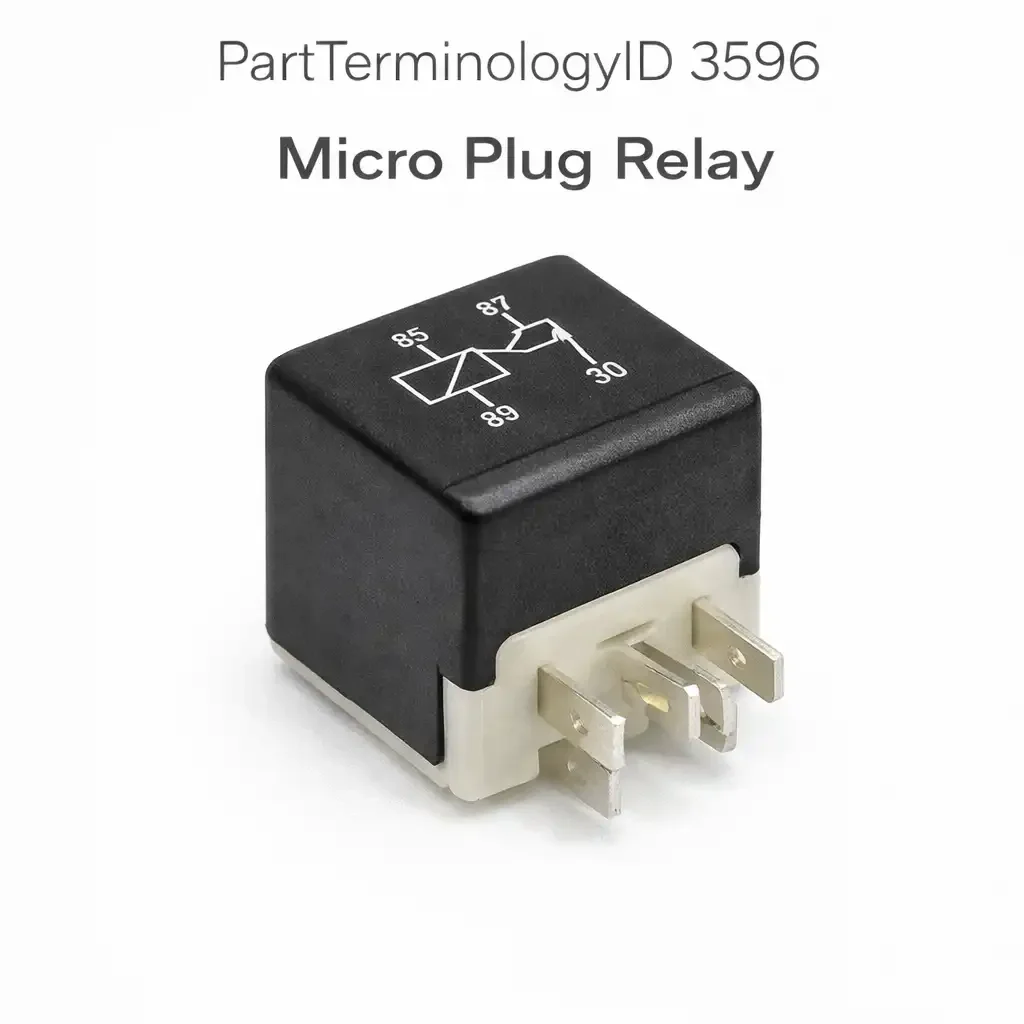
The Micro Plug Relay, cataloged under PartTerminologyID 3596, is a compact ISO-format electromechanical relay distinguished from the standard ISO mini relay by its reduced body thickness. Where the ISO mini relay occupies a roughly one-inch cube footprint in a fuse block socket, the ISO micro relay measures approximately one inch by one inch by half an inch, making it half the thickness of the mini relay. This dimensional difference is not cosmetic: micro relay sockets and mini relay sockets are not interchangeable. A micro relay installed in a mini relay socket will not seat correctly and will not make reliable contact. A mini relay cannot be inserted into a micro relay socket at all. The micro relay format was developed to allow higher-density fuse block designs that accommodate more relay positions in the same panel footprint, and it is found across a wide range of modern vehicle makes and models in both domestic and import applications.
PartTerminologyID 3596 categorizes the relay by its physical format rather than by the circuit function it serves. A micro plug relay may govern lamp circuits, door lock actuators, power window motors, fuel pumps, cooling fans, horn circuits, HVAC blower controls, sunroof motors, or any other moderate-current switched circuit where the fuse block designer specified the micro format for space efficiency. The relay's internal switching function, coil voltage, contact rating, and normally-open or normally-closed configuration vary across applications and must be confirmed against the target vehicle's specification before fitment is built. Sellers working with this category must resist the temptation to treat micro plug relays as a single interchangeable commodity and must account for the application-specific variations that determine whether a given relay is appropriate for a specific socket position.
What the Relay Does
ISO Micro Format and Physical Characteristics
The ISO micro relay body is rectangular, approximately 28mm by 15mm in footprint and 15mm in height, compared to the ISO mini relay's approximately 28mm square footprint at 28mm height. The pin layout on a micro relay differs from the mini relay pin layout despite using the same DIN 72552 terminal numbering conventions on some variants. On four-pin micro relays, the terminals are typically numbered 1, 2, 3, and 4 rather than 85, 86, 87, and 30 as on the mini relay, though the functional assignments are equivalent: pins 1 and 2 are the coil control circuit, pin 3 is the common load terminal, and pin 4 is the normally-open load output. Five-pin changeover versions add pin 5 as the normally-closed load output. On some manufacturer-specific micro relay variants, terminal numbering follows the 85, 86, 87, 87a, 30 convention used on mini relays, which can cause confusion when a buyer attempts to cross-reference the relay by pin function rather than by physical part number.
The micro relay's reduced height means it requires a dedicated socket with pin spacing matched to the micro body dimensions. Because the socket pin spacing is different from the mini relay socket, a physically correct micro relay for the application must be specified in fitment data. A relay that matches the circuit function but comes in the mini body format will not fit the micro socket and will be returned immediately. This physical format match requirement is the dominant fitment concern for PartTerminologyID 3596 and is what distinguishes this category from the application-specific relay categories where circuit function is the primary fitment variable.
Circuit Functions Served by Micro Relays
The micro relay format is used across a broad range of vehicle electrical circuits wherever the fuse block or relay center design specified compact relay packaging. Common circuit assignments for micro relay positions include door lock actuator supply circuits, power window motor switched supplies, interior and exterior lamp circuits, HVAC blower motor supply relays, horn relay positions, fuel pump relay positions in space-constrained fuse block designs, sunroof and moonroof motor control circuits, accessory delay timer relay positions, and secondary fan relay positions on dual-fan cooling system architectures. Some fuse block designs use micro relay positions for body control module output circuits where the BCM controls the relay coil directly, requiring that the replacement relay's coil resistance fall within the range the BCM output driver can safely handle.
The breadth of circuit functions covered by the micro relay format means that two micro plug relays occupying adjacent positions in the same fuse block may have entirely different contact ratings, coil resistance specifications, and suppression diode requirements even though they appear physically identical. A 20-amp micro relay used on a door lock circuit is not interchangeable with a 25-amp micro relay used on a window motor circuit even if both fit the same socket style, because the contact rating must match the sustained current draw of the specific actuator the relay controls.
Normally-Open, Normally-Closed, and Changeover Configurations
Micro plug relays are available in make-and-break (normally-open, four-pin) and changeover (five-pin) configurations, and in some circuits the configuration is not interchangeable. A normally-closed micro relay, where the load circuit is completed at rest and broken when the coil is energized, serves specific circuit functions such as default-on circuits, safety interlock functions, and backup power paths that would not function correctly with a normally-open replacement. A changeover relay that switches between two load outputs simultaneously is used in circuits such as wiper park return, motor direction reversal, and dual-path switching circuits where a simple make-and-break relay cannot serve the circuit's logic.
Most micro relay positions in modern fuse blocks use normally-open four-pin relays for straightforward switched supply functions, but fuse block documentation must be consulted before assuming that any open micro relay socket accepts only the normally-open configuration. Installing a normally-open relay in a position that requires normally-closed operation produces a circuit that behaves exactly opposite to its intended function, which can produce persistent fault codes, inoperative components, or safety interlock failures depending on what the relay controls.
Suppression Components and ECM Coil Drive Compatibility
Micro relays intended for use in positions where the relay coil is driven directly by an ECM, BCM, or other module output pin are often specified with an internal suppression component, either a resistor or a diode across the coil terminals, to protect the module's output transistor from the voltage spike generated when the coil is de-energized. Substituting a micro relay without the specified suppression component in a module-driven position can cause cumulative damage to the module output driver over time, leading to module failure that is not immediately connected to the relay substitution. The suppression type also determines coil polarity sensitivity: a resistor-suppressed relay is polarity-insensitive, while a diode-suppressed relay must be installed with the correct polarity to prevent diode failure or module damage.
Top Return Scenarios
Mini Relay Substituted for Micro Relay
The single most common return for PartTerminologyID 3596 is a buyer who orders a mini relay based on circuit function description or coil voltage and contact rating without confirming the body format required by the target socket. The mini relay arrives, the buyer attempts to install it in the micro socket, and it does not fit. The relay is returned as incorrect. This return scenario is entirely a listing and buyer communication problem. A listing that clearly states the part is an ISO micro format relay, includes body dimensions, and notes that the micro socket does not accept the standard mini relay eliminates most of these returns before the order is placed. Including a format comparison in the listing description, noting that micro relays are approximately half the thickness of standard mini relays, gives buyers who are unsure of their socket format the information to verify before purchasing.
Incorrect Pin Count for the Socket Position
Micro relay positions in fuse blocks are designed for either four-pin or five-pin relays, and the socket cavity geometry enforces this: a four-pin socket has no cavity for the fifth pin, and a five-pin relay cannot be fully seated in a four-pin socket. A buyer who orders a five-pin changeover micro relay to replace a four-pin make-and-break relay, or vice versa, discovers the mismatch at installation. Because micro relay bodies are compact and the pin count difference is not always apparent from a photograph or brief description, buyers frequently order the wrong pin count when listings do not specify it explicitly. Every listing for PartTerminologyID 3596 must state pin count clearly, and the listing should distinguish whether the relay is a make-and-break (normally-open or normally-closed) four-pin design or a changeover five-pin design.
Wrong Contact Rating for the Circuit Load
A micro relay rated below the sustained current draw of the circuit it controls will fail at its contacts, either immediately under inrush current on motor circuits or progressively through contact arcing and pitting on high-cycle lamp or actuator circuits. Buyers who select a micro relay based on socket fit without confirming the contact rating against the circuit specification will install a relay that initially appears to function but fails within a short period of use. Because the relay failure mode on an underrated relay is contact pitting and eventual failure to close rather than visible burn damage, the buyer may not immediately identify the relay as the cause of the recurring fault and may return it as defective after a second installation produces the same result. Listing content that specifies the rated current and the circuit types for which the rating is appropriate, along with a recommendation to confirm the circuit's current draw before ordering, prevents returns from buyers on high-current circuit positions.
Suppression Mismatch on Module-Controlled Relay Positions
A buyer who replaces a resistor-suppressed micro relay with a diode-suppressed relay, or who installs a relay with no suppression component in a position that specified a suppressed relay, may not notice any immediate fault. The module continues to control the relay correctly in the short term. Over time, the repeated coil de-energization voltage spikes either degrade the module output transistor in the case of missing suppression or cause the diode to fail in the case of a polarity-reversed diode-suppressed relay installed backwards. The resulting module fault, which can appear months after the relay replacement, will not be connected to the relay choice by the buyer and will produce a module replacement that could have been avoided. This scenario does not produce a relay return but does produce a reputation problem. Listing content that identifies suppression type and notes the installation polarity requirement for diode-equipped relays prevents this downstream consequence.
Correct Format Relay with Wrong Terminal Numbering Convention
Some buyers, particularly those with service manual access who are verifying pin function before ordering, encounter micro relays labeled with the 1, 2, 3, 4 numbering convention and compare them to wiring diagrams that use the 85, 86, 87, 30 numbering convention for the same socket position. Without understanding that these two numbering schemes refer to the same terminal functions by different naming systems, the buyer may conclude the relay is incorrect and return it. Including a terminal equivalency note in listing content, clarifying that micro relay pins 1 and 2 correspond to coil terminals 85 and 86, pin 3 corresponds to common terminal 30, and pin 4 corresponds to normally-open terminal 87, eliminates this confusion and prevents returns from technically informed buyers who are working from mini-relay-format wiring diagrams.
Listing Requirements
To meet minimum catalog accuracy requirements for PartTerminologyID 3596, sellers should confirm and include the following:
ACES vehicle fitment data with year, make, model, and fuse block position confirmed against OEM fuse block documentation identifying the socket as a micro relay position
Physical body format explicitly identified as ISO micro relay, with dimensions or a clear statement distinguishing the micro format from the standard mini relay
Pin count specified as four-pin (make-and-break) or five-pin (changeover), with the relay's normally-open, normally-closed, or changeover configuration stated
Rated contact current confirmed against the circuit load specification for the target fuse block position
Coil voltage confirmed as 12V DC for 12-volt vehicle platforms or 24V DC for heavy-duty commercial vehicle applications
Suppression component type identified where applicable: no suppression, resistor suppression, or diode suppression, with polarity requirement noted for diode-equipped relays
Terminal numbering convention stated, with equivalency to DIN 72552 standard numbers noted where the relay uses 1, 2, 3, 4 rather than 85, 86, 87, 30
OEM and aftermarket cross-reference part numbers where available
Explicit statement that the micro relay format does not fit standard mini relay sockets and that mini relays do not fit micro relay sockets
Confirmation that the relay is sold as a standalone component without relay socket, wiring harness, or fuse block
Frequently Asked Questions
How do I tell whether my vehicle needs a micro relay or a mini relay without pulling the existing relay?
The most reliable method is the fuse block diagram printed on the inside of the fuse block cover or in the owner's manual. If the diagram labels the position as a micro relay position or shows the compact rectangular symbol rather than the square mini relay symbol, you need a micro relay. If you have access to the relay itself, compare it to a known reference: micro relays are approximately half the thickness of mini relays, measuring roughly 15mm in height versus the mini relay's 28mm height, while both share a similar one-inch square footprint. If you can see the relay socket without removing the relay, a micro socket cavity is noticeably shallower than a mini socket cavity. When uncertain, pulling the existing relay and comparing it to product images before ordering is the most reliable verification method.
Can I use a micro relay rated at 20 amps where the original was rated at 25 amps?
Not reliably. Contact current ratings define the maximum sustained current the relay contacts can handle without overheating and degrading. A relay rated below the circuit's current draw will experience accelerated contact wear and eventual failure. On motor circuits with significant inrush current on startup, an underrated relay may fail immediately during the first activation cycle. On lamp circuits where current draw is near the relay's rating, the relay may function for weeks or months before contact degradation causes intermittent operation. Always match the replacement relay's contact rating to or above the OEM specification for the position. Going slightly above the rated current, for example using a 25-amp relay where a 20-amp was specified, is acceptable provided the body format and pin configuration match.
My fuse block has a labeled micro relay position that is currently empty. Can I install any micro relay there?
No. An empty relay socket position in a factory fuse block is typically either an unused option position reserved for a trim level or market variant that includes an additional circuit, or a position where the relay has been removed and not replaced. Before installing a relay in an empty position, confirm from the fuse block diagram or service manual that the position is designated for a circuit present on your specific vehicle. Installing a relay in an option position not wired for your vehicle will have no effect at best, and at worst may connect circuit paths that were intentionally left open. If the position is a valid circuit position for your vehicle, confirm the relay specification from the service manual before selecting a replacement.
My new micro relay fits the socket but the circuit it controls does not work after installation. What should I check?
First verify that the relay is correctly seated. Micro relays must be fully pressed into the socket until they bottom out and the pins make complete contact with the socket terminals. A partially seated relay will have intermittent or no contact on one or more pins. If seating is confirmed, check for trigger voltage at the coil control pins with the circuit commanded on. If coil trigger voltage is present and the relay clicks but the circuit does not operate, test for output voltage at the relay's load output pin. If output voltage is absent despite the relay clicking, the relay contacts have failed or the relay's contact rating is below the circuit's inrush demand. If coil trigger voltage is absent, the fault is upstream in the control circuit rather than at the relay.
What Sellers Get Wrong
Treating micro plug relay as a format-agnostic multi-purpose listing
The most pervasive error in the micro plug relay category is building a listing that describes the part's circuit function, coil voltage, and contact rating without explicitly identifying it as the ISO micro format. Because buyers searching for a relay by circuit function may not know whether their vehicle uses a micro or mini relay socket for that function, a listing that omits the format specification attracts orders from buyers on mini relay applications who discover the format mismatch at installation. Every listing for PartTerminologyID 3596 must lead with the format identification and must distinguish the micro relay from the mini relay in the first sentence of the product description, before any circuit function or rating information is provided.
Not specifying pin count and contact configuration
A listing that describes a micro relay as a four-terminal relay without stating whether it is normally-open, normally-closed, or a changeover design gives the buyer insufficient information to confirm the relay matches their socket's circuit requirement. On five-pin changeover socket positions, a four-pin normally-open relay will not seat fully and will not provide the normally-closed contact path that the circuit's logic depends on. On four-pin normally-open socket positions, a five-pin relay cannot be fully inserted. Stating pin count and contact configuration is not supplementary information for this category; it is primary fitment data without which the buyer cannot confirm the relay is appropriate for their application.
Not warning against mini relay substitution
A significant portion of micro relay searches begin with a buyer who has been told by a parts store that the mini relay with the correct circuit function will work in their micro socket. It will not. A listing that does not explicitly warn against mini relay substitution misses the opportunity to prevent the most common installation mistake in this category. The warning should be direct: micro relay sockets accept only micro relay body formats, and standard mini relays will not seat correctly regardless of matching coil voltage and contact ratings.
Omitting suppression type from listings covering ECM-driven positions
When the relay position is controlled directly by an ECM or BCM output pin, the suppression component specification is not optional information. A missing suppression note creates a risk that buyers will substitute a generic unsuppressed relay in a position that requires suppression, causing delayed module damage that cannot be traced back to the relay substitution. Even where the suppression type does not affect the immediate relay replacement outcome, its absence from the listing is a gap that experienced technicians notice and that reduces confidence in the listing's overall technical accuracy.
Cross-Sell Logic
Buyers replacing a micro plug relay are candidates for the following related components, which address parallel failure modes, circuit prerequisites, or installation requirements for micro relay applications.
Micro relay socket or base (corroded or heat-damaged relay sockets are a parallel failure mode that causes intermittent relay contact regardless of relay condition; a socket that shows discoloration, deformed pin cavities, or corrosion should be replaced alongside the relay)
Fuse supplying the relay's load circuit (a blown fuse upstream of the relay's load terminal produces an inoperative circuit that is diagnostically identical to relay failure; confirming fuse condition is the first diagnostic step before relay ordering)
Fuse block or relay center (on applications where the micro relay socket has become damaged or where the fuse block printed circuit board has developed an open between the relay socket and the circuit it serves, socket repair or fuse block replacement is required rather than relay replacement alone)
Circuit-specific components downstream of the relay (a relay that is energizing and delivering output voltage but whose downstream actuator, motor, or lamp has failed produces the same symptom as a failed relay; confirming voltage is present at the actuator connector before ordering the relay rules out the downstream component as the fault)
Dielectric grease or electrical contact cleaner (micro relay sockets in high-humidity environments or under-hood locations accumulate corrosion on socket terminals; cleaning socket contacts and applying a thin coat of dielectric grease at relay installation prevents premature socket corrosion and extends relay contact life)
Body control module (on BCM-driven micro relay positions, repeated relay failure or persistent fault codes after correct relay installation may indicate a failed BCM output driver that is overloading the relay coil circuit)
Final Take
PartTerminologyID 3596 is a format-based category rather than a function-based category, and that distinction defines the entire approach to listing content and fitment data. The relay's circuit function varies by application and must be confirmed at the platform and fuse block position level, but the defining characteristic that justifies this PartTerminologyID is the ISO micro body format that makes the relay physically incompatible with the standard mini relay sockets that dominate most fuse blocks. Getting that format identification into the first line of every listing in this category, and warning against mini relay substitution clearly and early, is the single most important thing a seller can do to reduce returns.
Beyond format, the sellers who build the strongest listings for 3596 add pin count, contact configuration, rated current, and suppression type to the product description for each fitment application. That combination of format identification and specification detail gives buyers on every application enough information to confirm the relay is correct before ordering, which is ultimately what separates a listing that generates confidence from one that generates confusion and returns.