
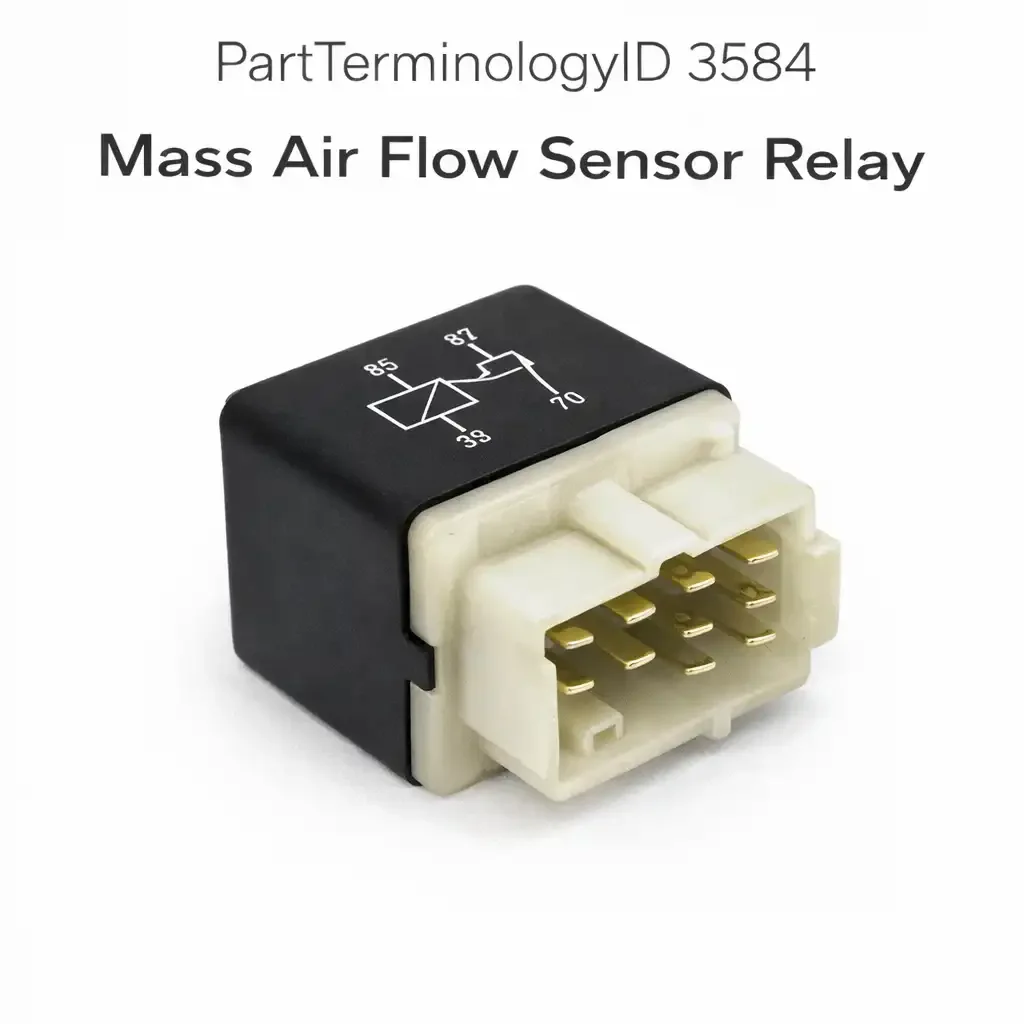
The Mass Air Flow Sensor Relay, cataloged under PartTerminologyID 3584, is the electromechanical switching device that controls power delivery to the MAF sensor circuit on vehicles where the sensor's supply voltage is routed through a relay rather than sourced directly from a fused ignition circuit or ECM reference output. On platforms where this relay is present, it typically serves one of two distinct functions: providing switched ignition voltage to the MAF sensor's operating power supply, or executing the post-shutdown burn-off cycle on hot wire MAF sensors equipped with a self-cleaning function. Some platforms use separate relays for each function, while others combine both under a single relay. Understanding which function applies to the target application is the first requirement of accurate fitment and listing content for this part number.
The MAF sensor is the primary air mass input to the engine control module on fuel-injected engines without a manifold absolute pressure sensor as the sole airload signal. The ECM uses the MAF signal to calculate injector pulse width and, on some platforms, ignition timing. A MAF sensor that loses its power supply produces a no-signal condition at the ECM input that forces the engine into a limp-home fueling strategy or causes stall, depending on the platform's failure mode behavior. A MAF sensor whose burn-off relay has failed does not lose operating function immediately but accumulates contamination on the sensing element over time, progressively degrading signal accuracy until driveability symptoms appear and a fault code is eventually set. Both relay functions are critical, but they fail on different timelines and produce very different symptom profiles, which must be handled separately in listing content.
What the Relay Does
MAF Sensor Power Supply Function
On platforms where the MAF relay serves as the operating power supply, the relay is energized by the ignition switch or by an ECM-controlled output when the ignition is placed in the run or start position. Its closed contacts deliver battery voltage to the MAF sensor's power supply terminal, typically a 12-volt input that the sensor's internal circuitry uses to maintain the heated sensing element at its operating temperature differential above ambient air. Without relay-supplied power, the sensing element cannot maintain its operating temperature, the internal bridge circuit produces no valid output, and the ECM receives either zero volts or an out-of-range signal on the MAF input pin.
On many platforms, particularly GM TPI and TBI engines from the late 1980s through the mid-1990s, the MAF relay also supplies operating power to other sensors and modules on the same switched circuit. A failed MAF relay on these platforms may produce faults in multiple circuits simultaneously, because multiple components share the relay's load-side output. Buyers who encounter a cluster of simultaneous sensor codes on these platforms should verify relay output voltage before replacing individual sensors, as relay replacement may resolve all codes in a single repair.
Hot Wire Burn-Off Relay Function
Bosch hot wire MAF sensors used on many European and domestic vehicles from the mid-1980s through the 1990s incorporate a self-cleaning function that activates for approximately one second after the engine is shut down. During this burn-off cycle, the ECM applies full operating current through the burn-off relay to the platinum sensing wire, raising its temperature to approximately 1000 degrees Celsius. This brief high-temperature pulse vaporizes contaminants that have accumulated on the wire surface during engine operation, preventing the buildup that would otherwise degrade signal accuracy over time. The burn-off cycle occurs only when the ECM was in closed-loop operation at shutdown, confirming that the engine had reached normal operating temperature before the cycle is attempted.
A failed burn-off relay does not immediately cause a driveability problem or a fault code on most platforms. The MAF sensor continues to operate normally on its separate power supply circuit, and the ECM continues to receive a valid air mass signal. However, without regular burn-off cycles, contaminants gradually accumulate on the sensing wire. Over weeks and months this contamination causes the wire to read airflow as lower than actual, producing a progressively richer fuel trim condition that eventually generates lean code corrections as the LTFT counters pull fuel to compensate. On GM C4 Corvettes and other platforms with OBD-I diagnostic capability, a failed burn-off relay sets Code 36, which specifically indicates a burn-off circuit fault rather than a sensor output fault. Sellers whose listings cover burn-off relay applications must make this delayed-symptom profile clear so buyers do not dismiss the relay as unimportant because the engine is running normally at the time of order.
Dual-Relay Architecture on Third-Generation GM Applications
On GM TPI-equipped vehicles, particularly the 1985 to 1992 Camaro and Firebird and the 1985 to 1991 Corvette with L98 engines, two separate relays govern the MAF circuit. The MAF power relay supplies operating voltage to the sensor, and the MAF burn-off relay handles the post-shutdown cleaning cycle. Both relays use the same physical form factor on many of these platforms and are interchangeable as components, though they serve distinct circuit functions. A failed power relay produces an immediate MAF signal loss and driveability fault. A failed burn-off relay produces Code 36 and eventual sensor contamination without immediate driveability impact. Sellers building fitment data for these platforms must specify which relay function the listing covers and, where the part number is the same for both functions, note that both relays should be inspected when one is found failed.
ECM Relay Integration Variants
On some platforms, particularly Nissan and other Japanese manufacturer applications from the late 1980s through the 1990s, the MAF sensor's 12-volt power supply is sourced from the same relay that supplies power to the ECM itself. In these architectures, the relay is cataloged separately as an ECM relay or main relay rather than a MAF-specific relay, but it serves as the power source for the MAF sensor as part of its broader function. For PartTerminologyID 3584, sellers must confirm that the relay being cataloged is specifically identified in OEM documentation as a MAF sensor relay rather than a multi-function main relay that happens to supply the MAF as one of multiple loads. Including main relay applications under PartTerminologyID 3584 produces fitment overlap with the ECM relay category and generates returns from buyers who receive a single-function MAF relay when their vehicle requires a multi-function main relay with different terminal configuration.
Top Return Scenarios
MAF Sensor Contamination Misdiagnosed as Relay Failure
The most common return scenario for PartTerminologyID 3584 on burn-off relay applications is a buyer whose MAF sensor is contaminated and whose driveability symptoms, hesitation, rich idle, lean fuel trim corrections, and poor throttle response, are attributed to the relay rather than the sensor element itself. A contaminated sensor produces these symptoms progressively, and a buyer who discovers the burn-off relay has failed may conclude that relay replacement will resolve the contamination-induced symptoms. It will not. A new burn-off relay restores the cleaning function going forward but does not clean a sensor that has already accumulated significant contamination. The buyer installs the relay, the Code 36 clears, but the driveability symptoms persist because the contaminated sensing element continues to output an inaccurate signal. The relay is returned as ineffective. Listing content that explains this sequence explicitly, and that recommends cleaning or replacing the MAF sensor before or alongside burn-off relay replacement on high-mileage applications, prevents this return.
Power Supply Relay Failure on Multi-Sensor Circuit Platforms
On GM TPI platforms where the MAF power relay supplies multiple sensors simultaneously, a relay that is failing intermittently under thermal or vibration conditions produces random, shifting symptom clusters that are difficult to reproduce and diagnose consistently. The buyer replaces the MAF sensor based on a MAF-related code, the code returns within days, and the relay is eventually identified as the actual fault. Buyers on these platforms who arrive at the listing after replacing the sensor may be skeptical that the relay is the correct diagnosis because sensor replacement produced no improvement. Listing content that explicitly describes the multi-sensor power architecture and names the relay as the first diagnostic step before sensor replacement on these platforms builds buyer confidence and prevents the return from buyers who have already replaced the sensor and are returning the relay when it also does not resolve their complaint.
Incorrect Relay Format for the Application
MAF sensor relays on various platforms use a range of physical formats: standard ISO mini relays in some fuse block sockets, application-specific relays with integrated resistors or diodes for ECM protection, and dedicated relay assemblies with unique connector configurations. A buyer who orders a standard ISO relay to replace an application-specific relay with an internal protection circuit may install a relay that functions for a short period but causes ECM output transistor damage from inductive kickback when the relay coil is de-energized. On GM TPI applications, the MAF power relay uses a part number that includes internal circuit protection to the ECM, and substituting a generic relay without this protection has been documented to cause ECM damage. Listing content that clearly identifies the relay type, notes any integrated protection components, and warns against generic relay substitution on applications where protected relays are specified prevents this return scenario and the associated ECM damage liability.
Wiring Fault Between Relay and Sensor Producing Relay-Like Symptom
An open circuit or high-resistance connection in the wiring between the MAF relay output and the sensor power terminal produces a no-power condition at the sensor that is indistinguishable from relay failure without circuit testing. Connector corrosion at the MAF sensor connector is a parallel failure mode that produces the same symptom as a failed relay on the power supply side, and intermittent connector contact produces the same symptom as an intermittently failing relay. Buyers who replace the relay without checking for supply voltage at the sensor connector, and without inspecting the connector for corrosion, will return the relay when the wiring or connector was the fault throughout. Directing buyers to verify supply voltage reaches the sensor connector before attributing the fault to the relay is the most effective single diagnostic recommendation for this part number.
Burn-Off Relay Returns After Code 36 Recurs on a Contaminated System
A Code 36 that recurs shortly after burn-off relay replacement almost always indicates a contaminated MAF sensor whose output during the burn-off cycle is outside the ECM's expected voltage window for a successful burn-off confirmation. The ECM monitors MAF output voltage during the burn-off cycle and sets Code 36 if the output is not within the expected range, which on some platforms is between 0.4 and 1.9 volts during the high-current burn-off pulse. A sensor element that is sufficiently contaminated produces an out-of-range output even during a successful relay-powered burn-off, causing the ECM to interpret the burn-off as incomplete and re-set the code. Buyers who replace the relay and have Code 36 return within a few drive cycles are experiencing this scenario. Listing content that notes Code 36 can persist after relay replacement on contaminated sensor applications, and that sensor cleaning or replacement may be required alongside relay replacement on high-mileage vehicles, prevents returns from buyers who assume the replacement relay is defective.
Listing Requirements
To meet minimum catalog accuracy requirements for PartTerminologyID 3584, sellers should confirm and include the following:
ACES vehicle fitment data with year, make, model, and engine type confirmed against OEM wiring diagrams identifying the relay function as MAF power supply, MAF burn-off, or both
Explicit identification in listing content of which relay function the part serves: power supply relay, burn-off relay, or a combined relay serving both functions on the target application
Relay type confirmed as standard ISO format or application-specific format with integrated protection components, with notation if substitution of a generic relay is contraindicated
For dual-relay platforms, confirmation of which relay position the part occupies and whether the same part number covers both positions or only one
Relay coil voltage and contact rating confirmed against OEM specification for the target application
OEM and aftermarket cross-reference part numbers where available, particularly for application-specific relay types where generic substitution carries risk
Diagnostic pre-purchase guidance directing buyers to confirm relay coil activation signal is present, check for supply voltage at the sensor connector, and test MAF sensor output before ordering
For burn-off relay applications, notation that Code 36 or equivalent fault code may persist after relay replacement if the sensor element is contaminated, and that sensor cleaning or replacement may be required alongside the relay
Notation that relay replacement will not resolve contaminated sensor elements, wiring faults between relay and sensor, connector corrosion at the sensor, or ECM output faults
Confirmation that the relay is sold as a standalone component without MAF sensor, wiring harness, or connector pigtail
Frequently Asked Questions
My engine runs fine but I have Code 36. Is the burn-off relay the cause and does it need to be fixed immediately?
Code 36 specifically indicates a fault in the MAF burn-off circuit, and a failed burn-off relay is the most common cause. The engine runs normally because the burn-off function is separate from the sensor's operating power supply. However, the code should not be ignored indefinitely. Without regular burn-off cycles, contaminants accumulate on the sensing wire over months of operation. The accumulated contamination eventually degrades MAF signal accuracy, causing fuel trim corrections, hesitation, and rough idle that develop gradually and may not be immediately connected to the original Code 36. Fixing the burn-off relay when the code is first set prevents downstream sensor contamination and the more complex diagnosis that results from it.
How do I know if my platform uses a combined MAF relay or separate power and burn-off relays?
The most reliable method is the factory service manual or a reliable OEM wiring diagram for your specific engine. On GM TPI applications, the under-hood relay center typically has two labeled relay positions for the MAF circuit: one for power and one for burn-off. If both positions are occupied, the platform uses separate relays. If only one relay position is labeled for the MAF, the platform uses either a combined relay or only a power relay without a burn-off function. On Bosch hot wire applications in European vehicles, the burn-off function is typically integrated into the sensor housing's internal electronics rather than controlled by an external relay, and PartTerminologyID 3584 may not apply to these platforms. Confirming relay count and function in the wiring diagram before ordering prevents returns from buyers who receive two relays when they need one, or one relay when they need two.
The MAF relay was replaced but the sensor codes came back within a week. Was the relay defective?
Probably not. A relay that functions correctly at installation and then produces sensor codes within a short period is almost certainly not the fault. If the new relay is energizing and delivering supply voltage to the sensor, the relay has done its job. Returning sensor codes after relay replacement most often indicate one of three things: a contaminated sensor element that is producing an inaccurate signal even with correct supply voltage, a wiring intermittent that was not resolved by relay replacement, or a secondary fault that was masked by the relay fault and is now the dominant cause. Before returning the relay, confirm that supply voltage is present and stable at the sensor connector, and check the MAF sensor output against specification at idle and under load.
Can a bad MAF relay cause damage to the ECM or sensor?
On most platforms, no. A relay that fails open simply removes power from the sensor, which produces a fault code and forces the ECM into an alternative fueling strategy. No damage occurs to the ECM or sensor from an open relay. However, on platforms that specify a MAF power relay with integrated circuit protection, substituting a generic relay without the protection components can expose the ECM output transistor to inductive kickback voltage spikes when the relay coil is de-energized. On GM TPI applications with the protected MAF power relay, this substitution has been documented to cause ECM damage. Replacing the relay with the correct part number, rather than a physically interchangeable generic relay, is essential on these platforms.
What Sellers Get Wrong
Not distinguishing power relay function from burn-off relay function in listing content
A listing that describes the MAF sensor relay without specifying which of the two circuit functions it serves leaves the buyer unable to determine if the part addresses their fault. A buyer with a no-start or poor-idle condition caused by a failed power supply relay and a buyer with Code 36 caused by a failed burn-off relay are in different diagnostic situations and need different information to confirm they are ordering the correct part. The symptom profile, the diagnostic test procedure, and the consequence of leaving the fault unaddressed are all different for the two relay functions. Merging both into a single generic description that does not distinguish between them produces confusion, incorrect applications, and returns from buyers who ordered based on one symptom profile and received a relay suited for the other.
Not explaining the delayed symptom profile of burn-off relay failure
A buyer whose burn-off relay has just failed has no driveability complaint and may not understand why the relay needs to be replaced at all. A listing that presents the burn-off relay as a part that resolves hesitation, poor idle, or rich running implies that these symptoms will be immediately resolved by relay replacement, which is only true if the sensor element is still clean. On a high-mileage vehicle where contamination has been accumulating due to an already-failed relay, the symptoms will not resolve with relay replacement alone. Explaining the contamination timeline, the difference between restoring the cleaning function and correcting an already-contaminated sensor, and the need to address sensor condition alongside relay replacement gives buyers accurate expectations and prevents returns from buyers who expected immediate driveability improvement.
Including ECM main relay fitment under PartTerminologyID 3584
On Nissan, Honda, and other platforms where the ECM main relay supplies the MAF sensor as one of several loads, the relay is a multi-function component that differs in terminal configuration, contact rating, and circuit architecture from a dedicated MAF sensor relay. Including these applications in PartTerminologyID 3584 fitment produces returns from buyers whose ECM main relay serves a broader circuit function and who find that the MAF-specific relay does not match their fuse box socket or connector. The correct catalog category for ECM main relays is a different PartTerminologyID, and fitment data for 3584 should be limited to applications where OEM documentation specifically designates a dedicated MAF sensor relay rather than a multi-function relay that incidentally powers the MAF sensor.
Omitting the sensor cleaning recommendation from burn-off relay listings
Every burn-off relay listing should recommend cleaning or inspecting the MAF sensor element alongside relay replacement, particularly on high-mileage applications where the relay may have been failed for an extended period before the buyer discovered the fault. This is not a cross-sell technique; it is a diagnostic necessity. A buyer who replaces the relay without addressing accumulated contamination will have Code 36 return within a short period on platforms where the ECM confirms burn-off success by monitoring sensor output during the cycle. Recommending MAF sensor cleaner as a concurrent maintenance step costs nothing to include in listing content and eliminates the most common cause of repeat returns on burn-off relay applications.
Cross-Sell Logic
Buyers diagnosing a MAF circuit fault who have confirmed the relay as the cause are candidates for the following related components, which share diagnostic overlap or represent the next logical step if relay replacement does not fully restore MAF system function.
MAF sensor (the sensing element degrades through contamination on burn-off relay applications, and relay replacement alone does not restore a significantly contaminated sensor's accuracy; sensor replacement or cleaning is often required alongside the relay on high-mileage applications)
MAF sensor cleaner (aerosol MAF-specific cleaner is the appropriate concurrent maintenance recommendation for any burn-off relay replacement, allowing the buyer to address existing contamination before the restored burn-off function takes over ongoing maintenance)
MAF sensor connector pigtail (connector corrosion at the sensor is a parallel failure mode that produces the same symptom as relay failure on the power supply side; a corroded connector that mimicked relay failure should be replaced when the relay is replaced)
Ignition or engine fuse supplying the relay coil circuit (a blown fuse upstream of the relay coil supply produces a relay that cannot energize, which is indistinguishable from a relay with a failed coil without circuit testing)
ECM or PCM (on GM TPI applications, a failed MAF power relay that was left unaddressed for an extended period, or that was replaced with a generic unprotected relay, may have caused ECM output transistor damage that requires ECM repair or replacement)
Air filter (oiled aftermarket air filters are a documented cause of MAF sensor contamination that overwhelms the burn-off function; a buyer whose burn-off relay failed while running an oiled filter should be directed to evaluate filter type alongside relay and sensor replacement)
Final Take
PartTerminologyID 3584 is one of the more technically nuanced relay categories in the catalog because the same part number terminology covers two relay functions with meaningfully different symptom profiles, diagnostic paths, and buyer expectations. A power supply relay failure announces itself immediately through loss of MAF signal and driveability fault. A burn-off relay failure is silent for months before its consequences appear in the form of contamination-induced sensor degradation. Treating both functions identically in listing content produces a description that serves neither buyer well.
Sellers who build the strongest listings for 3584 invest in function-specific content that explains what the relay does, what failure looks like on the specific application, and what the buyer should test before ordering. For burn-off relay applications, that includes an honest explanation of the contamination timeline and why sensor cleaning is not optional on high-mileage vehicles. For power relay applications, that includes the multi-sensor circuit architecture on GM TPI platforms and the protected relay requirement. That combination of technical specificity and honest diagnostic guidance is what separates a listing that generates trust from one that generates returns.