
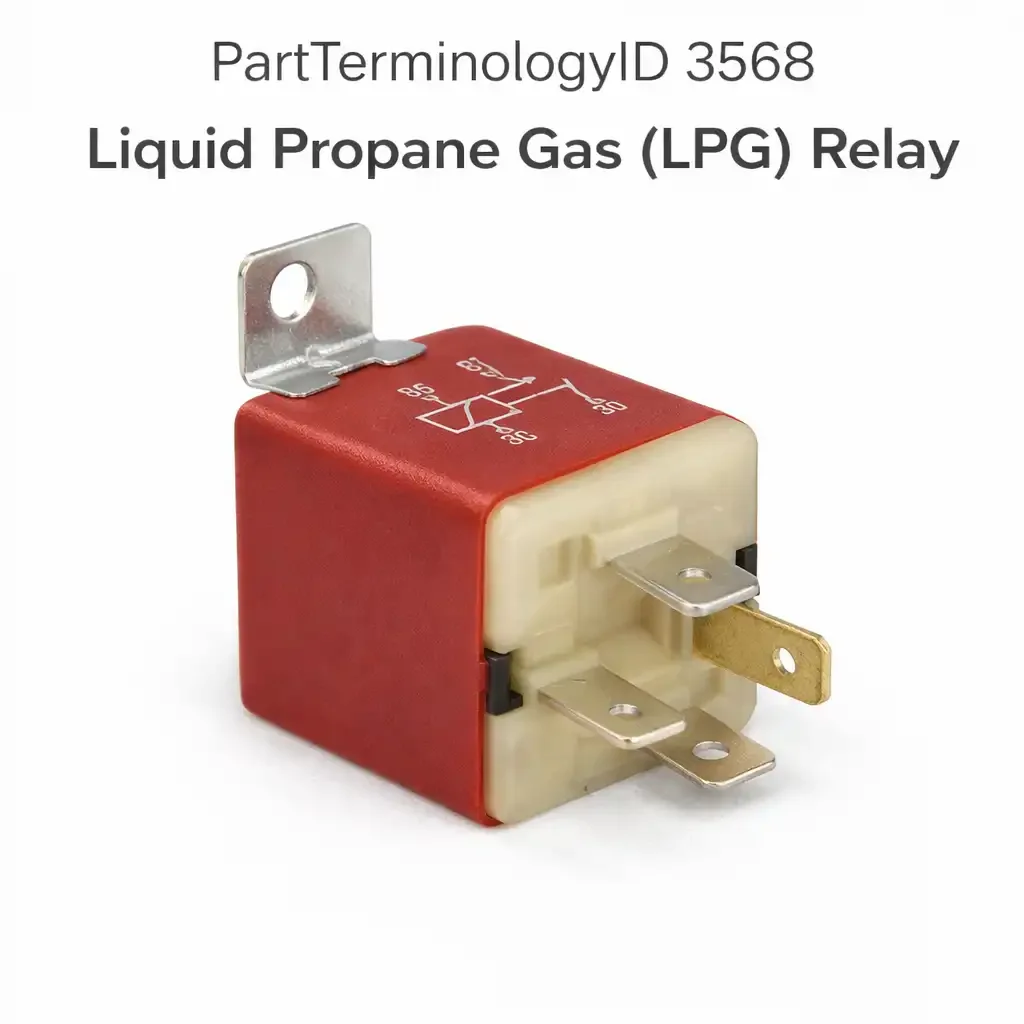
The Liquid Propane Gas Relay, cataloged under PartTerminologyID 3568, is the electromechanical switching device that controls power delivery to one or more critical components within an automotive LPG fuel system. Depending on the platform and system architecture, this relay may power the LPG tank solenoid valve that opens gas flow to the regulator, the LPG system control module that governs injector sequencing and fuel switching, the gasoline fuel pump cutoff circuit that disables petrol delivery while operating on gas, or a combination of these functions under a single switched output. The relay is typically energized by the LPG system controller once the engine has reached operating conditions suitable for gas operation, and it is de-energized automatically when the engine stops, when the driver selects petrol mode, or when a safety condition causes the system to revert to gasoline.
LPG as an automotive fuel is far more common in fleet, commercial, and government vehicle applications outside North America, and the aftermarket catalog for PartTerminologyID 3568 reflects that concentration. Many of the vehicles with factory or certified aftermarket LPG systems that require this relay are taxis, municipal fleet vehicles, delivery vans, and forklifts rather than privately owned passenger cars. Some dedicated LPG vehicles, particularly those sold in Australian, European, and South American markets, include LPG system relays as original equipment components in the fuse block. Sellers building ACES fitment data for PartTerminologyID 3568 must account for significant variation in relay function, location, and architecture across dedicated LPG vehicles, bi-fuel conversion platforms, and fleet-specific build variants.
What the Relay Does
LPG Tank Solenoid Valve Power Supply
The most safety-critical function served by the LPG relay in most system architectures is controlling the solenoid valve mounted on or near the LPG storage tank. This valve is normally closed by spring tension and opens only when energized, which means that loss of relay power causes the valve to close and cut off gas flow to the entire downstream system. This is an intentional fail-safe design: if the relay fails, the engine loses LPG supply and either stalls or reverts to gasoline on bi-fuel platforms rather than allowing uncontrolled gas flow in the event of a crash, stall, or electrical fault. The LPG system controller enforces this behavior deliberately by routing solenoid valve power through the relay rather than through a direct ignition-switched circuit.
On most systems the controller also monitors engine speed through a tachometer signal or CAN data and will de-energize the relay within two to three seconds of detecting engine stall, even if the ignition key remains in the run position. This tach-gated safety cutoff prevents LPG from continuing to flow at the tank valve after the engine stops, which would accumulate unburned gas in the intake manifold and engine compartment. A relay that fails to de-energize promptly after engine stop, or that remains energized without a tach signal present, is a safety fault and should be flagged in listing content rather than treated as a performance enhancement.
Gasoline Fuel Pump Cutoff Function
On bi-fuel LPG conversion systems, allowing the gasoline fuel pump to run continuously while the vehicle operates on LPG causes two problems. First, the fuel injectors on fuel-injected engines will pass small amounts of gasoline under rail pressure even when commanded closed, and that fuel entering the combustion chamber disrupts LPG air-fuel ratio control. Second, extended operation with a running fuel pump but no fuel returning through the return line, because LPG mode typically disables the injectors, can lead to premature pump failure from heat buildup in a pump designed to be cooled by moving fuel. Some LPG relay configurations address both issues by using one relay circuit to open the gas solenoid and a second relay circuit to simultaneously interrupt the gasoline pump power supply.
This dual-function relay architecture is important for sellers to understand because a buyer who replaces only the LPG relay without understanding the fuel pump cutoff function may inadvertently restore LPG operation while leaving the pump cutoff circuit disabled or incorrectly wired. Listing content that identifies whether the relay serves a single function or a combined gas-open and pump-cutoff function on the target application prevents installation errors and the returns they generate.
LPG System Controller Power Supply
On some platform architectures, particularly older carbureted LPG systems and some aftermarket conversion kits, the relay provides ignition-switched power to the LPG system controller itself rather than or in addition to the tank solenoid valve. In this configuration, a failed relay produces a completely inoperative LPG system: the controller has no operating power, the solenoid valve receives no command, the changeover switch has no indicator power, and the driver has no feedback that the system has failed. The vehicle will continue to operate on gasoline without driver awareness that LPG capability has been lost until the LPG tank is found empty at the next fill attempt.
This controller-supply architecture means that a relay failure on some platforms will not produce a visible fault. There is no check engine light, no warning lamp, and no driveability symptom as long as the gasoline system is intact. Buyers who discover the LPG system is inoperative after a long interval without attempting to switch fuels may not connect the failure to the relay immediately, and listings that describe only dramatic symptoms like no-start or hard-start will not match the buyer's experience. Accurate symptom descriptions for controller-supply relay failure should include LPG system that does not activate when the changeover switch is pressed and no indicator illumination on the changeover switch.
Changeover Switch and Fuel Level Gauge Integration
Many LPG system relay circuits also supply power to the dashboard changeover switch indicator lights and the LPG fuel level display. When the relay is energized and the system is operating on gas, the changeover switch indicator illuminates green and the LPG gauge shows current tank level. A failed relay that de-energizes these indicator circuits produces a dark changeover switch and a blank or pegged LPG gauge even with gas in the tank, which is a recognizable symptom that helps buyers identify the relay as the likely fault. This symptom pattern, no indicator light and no LPG gauge reading despite a known full or partly full tank, is more diagnostically useful than a no-start complaint and should be included in listing symptom descriptions for relay architectures that integrate changeover switch power into the relay circuit.
Top Return Scenarios
LPG System Controller Failure Misdiagnosed as Relay Fault
The most common return scenario for PartTerminologyID 3568 is a buyer whose LPG system controller has failed and whose complete system shutdown is attributed to the relay before the controller is tested. The relay is the first component in the power supply chain and is therefore the first candidate when the system stops responding entirely. Buyers who find no power at the solenoid valve connector may not trace the circuit back to the controller output that drives the relay coil, and they order the relay assuming it has failed open. Relay replacement restores no function because the controller that was supposed to energize the relay coil is itself inoperative. A pre-purchase test that confirms relay coil trigger voltage is absent at the relay socket, and that traces the absent trigger to the controller output rather than to the relay itself, identifies the correct fault before ordering.
LPG Tank Solenoid Valve Failure Producing Relay-Like Symptoms
A functioning relay that is energizing correctly but whose downstream solenoid valve has failed mechanically or electrically produces a no-gas symptom that is identical in driver experience to relay failure. The relay closes, power reaches the solenoid valve terminals, but the valve does not open because the solenoid coil has failed open or the valve body is mechanically stuck. Buyers who check for power at the relay output and find it present have confirmed the relay is functional, but those who do not perform this check will return a working relay after installation produces no change in LPG operation. Listing content that directs buyers to confirm power reaches the solenoid valve terminals and that the valve clicks audibly when energized, before attributing the fault to the relay, reduces returns from buyers whose solenoid valve was the actual fault.
Tach Signal Absence Causing Safety Cutoff Misread as Relay Failure
On LPG systems with tachometer-gated safety cutoff, a controller that is not receiving a valid tach signal will refuse to energize the relay coil regardless of its own operational status and the relay's condition. A broken tach wire, a failed ignition module output, or a CAN communication fault that disrupts the engine speed signal reaching the LPG controller produces a system that will not switch to gas under any conditions. The buyer experiences this as an inoperative LPG system and attributes it to the relay. Relay replacement produces no change because the controller is making the correct safety decision based on absent tach signal. This return scenario is diagnosable by confirming that the engine speed signal is present at the controller input connector before assuming the relay is at fault, and listing content that describes the tach-gated safety logic helps buyers understand why this check is necessary.
Incorrect Relay Type for the Application
LPG system relays vary in coil voltage, contact rating, terminal configuration, and timing function across different system brands and vehicle applications. Some LPG systems use standard ISO mini relays that are interchangeable with common automotive relays from other circuits. Others use application-specific relays with integrated timing delays, diode suppression, or multiple independent contact sets that are not interchangeable with general-purpose automotive relays. A buyer who orders a relay based on physical appearance or general relay specifications without confirming the exact part number required for the LPG system controller may install a relay that fits the socket but that does not provide the correct contact rating, coil impedance, or timing behavior for the application. The system may appear to function initially but fail prematurely under the sustained current loads typical of LPG solenoid valve operation.
Wiring Fault Between Relay and Solenoid Valve
The wiring between the LPG relay and the tank solenoid valve on conversion systems is often routed through areas of the vehicle that were not part of the original factory harness design, including through engine compartment grommets, under chassis, and through the trunk or cargo area to reach the tank. Installer routing choices during the conversion can place wiring in zones subject to heat, abrasion, or moisture exposure that factory harnesses avoid. A wire open or short in this aftermarket routing produces a no-power condition at the solenoid valve that mimics relay failure. Buyers who replace the relay without checking for continuity in the wiring between relay and solenoid will return the relay when the fault was in the wiring throughout.
Listing Requirements
To meet minimum catalog accuracy requirements for PartTerminologyID 3568, sellers should confirm and include the following:
• ACES vehicle fitment data with year, make, model, trim, and LPG system brand or type verified against OEM or conversion system documentation confirming relay specifications
• Identification of which function or functions the relay serves on the target application: tank solenoid valve power supply, gasoline fuel pump cutoff, LPG system controller power supply, changeover switch indicator supply, or a combination
• Relay coil voltage and resistance confirmed against LPG system controller output specification
• Contact current rating confirmed adequate for the solenoid valve load and any other loads switched through the relay on the target application
• Relay pin configuration and housing type confirmed to match the target system relay socket, distinguishing between standard ISO mini relay formats and application-specific relay types
• LPG system brand and controller type identified where the relay is not a standard ISO format: Prins, Tartarini, Lovato, Romano, BRC, OMVL, and others use system-specific relay types on some models
• OEM or conversion system cross-reference part numbers where available
• Diagnostic pre-purchase guidance directing buyers to confirm relay coil trigger signal is present from the LPG controller before ordering, and to verify solenoid valve coil resistance is within specification before attributing the fault to the relay
• Notation that relay replacement will not resolve LPG system controller failures, tank solenoid valve failures, tach signal faults that prevent controller activation, or open wiring between relay and solenoid
• Confirmation that the relay is sold as a standalone component without tank solenoid valve, LPG controller, or wiring harness
Frequently Asked Questions
My LPG system stopped switching to gas but the vehicle runs fine on petrol. Where do I start diagnosing?
Start at the changeover switch. When you press the switch to select gas, does the indicator light illuminate? If the indicator does not light at all, the relay circuit or its power supply may be at fault, but the LPG system controller is the more likely cause if the relay was functioning previously. If the indicator lights but the system does not switch, the controller is receiving your input but is withholding the relay trigger, most often because it is not detecting a valid engine speed signal or because it has stored a fault condition. Connect a scan tool compatible with your LPG system to check for stored faults before ordering any parts. If the indicator lights and the controller is commanding a switch but gas does not flow, test for power at the tank solenoid valve connector while in gas mode. Power present at the solenoid but no gas flow points to a failed solenoid valve. Power absent at the solenoid with the relay commanded on points to a wiring fault between relay and solenoid or a failed relay contact.
How do I test the LPG relay before replacing it?
Remove the relay from its socket. Measure coil resistance between the coil terminals and compare against the specification for your LPG system, typically between 70 and 100 ohms for standard ISO relays used in LPG applications, though application-specific relays may differ. Apply 12V DC to the coil terminals and listen for a click confirming contact closure. Use a continuity tester to confirm the load contacts are open without coil power and closed with coil power applied. In-vehicle, with the engine running and the system commanded into gas mode, check for coil trigger voltage at the relay socket. If trigger voltage is present and the relay is not closing, the relay has failed. If trigger voltage is absent with the engine running, the fault is in the controller output circuit rather than the relay.
Can I use a standard automotive relay as a replacement for the LPG relay?
On systems that use a standard ISO mini relay format, yes. Many LPG systems specify a standard 12V 30A or 40A ISO relay for the solenoid valve circuit, and a general-purpose automotive relay of the correct contact rating will function identically. However, some LPG system controllers use relays with integrated suppression diodes across the coil, and substituting a relay without the internal diode on a controller designed for diode-equipped relays may cause controller output transistor damage from back EMF spikes when the relay coil is de-energized. Check the LPG system documentation or the controller manufacturer's specification before substituting a generic relay for an application-specific part. If the original relay has a diode marking or the system documentation specifies a suppression diode relay, use a replacement with the same internal diode.
The LPG relay was working until recently. The system now reverts to petrol almost immediately after switching to gas. Is that a relay fault?
Probably not, or at least not the primary fault. A relay that closes and then opens intermittently under thermal or vibration conditions could produce this symptom, but the LPG system controller is the more likely cause. Most controllers will immediately revert to petrol and de-energize the relay if they detect a fault condition: a tach signal dropout, a solenoid valve current draw outside normal range, a temperature sensor fault, or a stored diagnostic code that triggers protective reversion. A controller that is transitioning into gas mode and then immediately reverting has detected something that triggered the safety reversion logic. Connect a compatible scan tool and review the system fault history before attributing the intermittent reversion to the relay. If no faults are stored and the reversion is confirmed to be a relay contact failure rather than a controller-commanded event, relay replacement is appropriate.
What Sellers Get Wrong
Not identifying relay function within the specific LPG system architecture
The LPG relay category covers relays that perform meaningfully different functions depending on the system architecture: solenoid valve supply, fuel pump cutoff, controller supply, changeover switch supply, or a combination. A listing that describes the part generically as an LPG relay without specifying which function it serves on the fitment vehicles gives the buyer no way to confirm they are ordering the correct component for their system. A buyer on a bi-fuel system who needs a relay that combines solenoid valve supply and fuel pump cutoff in a single component will receive the wrong part if the listing describes a single-function solenoid supply relay. Identifying function explicitly for each fitment application is not optional for this category.
Building fitment without distinguishing LPG system brand and type
LPG conversion systems are produced by numerous manufacturers, each with proprietary controller designs, relay specifications, and component part numbers. A Prins VSI system relay is not interchangeable with a Tartarini sequential system relay or a BRC sequential system relay even on the same vehicle. Sellers who build fitment data based on vehicle year, make, and model without specifying the LPG system brand installed on the vehicle will generate returns from buyers whose system does not match the relay specification. Fitment data for PartTerminologyID 3568 must identify the LPG system brand and generation, not just the vehicle, to be accurate.
Omitting the tach-gated safety logic from symptom descriptions
Buyers who encounter an LPG system that refuses to activate under any conditions, despite appearing otherwise functional, often do not know that the controller is withholding relay activation because it is not receiving a valid engine speed signal. This safety feature is invisible to the driver and produces exactly the same symptom as a failed relay. A listing that describes only relay failure as the cause of this symptom, without mentioning the tach signal dependency, will attract buyers whose engine speed signal circuit has a fault and who will return the relay unchanged after installation. A single sentence describing the tach-gated logic and noting that engine speed signal verification is required before relay ordering eliminates this return category.
Not flagging the solenoid valve as a first diagnostic step
The tank solenoid valve is the component that most commonly fails in LPG fuel systems after extended service, and its failure produces a symptom that is diagnostically indistinguishable from relay failure without circuit testing. A no-gas condition caused by a mechanically stuck or electrically open solenoid valve returns the same symptom as a relay that will not close. Buyers who do not know to test the solenoid before ordering the relay represent a significant portion of returns in this category. Listing content that names solenoid valve testing as the mandatory first diagnostic step, and that explains how to confirm power reaches the valve and how to listen for the actuation click, prevents returns from buyers whose valve was the fault and who never tested it.
Cross-Sell Logic
Buyers diagnosing an inoperative LPG system who have confirmed the relay as the cause are candidates for the following related components, which share diagnostic overlap or represent the next logical step if relay replacement does not fully restore LPG system operation.
• LPG tank solenoid valve (the most common mechanical failure in the LPG fuel path after extended service; if relay replacement restores power to the solenoid but gas does not flow and no click is heard when the valve is energized, the valve has failed)
• LPG system controller or ECU (the component that provides the relay coil trigger signal; if coil trigger voltage is absent at the relay socket with the engine running and system commanded to gas mode, the controller output has failed)
• LPG changeover switch (the driver interface that sends the fuel selection command to the controller; a failed switch produces a system that cannot be commanded into gas mode regardless of relay and controller condition)
• LPG wiring harness or solenoid valve connector pigtail (aftermarket conversion wiring is routed through non-factory paths and is more susceptible to abrasion and connector corrosion than OEM harnesses)
• LPG fuel level sensor or gauge (a failed level sensor produces inaccurate tank level readings that can cause the controller to withhold gas mode activation if it interprets the signal as an empty tank)
• Gasoline fuel pump relay (on bi-fuel systems where the LPG relay circuit also handles fuel pump cutoff, a failed LPG relay may be accompanied by fuel pump cutoff circuit faults that require separate diagnosis after LPG relay replacement)
Final Take
PartTerminologyID 3568 is one of the more technically complex relay categories in the aftermarket catalog because the relay's function, its fitment dependencies, and its diagnostic context all vary significantly across LPG system brands, vehicle types, and conversion architectures. A relay that controls only a solenoid valve on one platform controls a solenoid valve, a fuel pump cutoff, and a changeover switch indicator circuit simultaneously on another. Getting the fitment right requires specifying not just the vehicle but the LPG system installed on it, and getting the listing content right requires explaining the tach-gated safety logic and the solenoid valve diagnostic step that prevent the two most common return scenarios.
Sellers who perform best on 3568 treat it as a system-level part rather than a generic relay. They identify the LPG brand and system type in fitment data, specify the relay function explicitly, and lead diagnostic content with the solenoid valve and controller tests that rule out the more common causes of LPG system failure before the relay is implicated. That approach produces fewer returns, more confident buyers, and listings that stand apart from the generic catalog entries that describe a part without giving the buyer the information to confirm they actually need it.