
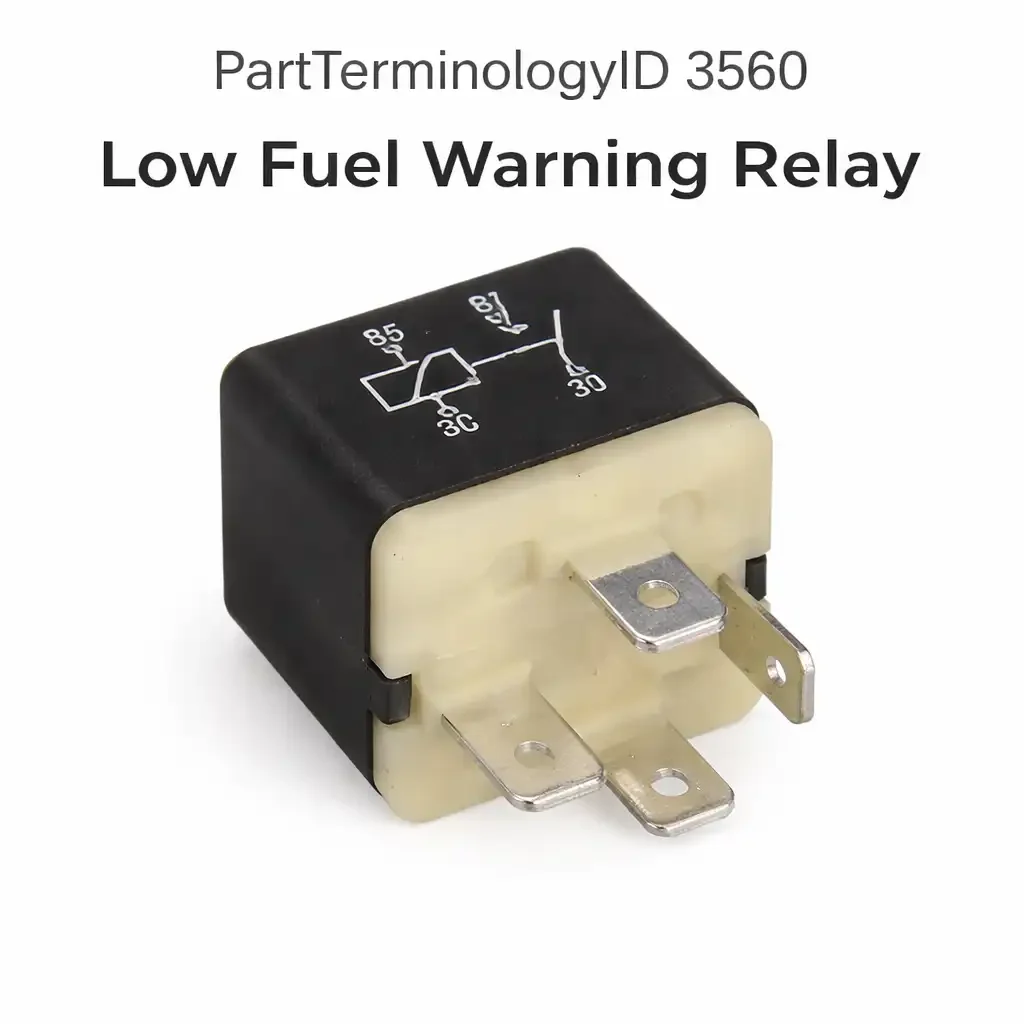
The Low Fuel Warning Relay, cataloged under PartTerminologyID 3560, is the electromechanical switching device that supplies power to the low fuel warning indicator circuit when the instrument cluster or body control module determines that fuel level has fallen below a defined threshold. On platforms that use this relay, it acts as the switched power source for the warning lamp, chime driver, or indicator module that alerts the driver to a low fuel condition. When the relay fails open, the low fuel warning system goes silent regardless of actual fuel level. When it fails closed or sticks energized, the warning activates continuously even with a full tank.
The low fuel warning relay is one of the less frequently cataloged relay categories because most modern vehicles integrate the warning indicator function directly into the instrument cluster microcontroller or BCM output circuit, eliminating the need for a discrete external relay. On platforms where this relay does appear as a separate component, it typically belongs to older architectures or to vehicles where the warning circuit draws enough current to require relay switching rather than direct module output. Sellers building ACES fitment data for PartTerminologyID 3560 must verify that the target application actually uses a discrete external relay in the warning circuit rather than a module-controlled indicator, as the two architectures produce identical symptoms and identical diagnostic starting points but require entirely different repairs.
What the Relay Does
Warning Indicator Power Supply
On relay-dependent low fuel warning architectures, the relay provides switched battery voltage to the warning lamp or indicator circuit when triggered by the controlling module. The fuel level sending unit in the tank outputs a resistance value that varies with float position. The instrument cluster or BCM monitors this resistance through a reference voltage circuit and computes a fuel level estimate from the signal. When the computed level falls below the calibrated threshold, the controlling module triggers the relay coil, closing the relay contacts and delivering power to the warning indicator. The indicator illuminates and, on applications with audible alerts, the chime circuit receives the same switched power.
On some platforms the relay does not power the indicator lamp directly but instead powers a separate warning module or alarm driver that then activates the indicator through its own output. This distinction matters for diagnosis because a relay that is functioning correctly but whose downstream warning module has failed produces the same no-warning symptom as a failed relay, and the correct repair is the module rather than the relay. Listing content should acknowledge this architecture variation so buyers understand that relay replacement alone may not restore warning function on every application.
Threshold-Based Activation and Damping Logic
The controlling module does not activate the low fuel warning relay the instant the computed fuel level crosses the threshold. Most architectures include deliberate damping logic that requires the fuel level signal to remain below the threshold for a defined period or across a defined number of samples before the relay is energized. This damping prevents nuisance activations caused by fuel sloshing in the tank during hard braking, sharp cornering, or steep inclines, all of which temporarily shift the float position and can produce momentary below-threshold readings on a tank that has adequate fuel for normal operation.
The damping logic is relevant to diagnosis and to listing content because it means the low fuel warning will not always activate immediately when fuel drops below the trigger point, and it will not always deactivate immediately after refueling if the module requires a sustained above-threshold reading before it de-energizes the relay coil. A driver who refuels and immediately sees the warning light extinguish has a platform with simple threshold logic. A driver who refuels and still sees the warning active for a short period afterward has a platform with sustained-off damping, and this is normal behavior rather than a relay fault.
Sending Unit Signal Dependency
The relay is entirely dependent on an accurate fuel level signal from the sending unit for its activation timing. A sending unit with a corroded resistance track, a stuck or restricted float arm, or a worn wiper contact will produce an inaccurate resistance output that the controlling module interprets as an erroneous fuel level. A sending unit that produces a falsely low resistance output causes the module to compute a higher-than-actual fuel level and withhold relay activation even when the tank is near empty. A sending unit that produces a falsely high resistance output causes the module to compute a lower-than-actual fuel level and energize the relay persistently even with adequate fuel in the tank.
For sellers, this sending unit dependency is the most important diagnostic variable in the low fuel warning relay category. The majority of low fuel warning malfunctions, whether a warning that never comes on or one that stays on permanently, trace to sending unit signal faults rather than relay failure. A listing that does not identify sending unit diagnosis as the mandatory first step before relay ordering will attract buyers whose sending units are the actual fault and who will return the relay after installation produces no change in warning behavior.
Circuit Architecture Across Platforms
Vehicle architectures that use a discrete low fuel warning relay tend to fall into two groups. The first is older vehicles from the 1980s and 1990s where the instrument cluster had limited output current capacity and the warning lamp circuit required relay switching to handle lamp loads. The second is vehicles where the low fuel warning activates ancillary devices beyond the instrument cluster indicator, such as a dashboard chime module, an external warning buzzer, or a separate display driver, and where the combined load of these devices exceeds what a direct module output can handle. On most vehicles produced after the mid-1990s, instrument clusters drive warning indicators directly through transistor outputs or LED drivers with no relay in between, and PartTerminologyID 3560 does not apply to these architectures.
Top Return Scenarios
Sending Unit Fault Misdiagnosed as Relay Failure
The highest-volume return scenario for PartTerminologyID 3560 is a buyer whose fuel level sending unit has a resistance track fault and whose warning is behaving abnormally as a result. A warning that stays on despite a full tank, or one that never activates despite running near empty, is caused by a sending unit producing an incorrect resistance output in the overwhelming majority of cases on modern vehicles. Buyers who encounter this symptom and search for the cause will find relay listed as a possible fault and may order it without completing the sending unit signal verification that would identify the actual cause. Relay replacement produces no change in warning behavior because the relay was not the fault. A listing that leads with sending unit diagnosis as the mandatory first check before relay ordering, and that explicitly describes how sending unit faults produce relay-like symptoms, eliminates the majority of returns in this category.
No-Relay Architecture Receiving a Relay
A buyer who orders PartTerminologyID 3560 for a vehicle whose low fuel warning is controlled entirely through a direct instrument cluster transistor output or a BCM-driven indicator circuit will find no relay socket to install the part. This is a fitment data problem with no diagnostic component. The buyer's vehicle does not have a discrete relay in the warning circuit, and the listing's fitment data incorrectly included that vehicle. These returns are fully preventable through circuit diagram verification at the platform level before any vehicle is added to fitment data. The symptom that drives the buyer to the listing in the first place, an inoperative low fuel warning, has a different cause entirely on non-relay platforms: a failed instrument cluster output transistor, a BCM software fault, a burned-out indicator bulb, or an LED driver failure.
Warning Module Failure on Relay-Equipped Platforms
On architectures where the relay supplies power to a downstream warning module or chime driver rather than directly to the indicator lamp, a failed downstream module produces an identical symptom to a failed relay. The buyer replaces the relay, power is now present at the module input, but the module's internal driver has failed and the indicator still does not illuminate. The relay was functional before and after replacement; the module was the fault throughout. This return scenario occurs most frequently on platforms with external chime or warning alarm modules that are separate from the instrument cluster. Listing content that acknowledges this architecture and directs buyers to verify whether voltage is present at the indicator lamp or module input after the relay closes, rather than only confirming the relay is energized, prevents returns from buyers in this category.
Damping Logic Misread as Relay Malfunction
A buyer whose low fuel warning activates briefly after a refill, or whose warning does not immediately activate when fuel drops below the expected level, may interpret the damping delay as a relay that is slow to respond or failing intermittently. The module's calibrated damping window, which can range from a few seconds to several minutes on some platforms, is designed behavior rather than a circuit fault. A buyer who replaces the relay based on this symptom returns it when the replacement behaves identically. Listing content that briefly explains the damping logic and confirms that delayed activation or deactivation relative to actual fuel level is a calibration feature rather than a relay fault prevents returns from buyers who misread normal behavior as component failure.
Intermittent Warning Caused by Connector Corrosion
An intermittent low fuel warning that activates and deactivates without apparent correlation to fuel level is more often caused by a corroded or loose connection in the sending unit circuit or at the relay socket than by relay contact failure. Corrosion at the sending unit connector alters the resistance signal the module reads and causes it to cross the activation threshold intermittently. Corrosion at the relay socket produces intermittent contact closure and random warning activation. Buyers who attribute this pattern to a relay fault and replace the relay without inspecting connectors will return the relay if the intermittent behavior continues after replacement. A pre-purchase recommendation to clean the relay socket and sending unit connector, and to verify the sending unit signal is stable with a multimeter, prevents returns from buyers whose connector corrosion was the actual fault.
Listing Requirements
To meet minimum catalog accuracy requirements for PartTerminologyID 3560, sellers should confirm and include the following:
• ACES vehicle fitment data with year, make, model, and trim verified against OEM wiring diagrams confirming the target application uses a discrete external relay in the low fuel warning circuit rather than a direct module-driven indicator output
• Relay coil activation source identified: instrument cluster output, BCM output, or standalone warning control module output
• Confirmation of what the relay supplies on the target application: instrument cluster indicator lamp directly, external chime module, external alarm buzzer, or combined warning output circuit
• Relay pin configuration and housing type confirmed to match the target vehicle relay socket
• OEM cross-reference part numbers where available
• Model year range bounded to exclude platform transitions where discrete relay architecture was replaced by direct module output
• Diagnostic pre-purchase guidance directing buyers to verify sending unit signal accuracy, check the warning circuit fuse, and confirm relay coil trigger signal is present before ordering
• Notation that relay replacement will not resolve sending unit faults, instrument cluster output failures, BCM software faults, burned-out indicator bulbs, or failed downstream warning modules
• Acknowledgment of damping logic where applicable, confirming that delayed warning activation or deactivation relative to fuel level is calibrated behavior rather than relay malfunction
• Confirmation that the relay is sold as a standalone component without sending unit, instrument cluster, or warning module
Frequently Asked Questions
My low fuel warning light stays on even after I fill the tank. Does that mean the relay is stuck closed?
A warning that stays on after refueling is almost always caused by a sending unit that is not accurately reporting the new fuel level to the controlling module. The float arm may be stuck at a low position due to a mechanical restriction inside the tank, the resistance track may be worn or corroded in a way that produces a falsely low resistance regardless of float position, or the sending unit connector may have a fault that is holding the signal at a below-threshold voltage. The relay is a passive component that responds to what the module tells it to do. If the module continues to command the relay on because it is reading a below-threshold signal from a faulty sender, the relay is doing its job correctly. Replacing the relay without addressing the sending unit will produce no change in the warning's behavior.
The low fuel warning never comes on even when I run close to empty. How do I know if it is the relay or something else?
Start by checking whether the warning lamp itself functions. Turn the ignition to the run position without starting and observe whether the warning lamp illuminates during the instrument cluster self-test that most vehicles perform on startup. If the lamp lights during self-test, the lamp and its supply circuit are intact, and the fault is upstream in the relay or trigger circuit. If the lamp does not light during self-test, the fault may be a burned-out bulb or a failed indicator circuit rather than the relay. If the lamp checks out, test for relay coil trigger voltage at the relay socket when fuel is known to be below the threshold. If trigger signal is absent, the fault is in the module's output or the sending unit signal. If trigger signal is present but the relay does not energize and close contacts, the relay has failed.
Can a low fuel warning relay fail in a way that causes random or false activations?
Yes, but this is not the most common cause of random or false activations. A relay with degraded contacts that close intermittently under vibration or temperature variation can produce random warning events. However, a corroded sending unit connector that causes the resistance signal to fluctuate across the activation threshold is far more likely to produce this symptom. The module responds to what the sensor reports, and an unstable sensor produces an unstable warning output regardless of relay condition. Before attributing random activation to the relay, confirm that the sending unit signal is stable by monitoring it with a multimeter or scan tool while the vehicle is driven. An unstable signal that crosses the threshold repeatedly is a sending unit or connection fault, not a relay fault.
Does the low fuel warning relay have any relationship to the fuel gauge reading?
Indirectly. Both the fuel gauge and the low fuel warning rely on the same sending unit signal as their primary input. A sending unit fault that corrupts the signal will typically affect both the gauge reading and the warning activation simultaneously. If the gauge reads accurately but the warning is misbehaving, the fault is downstream of the point where the signal is distributed, either in the relay or trigger circuit specific to the warning, or in the warning lamp circuit itself. If both the gauge and the warning are simultaneously wrong in the same direction, the sending unit or its signal circuit is the most likely cause and relay replacement will not correct either symptom.
What Sellers Get Wrong
Building fitment without confirming discrete relay architecture
This is the primary fitment error for PartTerminologyID 3560. The majority of vehicles in the current parc do not use a discrete relay in the low fuel warning circuit. The warning indicator is driven directly by the instrument cluster microcontroller or BCM output transistor on most platforms produced after the mid-1990s. Sellers who build fitment based on symptom match rather than circuit diagram verification will include vehicles that have no relay socket for this part. Every buyer on these platforms returns the relay immediately on discovery that there is no socket. This is not a diagnostic error; it is a catalog error, and it is entirely preventable with circuit diagram verification at the platform level before fitment is built.
Not leading with sending unit diagnosis
The sending unit is the most frequent cause of low fuel warning malfunction across all platform types, and it is the fault that buyers on relay-equipped platforms are most likely to have when they arrive at the listing with a warning that is permanently on or permanently off. A listing that presents relay replacement as the first or primary repair option for these symptoms, without explicitly naming sending unit diagnosis as the mandatory prerequisite, will generate returns from the substantial majority of buyers whose actual fault is the sender. Leading with a clear explanation that sending unit faults mimic relay faults and can only be distinguished by measuring the resistance signal at the sender connector before ordering reduces this return category more than any other single change to listing content.
Omitting the circuit fuse from the diagnostic checklist
The low fuel warning circuit fuse, where present as a separate fuse rather than shared with other instrument cluster circuits, produces an identical no-warning symptom when it blows. It is a thirty-second check that costs nothing to perform. A listing that does not name the fuse as the first circuit check before relay ordering generates preventable returns from buyers whose fuse was the fault. This is consistent with the pattern seen across all relay categories and is no less true for PartTerminologyID 3560.
Not acknowledging the transition from relay to module-driven warning architecture
Many vehicles were produced in transition years where the same body style or model was available with either a relay-based warning circuit in early production or a direct module-driven circuit in later production, sometimes without a visible external change to the fuse block. A fitment range that covers the full model run without accounting for this architecture transition mid-cycle will produce returns from buyers on later production vehicles whose circuits do not include the relay. Bounding the fitment year range to the production period confirmed by circuit diagram to include the discrete relay, and noting in the listing that later production of the same model may not apply, is the correct approach.
Cross-Sell Logic
Buyers diagnosing an inoperative or misbehaving low fuel warning who have confirmed the relay as the cause are candidates for the following related components, which share diagnostic overlap or represent the next logical step if relay replacement does not fully restore warning function.
• Fuel level sending unit (the most common actual cause of low fuel warning malfunction across all platforms; a sending unit with a corroded resistance track or stuck float produces relay-like symptoms and is the diagnosis that should be ruled out before relay ordering)
• Warning circuit fuse (the first circuit check before relay ordering and appropriate low-cost add-on for any warning circuit repair)
• Instrument cluster assembly (on platforms where the instrument cluster provides the relay coil trigger and the cluster output transistor has failed, relay replacement restores no function)
• Body control module (on BCM-controlled platforms where the BCM output that triggers the relay coil has failed internally)
• External chime or warning module (on platforms where the relay supplies a downstream warning module rather than the indicator lamp directly; if relay replacement restores voltage at the module input but the warning still does not activate, the downstream module has failed)
• Sending unit connector pigtail (corrosion at the sending unit connector is a parallel fault mode that produces erratic signal output and unstable warning activation; connector replacement or repair addresses this without replacing the sending unit itself)
Final Take
PartTerminologyID 3560 occupies a narrow position in the aftermarket catalog because the discrete low fuel warning relay is a relatively uncommon component on vehicles produced in the last three decades. Most modern platforms drive the warning indicator through direct module output without a relay in between. Where the relay does appear, it is typically on older architectures or on vehicles with ancillary warning devices that exceed direct module output capacity. Getting fitment right requires circuit diagram verification at the platform level, not model year estimation, and the fitment data must account for mid-cycle architecture transitions that eliminated the relay without changing the vehicle's external appearance.
The sellers who build the best-performing listings for 3560 lead with sending unit diagnosis, acknowledge the architecture variation between relay-equipped and direct-driven platforms, and give buyers a clear diagnostic path that distinguishes a relay fault from the far more common sending unit fault before any part is ordered. That combination eliminates the dominant return category and positions the listing as a genuinely useful diagnostic resource rather than a relay order form.