
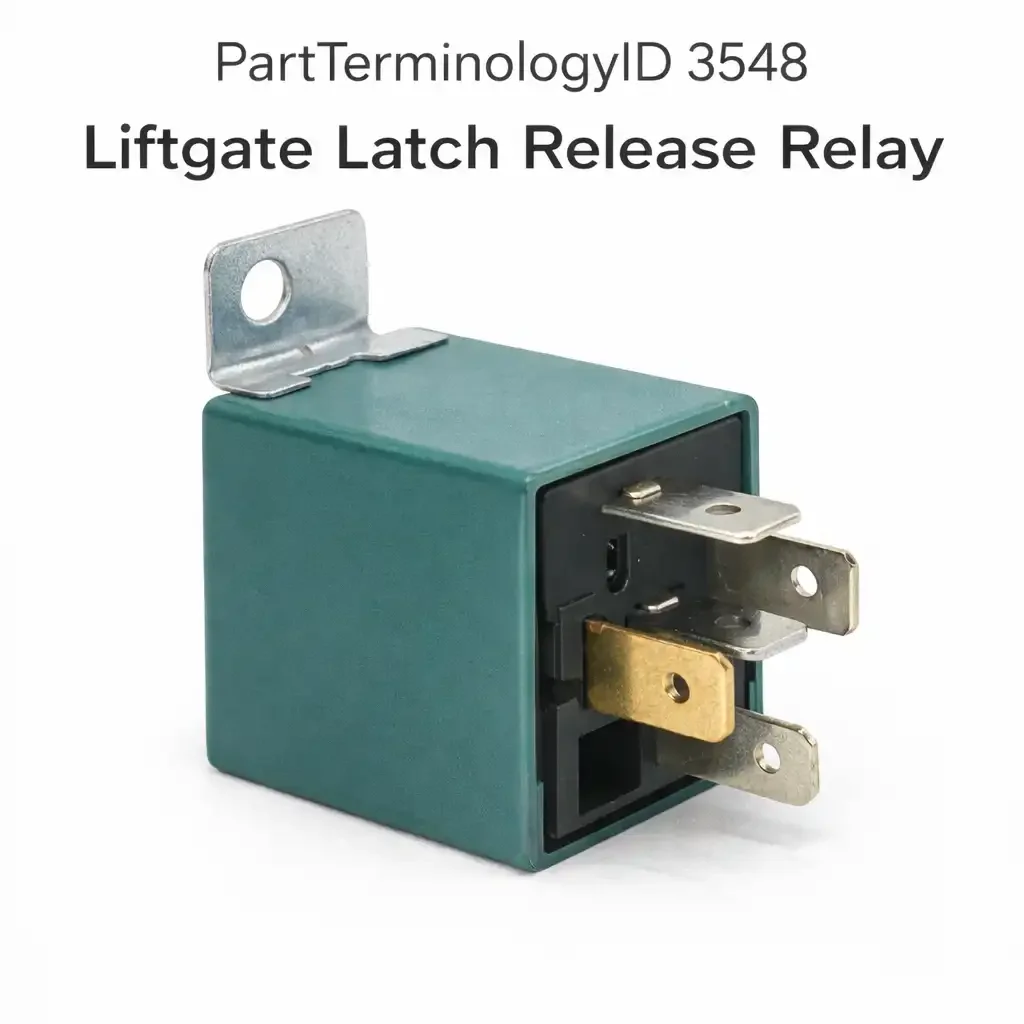
The Liftgate Latch Release Relay, cataloged under PartTerminologyID 3548, is the electromechanical switching device that delivers battery voltage to the liftgate latch actuator whenever the body control module receives a valid release input. The relay sits between the vehicle's power supply and the latch solenoid or motor, translating a low-current BCM output signal into the full current load required to physically retract the latch pawl and allow the liftgate to open. On SUVs, crossovers, minivans, and wagons that use power-assisted liftgate release, this relay is what separates a functioning tailgate from one that will not open by any electronic means.
The relay is energized only when specific conditions are satisfied simultaneously: the vehicle must typically be in park, the door locks must be in the unlocked state, and a valid release input must be received from the exterior liftgate touchpad, the key fob, the interior release switch, or a scan tool command. The BCM monitors all of these inputs and, when conditions are met, applies voltage and ground to the relay coil. The closed relay contacts then pass battery voltage through the latch fuse to the actuator. When the relay fails, the liftgate cannot be opened by any electronic method and must be accessed manually through a mechanical override or interior panel removal. Sellers building ACES fitment data for PartTerminologyID 3548 must account for significant variation in relay location, integration level, and circuit architecture across platforms.
What the Relay Does
Latch Actuator Power Delivery
The liftgate latch assembly contains either a solenoid or a small DC motor that, when energized, drives the latch pawl to the retracted position and allows the liftgate to swing open. This actuator draws significantly more current than BCM output circuits are designed to handle directly. The liftgate latch release relay bridges that gap, accepting a low-current coil signal from the BCM and closing high-current contacts that supply battery voltage directly to the actuator. On most applications the relay delivers a short pulse of current lasting long enough to complete the retraction cycle, after which the BCM de-energizes the relay coil and the contacts return to their normally-open state.
On vehicles with powered liftgate systems where the gate opens automatically after latch release, the same relay or an adjacent relay may also trigger the power open module to begin the lift sequence. On manual liftgate applications the relay serves only the release function, and the driver or passenger must lift the gate by hand after the latch retracts. The relay's role is identical in both cases: convert a BCM control signal into actuator current. The distinction matters for fitment because powered liftgate platforms often have additional relay and module architectures that can produce the same no-open symptom through multiple failure paths.
BCM Conditional Logic and Security Gate
The BCM does not energize the liftgate latch release relay unconditionally. It evaluates a set of vehicle state inputs before granting the release signal, and it will ignore all release requests if those conditions are not satisfied. The transmission must typically be in park on automatic transmission vehicles to prevent inadvertent liftgate opening while in motion. The door lock state must indicate that the vehicle is unlocked, a condition that prevents the release relay from operating in response to a fob button press when the vehicle is locked. This is a security feature, not a fault, and it produces symptoms that are often misdiagnosed as relay failure.
When a buyer reports that the liftgate does not open from the fob but does open from the interior switch or vice versa, the conditional logic explains the discrepancy. A fob with a weak or dead battery may not transmit a signal strong enough for the BCM to register a valid release request, even though the BCM and relay are fully functional. Understanding this logic is essential for building listing content that steers buyers through correct diagnosis before ordering, because a significant portion of liftgate release relay returns come from buyers whose relay was functional and whose actual fault was a fob battery, a lock state issue, or a BCM condition that was not met.
Integration Variants: Discrete Relay vs. PCB-Integrated Relay
Liftgate latch release relay architecture varies considerably across manufacturers and model years. On many GM platforms, the relay is integrated into the printed circuit board inside the underhood or instrument panel fuse block and cannot be removed, tested, or replaced as a standalone component. On these applications, a failed relay requires replacement of the entire fuse block assembly. On other platforms, particularly many Ford, Chrysler, and import applications, the relay is a discrete plug-in component in the fuse block that can be swapped individually. Some platforms locate the relay in the rear body fuse block near the liftgate rather than under the hood.
For sellers, this architecture distinction is not optional knowledge. A listing that shows PartTerminologyID 3548 as fitment for a platform that uses a PCB-integrated relay will result in returns from buyers who received a discrete relay they cannot install. The listing must reflect the relay type that actually applies to the target vehicle, and the fitment data must exclude platforms where the relay is not a serviceable discrete component.
Wiring Path and Fuse Relationship
The liftgate latch release relay typically receives its load-side supply voltage from a dedicated fuse that is always hot or hot in park. The relay output feeds to the latch assembly through a second fuse or directly through the latch circuit wiring. On some platforms, a blown fuse on either side of the relay creates a no-release condition that is identical in symptom to relay failure. On applications where back EMF from the latch motor is not adequately suppressed by a diode across the motor terminals, the returning voltage spike can arc across the relay contacts and cause repeated relay failure. A vehicle that burns through multiple relays in succession almost always has a suppression diode issue in the latch assembly, not a defective relay supply.
Top Return Scenarios
Fob Battery Mistaken for Relay Failure
The most common return scenario for PartTerminologyID 3548 is a buyer whose key fob battery is marginal and whose BCM is not consistently registering the release request from the fob signal. The symptom is intermittent or complete failure to open the liftgate from the fob, which the buyer correctly identifies as a liftgate release circuit problem and incorrectly diagnoses as a relay fault. Because the interior release switch or the exterior touchpad may still function, the buyer does not recognize that the failure is fob-specific. Replacing the relay produces no change because the relay and BCM were functional throughout. The fob battery replacement, which costs under two dollars, resolves the complaint.
Listing content that explicitly distinguishes fob-specific no-open from relay failure, and that names fob battery replacement as the first diagnostic step for fob-only complaints, eliminates this return category. It is the highest-volume preventable return for this part number across most platforms.
BCM Condition Blocking Release
A functioning relay receives no trigger signal when the BCM is withholding the release command due to unsatisfied conditions. If the vehicle is in gear, the doors are locked, or the BCM has stored a fault that suppresses liftgate release, the relay will not operate regardless of its condition. Buyers who encounter this scenario, particularly those who press the fob or touchpad while the vehicle is in drive or with a stuck door lock, may attribute the failure to the relay and return it after installation produces no change. A pre-purchase checklist that confirms the vehicle releases the liftgate normally via scan tool command, which bypasses all input conditions and directly triggers the BCM output, identifies BCM-blocked conditions before the buyer orders.
PCB-Integrated Relay Platform Receiving Discrete Relay
As described in the integration variants section, platforms that integrate the relay into the fuse block PCB cannot use a discrete plug-in replacement. A buyer who orders PartTerminologyID 3548 for one of these platforms will find no relay socket to receive the part. This return is entirely a fitment data problem. It requires that sellers confirm relay serviceability at the platform level before including that vehicle in ACES fitment, and that listing content describes the relay form factor clearly so buyers on applicable platforms can confirm their vehicle matches before ordering.
Suppression Diode Failure Causing Repeated Relay Burnout
A buyer who has already replaced the relay once and is ordering a replacement because the first one failed again is almost certainly dealing with a failed suppression diode in the latch assembly rather than a defective relay. The back EMF spike from the latch motor or solenoid arcs across the relay contacts on each activation cycle and degrades them progressively until the relay fails to close. Installing another relay without addressing the diode condition produces the same failure within weeks or months. This return scenario is recognizable because the buyer mentions a prior relay replacement and unusually short relay life. Listing content that flags this diagnosis and recommends actuator inspection before relay replacement retains buyer confidence and reduces returns from this cause.
Open Latch Wiring Between Relay and Actuator
A relay that is functioning correctly but whose load-side wiring has an open circuit produces a no-release symptom that is diagnostically identical to relay failure from the buyer's perspective. The wiring between the relay and the liftgate latch assembly routes through the liftgate hinge area, a high-flex zone where wire fatigue and insulation cracking are common. On vehicles with significant liftgate cycling history, this wiring path fails more frequently than the relay itself. Buyers who replace the relay without checking for voltage at the latch connector will return the relay when the symptom persists. Directing buyers to confirm battery voltage at the latch connector during a release command, before ordering, prevents these returns.
Listing Requirements
To meet minimum catalog accuracy requirements for PartTerminologyID 3548, sellers should confirm and include the following:
• ACES vehicle fitment data with year, make, model, and trim verified against OEM wiring diagrams confirming the target application uses a discrete serviceable relay rather than a PCB-integrated relay in the liftgate release circuit
• Relay form factor and pin configuration confirmed against the target vehicle relay socket, including terminal count and spacing
• Relay location identified: underhood fuse block, instrument panel fuse block, or rear body fuse block near liftgate
• Confirmation that the relay is the discrete switchable type for all fitment vehicles included, with PCB-integrated relay platforms excluded
• OEM cross-reference part numbers where available
• Load-side supply fuse identification and rating for the target application
• Diagnostic pre-purchase guidance directing buyers to confirm BCM conditions are met, check the latch circuit fuse, test for voltage at the latch actuator during a release command, and rule out fob battery and door lock state issues before ordering
• Notation that relay replacement will not resolve fob signal failures, BCM condition blocks, open wiring in the liftgate hinge zone, failed latch actuators, or suppression diode faults in the latch assembly
• Model year range bounded to exclude mid-cycle updates where the platform transitioned from discrete to PCB-integrated relay architecture
• Confirmation that the relay is sold as a standalone component without wiring harness, latch assembly, or fuse block
Frequently Asked Questions
My liftgate opens from the touchpad but not from the key fob. Is the relay at fault?
Almost certainly not. The relay is a single component that either functions or does not. If the touchpad on the liftgate releases the latch, the relay is receiving its trigger signal from the BCM and closing correctly. A fob-only failure points to a fob signal problem, a fob battery that is too weak to register consistently with the BCM receiver, or a BCM input issue specific to the remote entry circuit. Start by replacing the fob battery. If the fob opens other doors but not the liftgate specifically, check whether the BCM requires a dedicated liftgate release button on the fob that your key has or has not been programmed to recognize. The relay is not the diagnosis here.
The liftgate release worked yesterday and stopped today. No warning, no other electrical issues. What failed?
Sudden no-release failures without accompanying electrical complaints most commonly trace to a blown latch circuit fuse, a failed relay contact, or a wiring open in the hinge zone. Check the latch fuse first. If the fuse is intact, swap the liftgate relay with a matching relay from another circuit in the fuse block to confirm whether the relay is the fault before ordering a replacement. If relay swap restores function, the relay has failed. If relay swap changes nothing, the fault is in the wiring between the relay and the latch or in the BCM output trigger circuit. On vehicles with high liftgate mileage, open wiring in the hinge area is a more common cause of sudden no-release than relay failure.
Can I bypass the relay to open a stuck liftgate temporarily?
On most platforms you can. Locate the relay socket and jumper the load-side supply terminal directly to the load output terminal, which bypasses the relay and applies constant battery voltage to the latch circuit. Applying a momentary ground to the actuator control circuit at the latch assembly will then release the latch. This is a diagnostic step, not a repair. Operating the liftgate with a jumpered relay bypasses the BCM's conditional logic and security interlocks, which is acceptable for a one-time manual entry but should not be left in place. The mechanical override access point, typically a small hole or panel in the interior liftgate trim, provides a safer alternative for emergency access without electrical bypass.
How do I know if my vehicle has a discrete relay or a PCB-integrated relay?
The most reliable method is to pull the fuse block cover and look at the diagram printed on the underside of the lid. If the liftgate relay is shown as a removable component with a designated socket, the vehicle uses a discrete relay. If the diagram shows a relay symbol inside the fuse block body without a corresponding open socket, the relay is integrated into the circuit board and is not individually serviceable. On GM trucks and full-size SUVs from the mid-2000s onward, the liftgate relay is frequently PCB-integrated. If you are uncertain, a factory service manual for your vehicle will describe the relay serviceability and replacement procedure definitively.
What Sellers Get Wrong
Including PCB-integrated relay platforms in discrete relay fitment
This is the highest-impact fitment error for PartTerminologyID 3548. Multiple GM truck and SUV platforms that use a liftgate latch release relay function in their BCM circuit architecture do not have a serviceable discrete relay in a socket. The relay is integrated into the underhood fuse block PCB and requires fuse block replacement when it fails. Sellers who build fitment data from symptom descriptions and model year ranges without verifying relay serviceability at the platform level will include these vehicles and generate returns from every buyer on those platforms who finds no relay socket to receive the part. The fix is circuit diagram verification before any platform is added to fitment data, not after returns accumulate.
Failing to account for the BCM's conditional release logic in symptom descriptions
A listing that describes the relay fault symptom as liftgate does not open without explaining the BCM conditions that must be met before the relay is even triggered will attract buyers whose liftgate does not open because a condition is not being satisfied. These buyers do not have a relay problem. They have a door lock state problem, a gear selector issue, a fob battery problem, or a BCM fault code that is suppressing the release output. None of these are resolved by relay replacement. Symptom descriptions that include a brief explanation of the conditions required for the BCM to trigger the relay, and that distinguish condition-blocked no-release from relay-failure no-release, prevent these returns and make the listing significantly more useful.
Not naming the fuse as a first diagnostic step
The latch circuit fuse is upstream of the relay on the load side of the circuit and produces an identical no-release symptom when it blows. It can be checked in under a minute and replaced for cents. Every relay listing for this part number that does not name the fuse as the mandatory first diagnostic check generates a predictable stream of returns from buyers whose fuse was the fault and who discover this after installation. This is one of the most consistent and preventable return categories for relay part numbers across all categories. It is fully preventable with a single sentence of listing content.
Overlooking hinge zone wiring as a parallel failure mode
The wiring harness that runs from the vehicle body to the liftgate passes through the hinge area and flexes with every open and close cycle over the vehicle's life. On vehicles with significant liftgate cycling history, broken conductors in this wiring are a more common cause of no-release than relay failure, and the symptom is identical. Buyers whose fault is open wiring between the relay and the latch will return the relay when installation produces no change. Listing content that directs buyers to confirm battery voltage at the latch connector terminal during a release command before ordering narrows the diagnosis correctly and prevents this return category.
Cross-Sell Logic
Buyers diagnosing a liftgate that will not open electronically and who have confirmed the relay as the cause are candidates for the following related components, which share diagnostic overlap or represent the next logical step if relay replacement does not fully restore liftgate operation.
• Liftgate latch assembly (the most common cause of liftgate no-release after relay and fuse have been confirmed functional; if voltage is present at the latch connector during a release command but the latch does not retract, the actuator inside the assembly has failed)
• Latch circuit fuse (the mandatory first check before relay ordering and appropriate low-cost add-on for any liftgate release repair)
• Key fob battery (the most common cause of fob-specific no-release and appropriate first recommendation for any buyer reporting fob-only failure)
• Liftgate wiring harness or pigtail (open conductors in the hinge zone are a parallel failure mode; if voltage is absent at the latch connector but present at the relay output, the fault is in the intervening wiring)
• Body control module (applications where the BCM output has failed and is not applying coil voltage or ground to the relay; confirmed when relay coil signal is absent at the relay socket with conditions met and scan tool release command issued)
• Underhood or rear body fuse block (platforms with PCB-integrated relay architecture where the relay cannot be serviced separately and fuse block replacement is required)
Final Take
PartTerminologyID 3548 operates at the intersection of BCM conditional logic, physical actuator current delivery, and vehicle access, which makes it one of the more diagnostic-intensive relay categories in the aftermarket catalog. The relay itself is not the most frequent cause of liftgate no-release complaints. Fob batteries, blown fuses, BCM condition blocks, and hinge zone wiring faults each account for significant complaint volume that buyers attribute to the relay before completing a full diagnosis. Sellers who address all of these in their listing content reduce returns substantially and build the kind of buyer confidence that generates positive reviews.
The sellers who perform best on 3548 invest in circuit diagram verification before adding any platform to fitment data, explicitly exclude PCB-integrated relay applications, and write symptom descriptions that walk buyers through the BCM condition requirements before presenting relay failure as the diagnosis. That combination eliminates the top three return categories before a single unit ships and makes the listing the most informative result the buyer will find when searching for this part.