
LCD Relay (PartTerminologyID 3540): Diagnosis, Return Prevention and Listing Guide
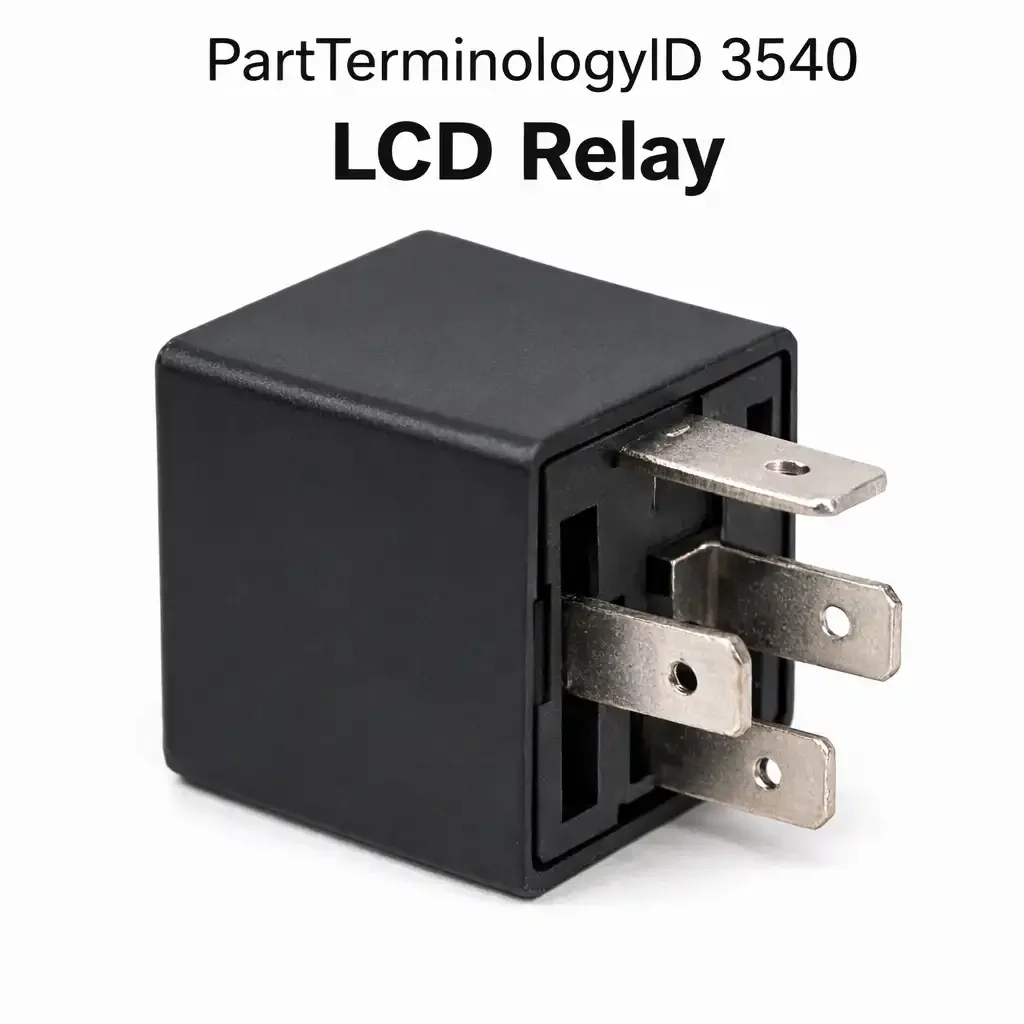
The LCD Relay, cataloged under PartTerminologyID 3540, is an electromechanical switching device that controls the supply of voltage to liquid crystal display modules within the vehicle. On applications that use this relay, it governs power delivery to the LCD screens embedded in HVAC control heads, automatic climate control modules, radio and audio head units, trip computers, and other in-dash display assemblies that use liquid crystal technology for their visual output. When the relay fails open, the LCD module receives no power, the display goes dark, and any functions dependent on that display interface become inaccessible to the driver even if the underlying control module is still operational.
LCD displays in automotive applications operate on low-voltage regulated supply circuits that are sensitive to voltage variation. The relay provides the switched supply voltage that feeds the display module's internal power regulation circuitry. On some applications this relay is part of the display module's own internal circuit architecture, while on others it is a discrete relay in the vehicle's fuse block or behind the instrument panel. Sellers building ACES fitment data for PartTerminologyID 3540 must confirm that the target application uses a discrete external relay in the LCD supply circuit, as many platforms power display modules directly through a fused ignition-switched circuit with no relay in between.
What the Relay Does
LCD Module Power Supply and Display Initialization
Liquid crystal display modules require a stable supply voltage to initialize their internal controller, charge the display matrix, and generate the visual output that presents information to the driver. On relay-dependent architectures, the LCD relay closes when an ignition-switched or accessory-switched control signal is applied to the relay coil, delivering battery voltage to the LCD module's power input. The module's internal voltage regulator converts this supply to the precise lower voltage required by the LCD controller and display matrix, typically between 3.3 and 5 volts depending on the display technology. Without stable relay-supplied input voltage, the internal regulator has no source to work from and the display cannot initialize.
On HVAC control heads with LCD displays, the relay may govern both the display supply and the control module's operating power simultaneously, meaning a failed relay produces a completely dark and unresponsive control head rather than a display-only failure. On applications where the display has a separate supply from the control logic, a failed relay may produce a dark screen while the control module continues to operate normally, accepting button inputs and controlling actuators without any visual feedback to the driver.
Ignition-Switched Activation and Accessory Circuit Integration
The LCD relay coil is typically activated by an ignition-on or accessory-on signal, ensuring the display is powered when the driver has selected a key position that enables vehicle accessories. On some applications the relay coil is triggered by the ignition switch directly. On others the BCM controls the relay coil as part of its accessory power management, allowing the BCM to delay display power-up until the module is ready to initialize, or to extend display power briefly after the ignition is switched off for retained accessory functions such as radio and climate control operation with the engine off.
On vehicles with ignition interrupt circuits, typically found on Honda and Acura platforms, a relay in the accessory power path opens briefly during engine cranking to prevent the high current draw of the starter from causing a voltage drop that would reset display modules. The LCD relay on these applications may be the same component as the ignition interrupt relay, meaning it must be closed during normal ignition-on operation and briefly opens only during cranking. A relay that fails to reclose after cranking leaves all display modules powered off with the engine running.
Display Technology Sensitivity and Voltage Stability
LCD modules are more sensitive to supply voltage instability than incandescent or LED lighting circuits. A relay with degraded contact resistance that causes intermittent voltage drop can produce display symptoms including flickering, partial initialization, pixel anomalies, or random reset cycles even though the display appears to work under static conditions. These intermittent symptoms are often misattributed to the display module itself or to the control head, leading to expensive module replacements that do not resolve the underlying relay contact degradation. A relay contact resistance test under load, measured with the display powered and drawing current, reveals this degradation more reliably than a bench test of the unloaded relay.
Extreme temperature cycling, a characteristic of instrument panel environments that experience both winter cold and summer heat soak, accelerates contact surface oxidation in relays located behind the dashboard. A relay that tests within specification at room temperature but produces voltage instability when hot is a characteristic pattern of thermally aggravated contact surface oxidation that becomes increasingly likely on high-mileage vehicles in climates with wide temperature variation.
Multi-Display Architectures and Shared Relay Supply
On vehicles with multiple LCD displays, including combined HVAC and radio display assemblies, trip computer displays integrated into the instrument cluster, and rear seat entertainment displays, a single LCD relay may supply all display modules from one contact. In this configuration, a failed relay produces simultaneous display loss across all LCD-equipped panels. This all-at-once failure pattern is a diagnostic indicator pointing toward the shared relay or its fuse rather than individual display module failure. When only one display fails while others remain functional, the display module itself, its individual power circuit, or the wiring to that specific module is more likely at fault than the shared relay.
Top Return Scenarios
Return Scenario 1: LCD Module or Control Head Internal Failure
The LCD display module itself is a more common cause of dark screen symptoms than the relay on most applications, particularly on higher-mileage vehicles where thermal cycling and vibration have stressed internal solder joints, capacitors, and the display matrix over time. A failed internal voltage regulator, a cracked solder joint on the display controller, or a deteriorated LCD matrix all produce a dark screen even when full supply voltage is present at the module's power input. Replacing the relay restores supply voltage but does not resolve an internal module fault. Buyers who do not verify that supply voltage is absent at the module input before ordering the relay will find the display still dark after relay replacement and return the part. Listing language should direct buyers to confirm that supply voltage is actually missing at the display module connector before ordering a relay.
Return Scenario 2: Fuse Protecting the LCD Supply Circuit Is Blown
The LCD supply circuit on most applications is protected by a dedicated fuse in the underdash or underhood fuse block. A blown fuse produces the same no-supply-voltage condition as a failed relay and is the first item to check. The fuse is faster and cheaper to verify than the relay. Buyers who skip the fuse check and order the relay will find no improvement if the fuse was the fault, or will find the new relay blows the same fuse if a wiring short has not been resolved first. Listing pre-purchase guidance should name the display circuit fuse as the first diagnostic step before relay ordering.
Return Scenario 3: BCM Coil Trigger Absent Due to BCM or Ignition Switch Fault
On applications where the BCM controls the LCD relay coil, the relay will not close if the BCM coil output has failed or if the BCM is not receiving the ignition-on input it needs to activate accessory power management. A buyer who replaces the relay without confirming that the coil trigger signal is present will find no change in display behavior and return the part. On applications where the ignition switch directly triggers the relay coil, a failed ignition switch output on the accessory or run circuit produces the same no-coil-trigger condition. Confirming coil voltage at the relay socket with the ignition on is a prerequisite to relay diagnosis.
Return Scenario 4: Application Powers LCD Module Directly Without a Discrete Relay
Many vehicles power display modules directly through a fused ignition-switched circuit routed through the body harness without any relay in the supply path. On these applications there is no relay socket for PartTerminologyID 3540. Buyers who search for an LCD relay on a vehicle that does not use one will receive a part they cannot install. ACES fitment data that does not accurately bound coverage to applications with a discrete LCD relay in the supply circuit generates this return category. Cross-referencing the factory wiring diagram for the display supply circuit on each included platform before publishing fitment data is the only reliable prevention.
Return Scenario 5: Display Works Intermittently Due to Connector Corrosion, Not Relay Failure
Connector corrosion at the display module harness connector or at the relay socket can produce display symptoms including intermittent blackouts, slow initialization, or flickering that mirror relay contact degradation. Buyers who attribute these symptoms to relay failure and replace the relay without inspecting connectors may find no change if the connector is the actual fault. A new relay installed into a corroded socket produces the same high-resistance supply path as the original relay with worn contacts. Listing language should recommend connector inspection and cleaning before and after relay replacement as part of the diagnostic process.
Listing Requirements
To meet minimum catalog accuracy requirements for PartTerminologyID 3540, sellers should confirm and include the following:
• ACES vehicle fitment data with year, make, model, and trim verified against OEM circuit diagrams confirming that the application uses a discrete external LCD relay in the display supply circuit
• Identification of which display modules the relay supplies on the target application: HVAC control head, radio display, trip computer, combined display assembly, or all in-dash LCD modules
• Relay coil activation source identified as ignition switch direct, BCM-controlled, or accessory circuit trigger
• Contact current rating confirmed adequate for the combined display module load on the target application
• Relay housing type and pin configuration confirmed to match the target vehicle socket
• Model year range bounded to exclude platform versions where direct-fused display supply circuits eliminated the discrete relay
• OEM cross-reference part numbers where available
• Diagnostic pre-purchase guidance directing buyers to confirm supply voltage is absent at the display module, check the display circuit fuse, and verify relay coil trigger signal before ordering
• Notation that relay replacement will not resolve internal display module failures, blown fuses, BCM output faults, or connector corrosion
• Confirmation that the relay is sold without display module or wiring harness
Frequently Asked Questions
Can a failing LCD relay cause only part of the display to stop working while the rest remains visible?
Not typically. A relay failure produces a loss of supply voltage to the entire display module, which should cause the full display to go dark simultaneously. Partial display failures, where some pixels are visible and others are not, or where certain display segments function while others do not, are characteristic of internal LCD matrix failures, damaged display controller connections, or deteriorated display ribbon cable contacts rather than relay failure. A relay fault produces all-or-nothing loss of display function. If any portion of the display is visible, the relay is almost certainly not the cause.
Will replacing the LCD relay require recalibration or reprogramming of the display module?
On most applications, no. The relay is a passive switching component with no programming function. The display module retains its settings, stored data, and calibration parameters independently of relay state. However, on some climate control systems with automatic calibration, a cold power-up after a prolonged de-energized period may cause the control head to perform a self-test or actuator sweep on initialization. This is normal behavior and does not indicate that the module requires reprogramming. On applications where the control module stores adaptive values in volatile memory that are lost during power interruptions, a brief recalibration period may be required after relay replacement, but this is a module characteristic rather than a relay replacement consequence.
My HVAC display is dark but the blower and temperature control still work. Does this confirm the relay has failed?
Not definitively. This symptom pattern indicates that the HVAC control module has operating power on its logic supply circuit but the display supply is absent. On applications where the control logic and the display have separate power inputs, a failed relay in the display supply circuit can produce this exact pattern. However, the same pattern is also produced by a blown display-specific fuse on a separate circuit from the logic supply, a failed display module backlight or internal display regulator, and a disconnected or corroded display connector. Confirming that supply voltage is absent specifically at the display module's power input pins, not just at the control head's logic supply, narrows the diagnosis to the relay or the display circuit fuse.
How do I test the LCD relay before replacing it?
Remove the relay from its socket. Apply 12V DC to the coil terminals. A functioning relay will click and show continuity between the load terminals when coil voltage is applied, and no continuity with coil voltage removed. In-vehicle, with the ignition on, check for coil activation voltage or ground at the relay socket to confirm the relay is receiving its trigger signal. Then check for supply voltage at the relay output terminal. If coil signal is present but no output voltage appears after a functional relay is installed, the fault is on the load side of the circuit between the relay and the display module. If coil signal is absent, the fault is upstream in the trigger circuit.
What Sellers Get Wrong
Applying fitment to platforms without a discrete LCD relay
This is the primary fitment risk for PartTerminologyID 3540. Display module power supply architectures vary significantly across manufacturers and even across trim levels within the same model. Some applications route display power through a relay and some route it directly through a fuse. Some applications transitioned from relay-based to direct-fused supply at a mid-cycle update without changing the external appearance of the fuse block. Building fitment data based on model year and body style without circuit diagram verification for the display supply architecture will cover vehicles with no relay socket for this part. These returns are unavoidable at installation and represent the most preventable return category for this part number.
Not distinguishing between display module failure and relay failure in symptom descriptions
A dark display screen is caused by internal display module failure more commonly than by relay failure on most applications. A listing that presents dark screen as the primary relay failure symptom without distinguishing it from module failure will attract buyers whose display modules have failed and who will return the relay when installation does not restore the display. The symptom description should specify that relay failure produces no supply voltage at the display module input, which can be confirmed with a multimeter before ordering, and that display function does not resume even with correct voltage applied if the module itself has failed.
Not directing buyers to check the fuse first
The display circuit fuse is upstream of the relay and its failure produces the identical symptom. It takes less than one minute to check and costs nothing to verify. A listing that does not name the fuse as the first diagnostic step before relay ordering generates a predictable return volume from buyers whose fuses were the fault and who discover this only after relay installation. This is one of the most consistent and preventable return categories across all relay part numbers, and the LCD relay is no exception.
Overlooking intermittent display issues caused by connector corrosion rather than relay failure
Intermittent display failures, particularly those that correlate with temperature, vibration, or time, are more often caused by connector corrosion or loose terminal contact than by relay failure. Buyers whose displays fail intermittently and who attribute this to a relay often return the relay when the display behavior does not change after replacement. Adding a recommendation to inspect and clean the relay socket and the display module connector before ordering establishes correct diagnostic expectations and prevents returns from buyers whose connectors were the actual fault.
Cross-Sell Logic
Buyers diagnosing a dark or non-functional display who have confirmed the LCD relay as the cause are candidates for the following related components, which share diagnostic overlap or represent the next logical step if relay replacement does not fully restore display function.
• HVAC control head or climate control module (the most common actual cause of dark display symptoms on automatic climate control applications; if relay replacement restores supply voltage but the display remains dark, the module is the next replacement candidate)
• Display circuit fuse (checked before relay ordering, appropriate low-cost add-on for any display circuit repair)
• Radio or audio head unit (on applications where the LCD relay supplies the radio display; a radio display that remains dark after relay replacement indicates a failed radio display module)
• Relay socket or pigtail connector (connector corrosion is a parallel failure mode that should be confirmed during relay replacement)
• Body control module (applications where the BCM provides the relay coil trigger and the BCM output has failed)
• Instrument cluster assembly (on applications where the trip computer or odometer LCD is supplied by the same relay and the cluster display has failed internally)
Final Take
PartTerminologyID 3540 occupies a narrow diagnostic position: it governs supply voltage to display modules that show driver information but are not themselves the control logic for the systems they represent. The relay can fail and leave a climate control system fully functional but invisible to the driver, or it can create what appears to be a complete module failure when the underlying hardware is intact.
The sellers who generate the fewest returns on 3540 build fitment data that accurately reflects which platforms actually use a discrete relay in the display supply circuit. They direct buyers to confirm that voltage is absent at the display module before ordering, and they name the fuse as the first check and the display module as the most likely alternate cause. That combination of accurate fitment and clear diagnostic guidance prevents the three most common return scenarios and makes the listing more useful than most of what the buyer will find when searching for this part.