
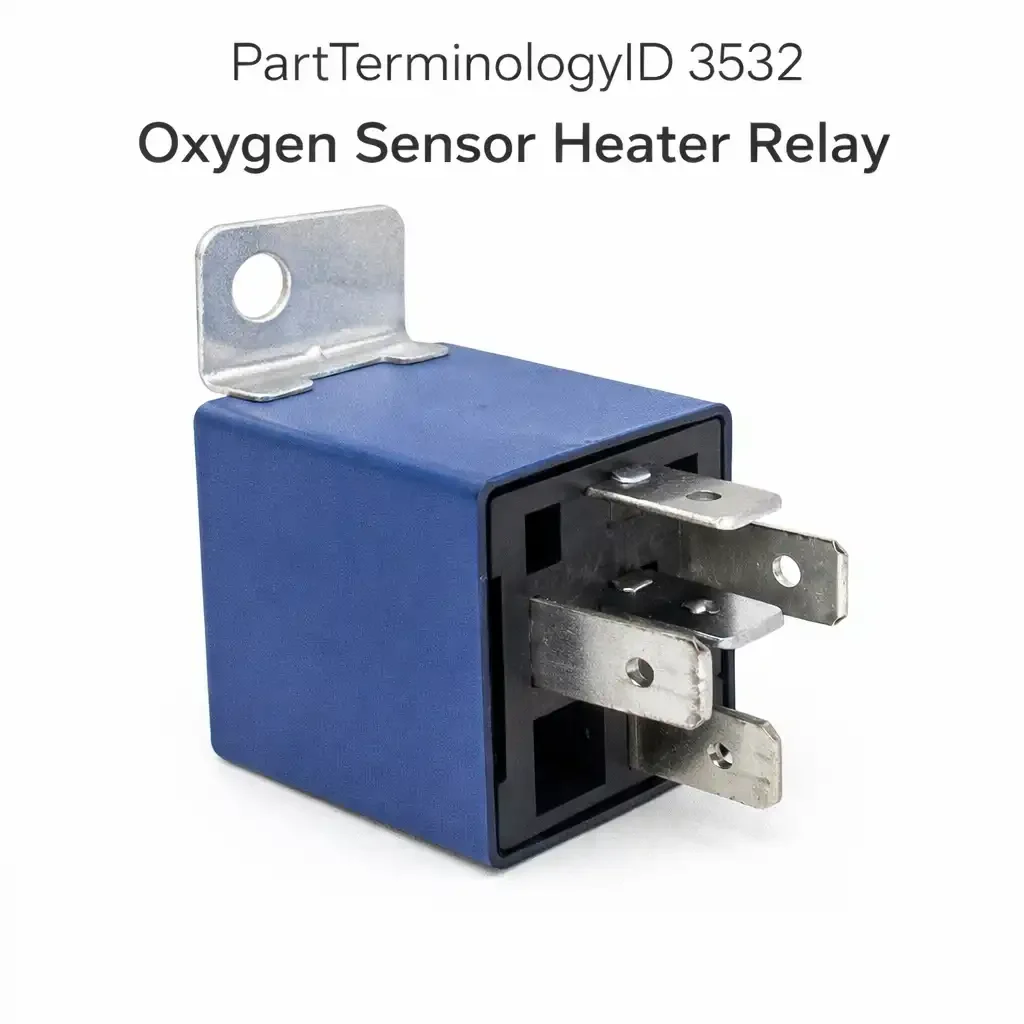
The Oxygen Sensor Heater Relay, cataloged under PartTerminologyID 3532, is an electromechanical switching device that supplies battery voltage to the heating elements embedded in heated oxygen sensors. When the relay closes, it completes the power circuit that allows the heater elements to rapidly bring each sensor to its minimum operating temperature, enabling the engine to exit open-loop fuel control and enter closed-loop operation as quickly as possible after a cold start. Without relay-supplied voltage, oxygen sensor heaters remain inactive, the sensors take significantly longer to reach operating temperature from exhaust heat alone, the engine runs open-loop longer than designed, fuel trims are not properly managed during the warm-up phase, and emissions increase.
On relay-dependent heater circuit architectures, battery voltage is supplied to the sensor heater elements through the relay contact, and the PCM controls the ground side of the heater circuit directly to regulate heater operation. On other architectures the PCM supplies voltage to the heater directly through an internal driver circuit with no external relay. Sellers building fitment data for PartTerminologyID 3532 must confirm that the target application uses a relay in the heater supply circuit before applying coverage. Applications where the PCM drives the heater directly will not have a relay socket for this part, and fitment errors on these platforms generate returns that cannot be resolved by relay replacement.
What the Relay Does
Heater Supply Voltage and Cold-Start Closed-Loop Transition
Heated oxygen sensors contain a ceramic element, typically zirconia, that requires a minimum operating temperature of approximately 600 degrees Fahrenheit to generate the voltage differential signal the PCM uses for air-fuel ratio feedback. At temperatures below this threshold the sensor produces no usable signal and the engine operates in open-loop mode, running on pre-programmed fuel maps without real-time exhaust oxygen feedback. Open-loop operation produces higher fuel consumption, richer air-fuel mixtures, and elevated hydrocarbon and carbon monoxide emissions.
The heater element inside the sensor draws current from the battery supply circuit, governed by the oxygen sensor heater relay, to raise sensor tip temperature rapidly from ambient to operating temperature. On a cold start at low ambient temperatures, heater elements can bring sensors to operating temperature within 30 to 60 seconds, compared to several minutes if the sensor relied solely on exhaust gas heat. The oxygen sensor heater relay closes when the PCM or ignition circuit commands it, supplying the heater supply voltage that makes this rapid warm-up possible. On vehicles with two banks of sensors, a single relay may supply all sensor heaters, or separate relays may supply each bank.
PCM Heater Ground Control and Current Monitoring
On the most common heater circuit architecture, the relay supplies the positive side of the heater circuit and the PCM controls the negative side. When the PCM is ready to activate a heater, it grounds the heater circuit at an internal driver transistor, completing the circuit through the sensor heater element. The PCM activates heaters after cold starts and during periods when sensor temperature may have dropped due to extended idle or low exhaust flow. The PCM monitors heater circuit current continuously by measuring the voltage drop across a known resistance in the circuit. If current flow is outside the expected range, the PCM sets a heater circuit diagnostic trouble code.
A failed relay that is open will prevent current from flowing regardless of PCM ground commands, which the PCM will detect as a heater circuit open fault. The resulting DTC will be a P003x or P004x series code indicating a heater circuit fault on the specific sensor position. Because the PCM monitors current rather than voltage, it can distinguish between a circuit that has no supply voltage due to a relay fault, a circuit that has an open heater element inside the sensor, and a circuit that has abnormally high resistance due to connector corrosion. Each failure mode produces a different current reading and may produce a different code variant within the heater circuit DTC family.
Ignition-Switched Supply and Relay Activation Timing
On most applications the oxygen sensor heater relay is energized by an ignition-switched voltage source, meaning the relay closes when the ignition key is turned to the run position and the PCM is initialized. Some applications use the PCM itself to trigger the relay coil, allowing the PCM to delay heater activation during cranking or to deactivate heaters under specific load conditions. On other applications the relay coil is tied directly to an ignition-on circuit with no PCM control, meaning the heaters are powered whenever the ignition is on regardless of PCM state.
The activation timing matters for diagnosis. On PCM-controlled relay applications, a relay that does not close may indicate a PCM output fault rather than a relay fault. On ignition-switched applications with no PCM coil control, an open relay at ignition-on confirms the relay is at fault unless the ignition circuit supplying the coil has failed. Confirming which activation method the target application uses is a prerequisite to accurate diagnosis.
Multi-Sensor Supply and Bank-Split Architectures
On four-cylinder applications with two sensors, a single oxygen sensor heater relay commonly supplies both upstream and downstream heater elements from one contact. On V6 and V8 applications with four sensors across two banks, the heater relay may supply all four heaters from one relay, or two separate relays may supply Bank 1 and Bank 2 sensors independently. When all four heater circuits set codes simultaneously, a failed single relay or a blown heater fuse is the most likely explanation, as simultaneous failure of four individual sensors is statistically improbable. A relay that supplies only Bank 1 or Bank 2 sensors will produce codes only on the sensors it supplies, leaving the other bank unaffected.
Top Return Scenarios
Return Scenario 1: Failed Oxygen Sensor Heater Element Was the Root Cause
The most common reason a sold oxygen sensor heater relay is returned is that the sensor heater element itself, not the relay, was the failed component. A burned-open heater element inside the sensor produces the same heater circuit open code that a failed relay produces, because both conditions result in no current flow through the heater circuit. Relay replacement restores supply voltage but still produces no current flow if the heater element is open. The PCM sets the same code again within one drive cycle. Testing heater element resistance at the sensor connector before ordering the relay, which should read between 2 and 30 ohms depending on sensor temperature and application, confirms or eliminates the sensor as the fault. Listing language should direct buyers to measure heater element resistance before ordering the relay.
Return Scenario 2: Heater Circuit Fuse Blown
The oxygen sensor heater circuit is protected by a dedicated fuse or fuses in the underhood fuse block. A blown heater fuse produces the same no-supply-voltage condition as a failed relay. The fuse is the first item to check and the least expensive to replace. Buyers who skip the fuse check and order the relay will find no improvement and return it. On applications with multiple heater fuses protecting individual sensor positions or banks, all fuses in the heater circuit should be verified before ordering. Listing pre-purchase guidance should name the heater circuit fuse as the first diagnostic step.
Return Scenario 3: Application Uses PCM-Direct Heater Control with No External Relay
On many platforms, particularly those from the late 1990s onward, the PCM drives the oxygen sensor heater supply voltage directly through an internal power transistor with no external relay in the circuit. These applications have no relay socket for PartTerminologyID 3532 in the fuse block or underhood electrical center. Buyers whose vehicles use PCM-direct heater control who locate a relay position near the heater fuse and order a replacement will receive a part their vehicle cannot use. ACES fitment data that does not exclude these platforms generates returns that are impossible to avoid at the installation step. Confirming relay presence in the factory wiring diagram for each platform in the fitment range before publishing coverage is the correct approach.
Return Scenario 4: Wiring Harness Fault Producing Open Heater Circuit Code
The wiring between the relay output, the sensor connector, and the PCM ground path is routed through the engine compartment in close proximity to heat sources, moving components, and sharp chassis edges. Chafed insulation, broken wires at harness flex points near the firewall or engine mounts, and corrosion at the sensor connector all produce open or high-resistance heater circuit conditions that the PCM logs as heater faults. Relay replacement does not resolve a wiring harness fault. Buyers who replace the relay after a heater code without inspecting the harness will find the code returns and may return the relay as defective. Listing language should note that harness integrity between the relay and sensor connector should be verified before and after relay replacement.
Return Scenario 5: Exhaust Leak Causing False Heater Fault Diagnosis
An exhaust leak upstream of an oxygen sensor can flood the sensor with ambient air, causing the sensor to report a continuous lean condition that the PCM may interpret as a heater circuit fault or sensor failure rather than an exhaust leak. When the PCM sees no voltage switching from a sensor it believes should be warm, it may log a heater performance code. Replacing the heater relay does not resolve an exhaust leak. Buyers who follow a heater code to relay replacement without confirming sensor signal behavior on a scan tool will sometimes find the code returns unchanged and return the relay. A quick scan tool check showing whether the sensor is producing any signal at all, even a steady lean signal, before ordering hardware helps redirect these buyers.
Listing Requirements
To meet minimum catalog accuracy requirements for PartTerminologyID 3532, sellers should confirm and include the following:
• ACES vehicle fitment data with year, make, model, engine, and trim verified against OEM circuit diagrams confirming that the application uses an external relay in the oxygen sensor heater supply circuit, not PCM-direct heater control
• Relay coil activation source identified as ignition-switched direct, PCM-controlled trigger, or combined path
• Relay contact current rating confirmed adequate for the combined heater element load of all sensors supplied by the relay on the target application
• Number of sensor heater circuits governed by the relay on the target application (single bank, dual bank, or all sensors)
• Relay housing type and pin configuration confirmed to match the target vehicle socket
• Model year range bounded to exclude platform generations where PCM-direct heater control eliminated the external relay
• OEM cross-reference part numbers where available
• Diagnostic pre-purchase guidance directing buyers to check heater circuit fuse, measure sensor heater element resistance, and confirm relay coil trigger signal before ordering
• Notation that relay replacement will not resolve a failed heater element inside the sensor, a blown heater fuse, a wiring harness fault, or a PCM driver circuit failure
• Confirmation that the relay is sold individually without sensor or fuse
Frequently Asked Questions
What diagnostic trouble codes indicate the oxygen sensor heater relay may have failed?
Heater circuit DTCs in the P003x and P004x range indicate faults in the oxygen sensor heater circuit for specific sensor positions and banks. P0031 indicates a heater circuit low condition on Bank 1 Sensor 1, which can be caused by low or absent supply voltage from a failed relay. P0037 indicates the same condition on Bank 1 Sensor 2. P0051 and P0057 indicate the corresponding conditions on Bank 2. When the same heater circuit low code sets on multiple sensors simultaneously, particularly those supplied by a single relay, a relay or fuse fault is a high-probability diagnosis. When a heater circuit code sets on only one sensor position, the more probable cause is the individual sensor heater element or a wiring fault at that specific sensor location. The relay being the cause of a single-sensor heater code is less likely but not impossible if the relay has a high-resistance contact fault affecting only part of its load.
How does the PCM detect an oxygen sensor heater relay failure?
The PCM monitors heater circuit current flow by measuring the voltage drop across an internal sense resistor or by direct current monitoring, depending on the architecture. When the PCM commands the heater circuit on by grounding the heater return path, it expects to see current in the range of 0.25 to 2 amperes depending on the sensor type and temperature. If the relay has failed open, no current flows and the PCM detects a circuit open condition. The code sets after the PCM has confirmed the fault for a calibrated period, typically at least 10 seconds of commanded-on time with no current response. On cold starts the PCM may also perform a pre-activation heater resistance test using the engine coolant temperature sensor to time the resistance measurement appropriately.
Will an oxygen sensor heater relay fault cause a failed emissions test?
Yes, on OBD-II equipped vehicles. A heater circuit DTC illuminates the MIL and causes the heater circuit monitor to report as failed. Most emissions testing jurisdictions fail a vehicle that has an illuminated MIL regardless of the specific code. Additionally, a vehicle that cannot complete its OBD-II readiness monitors due to a heater circuit fault may fail inspection on readiness monitor grounds even after the MIL is cleared but before the monitors have completed. The readiness monitor for the oxygen sensor heater must complete a full drive cycle to set to ready after any heater circuit repair, which requires specific operating conditions including a cold start and a calibrated period of closed-loop operation.
Can I test the oxygen sensor heater relay without a scan tool?
Yes. Remove the relay from its socket and apply 12V DC to the coil terminals. A functioning relay will click and show continuity between the load terminals when coil voltage is applied. With coil voltage removed, a normally open relay should show no continuity between load terminals. In-vehicle, with the ignition on and the PCM initialized, check for battery voltage at the relay output terminal before and after commanding the heater circuit on. On PCM-controlled relay applications this may require a scan tool command to trigger heater activation. On ignition-switched relay applications, output voltage should be present at ignition-on without scan tool intervention. The sensor heater element can be tested separately by disconnecting the sensor connector and measuring resistance between the heater pins, which should read 2 to 30 ohms depending on sensor temperature.
What Sellers Get Wrong
Applying fitment to PCM-direct heater control platforms
This is the most significant fitment error for PartTerminologyID 3532. The shift from relay-based to PCM-direct heater supply occurred across multiple manufacturers at different points in the 1990s and 2000s and did not follow a single industry-wide timeline. A fitment range built on model year and engine displacement alone, without circuit diagram verification, will cover platforms that have no relay socket for this part. The resulting returns are unavoidable because the buyer has no way to use the part. Cross-referencing factory wiring diagrams for the heater supply circuit architecture on each platform and model year in the fitment range is the only reliable way to prevent this category of return.
Not directing buyers to test the sensor heater element first
The sensor heater element fails more commonly than the relay on most applications, particularly on high-mileage vehicles where thermal cycling over hundreds of thousands of miles fatigues the heater wire. The heater element test takes two minutes with a multimeter and definitively confirms or eliminates the sensor as the fault before any parts are ordered. A listing that does not include this test step in its pre-purchase guidance will generate returns from buyers whose sensors were the actual fault and who installed a new relay only to see the same code return. Adding heater element resistance testing as the first diagnostic recommendation in the listing description is the highest-impact content change available for this part.
Not distinguishing single-sensor codes from multi-sensor codes in listing guidance
A heater code on a single sensor position points toward that sensor's heater element or the wiring serving that specific sensor. A heater code on multiple sensor positions simultaneously points toward the shared supply component, which is the relay or fuse. Sellers who describe relay failure as a cause of single-sensor heater codes without this context attract buyers whose single-sensor code is caused by a failed sensor rather than a relay. This is a predictable return category. Listing symptom descriptions should specify that relay failure typically produces heater codes on all sensors supplied by the relay simultaneously, not on a single sensor position in isolation.
Failing to mention that heater monitors must complete after repair
After an oxygen sensor heater relay is replaced and the heater circuit DTC is cleared, the PCM heater circuit readiness monitor must complete before an emissions test can be passed. Buyers who repair the relay, clear the code, and immediately drive to an emissions test station will fail on readiness grounds if the monitor has not yet run. This generates frustration that sometimes results in relay returns or negative reviews even when the relay replacement was the correct repair. A brief note in the listing or installation guidance that the heater monitor requires a complete drive cycle after repair, including a cold start, sets accurate post-repair expectations.
Cross-Sell Logic
Buyers diagnosing an oxygen sensor heater circuit fault who are replacing the relay are natural candidates for the following related components, which share the diagnostic circuit or represent the next logical repair step.
• Oxygen sensor (the heater element inside the sensor is the most common actual cause of heater circuit codes; buyers replacing the relay may still need to replace the sensor if the heater element has failed)
• Oxygen sensor heater circuit fuse (the first item to check before relay ordering, appropriate low-cost add-on for any heater circuit repair)
• Upstream oxygen sensor connector or pigtail repair kit (connector corrosion at the sensor is a common wiring fault that produces heater circuit codes without relay or sensor failure)
• Downstream oxygen sensor (buyers replacing a failed upstream heater circuit often discover the downstream sensor heater is approaching failure on the same drive cycle)
• Air-fuel ratio sensor (applications using wideband AFR sensors upstream have distinct heater circuit requirements and calibration procedures that may need to be addressed at the same service event)
• PCM (on applications where the PCM internal driver circuit has failed and is not supplying the relay coil trigger signal or heater ground command)
Final Take
PartTerminologyID 3532 is one of the more technically nuanced relay part numbers in the catalog because its circuit architecture varies widely by platform and because the symptom it produces, a heater circuit DTC, is most commonly caused by the sensor itself rather than the relay. A seller who builds listings for this part without accounting for that diagnostic hierarchy will generate returns at a predictable rate from buyers whose sensors were the fault.
The sellers who minimize returns on 3532 do three things well. They bound their fitment data to platforms that actually use an external relay in the heater supply circuit. They direct buyers to test sensor heater element resistance before ordering. And they note that when a heater code is on only one sensor position, the relay is an unlikely cause compared to the sensor or its wiring. That combination of accurate fitment and useful diagnostic guidance is what separates a relay listing that generates trust from one that generates returns.