
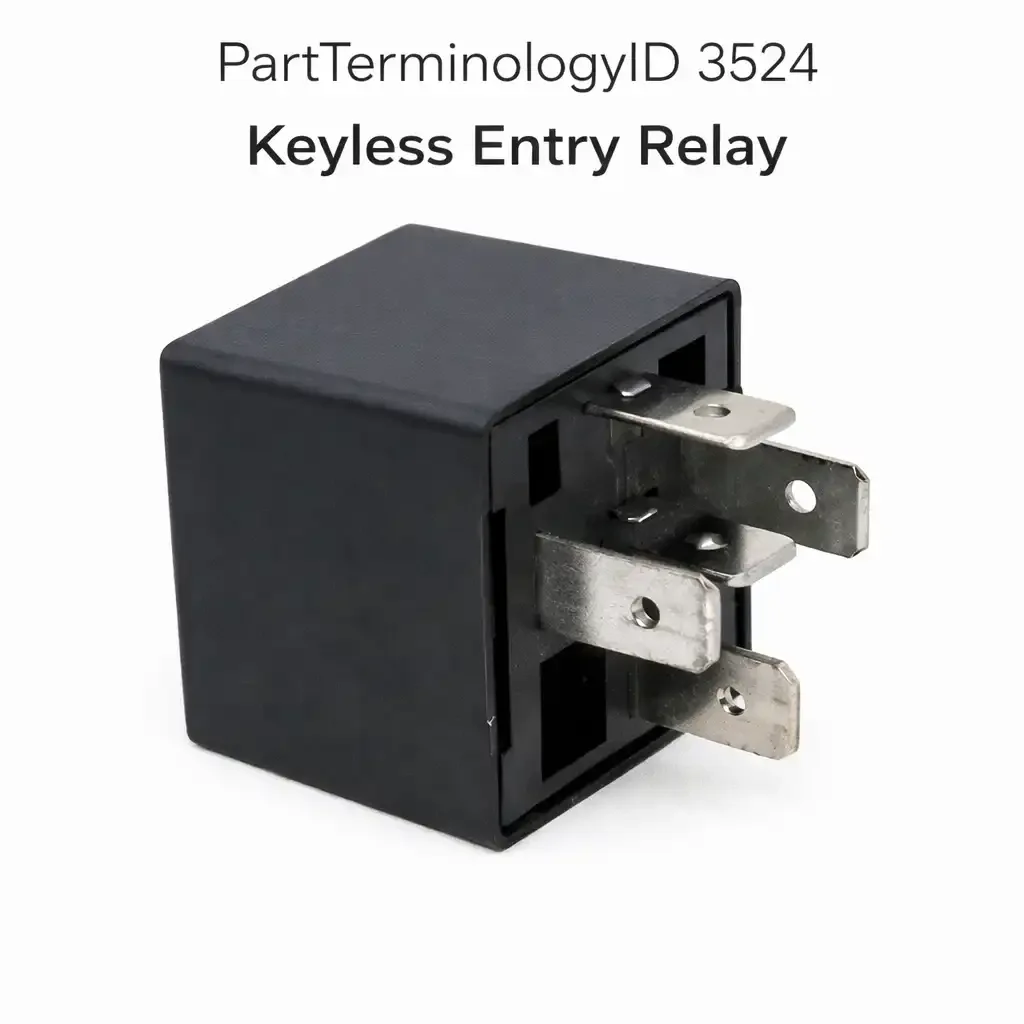
The Keyless Entry Relay, cataloged under PartTerminologyID 3524, is an electromechanical switching device that supplies or switches power within the keyless entry system, enabling the remote control door lock receiver (RCDLR) or keyless entry control module to operate and communicate with the body control module (BCM). On applications that use this relay, it typically governs the power supply to the RKE receiver module, the door lock actuator circuit, or both. When the relay fails, the keyless entry system loses power or loses the ability to deliver a switching signal to door lock actuators, resulting in key fob commands that produce no vehicle response.
The specific circuit function governed by PartTerminologyID 3524 varies by application. On some platforms the relay is in the power supply path to the RKE receiver module, meaning receiver failure without relay replacement will not restore keyless entry function. On others the relay is in the door lock actuator circuit and governs whether the BCM output signal can drive the actuators to lock or unlock. Sellers building ACES fitment data and product descriptions for this part must understand which circuit role the relay plays on each target application, because the diagnostic path and the competing root causes differ significantly between these two configurations.
What the Relay Does
RKE Receiver Power Supply and Signal Path
On relay-dependent keyless entry architectures, the keyless entry relay provides the power supply that keeps the remote control door lock receiver active and ready to detect incoming RF signals from the key fob transmitter. When the relay is closed, the receiver module receives battery voltage, initializes its RF detection circuit, and listens for valid transmitter signals on the designated frequency. When a fob button is pressed, the receiver decodes the RF signal, validates the rolling code or fixed code sequence against stored values, and sends a function request to the BCM over the keyless entry serial data circuit. The BCM then executes the requested function, whether that is door lock, door unlock, interior lamp activation, parking lamp flash, or horn chirp.
If the keyless entry relay fails open and the receiver module loses power, no RF signal from the key fob will produce a vehicle response regardless of fob battery condition, fob programming status, or BCM health. This is a complete and immediate failure with no partial functionality. All fob buttons will produce no response. Manual door lock switches and BCM-managed locking functions will continue to operate normally because the door lock actuator circuit has its own power path separate from the RKE receiver supply.
Door Lock Actuator Circuit Switching
On applications where the keyless entry relay is positioned in the door lock actuator circuit rather than the receiver power supply path, the relay governs whether the BCM lock or unlock command signal can reach the door lock actuators. The BCM receives the function request from the RKE receiver, generates an output signal to activate door lock or unlock, and sends that signal through the relay contact to the door lock motor circuit. If the relay fails open, the BCM output signal has no path to the actuators and doors will not lock or unlock in response to fob commands. On these applications, RKE receiver operation is not affected by the relay. The fob will still communicate with the receiver and the BCM will still process the command, but the actuators will not move.
On some platforms, separate lock and unlock relays are used, each governing one direction of actuator travel. A failed lock relay produces doors that will not lock via fob but will still unlock. A failed unlock relay produces the opposite pattern. If both directions of fob-commanded locking fail simultaneously, either the receiver power supply is lost, the BCM has a fault, or a single relay that governs both directions has failed.
BCM Integration and Rolling Code Validation
Modern keyless entry systems use rolling code encryption, meaning the fob transmits a new code sequence with each button press and the receiver validates the sequence against the next expected code stored in BCM memory. This prevents replay attacks where an intercepted signal is rebroadcast to unlock the vehicle. The keyless entry relay plays no role in code validation. It is a passive switching component. A vehicle that does not respond to a known-good programmed fob may have a relay fault, a receiver fault, a BCM communication fault, or a programming mismatch. The relay cannot be identified as the cause by the symptom alone. Voltage testing at the relay socket is required to narrow the diagnosis.
On platforms where the BCM incorporates the RKE receiver function internally, no external RKE receiver module and no separate keyless entry relay exist. On these vehicles, PartTerminologyID 3524 will not be present in the circuit. Applying fitment data to these platforms is a catalog error that generates misapplication returns.
Retained Accessory Power and Key-Off Relay Operation
The keyless entry relay on many applications is powered by battery-backed voltage rather than ignition-switched voltage, because RKE commands must be receivable when the ignition is off. The relay coil or load circuit is connected to a constant battery supply circuit, which means the relay must remain functional during vehicle storage and key-off periods. A relay that fails intermittently due to heat or vibration during vehicle operation may test functional when the vehicle is cold or parked but fail after a drive cycle, producing a symptom pattern where keyless entry stops working after the vehicle has been running and recovers after it sits. This thermal intermittency is a characteristic of contact surface degradation and is not resolved by fob reprogramming or BCM reset.
Top Return Scenarios
Return Scenario 1: Key Fob Battery Dead or Fob Needs Reprogramming
This is the most common reason a keyless entry relay is ordered and returned. A dead fob battery and a failed relay produce identical symptoms: the fob produces no vehicle response. Buyers who do not try a known-good spare fob or install a fresh fob battery before ordering the relay will frequently discover after installation that the original battery was the cause. Listing language should direct buyers to test with a fresh battery or a second programmed fob before ordering. A fob that has lost programming will also produce no response, and the relay replacement will not restore it. Buyers in this situation need a fob reprogramming procedure, not a new relay.
Return Scenario 2: RKE Receiver Module Failed
On applications where the keyless entry relay supplies power to the RKE receiver module, a failed receiver module produces no fob response even after relay replacement. If the relay is in the power supply path and tests functional, the receiver is the next component in the diagnostic chain. Buyers who replace the relay without confirming that the receiver module is receiving power and generating a valid serial data response to the BCM will find no improvement and return the relay. Testing requires confirming power at the receiver module connector and using a scan tool to observe whether the BCM logs a keyless entry data link fault code, which indicates the receiver is not communicating.
Return Scenario 3: BCM Not Processing RKE Commands
The BCM receives function requests from the RKE receiver over a dedicated serial data circuit and executes the requested function. If the BCM serial data input for the RKE system has a fault, or if the BCM has lost the fob programming due to a battery disconnect or memory fault, the relay and receiver may both be functional while fob commands produce no vehicle response. Buyers who have replaced both a fob battery and a relay without result are often facing a BCM programming or hardware issue. Relay replacement does not address BCM faults and will not restore keyless entry function when the BCM is the failed component.
Return Scenario 4: RF Interference Masquerading as Relay Failure
Keyless entry systems operating on the 315 MHz or 433 MHz frequency bands are susceptible to temporary interference from nearby RF sources including aftermarket electronics, cellular boosters, power inverters, and high-traffic RF environments such as parking garages or areas near broadcast equipment. During periods of interference, fob commands produce no vehicle response and the system appears completely failed. Once the interference source is removed or the vehicle is moved, keyless entry resumes normally. Buyers who experience this pattern and order a relay will find the system working normally by the time the part arrives and return it as unneeded. Listing language should note that temporary total failure of keyless entry that resolves on its own or in different locations suggests RF interference rather than relay failure.
Return Scenario 5: Application Has BCM-Integrated RKE with No External Relay
Late-model vehicles on many platforms integrated the RKE receiver function directly into the BCM hardware, eliminating the external receiver module and the keyless entry relay simultaneously. On these vehicles, there is no relay socket for PartTerminologyID 3524 in the fuse block. Buyers who locate a relay position labeled for keyless entry in the fuse block diagram of an older model year and assume the same position exists on a newer platform will order a relay their vehicle cannot use. ACES fitment data that is not bounded to the specific platform years where the external relay was present will generate this return category consistently.
Listing Requirements
To meet minimum catalog accuracy requirements for PartTerminologyID 3524, sellers should confirm and include the following:
• ACES vehicle fitment data with year, make, model, engine, and trim verified against OEM circuit diagrams confirming that the application uses an external keyless entry relay rather than BCM-integrated RKE
• Identification of the relay circuit role on the target application: RKE receiver power supply, door lock actuator switching, or combined function
• Relay coil voltage confirmed as 12V DC and power supply type identified as battery-backed constant voltage or ignition-switched voltage
• Contact current rating confirmed from part specification sheet, appropriate for the load on the target application
• Relay housing type and pin configuration confirmed to match the target vehicle socket
• Model year range bounded to exclude platform generations where BCM-integrated RKE eliminated the external relay
• OEM cross-reference part numbers where available
• Diagnostic pre-purchase guidance directing buyers to confirm fob battery condition, fob programming status, and relay coil trigger voltage before ordering
• Notation that relay replacement will not restore keyless entry if the fob needs programming, the RKE receiver module has failed, or the BCM is not processing fob commands
• Clear statement about whether the relay is sold with or without socket or pigtail connector
Frequently Asked Questions
Will replacing the keyless entry relay require fob reprogramming?
No. The keyless entry relay is a passive switching component with no memory or programming function. Replacing it does not affect fob programming status, rolling code synchronization, or BCM fob registration. The BCM retains fob programming independently of the relay. A fob that was programmed before relay replacement will remain programmed and functional after the new relay is installed, assuming the relay was the actual cause of the failure and the fob programming was intact to begin with.
Can a keyless entry relay fault set a diagnostic trouble code?
Not directly. The relay itself has no feedback circuit that reports its status to the BCM. However, if a failed keyless entry relay causes the RKE receiver module to lose power, and the BCM subsequently loses serial data communication with the receiver, the BCM may log a keyless entry data link fault code such as B3101 or a manufacturer-equivalent. This code indicates that the BCM sent a configuration request to the receiver and received no response, which is consistent with receiver power loss caused by a failed relay. Finding this code during diagnosis supports relay and receiver power supply investigation as the starting point rather than BCM or fob diagnosis.
My doors lock and unlock normally with the interior switch but not with the fob. Is the relay the cause?
This symptom pattern is one of the more useful diagnostic clues for this part number. If manual door lock switches operate normally, the door lock actuators and their wiring are functional. The failure is isolated to the RKE command path. On applications where the keyless entry relay is in the door lock actuator circuit, this symptom is consistent with relay failure because the manual switch bypasses the relay path and drives the actuators directly. On applications where the relay is in the RKE receiver power supply path, this symptom is consistent with either relay failure causing receiver power loss or receiver module failure. Confirming which circuit role the relay plays on the specific application determines whether the relay or the receiver module is the next diagnostic step.
How do I test the keyless entry relay before replacing it?
Remove the relay from its socket. Apply 12V DC to the coil terminals. A functioning relay will click and show continuity between the load terminals when coil voltage is applied. With coil voltage removed, a normally open relay should show no load terminal continuity. In-vehicle, check for coil trigger voltage or ground at the relay socket with the ignition off and battery connected, confirming that the relay is receiving its activation signal. If coil signal is present but the receiver module is still unpowered or door locks are still unresponsive after confirming fob and programming status, the relay is a reasonable replacement candidate. If coil signal is absent, the fault is upstream in the power supply or BCM output circuit.
What Sellers Get Wrong
Not identifying the relay circuit role in the listing
The keyless entry relay on different applications governs different parts of the circuit. A buyer diagnosing a keyless entry failure on a vehicle where the relay supplies the RKE receiver needs to follow a completely different diagnostic path than a buyer on a vehicle where the relay is in the door lock actuator circuit. A listing that does not clarify which circuit the relay governs leaves buyers unable to determine whether the relay is even in the suspected failure path. Adding a brief circuit role description in the product listing, whether receiver power supply or door lock switching, sets accurate diagnostic expectations and reduces returns from buyers who replaced a relay that was not in the fault circuit.
Applying fitment to BCM-integrated RKE platforms
The transition from external RKE receiver with relay to BCM-integrated RKE occurred at different model years across different platforms and often mid-generation within the same model line. Fitment data that does not account for this transition will cover vehicles that have no relay socket and no external receiver. This is the most structurally avoidable return category for PartTerminologyID 3524. Cross-referencing the factory wiring diagram for each platform generation included in the fitment range before publishing coverage is the correct approach. A single incorrect model year on a high-volume platform can generate sustained return volume.
Not directing buyers to check fob battery and programming first
A dead fob battery is the most common cause of no-response keyless entry and is resolved with a two-dollar battery replacement. A listing that does not name fob battery and programming status as the first diagnostic checks before relay ordering will attract buyers who have not performed these checks and will return the relay when it does not resolve a non-relay fault. Adding one sentence to the listing description that directs buyers to verify fob battery and programming before ordering is the highest-return-on-investment content change available for this part number.
Failing to note RF interference as a cause of apparent total failure
Buyers who experience intermittent or location-specific keyless entry failure often attribute the symptom to a hardware fault and order a relay. When the system resumes working on its own, they return the part as unnecessary. Noting in the listing that temporary, self-resolving keyless entry failures in specific locations are consistent with RF interference rather than relay failure gives these buyers a diagnostic framework that redirects them away from a hardware order. This is a small content addition that prevents a predictable return category.
Cross-Sell Logic
Buyers diagnosing a failed keyless entry system who have confirmed the relay as the cause, or who are replacing the relay as part of a broader RKE system repair, are natural candidates for the following related components.
• Key fob battery (the most common cause of no-response keyless entry, confirmed before relay ordering, appropriate low-cost add-on for any RKE repair)
• Remote control door lock receiver module (on applications where the relay supplies the receiver, a failed receiver is the next diagnostic step after relay replacement if the system still does not respond)
• Key fob transmitter (buyers whose fob has failed or lost programming after battery replacement may need a new fob in addition to relay repair)
• Door lock actuator (buyers whose relay is functioning and fob commands are reaching the BCM but doors are not moving may have a failed actuator rather than a relay fault)
• Body control module (applications where the BCM has lost fob programming or has a serial data fault preventing it from processing RKE commands)
• Relay socket or pigtail connector (corrosion in the relay socket is a parallel failure mode that should be confirmed before installing a new relay)
Final Take
PartTerminologyID 3524 sits at the intersection of two high-misdiagnosis risk factors: a symptom that multiple unrelated faults produce identically, and a buyer population that often has not performed the most basic diagnostic steps before ordering. A dead fob battery, an unprogrammed fob, a failed RKE receiver module, a BCM communication fault, and RF interference all produce the same no-response symptom as a failed keyless entry relay. The relay is one of the less frequent causes on the list.
The sellers who generate the fewest returns on this part are the ones who front-load the listing with diagnostic context. Not warnings or disclaimers, but useful, specific guidance that tells the buyer what to check first. Fob battery. Programming status. Coil trigger signal at the socket. That sequence costs a buyer five minutes and eliminates three of the five most common return scenarios before the order is placed. Content that does that is what separates a catalog that builds trust from one that generates returns and negative reviews.