
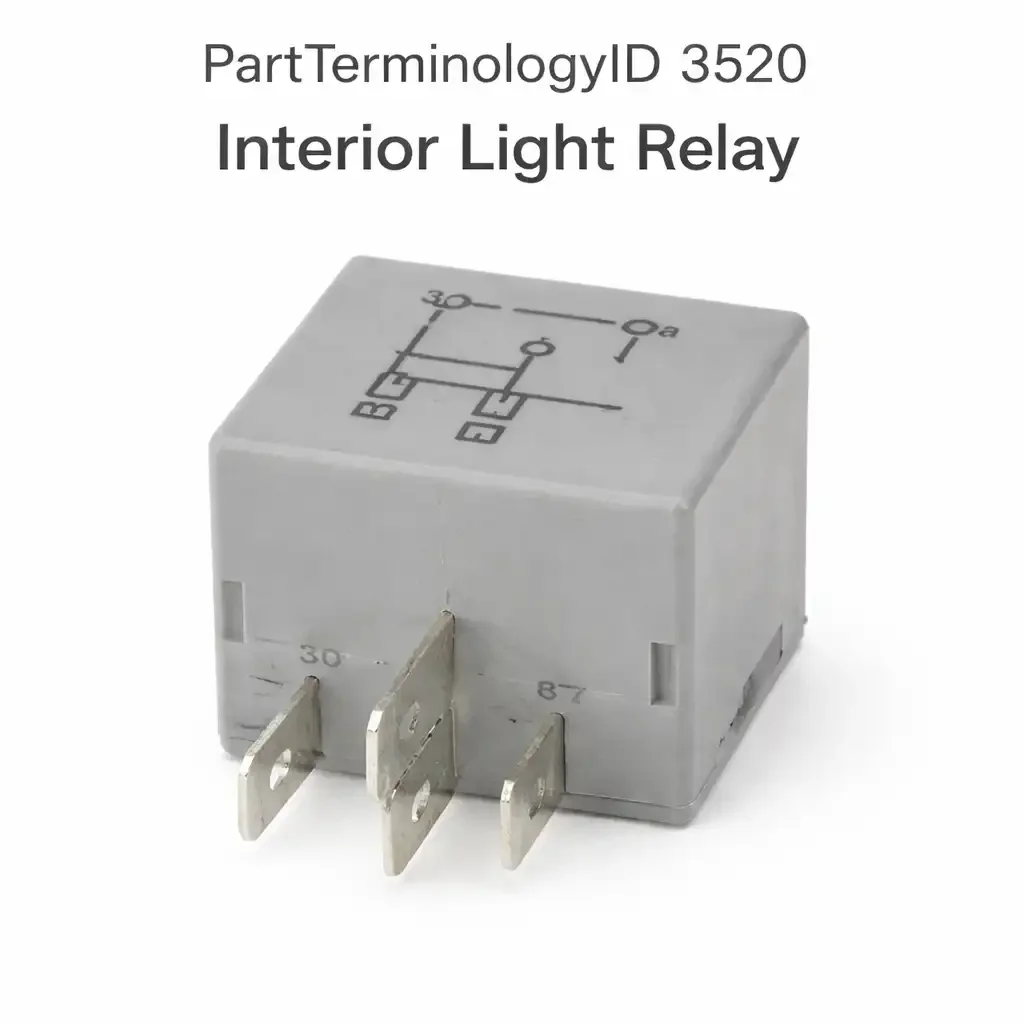
The Interior Light Relay, cataloged under PartTerminologyID 3520, is an electromechanical switching device that controls the supply of battery voltage to the vehicle's interior lamp circuit, including dome lamps, courtesy lamps, map lights, and reading lamps. When the relay closes, it completes the power circuit that allows interior lamps to illuminate in response to door opening, ignition state, RKE unlock commands, or manual switch inputs. Without a functioning relay, interior lamps receive no power and the cabin remains dark regardless of door position, switch setting, or BCM command output.
On relay-dependent interior lamp systems, the relay is typically controlled by the BCM, which monitors door jamb switch inputs, ignition state, and remote keyless entry signals to determine when interior lamps should activate. The BCM sends a coil trigger signal to energize the relay, which closes and delivers battery voltage to the lamp circuit. On platforms where the BCM provides a direct PWM-controlled ground to interior lamps without a discrete relay, PartTerminologyID 3520 will not be present in the circuit. Sellers building fitment data for this part must confirm that the target application uses a relay-based interior lamp circuit before applying coverage.
What the Relay Does
Door-Triggered Activation and BCM Coordination
The most common activation path for the interior light relay is a door open signal. When a vehicle door is opened, the door jamb switch contacts close and send a ground signal to the BCM on the door open input circuit. The BCM processes this input and sends a trigger signal to the interior light relay coil. The relay closes, delivering battery voltage to the dome and courtesy lamp circuit. The lamps illuminate and remain on while any door is open. After all doors close, the BCM keeps the relay energized for a calibrated delay period, typically between 10 and 30 seconds depending on the application, before de-energizing the coil and opening the relay contact. On vehicles with theater dimming, the BCM ramps down interior lamp brightness using PWM ground control during this delay rather than switching the relay off abruptly.
When the interior light relay fails in the open position, no door-triggered illumination occurs. The BCM may still send a valid coil trigger signal, and the door jamb switches may still be functional, but the lamps receive no voltage because the relay contact is not closing. Diagnosing this condition requires verifying that the BCM trigger signal is present at the relay coil terminal before condemning the relay.
RKE Unlock Integration and Entry Illumination
On vehicles with remote keyless entry, the BCM activates the interior light relay when it receives a door unlock command from the RKE transmitter or from the door key cylinder. This illuminated entry feature allows occupants to see inside the vehicle before opening the door. The BCM activates the relay, lights the interior, and maintains illumination for a calibrated period after the vehicle is entered and the door is closed. If the ignition is switched to the run position before the delay expires, the BCM de-energizes the relay and extinguishes interior lamps immediately.
On vehicles that use a separate illuminated entry relay for RKE-triggered activation, PartTerminologyID 3520 may govern only door-triggered and ignition-off illumination, while a dedicated illuminated entry relay governs RKE-triggered illumination. Sellers should confirm whether the target application uses a single interior light relay for all activation paths or splits the function across multiple relays before building fitment coverage.
Battery Protection and Inadvertent Activation Shutoff
The BCM on most late-model vehicles incorporates an inadvertent activation protection routine for interior lamps. If interior lamps remain on for an extended period, typically 10 to 20 minutes depending on manufacturer calibration, without an ignition-on event, the BCM de-energizes the interior light relay to prevent battery drain. This feature protects against situations where a door was not fully latched, a manual dome lamp switch was left in the on position, or a door jamb switch has failed in the closed position and is sending a continuous door-open signal to the BCM.
A door jamb switch that has failed closed is a common source of apparent interior light relay failure. When the switch fails closed, it reports a continuous door-open condition to the BCM. The BCM activates the relay and keeps interior lamps on indefinitely until the battery protection timer expires and the BCM shuts the relay off. The owner sees lamps that will not turn on when a door is opened and concludes the relay has failed, when in fact the BCM has disabled relay activation to protect the battery. Replacing the relay does not restore lamp operation in this scenario. The door jamb switch is the actual failed component.
Theater Dimming and PWM Ground Control
On vehicles with theater dimming, interior lamps do not switch off abruptly when the relay de-energizes. Instead, the BCM provides a pulse-width modulated ground path to interior lamps and gradually increases the off-duty cycle to fade lamp brightness over one to two seconds before full shutoff. On these systems, the interior light relay governs the positive supply to the lamp circuit while the BCM controls the ground side with PWM modulation. A failed relay produces no lamp output regardless of BCM ground control activity. A failed BCM PWM ground output produces lamps that illuminate at full brightness and switch off abruptly rather than dimming, even though the relay is functioning correctly.
Sellers should note in listings that theater dimming behavior is controlled by the BCM ground circuit independently of the relay. A complaint about lamps that switch off sharply instead of fading is a BCM output fault, not a relay fault.
Top Return Scenarios
Return Scenario 1: Door Jamb Switch Failed Closed
This is the most commonly misdiagnosed precursor to an interior light relay return. When a door jamb switch fails in the closed position, it continuously signals the BCM that a door is open. The BCM activates the relay and keeps lamps on. After the battery protection timer expires, the BCM stops activating the relay regardless of other inputs. The vehicle owner then observes that opening a door produces no lamp response and assumes the relay has failed. Replacing the relay does not resolve the condition because the BCM is intentionally withholding the trigger signal as a battery protection measure. The failed jamb switch must be identified and replaced first. Listing language should note that a no-illumination symptom following an extended period of lamps staying on unexpectedly points to a jamb switch fault rather than a relay fault.
Return Scenario 2: Interior Lamp Fuse Blown
A blown interior lamp fuse produces the same total no-illumination symptom as a failed relay. The fuse is upstream of the relay load circuit and is the first item that should be checked. Buyers who skip the fuse check and order the relay will install it, see no change, and return it. The fuse check takes under a minute and eliminates this return category. Listing pre-purchase guidance should direct buyers to check the interior lamp fuse before ordering.
Return Scenario 3: BCM Coil Trigger Signal Absent
The interior light relay coil requires a BCM output signal to close. If the BCM has failed, the BCM output circuit has an open or short, or the wiring between the BCM and relay coil is damaged, the relay will not close regardless of its condition. A buyer who replaces the relay without first verifying that the BCM trigger signal is present at the coil terminal will see no improvement and return the part. In-vehicle diagnosis requires checking for the expected coil voltage or ground signal at the relay socket with a door open before condemning the relay. Listings should note that relay operation depends on a valid BCM trigger output.
Return Scenario 4: Individual Lamp Bulb Failures Misread as Relay Failure
When multiple interior lamps are out simultaneously, buyers sometimes interpret this as a relay failure because they assume a relay failure would explain why nothing works. However, on vehicles where interior lamps are wired across multiple sub-circuits each protected by its own fuse or bulb socket, multiple individual bulb failures can produce the appearance of a total circuit failure. If the relay were actually failed, no lamps in the circuit would illuminate under any condition. A buyer who finds that some lamps work and others do not is facing individual bulb or socket failures, not a relay fault. Listing language should note that a relay failure produces no lamp output across the entire circuit, not selective lamp outages.
Return Scenario 5: Application Uses Direct BCM Control with No Relay
On many late-model platforms, the BCM controls interior lamp ground circuits directly without an intervening relay in the positive supply path. These systems may still have relay sockets in the fuse block labeled for interior lamps, but the relay position may be occupied by a fuse or blank insert rather than an active relay. Buyers who locate a relay socket near the interior lamp fuse and order a replacement relay for it will receive a part that their vehicle does not use. Accurate ACES fitment data that excludes these platforms prevents this return category. Sellers should audit fitment coverage for platform years where BCM-direct lamp control replaced relay-based switching.
Listing Requirements
To meet minimum catalog accuracy requirements for PartTerminologyID 3520, sellers should confirm and include the following:
• ACES vehicle fitment data with year, make, model, engine, and trim verified against OEM circuit diagrams confirming relay-based interior lamp control (not BCM-direct PWM ground control)
• Relay coil voltage confirmed as 12V DC and coil activation source identified as BCM output, door jamb switch direct trigger, or ignition switch-linked signal
• Contact current rating in amperes confirmed from part specification sheet, adequate for the interior lamp load on the target application
• Relay housing type and pin configuration confirmed to match the target vehicle socket
• Model year range bounded to exclude platform generations where BCM-direct lamp control eliminated the discrete interior light relay
• OEM cross-reference part numbers where available
• Diagnostic pre-purchase guidance recommending interior lamp fuse check, door jamb switch verification, and BCM coil trigger signal check before ordering
• Notation that a relay replacement will not resolve door jamb switch faults, BCM output failures, or individual lamp bulb failures
• Clear statement that theater dimming behavior is controlled by the BCM ground circuit and is separate from relay function
• Confirmation of whether the relay is sold with or without socket or pigtail connector
Frequently Asked Questions
Can a failed interior light relay cause a battery drain?
Yes, but only if the relay fails in the closed position, meaning the contact is stuck closed and continuously supplies voltage to the interior lamp circuit with no BCM trigger signal required. In this condition interior lamps remain on whenever the circuit has power, draining the battery over time. However, battery drain attributed to interior lighting is more commonly caused by a failed door jamb switch that continuously signals the BCM to activate the relay, rather than by relay contact failure. Distinguishing between these two causes requires checking whether the relay contact is closed when the BCM coil trigger is absent. If the contact is closed at rest with no coil voltage applied, the relay has failed closed. If the contact is open at rest and the BCM is still triggering the coil, the jamb switch or BCM programming is the issue.
Will the interior light relay control map lights and reading lamps as well as the dome lamp?
This depends on the circuit architecture of the specific application. On some vehicles, all interior lamps including the dome, courtesy lamps, map lights, and reading lamps share a single power circuit governed by one relay. On others, map lights and reading lamps are wired on a separate sub-circuit with their own fuse and may or may not pass through the same relay. A relay failure that leaves the dome lamp dark while map lights still function indicates that map lights are on a separate circuit not governed by this relay. Sellers should note in listings that interior lamp circuit architecture varies by application and that buyers should confirm which lamps are affected before ordering.
Why do my interior lights work when I manually flip the dome switch to the on position but not when I open a door?
This symptom pattern indicates that the interior lamp circuit has power and the lamps are functional, but the door-triggered activation path has a fault. The manual dome switch position bypasses the BCM-controlled relay trigger path and completes the lamp circuit directly. The door-triggered path requires the BCM to receive a valid door open signal from the jamb switch and respond with a relay coil trigger. If the BCM trigger is absent when a door opens, the fault is either a failed door jamb switch that is not sending a door-open input to the BCM, a BCM input circuit fault, or a BCM output fault. This symptom pattern does not indicate relay failure.
How do I confirm the interior light relay is the failed component before replacing it?
Remove the relay from its socket. Apply 12V DC across the coil terminals. A functioning relay will click and show continuity between the load terminals when the coil is energized. In-vehicle, check for the BCM coil trigger signal at the relay socket with a door open and the battery protection timer not yet expired. If trigger voltage or ground is present at the coil terminals and the relay does not click or show load continuity, the relay has failed. If no coil trigger signal is present, the fault is upstream of the relay in the BCM output circuit or door jamb switch circuit. Replacing the relay without a confirmed coil signal present produces no change in lamp behavior.
What Sellers Get Wrong
Applying fitment to BCM-direct lamp control platforms
The most structurally damaging fitment error for PartTerminologyID 3520 is extending coverage into platform generations where the BCM controls interior lamps directly through a PWM ground circuit with no relay in the positive supply path. These vehicles have no relay socket for this part. The return from buyers on these applications is unavoidable because the part cannot be installed. Auditing fitment data for transition model years within each platform is the correct fix. A single misapplied model year on a high-volume platform can generate a significant return volume before the catalog error is identified and corrected.
Not distinguishing the relay fault from the door jamb switch fault in listing language
The door jamb switch is a more common failure than the interior light relay on most applications. It is a mechanical contact switch that experiences wear from tens of thousands of door open and close cycles over the vehicle's life. A seller whose listing does not mention the door jamb switch as a diagnostic checkpoint will receive returns from buyers whose jamb switch was the actual fault. Adding one sentence directing buyers to confirm that the BCM is receiving a valid door open signal before ordering the relay redirects buyers toward the correct diagnosis at no cost to the seller.
Not noting battery protection timer behavior in listings
Buyers whose vehicles have been sitting with interior lamps on due to an ajar door or failed jamb switch often find that lamps stop responding entirely after the BCM battery protection timer activates. They assume the relay has failed because nothing works when a door is opened. This is one of the most predictable and preventable return scenarios for this part. A brief note in the listing that a vehicle whose interior lamps recently stayed on for an extended period may have the BCM in battery-protection mode, requiring a door jamb switch check before relay replacement, addresses this return category directly.
Listing individual lamp failures as relay failure symptoms
A relay failure produces total loss of interior lamp power across the entire circuit. If some lamps work and others do not, the relay is not the cause. Sellers who include selective lamp outages in the symptom list for relay failure will attract buyers with individual bulb or socket problems who will replace the relay, see no change, and return it. Symptom descriptions in listings should accurately state that relay failure produces no lamp output under any condition in the affected circuit, not selective outages.
Cross-Sell Logic
Buyers diagnosing a failed interior lamp circuit who have confirmed the relay as the cause, or who are replacing the relay as part of a broader interior lamp repair, are good candidates for the following related components.
• Door jamb switch (the most common co-failure with relay-based interior lamp circuits, and the component most likely to have contributed to the relay fault through battery protection timer activation)
• Interior lamp fuse (checked before relay ordering, inexpensive add-on, appropriate for buyers replacing multiple interior lamp circuit components at once)
• Illuminated entry relay, PartTerminologyID 3496 (on applications where RKE-triggered entry illumination uses a separate relay from door-triggered activation)
• Dome lamp bulb or lamp assembly (buyers restoring interior lamp circuit function often find individual bulbs have failed during the same repair window)
• Relay socket or pigtail connector (corrosion in the relay socket is a parallel failure mode that should be confirmed before installing a new relay)
• Body control module (applications where BCM output failure is preventing relay coil activation and the relay itself has tested functional)
Final Take
PartTerminologyID 3520 is a high-context part. Its symptom, interior lamps that do not respond to door opening, has at least five distinct root causes that are more common than relay failure itself. The door jamb switch fails more often. The fuse blows more often. The BCM battery protection timer is misread as relay failure frequently enough that it deserves specific mention in every listing for this part.
The sellers who keep return rates low on 3520 treat the listing description as a diagnostic guide, not just a product description. They bound their fitment data to relay-dependent applications, call out the jamb switch and fuse as first checks, and explain battery protection timer behavior in plain language. A listing that saves a buyer from ordering the wrong part builds more long-term catalog authority than one that generates a return and a one-star review. On a part this closely tied to misdiagnosis, the content around the listing is as important as the fitment data inside it.