
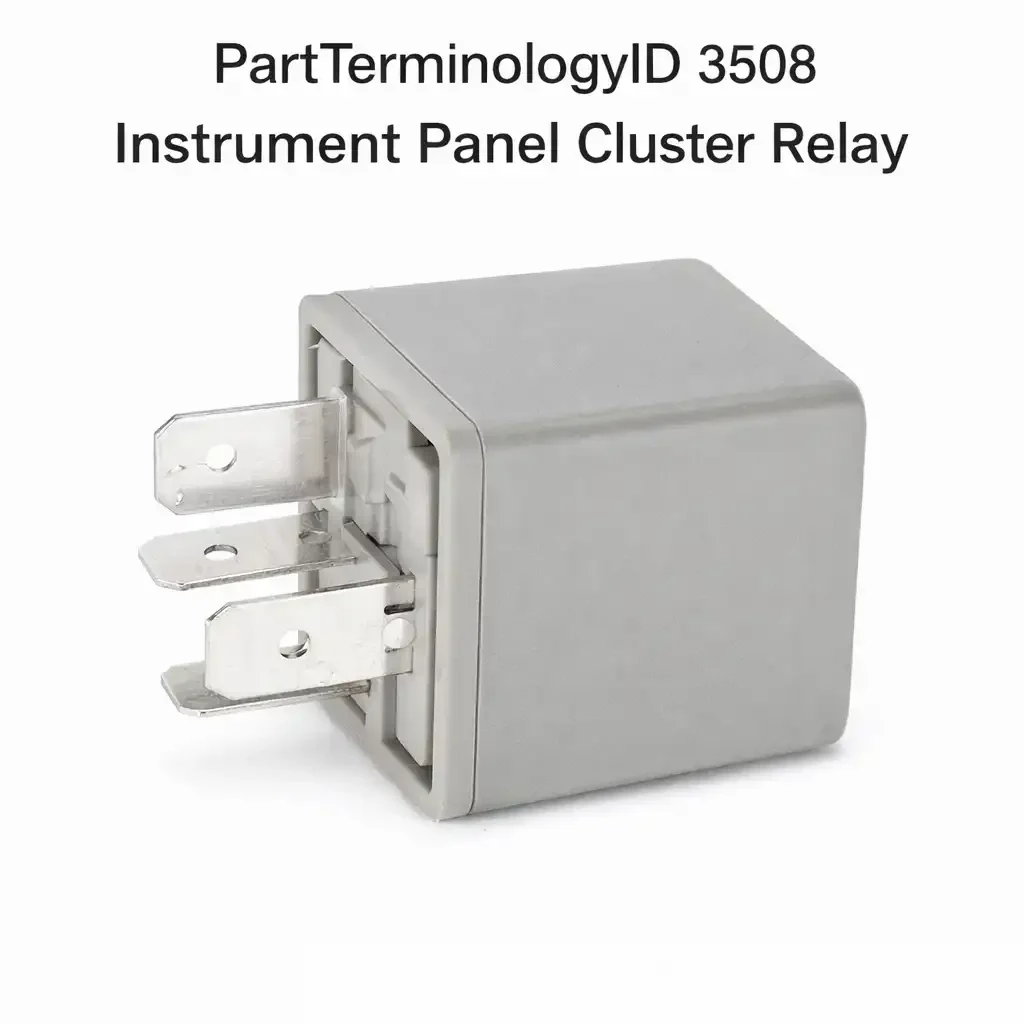
The Instrument Panel Cluster Relay, cataloged under PartTerminologyID 3508, is an electromechanical switching device that controls the supply of ignition-switched or battery-backed voltage to the instrument panel cluster assembly. When the relay closes, it completes the power circuit that allows the cluster to initialize, display gauge readings, illuminate warning indicators, and communicate with the vehicle network. Without a functioning relay, the cluster receives no power and the driver loses all instrument feedback including vehicle speed, engine temperature, fuel level, and warning lamp status. The relay is distinct from the instrument panel illumination relay (PartTerminologyID 3500), which governs backlight circuits tied to headlamp activation. PartTerminologyID 3508 governs operational power to the cluster itself, not its brightness.
What the Relay Does
Ignition-Switched Power Supply and Cluster Initialization
On most applications, the instrument panel cluster relay is energized by an ignition-on or accessory-on signal from the ignition switch or body control module. When the driver turns the key to the run position or the BCM detects an authorized start sequence, a control-side signal is sent to the relay coil. The coil generates a magnetic field that pulls in the relay contact, closing the load-side circuit and delivering battery voltage to the cluster power rail. This powers the cluster microprocessor, allows gauge stepper motors to complete their startup sweep, and enables the cluster to begin polling sensors and modules over the vehicle communication bus.
On vehicles where the BCM manages relay activation, the relay may remain closed for a calibrated period after the ignition is switched off, allowing the cluster to log final trip data, record odometer readings, and complete shutdown routines before power is removed. Premature relay opening during this shutdown window can result in odometer data corruption or incomplete trip meter logging.
Battery-Backed Retention and Sleep Mode Behavior
Some cluster designs require a continuous low-current battery-backed supply in addition to the ignition-switched main feed. This secondary supply keeps the cluster microprocessor in a sleep state, retaining volatile memory for personalization settings, stored fault codes, and odometer data between drive cycles. The instrument panel cluster relay typically governs the main ignition-switched feed, while a dedicated fused circuit or secondary relay handles the memory-retention supply. Confusing these two circuits during diagnosis is a common source of misdiagnosis.
On vehicles with power management systems, the BCM may cycle the relay to reduce parasitic drain after extended key-off periods. If the relay fails in the open position, the cluster will not power up. If it fails in the closed position, it may contribute to battery drain by holding the cluster in an active or semi-active state after the vehicle is parked.
Communication Bus Integration and Module Coordination
Modern instrument clusters are fully integrated network nodes. Once powered by relay closure, the cluster sends and receives messages over CAN bus, LIN bus, or vehicle-specific protocols to gather vehicle speed from the ABS module, engine RPM from the PCM, fuel level from the tank sender module, transmission range from the TCM, and body status from the BCM. The relay does not participate in these communications directly, but its failure eliminates power to the cluster entirely, which causes all of these data pathways to produce no displayed output and may generate network absence fault codes in other modules that expect cluster acknowledgment on the bus.
When the cluster loses power due to relay failure, modules that rely on the cluster as a gateway for driver feedback may log U-code faults indicating loss of communication. These bus absence codes are a secondary symptom of relay failure, not a sign of bus or module damage. They will clear once relay power is restored and the cluster resumes bus participation.
Ground Path Stability and Relay Contact Quality
The relay contact carries the full operational current load of the cluster assembly, which on feature-rich vehicles with multiple gauges, digital displays, warning lamps, and bus transceivers can range from 1 to 5 amperes depending on the design. Contact resistance caused by heat cycling, vibration, or contamination increases voltage drop across the relay and reduces the voltage available at the cluster power rail. A cluster requiring a minimum operating voltage of 10 volts may exhibit erratic behavior or intermittent blackouts when supply voltage falls to 10.5 or 11 volts due to degraded relay contacts, even though the relay has not failed completely.
Top Return Scenarios
Return Scenario 1: Fuse Was the Actual Cause
The most common reason a sold instrument panel cluster relay is returned is that the cluster fuse, not the relay, was the root cause of the dead cluster. Both a failed relay and a blown fuse produce an identical symptom: no cluster power. The fuse is faster and cheaper to check. Buyers who do not check the fuse before ordering the relay will often find the relay has no effect when installed and conclude it was the wrong part. Prevention language should direct buyers to check the instrument cluster fuse or fuses before ordering. On vehicles with multiple cluster-related fuses, all should be checked.
Return Scenario 2: BCM Control Signal Failure
The instrument panel cluster relay on many applications is not self-activating. It requires a trigger signal from the BCM or ignition switch to close. If the BCM fails to send the control signal, or if the wiring between the BCM and relay coil is open or corroded, the relay will not close regardless of its condition. Replacing the relay does not restore a missing control signal. A seller who does not disclose this diagnostic requirement will receive the relay back from a buyer who installed it, found the cluster still dead, and assumed the relay was defective. Listing language should note that relay operation requires a valid control signal at the coil terminal.
Return Scenario 3: Wrong Application Match on Multi-Relay Vehicles
Many vehicles position multiple relays in a fuse block with physically identical housings and the same pin configuration. The instrument panel cluster relay may share a body style with the horn relay, blower relay, or accessory relay. Buyers who identify the relay by location or visual match rather than by circuit label or factory wiring diagram may order the correct part for the wrong relay position. When they install it and the cluster still does not respond, they return the relay as non-functional. Listings should recommend buyers verify circuit identity using the fuse box label or factory wiring diagram before removing the original relay.
Return Scenario 4: Cluster Hardware Failure Behind a Good Relay
When a relay is replaced and the cluster still does not function, the cluster itself is often the actual failed component. Cluster microprocessor failures, printed circuit board cracks, solder joint failures, and stepper motor failures are common on high-mileage vehicles. These failures produce no cluster output even when full voltage is delivered by a functional relay. Buyers who have already replaced the fuse and relay without results often return the relay as a last step before accepting that the cluster needs repair or replacement. Listing language should note that relay replacement addresses power delivery only and does not diagnose or repair cluster hardware faults.
Return Scenario 5: Relay Socket Corrosion Creating False Open Circuit
A relay installed into a corroded or damaged socket may fail to make proper contact even if the relay itself tests correctly. Corrosion on socket terminals raises contact resistance and can prevent relay coil energization entirely. Buyers who install a new relay into a compromised socket will find no improvement and return the relay. Listing language should recommend inspecting and cleaning relay socket terminals before installation, and note that a relay that tests functional on the bench may not perform correctly if socket corrosion is present.
Listing Requirements
To meet minimum catalog accuracy requirements for PartTerminologyID 3508, sellers should include the following in product listings and fitment notes:
• ACES vehicle fitment data with year, make, model, engine, and trim confirmed against OEM relay specifications
• Relay coil voltage, which is 12V DC on all standard passenger vehicle applications, confirmed by part specification
• Contact rating in amperes, confirmed from the relay specification sheet, to allow buyers to verify load compatibility
• Coil activation source (ignition-switched, BCM-controlled, or accessory-switched) to support diagnostic pre-purchase decisions
• Relay housing type and pin configuration (4-pin or 5-pin ISO mini relay, micro relay, or application-specific form factor) to prevent socket mismatch
• Confirmation that the part includes or does not include the relay socket or pigtail connector, as these are often sold separately
• OEM cross-reference numbers where available to support buyers sourcing by OEM part number
• Notation of any known supersession or OEM part number update that affects fitment confirmation
• Diagnostic pre-purchase guidance recommending fuse check and BCM signal verification before relay replacement
• Clear statement that relay replacement addresses power delivery to the cluster and does not resolve cluster hardware faults, BCM faults, or missing control signals
Frequently Asked Questions
Can a failing instrument panel cluster relay cause intermittent gauge operation?
Yes. A relay with degraded contact surfaces, high contact resistance, or a coil that is beginning to fail may close inconsistently under heat or vibration. This produces intermittent cluster operation where the cluster works normally during cold starts, loses power after the vehicle warms up, or recovers after the vehicle sits. Intermittent relay failure is harder to diagnose than complete failure because the relay may test within spec when cool and fail only when thermal stress is applied. If a buyer reports intermittent cluster blackouts with no fuse or wiring fault found, the relay is a reasonable replacement candidate.
Will replacing the relay clear the U-code bus absence faults that set when the cluster lost power?
Restoring relay power allows the cluster to rejoin the network, which stops new bus absence faults from setting. Existing stored fault codes must be cleared with a scan tool after the repair is complete. Some modules will clear bus absence codes automatically after a set number of successful communication cycles, but this behavior varies by manufacturer and module. Buyers should be advised that relay replacement alone does not clear stored codes and that a scan tool will be needed to confirm code resolution after the repair.
Is PartTerminologyID 3508 the same as the cluster illumination relay?
No. PartTerminologyID 3508 governs operational power to the instrument cluster assembly and is active whenever the ignition is on. PartTerminologyID 3500 (Illumination Relay) governs the instrument panel backlight circuit and is activated by the headlamp switch signal. A vehicle can have a failed illumination relay and retain full gauge operation in daylight, or a failed cluster relay and display no gauges regardless of headlamp status. These are separate relays on most applications and should be diagnosed and ordered independently.
Can the instrument panel cluster relay be tested before replacement?
Yes, using a standard relay test procedure. Remove the relay and apply 12V DC to the coil terminals (typically pins 85 and 86 on a standard ISO relay). A functioning relay will produce an audible click and show continuity between the load terminals (typically pins 30 and 87) when tested with a multimeter. Absence of a click or no continuity change under coil voltage confirms relay failure. Contact resistance can be tested by measuring resistance between load terminals with the coil energized. Resistance above 0.5 ohms indicates degraded contacts that may cause voltage drop issues even if the relay is technically functional.
What Sellers Get Wrong
Listing the relay without diagnostic pre-purchase guidance
The instrument panel cluster relay is one of the easiest parts to over-order because a dead cluster has only a few root causes and the relay is visually accessible and inexpensive. Sellers who list the relay without directing buyers to check fuses and BCM signal integrity first will generate returns from buyers who replaced the relay without identifying the actual fault. A single sentence in the listing description noting that fuse and control signal checks should precede relay replacement will reduce this return category.
Using generic relay listings that do not specify activation source
Standard ISO mini relays with the same pin count and housing dimensions are used across dozens of different circuits in the same vehicle. A generic listing that identifies the relay by dimensions and coil voltage without specifying that it is the instrument panel cluster relay and confirming the activation source creates ambiguity for buyers who are cross-referencing from a factory circuit diagram. Specifying the controlled circuit in the listing title and description reduces misapplication returns.
Not distinguishing between relay failure and relay socket failure
Relay socket terminals corrode on older vehicles, particularly in humid climates or vehicles that have experienced water intrusion in the fuse box area. Selling a relay without noting the importance of socket inspection leads to cases where a new relay installed into a corroded socket produces no improvement and is returned as defective. Adding a socket cleaning recommendation to installation notes costs nothing and prevents a significant category of unnecessary returns.
Failing to note that BCM-controlled relays require a valid trigger signal
On late-model vehicles where the BCM activates the cluster relay rather than the ignition switch doing so directly, the relay is entirely dependent on a healthy BCM output. A seller who does not disclose this will receive returns from buyers with BCM faults who have replaced a functioning relay and found no change in cluster behavior. A note that BCM-controlled applications require signal verification before relay replacement sets accurate buyer expectations and prevents this return scenario.
Cross-Sell Logic
Buyers diagnosing a dead instrument cluster who have confirmed the relay as the failed component are good candidates for the following related parts. These components share failure modes or diagnostic overlap with the cluster relay and represent natural add-to-cart opportunities when positioned correctly.
• Instrument cluster fuse (same fuse block, checked during relay diagnosis, low cost, logical add-on purchase)
• Relay socket or pigtail connector (corrosion in the socket is a parallel failure mode that should be addressed at the same time as relay replacement)
• Body control module (BCM-controlled applications where a missing relay trigger signal points to a BCM output fault)
• Instrument cluster assembly (buyers who have replaced the fuse and relay without result are facing a cluster hardware fault and need the next diagnostic step addressed)
• Ignition switch electrical assembly (applications where ignition-switched power to the relay coil is disrupted by a failing ignition switch rather than a BCM fault)
• Wiring harness repair kit or pigtail (for applications with known harness chafing or connector damage between the ignition switch, BCM, and relay block)
Final Take
PartTerminologyID 3508 is a straightforward part with a focused diagnostic scope: it either delivers power to the instrument cluster or it does not. Its failure produces a clear and immediate symptom. That clarity makes it a high-return-risk item because the same symptom is produced by a blown fuse, a missing BCM control signal, a corroded relay socket, and cluster hardware failure. Every one of those failure modes generates a relay return when it is not ruled out before the relay is ordered.
The sellers who keep return rates low on PartTerminologyID 3508 are the ones who build diagnostic logic into the listing. Not a wall of text, but a clear sentence or two that tells the buyer to check the fuse, verify the control signal if BCM-managed, and inspect the socket before ordering. That content does not just reduce returns. It makes the listing more useful than the one next to it, which is increasingly how aftermarket catalog real estate is won.