
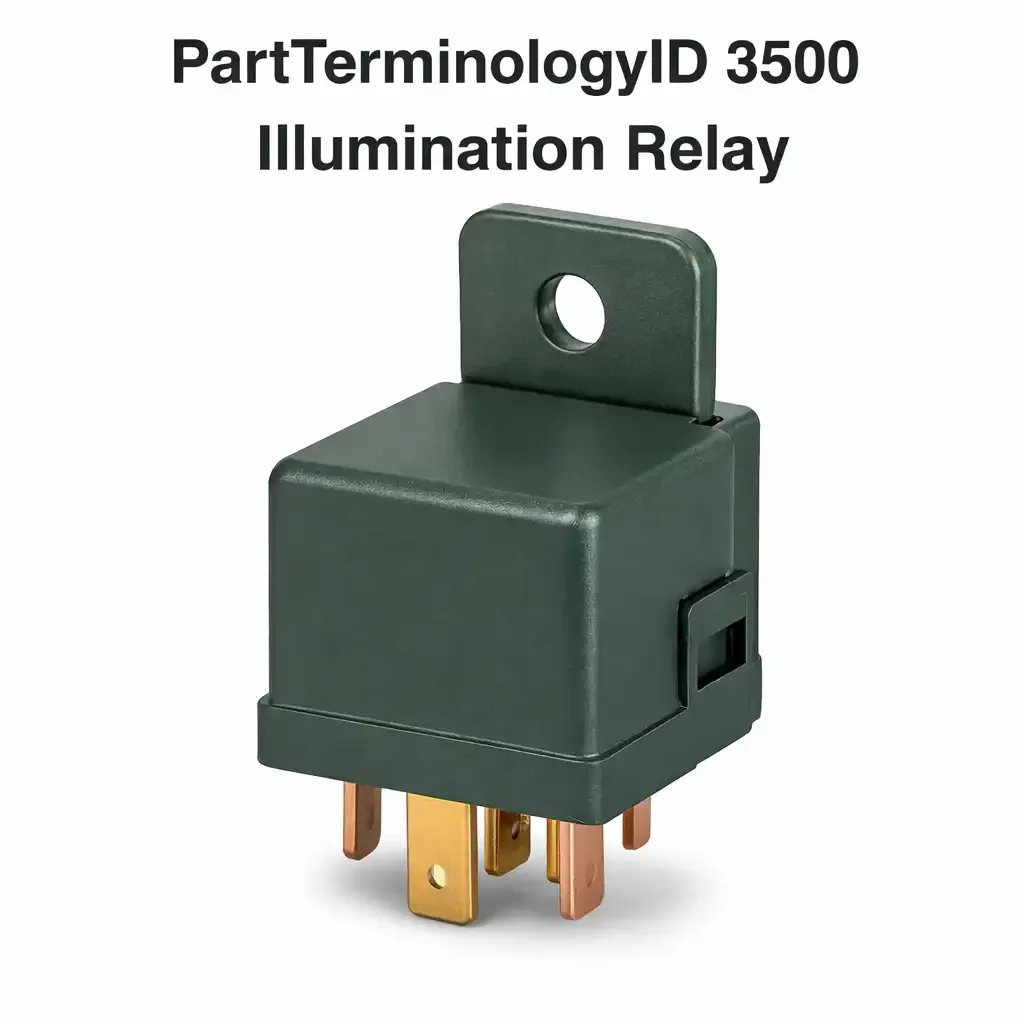
Headlamp-Activated Circuit Control, and Differentiation from the Park Lamp Relay, Dimmer Switch, and Headlamp Switch
PartTerminologyID 3500, Illumination Relay, is the relay that supplies switched power to the vehicle's instrument panel illumination circuit, dashboard backlight lamps, switch panel backlighting, and related gauge cluster lighting when the exterior lighting system is activated. The relay is triggered by the headlamp switch output when the parking lamps, tail lamps, or headlamps are turned on, and its contact delivers battery voltage to the illumination circuit that powers the cluster backlights, HVAC panel illumination, radio face illumination, switch pod backlighting, and any other interior component that requires a headlamp-linked illumination supply. The four attributes that define correct fitment and listing accuracy are the specific illumination loads the relay serves on the application, the headlamp switch output that activates the relay coil, the dimmer control architecture used to regulate brightness on that circuit, and the four-way symptom differentiation that separates an illumination relay fault from a blown illumination fuse, a failed headlamp switch, a failed dimmer switch, and an open ground on the illumination circuit.
What the Illumination Relay Does
Illumination circuit supply and headlamp-linked activation
The illumination relay contact supplies battery voltage to the instrument panel illumination bus, which distributes lighting current to every component on the vehicle that uses headlamp-linked backlight illumination. This includes the instrument cluster backlights that illuminate the speedometer, tachometer, fuel gauge, and temperature gauge faces; the HVAC control panel backlight that makes heater and climate control settings visible in low-light conditions; the audio system face illumination; and the backlight circuits of every switch pod and control knob that is designed to glow when the exterior lights are on. On most applications, all of these loads share a common illumination supply voltage that originates at the illumination relay contact output.
The relay coil is activated by the headlamp switch park lamp output, which is the switched output terminal of the headlamp switch that goes live when the switch is turned to the parking lamp, tail lamp, or headlamp position. On applications where the headlamp switch uses a separate illumination terminal distinct from the park lamp output, the relay coil is activated by that dedicated illumination terminal. On BCM-controlled applications, the BCM monitors the headlamp switch position and generates the relay coil activation signal independently of the switch output wire, meaning the coil supply path begins at the BCM output rather than at the headlamp switch directly. Confirming whether the application uses a direct headlamp-switch-to-relay-coil connection or a BCM-managed coil activation path is the first step in diagnosing a relay coil fault, since these two architectures require completely different diagnostic approaches.
Dimmer control and brightness regulation
The illumination relay contact delivers battery voltage to the illumination circuit, but brightness control is handled downstream of the relay by a separate dimmer circuit. On most applications, the dimmer is a rheostat or potentiometer integrated into the headlamp switch or mounted as a separate rotary control on the instrument panel. The dimmer places variable resistance in the illumination supply path, reducing current flow to the illumination lamps and decreasing their brightness as the driver rotates the control toward its minimum position.
On BCM-controlled applications with electronic dimming, the BCM delivers a pulse-width modulated output to the illumination circuit rather than routing power through a mechanical rheostat. The PWM signal varies the duty cycle of the illumination supply voltage to achieve brightness regulation without resistive energy loss. On these applications, a failed dimmer produces a fixed-brightness illumination output rather than no illumination at all, since the relay contact is still supplying power to the circuit. This distinction is diagnostically important because a symptom of no illumination on a PWM-controlled application points to the relay or its supply circuit rather than the PWM output stage.
On older applications with a traditional rheostat dimmer, a failed dimmer that has opened internally produces a no-illumination symptom even when the relay is functioning correctly, because the open dimmer interrupts the supply path between the relay contact output and the illumination lamps. The illumination relay is frequently ordered in response to this symptom, and returns occur when the new relay is installed and the illumination remains absent because the fault was in the dimmer, not the relay. Testing for voltage at the relay contact output before tracing the circuit downstream through the dimmer is the diagnostic step that prevents this return scenario.
Multi-circuit illumination load and ground path requirements
The illumination relay contact serves a distributed load across multiple vehicle systems simultaneously. Unlike a single-device relay that powers one actuator with a defined current draw, the illumination relay contact supplies a network of low-power backlight lamps whose combined current draw varies by application, vehicle content level, and whether incandescent or LED illumination is used throughout the cabin. On fully equipped vehicles with incandescent cluster illumination, HVAC backlight lamps, audio face illumination, and multiple switch pod backlights, the combined illumination load can reach 10 to 15 amperes. On vehicles with LED illumination throughout the cabin, the combined load is substantially lower, often under 3 amperes, which reduces relay contact stress and makes contact failure even less likely relative to higher-current relay applications.
The ground path for the illumination circuit is a common diagnostic oversight. Illumination lamps require both a supply voltage from the relay contact and a complete ground return path to complete the circuit. On applications where the instrument cluster or dashboard assembly is mounted in plastic without a direct chassis ground path, the illumination circuit ground wire is routed through the wiring harness to a chassis ground point. An open or high-resistance ground on the illumination circuit produces a no-illumination symptom that is identical to a failed relay contact, a blown fuse, or an open dimmer. Testing for voltage at the illumination lamp positive supply terminal confirms whether the relay contact is delivering power. If voltage is present at the supply terminal but no illumination occurs, the fault is in the ground circuit, not the relay.
Park lamp and tail lamp simultaneity
On most applications, the illumination relay activates simultaneously with the park lamps and tail lamps because all three circuits share the same headlamp switch output terminal. A fault in the illumination relay coil supply or the relay contact affects only the illumination circuit and leaves the park lamps and tail lamps functional. A fault in the headlamp switch park lamp output terminal affects all three circuits simultaneously, producing no illumination, no park lamps, and no tail lamps at the same time. When a customer reports no instrument illumination alongside no parking lights and no tail lights simultaneously, the diagnostic path begins at the headlamp switch, not the illumination relay. The relay is the correct diagnosis target only when instrument illumination is absent while park lamps and tail lamps remain functional, confirming the headlamp switch output is present and the relay coil is receiving its activation signal.
Top Return Scenarios
Scenario 1: No instrument panel illumination when headlamps are turned on, park lamps working normally
This is the primary symptom that correctly identifies the illumination relay as a candidate diagnosis target. Before ordering, confirm the illumination fuse is intact, since a blown illumination fuse produces the identical symptom with no relay fault present. With the fuse confirmed good, test for relay coil activation voltage at the coil terminal when the headlamp switch is in the park or headlamp position. If coil voltage is present but the relay contact does not close, relay contact failure is confirmed and replacement is appropriate. If coil voltage is absent, the fault is in the headlamp switch output, the BCM coil activation circuit, or the wiring between the switch and the relay coil, and relay replacement will not restore illumination.
Prevention language: "Before ordering this relay, confirm the illumination fuse is good and that the park lamps are working normally. Test for voltage at the relay coil terminal with the headlamp switch on. Coil voltage present with no illumination indicates relay contact failure. No coil voltage with park lamps working indicates a headlamp switch output fault or open wiring to the relay coil, not a relay fault."
Scenario 2: No instrument illumination and no park lamps simultaneously
Simultaneous loss of instrument illumination and park lamps confirms the fault is upstream of the illumination relay, in the headlamp switch output circuit that serves both loads. The illumination relay coil and the park lamp circuit both receive their activation signal from the same headlamp switch terminal, so a failed switch output removes activation voltage from both simultaneously. Relay replacement for this symptom produces no improvement. The diagnostic path begins at the headlamp switch park lamp output terminal, testing for switched voltage when the switch is placed in the park or headlamp position. No output voltage with the switch activated confirms a failed headlamp switch or an open circuit between the battery supply and the switch input.
Prevention language: "If instrument illumination and park lamps both failed at the same time, the illumination relay is not the fault source. Both circuits share the same headlamp switch output. A failed headlamp switch that has lost its park lamp output terminal will remove power from both circuits simultaneously. Replace the headlamp switch rather than the illumination relay for this symptom combination."
Scenario 3: Instrument illumination present but no brightness control, dimmer has no effect
Illumination that is present at fixed brightness with no dimmer response confirms the relay contact is functioning correctly. The relay delivers supply voltage to the illumination circuit and that voltage is reaching the lamps, since they are illuminated. The absence of dimmer response indicates the dimmer rheostat or PWM control circuit has failed internally. On mechanical rheostat applications, an internally open rheostat produces this symptom when the rheostat wiper has lost contact with the resistance element, leaving the illumination circuit supplied at battery voltage with no attenuation. On BCM-controlled PWM applications, a fixed-brightness symptom with no dimmer response indicates a BCM PWM output fault or a failed dimmer switch input that the BCM reads to calculate its output duty cycle. Relay replacement for this symptom will produce no change in the dimmer response.
Prevention language: "If instrument lights are on but the dimmer control has no effect on brightness, the illumination relay is functioning correctly. The supply voltage is reaching the illumination lamps, confirming relay contact closure. The fault is in the dimmer rheostat, the BCM PWM output, or the dimmer switch input circuit. Relay replacement will not restore dimmer function."
Scenario 4: Instrument illumination flickers or is intermittent when driving over bumps or during vibration
Intermittent illumination that correlates with vibration or road inputs indicates a connection fault rather than a relay contact failure. Relay contact failure produces a consistent no-illumination symptom rather than an intermittent one, since a failed relay contact does not restore function under vibration. Intermittent illumination that responds to physical movement of the harness, dashboard, or headlamp switch area is most commonly caused by a loose connector at the relay socket, a poor ground connection on the illumination circuit, a cracked solder joint within the instrument cluster, or a worn headlamp switch contact that makes and breaks intermittently. Confirm the relay is fully seated in its socket and that the relay socket terminals have adequate tension before replacing the relay. A relay that is not fully engaged in its socket can produce intermittent contact symptoms that are resolved by reseating rather than replacement.
Prevention language: "Intermittent illumination that flickers with vibration is not typically a relay contact failure. Check that the relay is fully seated in its socket. Inspect the relay socket terminals for corrosion or reduced spring tension. Also check the illumination circuit ground connection and the headlamp switch connector for looseness. Relay replacement rarely resolves vibration-sensitive intermittent illumination faults."
Scenario 5: Some illuminated components work but others do not
Selective illumination failure where some dashboard components illuminate and others do not confirms the illumination relay is supplying power to the illumination bus, since at least some of the connected loads are receiving voltage. The non-illuminating components have a fault in their individual supply branch, their individual ground connection, or their illumination lamp itself. A blown sub-circuit fuse that protects a subset of the illumination loads, a broken wire in the harness branch serving the non-illuminating components, or individual lamp failures can all produce selective illumination loss. Relay replacement for selective illumination failure will not restore the non-illuminating components, since the relay is already supplying the bus correctly.
Prevention language: "If some dashboard components are illuminated and others are not, the illumination relay is supplying the circuit correctly. The fault is in the individual supply branch, ground, or lamp for the non-illuminating components. Check for a sub-circuit fuse or individual lamp failure before ordering a relay."
Listing Requirements
• PartTerminologyID: 3500
• Controlled circuit: instrument panel and dashboard illumination supply (mandatory)
• Activation trigger: headlamp switch park lamp output or BCM-managed coil signal (mandatory)
• Brightness control: downstream dimmer rheostat or BCM PWM output, not controlled by relay (mandatory)
• No impact on engine start, run, headlamp operation, or park lamp function (mandatory)
• Illumination fuse check as first pre-relay diagnostic step (mandatory)
• Simultaneous park lamp loss as headlamp switch fault, not relay fault (mandatory)
• Fixed-brightness with no dimmer response as dimmer fault, not relay fault (mandatory)
• Differentiation from Park Lamp Relay, Headlamp Switch, and Dimmer Switch (mandatory)
• OEM part number cross-reference (mandatory)
FAQ (Buyer Language)
My dashboard lights do not come on when I turn on my headlights. Is the relay the problem?
It may be, but the illumination fuse is a more common fault source and should be checked first. If the fuse is good, confirm your parking lights are still working. If parking lights are working but dash lights are not, the headlamp switch is delivering its output signal and the relay coil should be receiving activation voltage. Test for relay coil voltage at the relay terminal with the headlamps on. If coil voltage is present but no illumination occurs, the relay contact has likely failed and replacement is appropriate. If coil voltage is absent, the fault is in the switch output or wiring rather than the relay.
My dash lights stopped working at the same time my parking lights went out. Is it the relay?
No. When both instrument illumination and parking lights fail simultaneously, the fault is in the headlamp switch that supplies both circuits from the same output terminal. The illumination relay coil receives its activation signal from that same switch output, so when the switch output fails, the relay loses coil activation and the illumination circuit loses supply at the same time the park lamps go dark. Replace the headlamp switch rather than the illumination relay for this symptom combination.
My dash lights work but I cannot dim them. Does the relay control brightness?
No. The illumination relay supplies power to the illumination circuit but does not control brightness. Brightness is regulated by a separate dimmer rheostat or a BCM pulse-width modulated output that operates downstream of the relay. If the lights are on but the dimmer has no effect, the relay is functioning correctly. The fault is in the dimmer switch, the rheostat mechanism, or the BCM dimming output circuit.
Will replacing the illumination relay affect my headlights or parking lights?
No. The illumination relay supplies only the instrument panel and dashboard backlight circuit. It does not control the headlamp supply circuit, the park lamp supply circuit, or any exterior lighting function. Replacing the illumination relay has no effect on headlamp or park lamp operation, regardless of whether the replacement relay is functional or not.
What Sellers Get Wrong About PartTerminologyID 3500
The most common listing error is omitting the simultaneous park lamp failure note. Buyers who lose both instrument illumination and parking lights in a single event are a significant return population for this relay because both failures appear connected and the illumination relay is a visible component associated with dashboard lighting. A listing that does not clarify that simultaneous park lamp loss indicates a headlamp switch fault rather than a relay fault will generate returns from buyers who replace the relay and find no improvement because the headlamp switch is the actual fault source. This note is the single highest-return-prevention content element for this listing because it redirects the largest misdiagnosis population before any part is ordered.
The second most common error is omitting the dimmer fault clarification. Buyers who have illumination at fixed brightness with no dimmer response represent a return profile unique to this relay because the symptom involves the illumination circuit and the part name contains the word illumination. A sentence clarifying that the relay does not control brightness and that fixed-brightness illumination with no dimmer response is a dimmer fault rather than a relay fault prevents this return scenario effectively.
The third error is failing to list the illumination fuse check as the first diagnostic step for no-illumination complaints. Many no-illumination events are caused by a blown illumination fuse rather than a relay fault. A listing that does not direct the buyer to check the fuse before ordering a relay will generate returns from buyers who replace a functional relay without ever identifying the blown fuse that was the actual cause.
The fourth error is describing the relay as controlling instrument panel brightness or dimmer function. The illumination relay supplies the illumination circuit at full battery voltage. Brightness regulation is handled entirely downstream by the dimmer. A listing that implies the relay is involved in dimming creates buyer expectations that cannot be met and generates contacts and returns from buyers who installed the relay and found that their dimmer still does not respond.
Cross-Sell Logic
• Illumination Fuse: a blown illumination fuse is the most common cause of the same no-illumination symptom that prompts relay orders; always confirm fuse condition before relay diagnosis and include the fuse as a low-cost cross-sell for buyers in the diagnostic process
• Headlamp Switch: simultaneous loss of instrument illumination and park lamps indicates a failed headlamp switch park lamp output terminal; the headlamp switch is the correct replacement target for this symptom combination and the most common single cause of illumination relay misdiagnosis
• Dimmer Switch / Rheostat: fixed-brightness illumination with no dimmer response confirms the relay is supplying the circuit and the fault is in the dimmer rheostat or its connection to the illumination bus; the dimmer switch is the correct cross-sell for buyers reporting no brightness control
• Instrument Cluster: if the relay and fuse are confirmed functional and illumination voltage is present at the cluster harness connector but the cluster remains dark, the fault is in the cluster's internal illumination circuit or its ground connection within the cluster housing
• BCM (Body Control Module): on BCM-managed illumination systems, if the relay coil circuit is confirmed functional but the relay does not activate when the headlamps are on, a BCM output fault is the next diagnostic step; BCM replacement is a high-cost repair that should be confirmed by verifying all other causes are absent first
• Ground Strap / Ground Wire: an open or corroded illumination circuit ground produces a no-illumination symptom with relay contact voltage present at the supply terminal; confirm ground integrity at the instrument cluster and dashboard harness ground points before replacing the relay
Final Take for PartTerminologyID 3500
Illumination Relay (PartTerminologyID 3500) is the instrument panel and dashboard backlight supply relay where the illumination fuse pre-check, the simultaneous park lamp failure redirect to the headlamp switch, the dimmer fault clarification for fixed-brightness complaints, and the ground circuit note for voltage-present but no-illumination symptoms are the four listing elements that prevent the most common wrong-diagnosis orders on this part number. The illumination fuse pre-check filters out the largest single population of buyers ordering the relay unnecessarily, since a blown fuse is statistically the most common cause of the no-illumination symptom that drives relay demand. The simultaneous park lamp failure note redirects the second-largest return population to the headlamp switch before the order is placed. The dimmer fault clarification screens out buyers whose illumination circuit is functioning correctly but whose dimmer has failed independently. The ground circuit note addresses the diagnostic edge case where relay contact voltage is confirmed but illumination remains absent due to an open ground path.
Sellers who include all four elements give buyers the complete diagnostic context to confirm the illumination relay is the correct component for their specific dashboard lighting complaint, and to avoid ordering it when the fault is in the headlamp switch, the illumination fuse, the dimmer circuit, or the illumination ground path instead. The illumination relay is a low-frequency failure component on a circuit that sees no mechanical load and no thermal stress from high-current switching, which means the majority of buyers searching for this part number are experiencing a fault in one of the upstream or downstream components rather than the relay itself. A listing that makes this context clear reduces returns, reduces unnecessary orders, and builds the catalog reputation for accuracy that keeps buyers returning to the same source for their next diagnostic need.