
Illuminated Entry Relay (PartTerminologyID 3496): Interior Lamp Supply, Timed Shutoff Circuit
Differentiation from the Courtesy Lamp Relay and Door Switch
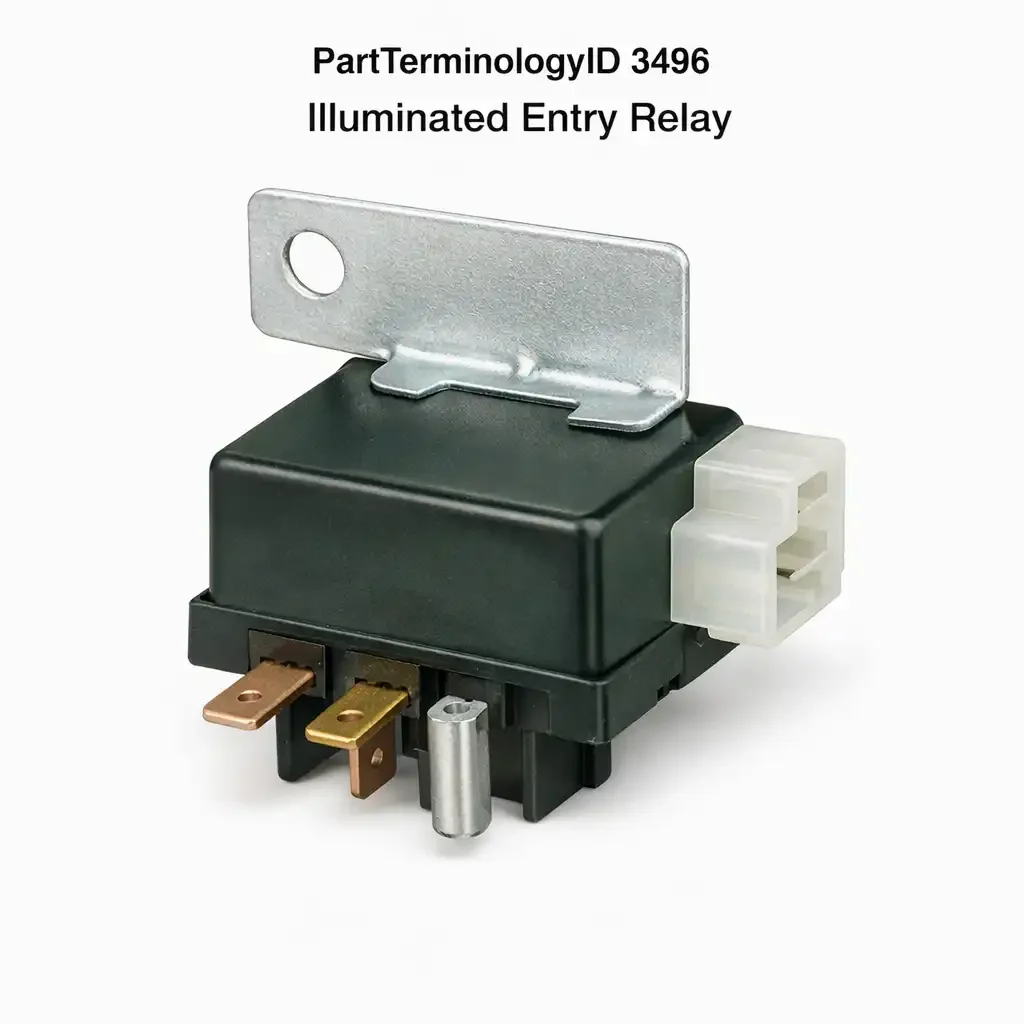
PartTerminologyID 3496, Illuminated Entry Relay, is the relay that supplies switched power to the vehicle's interior courtesy lamps and door-activated lighting circuits, enabling the timed illumination sequence that activates when a door is opened, when the ignition key is removed, or when a remote keyless entry unlock signal is received. The relay governs both the activation and the timed shutoff of interior lighting, preventing battery drain by extinguishing the lamps after a defined interval when no ignition input is present. The three attributes that determine correct fitment and listing accuracy are the trigger conditions that activate the relay, the timeout duration the relay controls, and the three-way symptom differentiation that separates a relay fault from a failed door jamb switch, a failed BCM output, and a stuck-on courtesy lamp circuit.
What the Illuminated Entry Relay Does
Interior lamp supply and trigger conditions
The illuminated entry relay contact supplies battery voltage to the interior courtesy lamp circuit when activated by one of three trigger conditions: a door opening detected via the door jamb switch input, an ignition key removal signal from the ignition switch circuit, or a remote keyless entry unlock command received by the BCM or RKE module. On BCM-controlled applications, the BCM manages relay coil activation in response to these inputs and handles the timed shutoff sequence internally. On older applications without BCM integration, a dedicated timer circuit within the relay module itself controls the shutoff interval, typically between 15 and 40 seconds depending on the trigger condition and vehicle application.
The current load on the illuminated entry relay contact is moderate compared to high-current relays, typically between 5 and 15 amperes depending on the number of interior lamps served, their lamp type, and whether the circuit includes dome lamps, map lamps, door courtesy lamps, and footwell lamps simultaneously. Relay contact failure is possible on this circuit but is less common than door jamb switch failure or BCM output fault, both of which present with identical symptoms from the driver's perspective.
Timed shutoff function and battery protection
The timed shutoff is one of the most diagnostically significant functions of the illuminated entry relay and one of the most common sources of buyer confusion. When the relay is functioning correctly, interior lamps illuminate upon door opening and extinguish automatically after the programmed interval, typically 15 to 40 seconds after the last door is closed. On applications with RKE integration, the timeout duration is often longer after a remote unlock than after a manual door open, reflecting the expectation that the driver is approaching the vehicle from a distance.
When the timed shutoff fails and interior lamps remain on continuously, the relay is frequently suspected as the fault source. However, a stuck-closed relay contact is only one of three causes for this symptom. A door jamb switch that is stuck in the open-door position sends a continuous door-open signal that keeps the relay activated indefinitely. A BCM fault that generates a continuous relay activation command produces the same result without any relay hardware failure. Diagnosing which of these three conditions is present before ordering a relay prevents the most common return scenario for this part.
RKE integration and BCM-managed activation
On vehicles equipped with remote keyless entry, the illuminated entry relay activates when the RKE receiver or BCM receives an unlock command from the key fob, even when all doors remain closed. This provides the approaching driver with interior illumination before the door is opened. The relay remains active for the programmed RKE timeout duration, typically 40 seconds, and deactivates when the ignition is turned to the run position or when the timeout expires without a door opening. On applications where the RKE module is separate from the BCM, the RKE module provides the relay coil activation signal directly. Confirming whether the application uses BCM-managed or RKE-module-managed relay activation is important when diagnosing coil circuit faults, since the signal source determines where the diagnostic path begins.
Top Return Scenarios
Scenario 1: Interior lights do not come on when door is opened
Before diagnosing the relay, confirm the door jamb switch is providing the correct door-open input signal to the BCM or relay coil circuit. Test for voltage or ground change at the jamb switch output terminal when the door is opened. A jamb switch that does not change state when the door opens will not trigger the relay regardless of relay condition. If the jamb switch is confirmed functional, test for relay coil activation voltage at the relay coil terminal when the door is open. No coil voltage with a confirmed functional jamb switch indicates a BCM output fault or an open circuit in the coil supply wire. Coil voltage present with no relay contact closure indicates relay contact failure and relay replacement is appropriate.
Prevention language: "Confirm the door jamb switch changes state when the door is opened before ordering this relay. A jamb switch that does not signal door-open prevents relay activation regardless of relay condition. Test for coil activation voltage at the relay terminal with the door open. Coil voltage present with no lamp activation indicates relay contact failure. No coil voltage with a confirmed functional jamb switch indicates a BCM output or wiring fault."
Scenario 2: Interior lights stay on and will not turn off
Continuous interior lamp illumination is the highest-return scenario for the illuminated entry relay because the relay is the most visible component associated with interior lighting and is frequently replaced without diagnosis. The three causes for this symptom are a stuck-closed relay contact, a door jamb switch stuck in the open-door position, and a BCM fault generating a continuous relay activation command. To isolate the relay as the cause, remove the relay from its socket with all doors closed and the ignition off. If the interior lamps extinguish immediately when the relay is removed, the relay contact is stuck closed and relay replacement is correct. If the interior lamps remain on after relay removal, the fault is in the lamp circuit ground path or the BCM output, and relay replacement will produce no improvement.
Prevention language: "If interior lights stay on continuously, remove the relay with all doors closed and ignition off. If lights go out when the relay is removed, the relay contact is stuck closed and replacement is correct. If lights remain on after relay removal, the fault is in the door jamb switch, the BCM, or the lamp ground circuit. Relay replacement will not resolve lights-on symptoms when the relay is not the active fault source."
Scenario 3: Interior lights work from door switch but not from remote keyless entry unlock
Selective failure of the RKE-triggered illuminated entry function with normal door-switch-triggered illumination confirms the relay contact is functional, since the door-switch trigger activates the same relay contact as the RKE trigger. The fault in this scenario is in the RKE signal path to the relay coil or BCM, which may include a failed RKE receiver, a failed BCM RKE input circuit, or a wiring fault in the RKE-to-relay signal wire. Relay replacement for this symptom will produce no improvement. The diagnostic path begins at the RKE receiver output, not the relay.
Prevention language: "If interior lights illuminate correctly when a door is opened but do not activate when the key fob unlock button is pressed, the relay contact is functioning correctly. This symptom indicates a fault in the RKE receiver, the BCM RKE input circuit, or the signal wire between the RKE system and the relay coil. Relay replacement will not restore RKE-triggered illuminated entry function."
Scenario 4: Interior lights flash briefly then go out immediately instead of staying on for the timed interval
A relay that activates briefly and then deactivates before the timeout interval expires indicates a fault in the timer control circuit rather than the relay contact. On BCM-controlled applications, an abbreviated timeout suggests a BCM programming or fault condition that is terminating the illuminated entry sequence early. On standalone timer relay applications, an abbreviated timeout indicates the timer circuit within the relay module has degraded. Confirm whether the application uses an external BCM-controlled timeout or an internal relay timer before replacing the relay, since a BCM fault will return the same abbreviated behavior after relay replacement.
Listing Requirements
• PartTerminologyID: 3496
• Controlled circuit: interior courtesy lamp supply with timed shutoff (mandatory)
• Trigger conditions: door jamb switch, ignition key removal, RKE unlock signal (mandatory)
• No impact on engine start, run, or any operational vehicle system (mandatory)
• Door jamb switch test as first pre-relay diagnostic for no-illumination complaints (mandatory)
• Relay removal test as first pre-relay diagnostic for lights-on complaints (mandatory)
• RKE selective failure as RKE circuit fault, not relay fault (mandatory)
• Differentiation from Courtesy Lamp Relay and Door Switch (mandatory)
• OEM part number cross-reference (mandatory)
FAQ (Buyer Language)
My interior lights do not come on when I open the door. Is the relay the likely cause?
The door jamb switch is a more common fault source than the relay for this symptom. Before ordering, open the door and listen for any relay click from the fuse box or relay panel. If no click is heard, the relay coil is not receiving an activation signal, which points to the door jamb switch or BCM rather than the relay contact. If a click is heard but no lamps illuminate, the relay contact has likely failed and relay replacement is the appropriate next step.
My interior lights stay on and will not go off. Will a new relay fix this?
Only if the relay contact is stuck closed. The fastest test is to pull the relay from its socket with all doors closed and the ignition off. If the lights go out when the relay is removed, the relay contact is stuck closed and replacement will fix the problem. If the lights stay on after the relay is removed, the fault is elsewhere, most commonly a door jamb switch stuck in the open position or a BCM fault, and relay replacement will not help.
Will a failed illuminated entry relay prevent my car from starting or affect engine operation?
No. The illuminated entry relay supplies only the interior courtesy lamp circuit. It has no connection to engine management, fuel delivery, ignition coil supply, or any system required for the vehicle to start and run. A failed illuminated entry relay produces only the loss of timed interior lamp function. All other vehicle systems operate normally.
What Sellers Get Wrong About PartTerminologyID 3496
The most common listing error is omitting the relay removal diagnostic note for lights-on complaints. Buyers whose interior lights are stuck on represent the largest single population ordering this relay, and the majority of them have not performed the relay removal test that confirms whether the relay contact is the actual fault source. A listing that does not include this test will generate returns from buyers who installed a new relay and found no change because the fault was in the door jamb switch or BCM. The relay removal test note is the single highest-return-prevention content element for this listing.
The second error is omitting the RKE selective failure note. Buyers whose illuminated entry works from the door switch but not from the key fob represent a common return profile because the part name contains the words illuminated entry and the symptom involves the illuminated entry system. A sentence clarifying that selective RKE failure is not a relay fault redirects these buyers before the order is placed.
The third error is failing to state that the relay has no effect on engine start or vehicle operation. Buyers searching for an ignition-adjacent relay or any relay associated with entry may find this listing and order it for unrelated complaints. The no-operational-impact statement screens out those buyers before the wrong part is purchased.
Cross-Sell Logic
• Door Jamb Switch: if the relay receives no coil activation signal when the door is opened, the door jamb switch is the primary diagnostic target and the most likely replacement component for no-illumination complaints
• BCM (Body Control Module): if relay coil voltage is absent with a confirmed functional door jamb switch, or if the relay removal test confirms the relay contact is not stuck but lights remain on, a BCM output fault is the next diagnostic step
• Courtesy Lamp / Dome Lamp: if the relay activates correctly but specific lamps do not illuminate, the individual lamp or its socket ground is the fault source rather than the relay supply circuit
• RKE Receiver or Keyless Entry Module: if illuminated entry works from the door switch but not from the key fob, the RKE receiver or its output circuit is the correct diagnostic and replacement target
• Fuse (Interior Lamp Circuit): a blown interior lamp fuse removes power from the entire courtesy lamp circuit and produces the same no-illumination symptom as a failed relay contact; confirm fuse condition before relay diagnosis
Final Take for PartTerminologyID 3496
Illuminated Entry Relay (PartTerminologyID 3496) is the interior lamp supply relay where the relay removal test for lights-on complaints, the door jamb switch pre-check for no-illumination complaints, and the RKE selective failure note are the three listing elements that prevent the most common wrong-diagnosis orders. The relay removal test filters out the largest return population by confirming whether the relay contact is the active fault source before the part is purchased. The door jamb switch pre-check redirects the second-largest return population to the correct component for no-illumination complaints. The RKE selective failure note prevents orders from buyers whose fault is in the keyless entry signal path rather than the relay. Sellers who include all three give buyers the complete diagnostic context to confirm the illuminated entry relay is the correct component for their specific interior lighting complaint, and to avoid ordering it when the fault is in the door jamb switch, the BCM output, or the RKE receiver circuit instead.