
Written by Arthur Simitian | PartsAdvisory
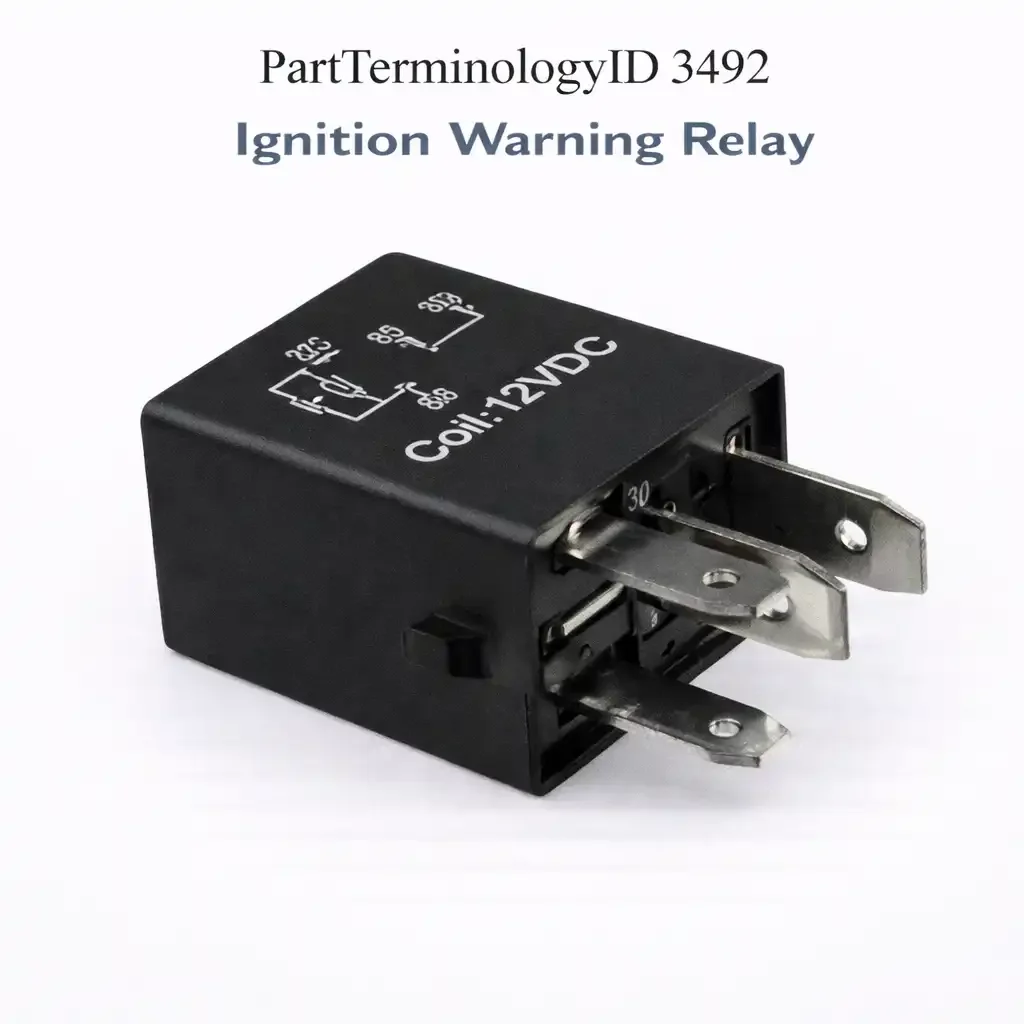
PartTerminologyID 3492, Ignition Warning Relay, is the relay that supplies the vehicle's ignition-state warning systems with switched power, enabling the chime module, buzzer, or warning indicator circuits that alert the driver to conditions such as a key left in the ignition switch with the door open, a seatbelt not fastened, or a headlight left on after ignition-off. The relay is a low-current supply component that powers the warning and alert circuitry rather than any high-current operational load, and its failure produces a loss of warning signals without affecting engine start, engine run, accessory function, or any other vehicle operational capability. The three attributes that determine correct fitment are the specific warning systems served by the relay on the application; the ignition state or states in which the relay is active; and the three-way symptom differentiation that separates a warning relay fault from a failed chime module, a failed warning switch input, and a failed BCM warning output.
What the Ignition Warning Relay Does
Warning system supply and low-current load profile
The ignition warning relay contact supplies battery voltage to the chime module or warning buzzer assembly and to the warning indicator lamp driver circuits that require switched ignition power to operate. The combined current draw of these warning circuits is low relative to every other relay load category in the vehicle electrical system, typically between 1 and 5 amperes total, because chime modules, buzzers, and warning lamp drivers are low-power devices. The low current demand means the ignition warning relay contact experiences less thermal stress and less contact wear per switching cycle than any relay in a higher-current application, and relay contact failure is therefore less common on this circuit than on high-current relays. When a warning relay fault is suspected, the chime module itself and the warning switch inputs are statistically more common fault sources than the relay contact, and the relay should be tested after the chime module supply voltage and the switch inputs are confirmed correct.
Ignition state activation and BCM integration
The ignition warning relay is typically active across multiple ignition states, including the off position with the key inserted, the accessory position, and the run position, because the key-in warning and door-open chime must function even when the ignition is not in the run position. On BCM-controlled applications, the BCM manages the warning relay coil activation in response to ignition switch position and door switch inputs, activating the relay when any warning condition is present and de-activating it when all conditions are clear. On older applications without BCM integration, the relay coil may be activated directly by the ignition switch output for the warning terminal, which is a separate switch output from the accessory and run terminals and is active across all key-in positions. Confirming whether the application uses BCM-managed warning relay activation or direct ignition switch activation is the first step in diagnosing a warning relay coil fault.
Symptom scope and operational impact of relay failure
A failed ignition warning relay produces silence where warning chimes and alerts should sound, and dark warning indicators where they should illuminate, without any effect on engine start, engine run, accessory operation, or any other vehicle system. The vehicle operates normally in every functional sense; only the driver alert features are absent. This no-consequence-for-operation characteristic means the warning relay fault is often discovered incidentally, when the driver notices the absence of the seatbelt chime or the key-in warning, rather than through a vehicle malfunction complaint. The low urgency of the symptom leads many drivers to defer diagnosis, and the relay is often purchased as a simple first-replacement attempt without any testing. Given the low cost of the relay and the low probability of relay contact failure on this low-current circuit, this approach is pragmatically reasonable, though it produces returns when the chime module or a switch input is the actual fault source.
Top Return Scenarios
Scenario 1: "No chime when key is left in ignition with door open, no seatbelt warning"
Before diagnosing the relay, confirm the chime module has supply voltage from the relay contact output. Test voltage at the chime module supply terminal with the ignition key inserted and the door open. No voltage at the chime module supply terminal with relay coil confirmed active indicates a relay contact failure. Voltage present at the chime module supply terminal with no chime output indicates the chime module has failed internally or its ground circuit is open. Also confirm the door switch is providing the correct input signal to the BCM or chime module when the door is open, since a failed door switch prevents the key-in warning condition from being detected regardless of relay and module function.
Prevention language: "Confirm supply voltage at the chime module terminal before ordering a relay. Voltage present at the module with no chime output indicates a failed chime module or ground fault, not a relay fault. No voltage at the module with coil activation confirmed indicates relay contact failure."
Scenario 2: "Warning chimes sound continuously and will not stop"
A continuously sounding chime that does not stop when its trigger condition is cleared is most commonly a chime module fault or a stuck door switch or seatbelt switch that is sending a continuous warning condition input, not a relay fault. A stuck-closed relay contact on the warning circuit would keep the chime module supplied with power but would not cause it to sound continuously, since the module requires both supply power and an active warning condition input to generate an alert. Diagnose the switch inputs and chime module before the relay when the symptom is continuous sounding rather than absence of chimes.
Scenario 3: "Some warning chimes work but others do not"
Selective warning chime failure with other chimes functioning correctly confirms the relay is supplying the chime module, since a relay fault would remove supply from all chime functions simultaneously. The failure of specific chime functions while others remain active indicates a fault in the switch input for the non-functioning chime or a failed internal circuit within the chime module that handles that specific alert function. A door chime that sounds correctly while a seatbelt chime does not indicates a seatbelt switch fault or a chime module internal fault, not a relay fault. Relay replacement for selective chime failure will produce no improvement.
Prevention language: "If some warning chimes work and others do not, the relay is supplying the chime module correctly. Selective chime failure indicates a failed switch input for the non-working chime or a chime module internal fault. Relay replacement will not restore selectively failed chime functions."
Listing Requirements
PartTerminologyID: 3492
controlled circuit: warning chime module and alert indicator supply (mandatory)
no impact on engine start, run, or accessory function (mandatory)
chime module supply voltage test as first pre-relay diagnostic (mandatory)
selective chime failure as module or switch fault, not relay fault (mandatory)
differentiation from Ignition Relay (3480) and Ignition Feed Relay (3488) (mandatory)
OEM part number cross-reference (mandatory)
FAQ (Buyer Language)
My key-in warning chime stopped working. Is the relay the likely cause?
The chime module and door switch are more common fault sources than the relay on this low-current circuit. Before ordering, test for supply voltage at the chime module's power terminal with the key inserted. If supply voltage is present and the chime is silent, the module has failed or its ground is open. If supply voltage is absent, the relay contact may have failed and relay replacement is the appropriate next step. Also confirm the door switch is providing its input signal to the module when the door is open, since a failed door switch prevents the warning condition from triggering regardless of relay and module condition.
Will a failed ignition warning relay prevent my car from starting?
No. The ignition warning relay supplies only the low-current warning and chime circuits. It has no connection to the engine management, fuel system, or ignition coil supply circuits that must function to start and run the engine. A failed warning relay produces only the loss of chime and alert functions. The engine starts, runs, and operates normally in every other respect.
What Sellers Get Wrong About PartTerminologyID 3492
The most common listing error is omitting the no-operational-impact note. Buyers who search for an ignition relay based on a no-start complaint may find the ignition warning relay in results and order it based on the word ignition in the name. A listing that does not state clearly that this relay has no effect on engine start or run capability will generate returns from no-start buyers who correctly installed the warning relay but found no improvement. The no-operational-impact statement is the single most important return-prevention content in this listing because it screens out the largest population of buyers who would order based on name similarity rather than symptom match.
The second error is omitting the selective chime failure note. Buyers with one non-functioning chime among several functioning chimes are the most likely to return the relay after installation, since their symptom indicates the relay is supplying the chime module correctly and the fault is in a switch input or module internal circuit. A sentence noting that selective chime failure is not a relay fault redirects these buyers to the correct component before the order is placed.
Cross-Sell Logic
Chime Module: if relay contact output voltage is confirmed at the module supply terminal but chimes are absent or non-functional, the chime module has failed and is the replacement target
Door Switch: a failed door switch that does not send the open-door input to the BCM or chime module prevents key-in and door-open warnings from activating regardless of relay and module condition
Seatbelt Switch: a failed seatbelt buckle switch prevents seatbelt warning activation independently of the relay and chime module
Ignition Feed Relay (PartTerminologyID 3488): on applications where warning system supply is routed through a feed relay rather than a dedicated warning relay, the feed relay is the correct diagnosis target for warning system power loss
Final Take for PartTerminologyID 3492
Ignition Warning Relay (PartTerminologyID 3492) is the driver alert supply relay where the no-operational-impact note, the chime module supply voltage pre-check, and the selective-chime-failure-as-module-fault note are the three listing attributes that prevent the most common wrong-relay orders and wrong-component installations on warning system complaints. The no-operational-impact statement filters out the no-start buyer population before any part is ordered. The supply voltage pre-check redirects chime module fault buyers to the module before the relay is purchased. The selective failure note redirects switch fault and module internal fault buyers away from the relay entirely. Sellers who include all three give buyers the complete diagnostic context to confirm the warning relay is the correct component for their specific alert system complaint, and to avoid ordering it when the fault is in the chime module, the switch inputs, or the BCM warning output instead.