
Ignition Feed Relay (PartTerminologyID 3488): Secondary Ignition Supply Branch, Load-Specific Feed Circuit, and Differentiation from the Ignition Relay and Ignition Accessory Relay
Written by Arthur Simitian | PartsAdvisory
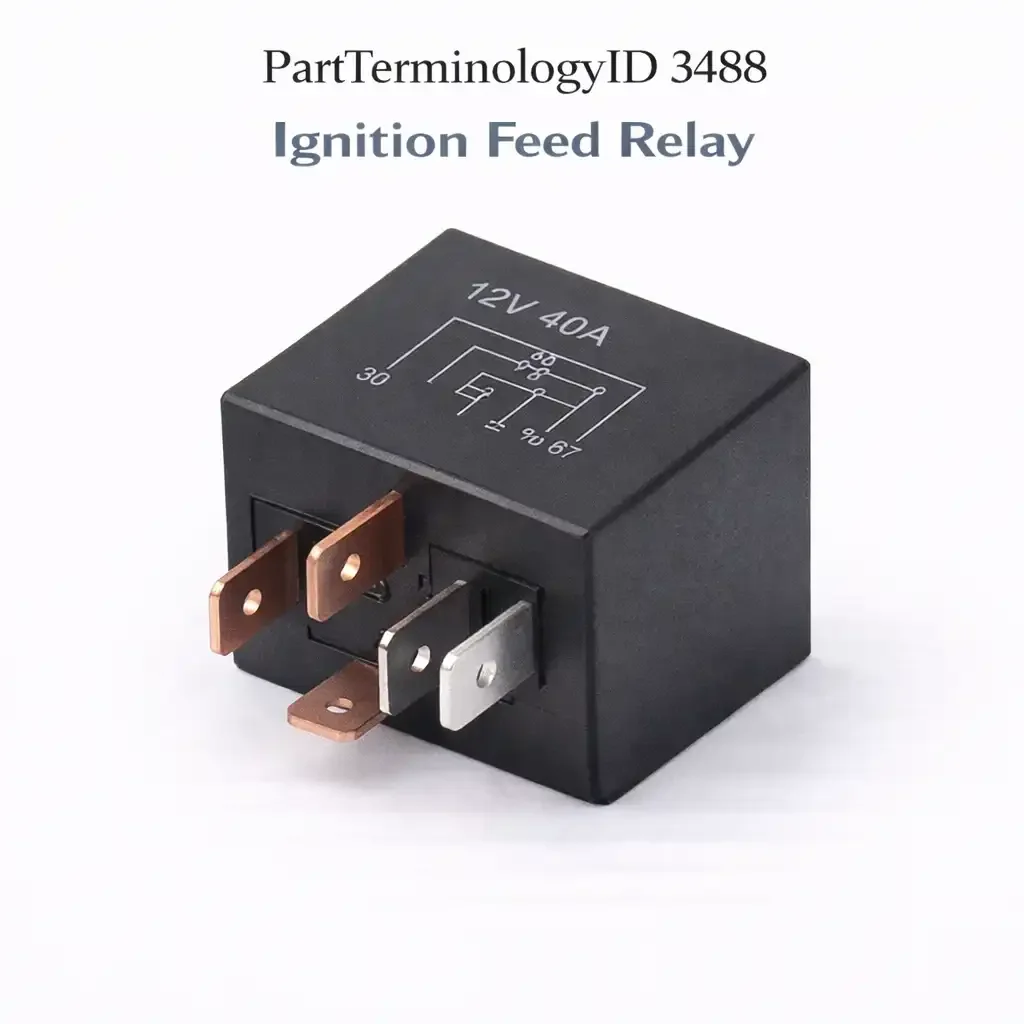
PartTerminologyID 3488, Ignition Feed Relay, is a secondary ignition supply relay that provides a dedicated ignition-switched power feed to a specific load group or system branch that is separated from the main ignition relay output circuit. Where the Ignition Relay (PartTerminologyID 3480) supplies the primary ignition-controlled loads including the ECM, fuel system, and ignition coils, and the Ignition Accessory Relay (PartTerminologyID 3484) supplies comfort and convenience loads in the accessory and run positions, the Ignition Feed Relay supplies a defined subset of ignition-switched loads that the manufacturer has isolated on a separate relay for current capacity, circuit protection, or sequencing reasons. The three attributes that determine correct fitment are the specific load group the relay feeds on the application; the ignition position in which the relay is active; and the partial-loss symptom pattern that a feed relay fault produces, which affects only its assigned load branch while the main ignition and accessory circuits continue to function normally.
What the Ignition Feed Relay Does
Secondary feed branch and load isolation rationale
Manufacturers isolate specific load groups onto dedicated ignition feed relays for several practical reasons. A load group with a high combined current draw that would exceed the main ignition relay's contact rating is given its own relay with an appropriately rated contact. A load group that requires a specific power sequencing behavior, such as energizing after a defined delay following main ignition relay closure or de-energizing before the main relay opens on ignition-off, uses a separate feed relay with the appropriate timing characteristics. A load group that must be protected by its own fuse separate from the main ignition fuse, so that a fault in that branch does not interrupt the main ignition supply to the ECM and fuel system, is isolated on its own relay with its own fuse protection. The specific loads assigned to the ignition feed relay on a given application are defined by the fuse box circuit legend and the body electrical service manual, and these sources are the only reliable way to confirm which system is served by the feed relay before ordering.
Partial ignition loss symptom and diagnostic scope
The defining characteristic of an ignition feed relay fault is partial ignition-controlled load loss with the engine starting and running normally and the primary accessory loads functioning correctly. A driver who finds that a specific system or group of systems, such as the HVAC controls, the instrument cluster secondary functions, or a particular set of sensors, has lost ignition supply while the engine operates correctly and the radio and windows work normally has presented a symptom consistent with an ignition feed relay fault on the branch supplying those specific loads. The partial-loss pattern is the key differentiating observation. Total ignition load loss with no engine start points to the main Ignition Relay (3480). Accessory load loss with normal engine operation points to the Ignition Accessory Relay (3484). A specific subset of ignition loads failing while all others remain correct points to the Ignition Feed Relay (3488) serving that subset. Identifying the exact loads that have lost power and confirming from the fuse box diagram which relay feeds those loads is the complete diagnostic path for an ignition feed relay fault.
Activation position and coil command source
The ignition feed relay is typically active in the run position only, activated by the ignition switch run output or by a BCM ignition run command. On applications where the feed relay serves loads that must also be available during engine cranking, the relay coil activation is sourced from both the run and start positions of the ignition switch to prevent a dropout during crank. The coil command source must match the application's requirement: a relay coil activated only from the run terminal will drop out during cranking if the run terminal voltage drops during starter engagement, removing supply from the feed relay's load branch at the precise moment the engine needs those systems operational for starting.
Top Return Scenarios
Scenario 1: "Specific vehicle systems stopped working but the engine runs fine and the radio works"
Partial system loss with normal engine and accessory operation is the ignition feed relay fault pattern. Identify the specific systems that have lost power, locate them in the fuse box circuit legend, and confirm which relay supplies their ignition feed circuit. If the legend identifies an ignition feed relay for those systems, test for relay coil activation in the run position and relay contact output at the affected load supply terminal. Coil activation present with no contact output confirms relay contact failure on the feed branch.
Prevention language: "Identify the specific systems that stopped working and confirm from the fuse box legend which relay supplies their ignition feed. Partial load-loss with normal engine and accessory operation isolates the fault to the feed relay for that load group. Test contact output at the affected load supply terminal before ordering."
Scenario 2: "Replaced the ignition relay but the specific systems still do not work"
A buyer who replaced the main Ignition Relay (3480) for a partial load-loss complaint has replaced the wrong relay. The main ignition relay supplies the ECM and fuel system, and its replacement does not restore loads served by a separate feed relay branch. With the main relay confirmed functioning, redirect the diagnosis to the feed relay serving the specific loads that remain inoperative. The fuse box legend identifies which relay serves each load, and a targeted relay contact test on the correct feed relay is the next step.
Listing Requirements
PartTerminologyID: 3488
function: secondary ignition supply to a specific load branch (mandatory)
partial-loss symptom pattern and scope (mandatory)
differentiation from Ignition Relay (3480) and Ignition Accessory Relay (3484) (mandatory)
fuse box legend confirmation step before ordering (mandatory)
activation position: run or run-plus-start (mandatory)
OEM part number cross-reference (mandatory)
FAQ (Buyer Language)
How do I know if my vehicle has an ignition feed relay separate from the main ignition relay?
Check the fuse box cover legend or the body electrical service manual. A relay labeled as an ignition feed relay, a secondary ignition relay, or a run relay for a specific system in the legend indicates a separate feed relay is present. The legend identifies which loads each relay supplies, allowing you to match the relay to the specific systems that have stopped working. Not all vehicles use a discrete ignition feed relay; some consolidate all ignition supply onto the main ignition relay or distribute it through solid-state BCM outputs with no discrete relay at all.
My instrument cluster lost some functions but others still work. Could this be the ignition feed relay?
Possibly, if the non-functioning cluster functions are supplied from an ignition feed relay branch that is separate from the functions that continue to work. Instrument clusters on some applications draw their supply from two or more relay sources, with different relay branches supplying different circuit sections within the cluster. Check the fuse box legend for a relay specifically associated with the cluster or with the systems that have lost function. Testing supply voltage at the cluster's secondary power supply connector confirms whether the ignition feed relay is delivering voltage to that cluster circuit.
What Sellers Get Wrong About PartTerminologyID 3488
The most common listing error is providing a generic ignition relay description that does not define the partial-loss symptom pattern. Without the partial-loss context, buyers with a main ignition relay fault or an accessory relay fault will order the feed relay because it appears in results for ignition relay searches, and buyers with an actual feed relay fault will not recognize the relay as the correct component because no listing describes the specific partial-load-loss symptom that identifies it. Every listing under PartTerminologyID 3488 must describe the partial-loss pattern explicitly: specific loads inoperative while engine starts and runs and primary accessory loads function correctly. This description narrows the buyer population to those with a genuine feed relay fault and excludes the no-start buyers and the full-accessory-loss buyers who belong to the 3480 and 3484 PartTerminologyIDs respectively.
The second error is omitting the fuse box legend confirmation step. The ignition feed relay's load coverage is application-specific and cannot be determined from a generic description. A buyer who does not confirm which relay serves their inoperative loads from the fuse box legend before ordering may replace a correctly functioning feed relay while the actual fault is in a different branch. The fuse box confirmation step is the minimum diagnostic instruction that prevents this class of returns.
Cross-Sell Logic
Ignition Relay (PartTerminologyID 3480): supplies ECM, fuel system, and ignition coils; total ignition load loss with no engine start points here, not to the feed relay
Ignition Accessory Relay (PartTerminologyID 3484): supplies radio, windows, and comfort loads; full accessory loss with normal engine operation points here, not to the feed relay
Ignition Warning Relay (PartTerminologyID 3492): on applications with an ignition warning relay, certain alert and warning system loads are supplied through a dedicated warning relay rather than the main ignition or feed relay
BCM: on applications where the BCM manages ignition feed distribution through solid-state outputs with no discrete relay, an ignition feed supply fault is a BCM output fault and no relay replacement is applicable
Final Take for PartTerminologyID 3488
Ignition Feed Relay (PartTerminologyID 3488) is the secondary ignition supply relay where partial-loss symptom description, fuse box legend confirmation guidance, and three-way differentiation from the main Ignition Relay (3480) and Ignition Accessory Relay (3484) are the three listing attributes that direct the correct buyers to this relay and prevent orders from buyers whose fault is in the adjacent ignition relay PartTerminologyIDs. The partial-loss pattern is the complete symptom fingerprint for this relay and no other ignition relay in the category produces it: specific loads inoperative, engine runs normally, primary accessories function correctly. A listing that describes this pattern clearly gives buyers the self-check that confirms in one observation whether the ignition feed relay is the correct diagnosis target for their specific complaint.