
Written by Arthur Simitian | PartsAdvisory
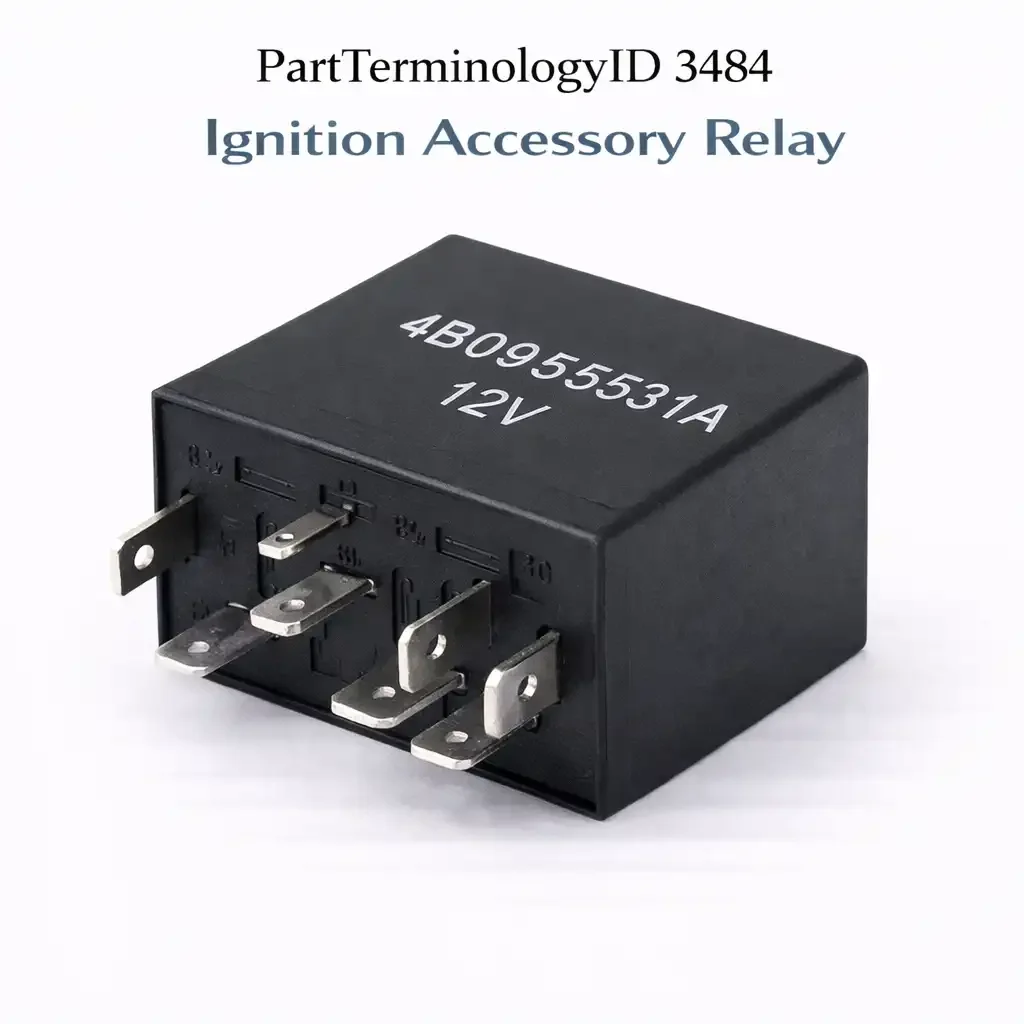
PartTerminologyID 3484, Ignition Accessory Relay, is the relay that supplies battery voltage to the vehicle's accessory loads, including radio, power windows, HVAC blower, interior lighting controls, and similar convenience features, when the ignition switch is in the accessory position and continues that supply when the ignition is advanced to the run and start positions. The relay is distinct from the Ignition Relay (PartTerminologyID 3480), which supplies the engine management and fuel system loads required to start and run the engine, because the accessory relay serves comfort and convenience functions that can be operated without the engine running and that do not affect engine start or run capability when they fail. The four attributes that determine correct fitment are the accessory position activation logic; the run-mode continuation behavior that keeps accessory loads energized while the engine is running; the retained accessory power function on applications where the BCM holds the accessory relay closed for a calibrated period after ignition-off to allow the driver to finish using the radio or close the windows; and the symptom boundary that distinguishes a failed accessory relay from a failed ignition relay from a failed BCM accessory output.
What the Ignition Accessory Relay Does
Accessory position activation and load coverage
When the ignition switch is turned to the accessory position, it applies an activation signal to the ignition accessory relay coil. The relay contact closes and supplies battery voltage to the accessory load bus, which distributes power to the radio, power window circuits, HVAC blower control, and other convenience loads. The loads served by the accessory relay vary by application and are defined by the vehicle manufacturer's power distribution architecture. On some applications the power window circuit is served by a dedicated window relay rather than the accessory relay, and the accessory relay supplies only audio and climate control. On other applications the accessory relay is the sole supply for a broad range of comfort features. The fuse box circuit legend for the application is the authoritative reference for which loads the accessory relay supplies, and this information must be confirmed from the service manual before the relay is ordered to ensure the accessory relay fault is consistent with the specific loads that have stopped functioning.
Run-mode continuation and seamless transition
The accessory relay remains closed when the ignition is advanced from the accessory position through the start position to the run position. The same loads that were available in the accessory position continue to be available while the engine is running, because the relay coil continues to receive its activation signal from the ignition switch run output. On applications where the ignition switch output for the accessory position and the run position are the same terminal, the relay coil is continuously energized from accessory through run without interruption. On applications where separate switch terminals supply the accessory and run relay coil inputs, the relay must transition between two activation sources without dropping out, and a momentary open in either source during the transition produces a brief loss of accessory power during crank that some drivers notice as a radio reset during starting.
Retained accessory power and post-ignition-off behavior
On applications with a retained accessory power function, the BCM holds the ignition accessory relay closed for a calibrated period after the ignition is switched off, typically until a door is opened or until a timer of one to ten minutes expires. This allows the driver to continue listening to the radio, operating the power windows, or using other accessory loads after shutting off the engine without leaving the ignition switch in the accessory position. A relay contact stuck closed beyond the retained accessory period will drain the battery if the vehicle is parked with the contact held active, since the radio, blower, and other accessory loads continue drawing current. A relay contact that opens immediately on ignition-off and does not provide the retained accessory period produces a symptom of accessories cutting off the moment the key is turned off, which buyers on applications designed to provide retained accessory power will notice and diagnose as a relay or BCM fault.
Differentiation from Ignition Relay (3480) and BCM accessory output
The defining diagnostic boundary between the Ignition Relay (3480) and the Ignition Accessory Relay (3484) is engine start and run capability. A failed Ignition Relay (3480) prevents the engine from starting or running and removes ECM and fuel system power. A failed Ignition Accessory Relay (3484) leaves the engine start and run functions fully intact while removing power from the radio, power windows, and other comfort loads. A vehicle that starts and runs normally but has no radio and no power windows has a failed accessory relay, not a failed ignition relay. A vehicle that cranks but will not start with no ECM communication has a failed ignition relay, not a failed accessory relay. This single engine-starts-or-does-not observation is the complete diagnostic separator between these two adjacent relay PartTerminologyIDs and every listing under either number must include it explicitly.
Top Return Scenarios
Scenario 1: "Radio and power windows stopped working, engine starts and runs fine"
Engine starts and runs correctly confirming the Ignition Relay (3480) is functioning. The simultaneous loss of multiple accessory loads with normal engine operation points to the ignition accessory relay contact having failed open. Confirm the relay coil is receiving its activation signal from the ignition switch in the accessory and run positions, then test for relay contact output voltage at the accessory load bus. No contact output with confirmed coil activation confirms relay contact failure. If coil activation is absent, trace the ignition switch accessory output circuit to the relay coil terminal.
Prevention language: "Engine starts and runs normally with radio and power windows inoperative isolates the fault to the ignition accessory relay, not the ignition relay. Test for accessory relay coil activation in the accessory and run positions, then test contact output at the accessory bus. Coil activation present with no contact output confirms relay contact failure."
Scenario 2: "Accessories work in accessory position but cut off the moment the key is turned off"
On applications with retained accessory power, the accessories should remain active for a calibrated period after ignition-off until a door is opened or the timer expires. Immediate accessory cutoff on ignition-off on these applications indicates the retained accessory function has been lost. The BCM manages the retained accessory period by holding the relay coil active after the ignition switch output drops. A relay coil that stops receiving BCM hold activation on ignition-off loses the retained period. Test for BCM relay coil output in the seconds after ignition-off to confirm whether the BCM is sending the hold signal. No BCM hold signal indicates a BCM output fault. Hold signal present with immediate accessory cutoff indicates the relay contact is not responding to the BCM hold command, which may indicate a relay coil resistance change that requires higher coil voltage than the BCM output can sustain.
Scenario 3: "Accessories cut out briefly during engine cranking then restore"
A brief loss of accessory power during engine cranking that restores when the engine starts is characteristic of the ignition switch's transition between the accessory and start positions on applications where these are separate switch output terminals. During cranking, the accessory terminal may drop to zero voltage momentarily if the switch design removes accessory power during the start position, and the relay drops out briefly before the run position restores the coil activation. This is normal behavior on some applications and not a relay fault. On applications designed to maintain accessory power through cranking, a brief dropout indicates either the relay coil activation is being lost during cranking or the relay contact drops out due to the battery voltage reduction during starter motor engagement. Confirming which behavior the application is designed for establishes whether the dropout is a fault or expected behavior.
Listing Requirements
PartTerminologyID: 3484
controlled circuit: accessory loads including radio, power windows, HVAC blower (mandatory)
activation positions: accessory and run (mandatory)
retained accessory power behavior on applicable platforms (mandatory)
differentiation from Ignition Relay (3480) by engine-starts symptom boundary (mandatory)
contact output test at accessory bus procedure (mandatory)
OEM part number cross-reference (mandatory)
FAQ (Buyer Language)
My radio and windows stopped working but the car starts fine. Is this the accessory relay?
Yes. Normal engine start and run with multiple accessory loads inoperative simultaneously is the characteristic ignition accessory relay failure presentation. The ignition relay is functioning correctly as confirmed by normal engine operation. Test for accessory relay contact output voltage at the radio supply fuse or power window supply fuse with the ignition in the run position. No voltage at these points with the relay coil confirmed active identifies the relay contact as the fault.
My retained accessory power stopped working after I replaced the battery. Is the relay damaged?
Battery replacement can reset the BCM's learned configuration on some platforms, including retained accessory power settings. The relay itself is unlikely to have been damaged by battery replacement. The BCM may require a drive cycle or a configuration reset to restore the retained accessory programming. Confirm with a scan tool whether the BCM retained accessory configuration is active before diagnosing the relay as the fault cause.
Can a failed accessory relay prevent the car from starting?
No. The ignition accessory relay supplies comfort and convenience loads only. The engine management, fuel system, and ignition coil circuits that must function to start and run the engine are supplied by the Ignition Relay (PartTerminologyID 3480), which is a separate relay on a separate circuit. A failed accessory relay produces no effect on engine start or run capability.
What Sellers Get Wrong About PartTerminologyID 3484
The most common listing error is omitting the engine-starts symptom boundary that separates this relay from the Ignition Relay (3480). Both relay PartTerminologyIDs appear in searches for ignition relay, no start relay, and electrical problem relay, and a buyer with a cranks-but-no-start complaint may order the accessory relay based on the word ignition in the part name without understanding that the accessory relay has no effect on engine start or run function. Every listing under PartTerminologyID 3484 must state explicitly that a failed accessory relay does not prevent engine starting, and that engine-starts-normally with accessory loads inoperative is the correct symptom pattern for this relay. This one statement prevents all wrong-relay orders from no-start buyers who searched for an ignition relay and found this listing.
The second most common error is omitting the retained accessory power description. Buyers on applications with retained accessory power who notice that the feature has stopped working will search for an accessory relay, and a listing that does not mention retained accessory power gives them no context for whether the relay failure can cause the loss of this feature or whether the BCM is the more likely fault source. The listing must describe the retained accessory function, note that the BCM manages the hold signal, and direct buyers to confirm BCM hold signal output before ordering the relay as the fault source for a retained power complaint.
Cross-Sell Logic
Ignition Relay (PartTerminologyID 3480): supplies ECM, fuel pump relay, and ignition system; engine cranks but does not start with no ECM communication points here, not to the accessory relay
Ignition Feed Relay (PartTerminologyID 3488): supplies secondary ignition load branches independently; partial load-loss with both ignition and accessory function otherwise correct points to the feed relay
Radio: if accessory relay contact output is confirmed at the radio supply terminal but the radio does not power on, the radio itself has failed or its dedicated fuse has blown
BCM: if no accessory relay coil activation is present in either the accessory or run position despite correct ignition switch output, the BCM accessory relay command output has failed
Final Take for PartTerminologyID 3484
Ignition Accessory Relay (PartTerminologyID 3484) is the comfort and convenience load supply relay where the engine-starts symptom boundary, the retained accessory power description, and the activation position scope are the three listing attributes that prevent the most common wrong-relay orders and misunderstood fault presentations in the ignition relay category. The engine-starts boundary is the non-negotiable baseline that must be in every listing to prevent no-start buyers from ordering the wrong relay. The retained accessory description covers the second-most-common accessory relay complaint and directs BCM-originated retained power faults away from the relay before an unnecessary replacement is ordered. Sellers who include both alongside the accessory position and run-mode activation scope give buyers the complete diagnostic framework to confirm the accessory relay is the correct component for their specific symptom before the order is placed.