
Idle Speed Control Relay (PartTerminologyID 3472): Where Idle Air Control Valve Supply, ECM Command Path, and Differentiation from the Idle Up Relay Solenoid
Written by Arthur Simitian | PartsAdvisory
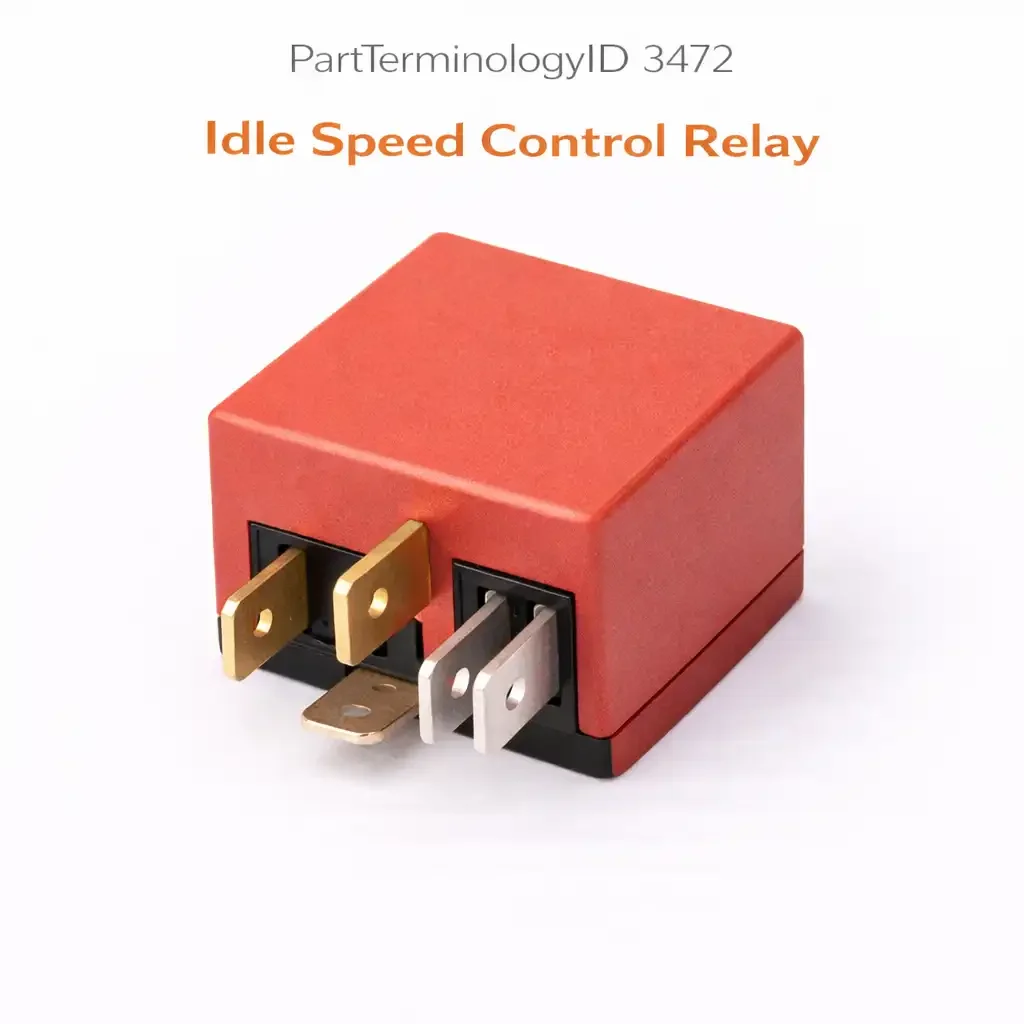
PartTerminologyID 3472, Idle Speed Control Relay, is the relay that supplies battery voltage to the idle speed control system's actuating component, which is either an idle air control valve that meters additional air into the intake manifold to raise idle speed, or a throttle body actuator that adjusts throttle plate position under ECM command to maintain stable idle speed under varying engine loads. The relay is positioned between the battery supply circuit and the idle speed control actuator, and the ECM activates the relay coil when it determines that idle speed adjustment is needed, typically during engine warm-up, during high-load accessory activation such as A/C compressor engagement, or during deceleration fuel cut-off events where idle stabilization is required to prevent stalling. The three attributes that determine correct fitment are the actuator type the relay supplies; the ECM activation command path that governs when the relay closes; and the differentiation from the Idle Up Relay Solenoid (PartTerminologyID 3476), which addresses a specific idle speed increase command rather than the general idle speed control function.
What the Idle Speed Control Relay Does
Idle air control valve supply and ECM feedback loop
On throttle body and port fuel injection systems from approximately 1980 through the early 2000s, idle speed is controlled by an idle air control valve that is a stepper motor or solenoid valve mounted on or near the throttle body, which opens and closes a bypass air passage around the throttle plate to add or remove air from the intake charge without moving the throttle plate itself. The ECM monitors engine speed through the crankshaft position sensor and adjusts the IAC valve position in a closed-loop feedback cycle to maintain the target idle speed under all engine load conditions. The idle speed control relay supplies battery voltage to the IAC valve actuator motor or solenoid coil, and a relay contact failure that removes this supply voltage leaves the IAC valve in its de-energized default position, which may be fully open or fully closed depending on the valve design and application. A valve that defaults to fully open on relay failure produces a high idle that cannot be controlled by the ECM. A valve that defaults to fully closed produces a low or unstable idle that may not recover from a deceleration or accessory load event.
Throttle actuator supply on drive-by-wire systems
On drive-by-wire applications from the early 2000s onward, there is no mechanical throttle cable connection between the accelerator pedal and the throttle plate. The ECM receives the accelerator pedal position sensor signal and commands a throttle body actuator motor to position the throttle plate at the corresponding angle, including at idle where the ECM commands the minimum throttle opening required to maintain target idle speed. On these applications, the idle speed control relay may supply the throttle actuator motor circuit or the throttle body control module, and a relay failure that cuts power to the throttle actuator produces a limp-home throttle response or a no-start condition depending on the application's fail-safe architecture. Drive-by-wire relay faults typically set an ECM throttle control fault code that distinguishes the circuit supply fault from a throttle position sensor fault or actuator motor fault.
Differentiation from Idle Up Relay Solenoid (PartTerminologyID 3476)
The Idle Up Relay Solenoid (3476) is a specific component that commands a step increase in idle speed in response to a defined high-load input, most commonly A/C compressor engagement, and typically operates as a single fixed-command solenoid rather than as part of a continuously modulated feedback control loop. The Idle Speed Control Relay (3472) supplies the continuously operating closed-loop idle speed control actuator that the ECM modulates throughout the engine operating cycle to maintain stable idle speed under all conditions. A vehicle with both components uses the idle speed control relay for continuous idle regulation and the idle up solenoid for discrete high-load idle compensation. A vehicle with only the idle speed control relay uses that relay's actuator for all idle speed management including high-load compensation. Confirming which component is present on the application before ordering prevents wrong-component orders between these two adjacent PartTerminologyIDs.
Top Return Scenarios
Scenario 1: "Engine idle is rough or unstable, stalls at stops"
An unstable idle that stalls at stops is the most common presenting symptom for idle speed control relay faults on IAC-equipped applications. However, the same symptom is produced by a dirty or failed IAC valve, a vacuum leak in the intake system, a failed throttle position sensor, or a mass airflow sensor fault. Reading ECM fault codes before ordering a relay is mandatory for this symptom because a code pointing to an IAC circuit current fault or IAC motor driver fault confirms the relay or actuator is the circuit element at fault, while a code pointing to a throttle position sensor or MAP sensor redirects the diagnosis away from the relay entirely. A relay replacement for a rough idle without fault code confirmation of a relay or IAC supply circuit fault has a low probability of resolving the symptom.
Prevention language: "Read ECM fault codes before ordering for a rough or unstable idle. An idle circuit fault code confirms the relay or IAC actuator supply circuit is the diagnosis target. Codes pointing to throttle position, MAP sensor, or vacuum system faults indicate the idle relay is not the cause. IAC valve carbon deposits produce unstable idle more often than relay failure on high-mileage applications."
Scenario 2: "Engine idles very high and will not come down after warm-up"
A fixed high idle after warm-up that is not responsive to ECM control indicates the IAC valve is stuck open or is being supplied at full voltage without ECM modulation. A relay contact stuck closed at full supply voltage bypasses the ECM's ability to reduce IAC valve opening by removing supply voltage, producing a fixed-open valve condition. Removing the relay from its socket should produce an immediate change in idle speed on a stuck-closed relay, since removing the supply causes the valve to move to its de-energized default position. If idle speed does not change on relay removal, the IAC valve is mechanically stuck open and the relay is not the fault.
Listing Requirements
PartTerminologyID: 3472
actuator type: IAC valve or throttle actuator (mandatory)
ECM command path and closed-loop feedback context (mandatory)
differentiation from Idle Up Relay Solenoid (3476) (mandatory)
ECM fault code read before relay diagnosis (mandatory)
application window: 1980s through early 2000s IAC systems primarily (recommended)
OEM part number cross-reference (mandatory)
FAQ (Buyer Language)
My engine stalls when I stop at a light. Could this be the idle speed control relay?
It is possible but not the most likely cause. Read ECM fault codes first. An idle control circuit fault code points to the relay or IAC actuator supply circuit. No idle control code with a stalling complaint more commonly indicates a dirty IAC valve, a vacuum leak, or a fuel pressure issue rather than a relay fault. A dirty IAC valve is the most common cause of stalling at stops on high-mileage port fuel injection engines and cleaning the valve often resolves the symptom without any relay or actuator replacement.
Is this the same as the idle up relay?
No. The Idle Speed Control Relay (3472) supplies the idle speed control actuator that the ECM modulates continuously to regulate idle speed under all engine operating conditions. The Idle Up Relay Solenoid (PartTerminologyID 3476) commands a specific fixed idle speed increase in response to a defined input such as A/C compressor engagement. They are separate components that serve related but distinct functions within the idle speed management system.
What Sellers Get Wrong About PartTerminologyID 3472
The most common listing error is omitting the ECM fault code read recommendation. The rough or unstable idle symptom that drives most idle speed control relay orders is produced by a larger number of more common faults than relay failure, including IAC valve deposits, vacuum leaks, and sensor faults. A listing that describes only the relay's function without directing buyers to read fault codes first generates relay orders from buyers with vacuum leaks and dirty IAC valves who install the relay and find no improvement. The fault code recommendation is the single most effective return-prevention instruction for this PartTerminologyID and must be present in every listing. The second error is failing to differentiate from the Idle Up Relay Solenoid (3476). Both components serve idle speed functions and buyers searching for an idle relay without knowing the distinction will order based on whichever listing they find first. The differentiation must be explicit: the idle speed control relay is for continuous ECM-modulated idle regulation, while the idle up solenoid is for discrete high-load step commands.
Cross-Sell Logic
Idle Up Relay Solenoid (PartTerminologyID 3476): commands fixed idle speed increase on high-load inputs; separate from the idle speed control relay on applications that use both components
IAC Valve: if relay contact output voltage is confirmed at the IAC valve connector but idle remains unstable, the IAC valve is dirty or has failed mechanically; cleaning or replacing the IAC valve is the next diagnosis step
ECM: if no relay coil activation is present from the ECM during conditions that should require idle speed adjustment, and no fault codes point to a sensor or input fault, the ECM idle control output has failed
Throttle Body: on drive-by-wire applications, a relay fault code pointing to the throttle actuator supply circuit may indicate a throttle body actuator fault rather than a relay fault if relay contact output is confirmed correct at the actuator connector
Final Take for PartTerminologyID 3472
Idle Speed Control Relay (PartTerminologyID 3472) is the idle actuator supply relay where ECM fault code pre-check guidance, actuator type identification, and Idle Up Relay Solenoid differentiation are the three listing attributes that prevent the most common wrong-component orders in the idle speed management relay category. The fault code pre-check is the highest-return-prevention instruction in the listing because idle instability is a multi-cause symptom where relay failure is one of several possible causes and not the most common one, and directing buyers to read codes before ordering separates relay fault buyers from IAC valve, vacuum, and sensor fault buyers before any parts are ordered. Sellers who include all three attributes give buyers the diagnostic context to confirm the relay is the correct component for their specific idle fault presentation before placing the order.