
Written by Arthur Simitian | PartsAdvisory
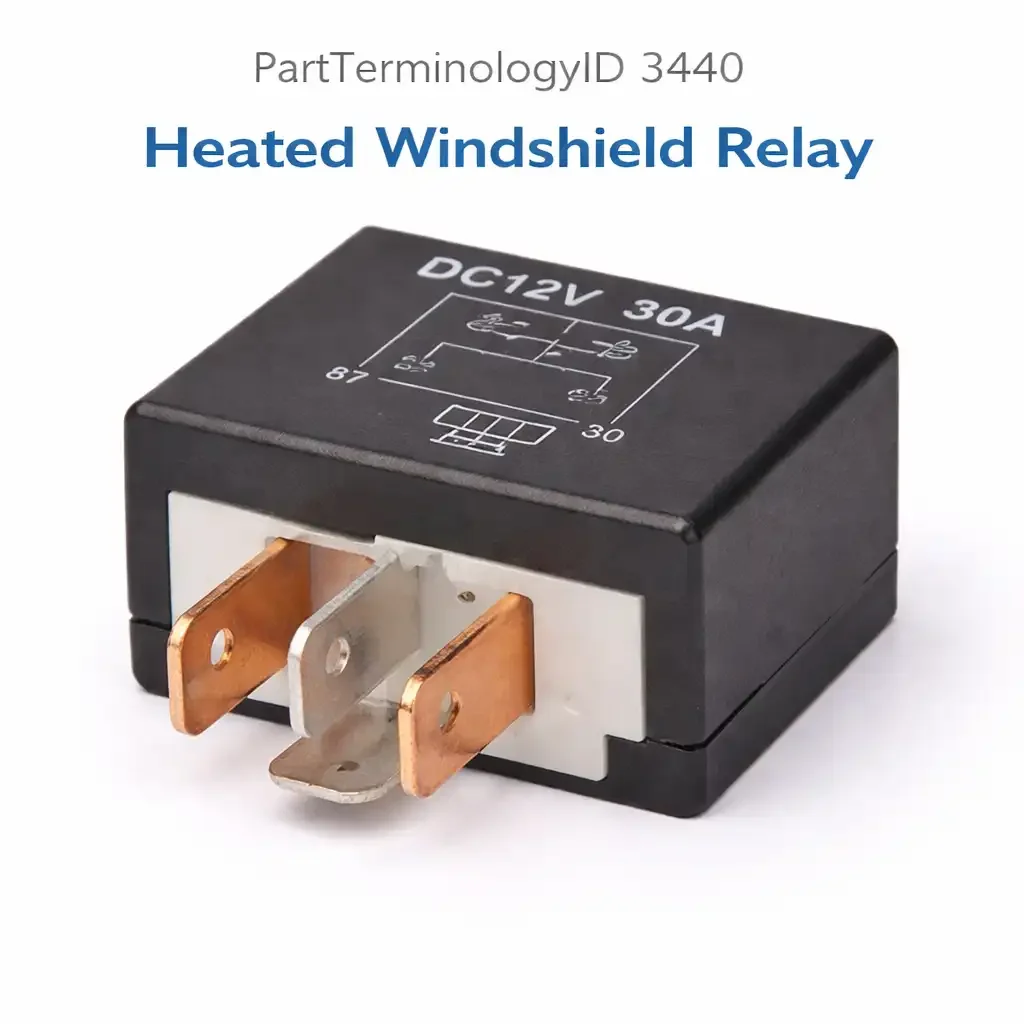
PartTerminologyID 3440, Heated Windshield Relay, is the relay that supplies battery voltage to the electrically heated front windshield element, which is a network of very fine resistive wires or a conductive coating laminated between the layers of the windshield glass, designed to clear frost and ice from the entire windshield surface in a fraction of the time required by the HVAC defroster duct alone. The heated windshield draws substantially more current than the rear window defroster grid because of its much larger glass area, placing the heated windshield relay at the high end of the body electrical current spectrum with contact ratings commonly ranging from 40 to 80 amperes depending on the windshield design and the vehicle's electrical architecture. The four attributes that determine correct fitment are the contact current rating, which must match the windshield element's full operating draw without derating over the timed activation cycle; the BCM timed cut-off and how it differs from the rear defroster timer on the same vehicle; the application concentration on specific manufacturers and platforms where factory heated windshield systems were offered; and the differentiation from the Window Defroster Relay (PartTerminologyID 3432), which serves the rear glass on the same vehicle and is a separate component with a different current rating.
What the Heated Windshield Relay Does
Front windshield element construction and current demand
Factory-installed heated windshields use one of two element construction methods. The first is a pattern of very fine resistance wire filaments bonded between the inner and outer glass layers during lamination, arranged in horizontal rows across the full windshield area. These wires are fine enough that they are nearly invisible to the driver but dense enough to provide uniform heating across the glass surface. The second method is a conductive tin oxide or silver-based coating applied to the inner surface of one glass layer, providing heating through the resistive properties of the coating rather than discrete wires. Both constructions draw high current because the total resistance of the element network across the full windshield area is low, typically between 0.2 and 0.8 ohms, producing current draws of 15 to 60 amperes at 12 volts depending on the specific element design and glass size. The relay contact must sustain this current for the full BCM-controlled heating cycle without thermal damage to the contact surfaces.
BCM timed cut-off and cycle duration
The BCM limits the heated windshield activation to a calibrated maximum duration, commonly between 4 and 10 minutes on most applications, which is shorter than the rear window defroster timer because the heated windshield clears frost much faster than the rear defroster grid clears the rear glass and because the higher current draw imposes a greater load on the charging system. After the timer expires, the BCM de-activates the relay and the windshield element stops heating. The indicator light on the heated windshield switch extinguishes when the timer cuts off. A buyer who observes the windshield heating indicator light extinguish after a consistent period is experiencing normal BCM timer behavior. A buyer who observes no windshield heating indicator light and no warmth from the windshield surface after pressing the heated windshield switch is experiencing a relay or BCM output fault. The timer duration note in the listing prevents the most common non-fault return in this category.
Differentiation from Window Defroster Relay (PartTerminologyID 3432)
The Window Defroster Relay (3432) supplies the rear window defroster grid on the rear glass. The Heated Windshield Relay (3440) supplies the front windshield heating element. On a vehicle equipped with both systems, these are two separate relays with separate contacts, separate BCM outputs, and separate timer calibrations. The rear defroster relay typically has a lower contact current rating than the heated windshield relay because the rear glass element draws less current than the front windshield element. A vehicle with a functional rear defroster but no front windshield heating has a heated windshield relay fault. A vehicle with functional front windshield heating but no rear defogging has a window defroster relay fault. Listings for each relay must state clearly which glass surface the relay serves to prevent buyers from ordering the wrong relay for their specific non-functioning defroster circuit.
Application concentration and OEM platform identification
Factory-installed heated windshields are offered by a limited number of manufacturers and on specific platforms. Ford introduced the technology broadly across its North American passenger car and truck lineup from the late 1980s onward under the Quickclear name, and Ford applications represent the largest share of the North American heated windshield relay market. Several European manufacturers including Jaguar, Land Rover, and Volvo have offered heated windshields on various models. The technology is less common on Asian-market brands sold in North America. Confirming that the specific application is factory-equipped with a heated windshield before ordering under PartTerminologyID 3440 is essential, since a vehicle without this feature will have no relay socket and no element wiring, and no relay can add the feature retroactively.
Top Return Scenarios
Scenario 1: "Heated windshield switch light comes on but windshield does not warm"
The BCM is activating the indicator and commanding the relay coil, but the relay contact is not closing to supply the windshield element. Test for relay contact output voltage at the windshield element supply terminal when the switch is activated. No output voltage with confirmed coil activation confirms a relay contact failure. This is the most unambiguous heated windshield relay fault symptom and produces a straightforward relay replacement diagnosis when the coil-activates-but-contact-does-not-close pattern is confirmed.
Prevention language: "A heated windshield indicator light that illuminates but the windshield does not warm is the characteristic relay contact failure symptom. Test for contact output voltage at the element supply terminal. No voltage with the indicator light on and the relay coil receiving activation voltage confirms relay contact failure. The BCM and switch are functioning correctly."
Scenario 2: "Heated windshield stopped working after a few minutes"
Confirm the BCM timer calibration for the application before diagnosing a fault. Most heated windshield systems cut off between 4 and 10 minutes after activation. A system that activates correctly and clears frost during the operating period but then stops at a consistent time has experienced normal BCM timer cut-off. If the system stops at a time shorter than the calibrated maximum and the timing is inconsistent, an intermittent relay contact is the likely cause. Measuring contact voltage drop under element load during the heating cycle and watching for a rising voltage drop as the contact heats identifies an intermittent contact fault before it progresses to a complete open circuit failure.
Scenario 3: "Heated windshield relay fuse blows every time the system is activated"
A repeated fuse failure on the heated windshield circuit indicates either a short circuit in the element wiring or element connections, or a relay contact that is welding closed and causing a sustained overcurrent condition in an associated protection circuit. Replacing the relay without inspecting the wiring and element connections for a short circuit will produce repeated fuse failures. A relay contact welded closed can be confirmed by measuring resistance between the relay contact terminals with the relay removed from the socket: a failed-closed contact will show near-zero resistance between the normally-open contact terminals with no coil voltage applied.
Prevention language: "A heated windshield fuse that blows on every activation indicates a short circuit in the element wiring or a relay contact welded closed. Test element wiring resistance to chassis ground before replacing the relay. A relay contact welded closed shows near-zero resistance between contact terminals with the relay removed and no coil voltage applied."
Listing Requirements
PartTerminologyID: 3440
controlled circuit: front windshield heating element (mandatory)
contact current rating: must match application element draw (mandatory)
BCM timer cut-off duration range (mandatory)
differentiation from Window Defroster Relay (3432) (mandatory)
application platform: Ford Quickclear and other OEM equipped vehicles only (mandatory)
fuse-blowing short circuit pre-check note (mandatory)
OEM part number cross-reference (mandatory)
FAQ (Buyer Language)
My heated windshield worked last winter but does not work this year. What fails first on these systems?
The relay contact is the most common single failure on heated windshield systems because it carries the highest sustained current of any body electrical relay and accumulates contact wear from the inrush current surge at each activation. Test for relay contact output voltage at the windshield element supply terminal with the switch activated. If no output voltage is present with the relay coil receiving activation voltage, the relay contact has failed and relay replacement is the first step. If contact output voltage is present but the windshield does not warm, inspect the element bus bar connections at the windshield edge for corrosion or separation before concluding the element itself has failed.
Can I use the rear defroster relay in place of the heated windshield relay?
No, not on most applications. The heated windshield element draws substantially more current than the rear defroster grid, and the rear defroster relay's contact rating is sized for the lower rear grid current. Installing an undersized relay in the heated windshield circuit risks contact overheating, accelerated wear, and premature relay failure within one heating season. Use a relay with a contact current rating that matches or exceeds the heated windshield element's specified draw for the application.
How do I tell if my windshield element wires are broken before replacing the relay?
With the relay removed, measure resistance between the element supply and return terminals at the relay socket's output side. A resistance within the expected range for the element design confirms the element is intact. An open circuit reading with the relay removed confirms the element or its wiring has an open circuit that relay replacement will not resolve. Compare the measured resistance to the service manual specification for the application to confirm whether the reading is within normal range or indicates a break in the element circuit.
What Sellers Get Wrong About PartTerminologyID 3440
The most prevalent listing error is failing to state the contact current rating clearly and in relation to the element's actual current draw. Heated windshield relays carry the highest sustained body electrical current on most applications where they are used, and an aftermarket relay with a contact rating that covers the rear defroster application but not the front windshield application will be installed and will fail prematurely within the first or second heating season. Every listing under PartTerminologyID 3440 must state the contact current rating explicitly and recommend that buyers verify it against the element current specification in the service manual before ordering, particularly on large-format windshield applications where element current may exceed 50 amperes.
The second error is omitting the platform-specific application note. Buyers on vehicles without factory-installed heated windshields will find no relay socket when they attempt installation, and a one-line application note confirming the relay applies only to factory-equipped vehicles would prevent these orders entirely. The application note must confirm the make, model, and production year range for the specific relay being listed, since even within the Ford Quickclear family the relay part numbers and ratings vary across model years and vehicle lines.
Cross-Sell Logic
Window Defroster Relay (PartTerminologyID 3432): serves the rear glass defroster grid on the same vehicle; a vehicle with both systems uses two separate relays with different current ratings; front windshield heating fault does not affect rear defroster function
Heated Windshield Element Bus Bar: the connection between the element wiring in the glass and the vehicle harness at the windshield edge is a common failure point on high-mileage applications; corrosion at the bus bar connection produces a partial or complete loss of element heating that presents identically to a relay fault until the bus bar connection is inspected
BCM: if no relay coil activation is present from the BCM when the heated windshield switch is pressed, and the switch input is confirmed correct, the BCM output for the heated windshield relay has failed; this fault affects only the front windshield circuit
Final Take for PartTerminologyID 3440
Heated Windshield Relay (PartTerminologyID 3440) is the front windshield heating relay where contact current rating, BCM timer explanation, application platform confirmation, and rear defroster relay differentiation are the four listing attributes that prevent the most common wrong-rating installations, non-fault returns, and wrong-application orders in this technically specific low-volume category. The contact current rating note is the most technically consequential attribute because an undersized relay in this circuit fails faster than in any other body electrical relay application due to the uniquely high sustained current demand of the front windshield element. Sellers who specify the rating, explain the timer, identify the application platform, and distinguish this relay from the rear defroster relay give buyers the complete technical basis to select the correct relay, install it correctly, and avoid the premature failure that results from an undersized contact in the highest-current body relay circuit on the vehicle.