
Written by Arthur Simitian | PartsAdvisory
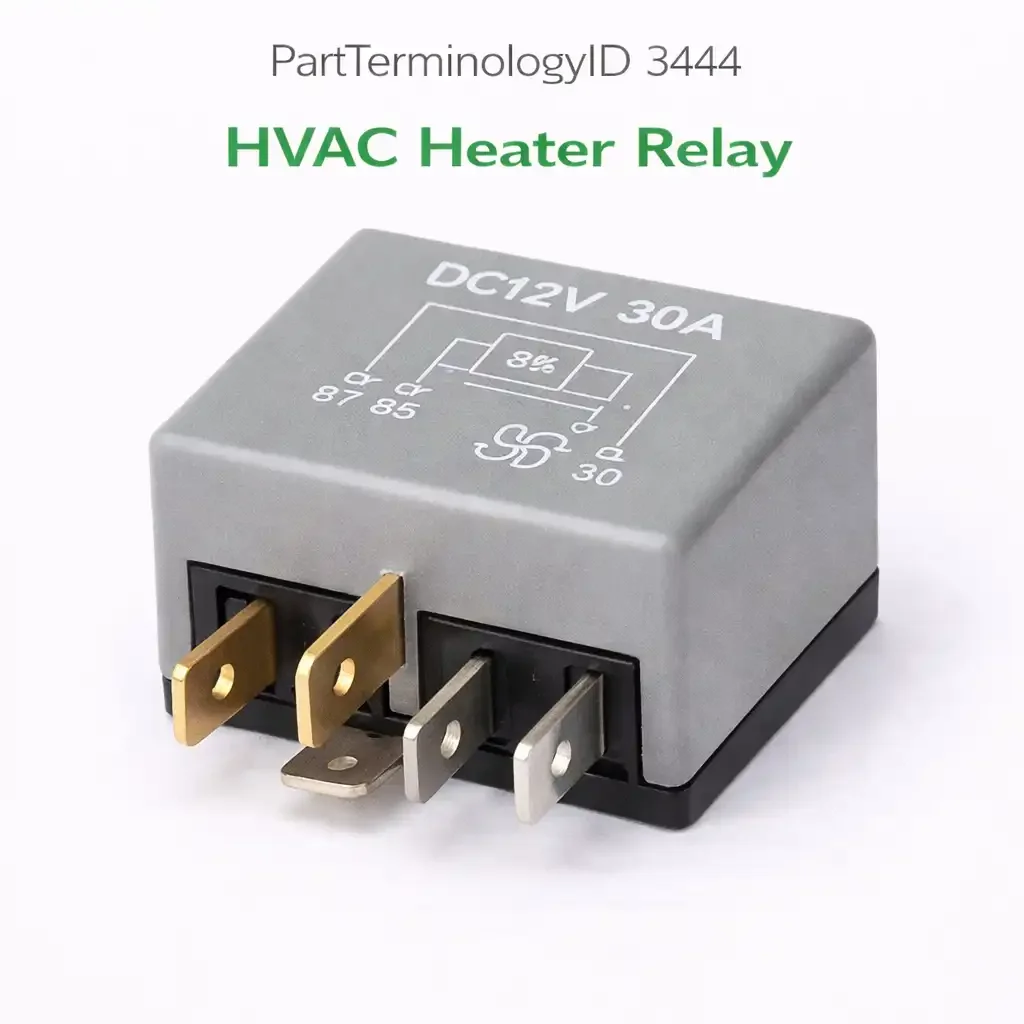
PartTerminologyID 3444, HVAC Heater Relay, is the relay that controls the electrical supply to the heating function of the vehicle's HVAC system, which on different applications means either the electrical actuator or solenoid valve that controls coolant flow through the heater core, or the supplemental positive temperature coefficient resistive heating element that provides cabin heat on hybrid and electric vehicles where engine waste heat is insufficient or unavailable. The relay is distinct from the HVAC Heater Blower Relay (PartTerminologyID 3448), which controls only the blower motor that circulates air through the HVAC housing, because the heater relay governs the heat source itself rather than the air movement mechanism. The three attributes that determine correct fitment are the heat source architecture on the specific application; the relay's position in the HVAC control module command chain; and the symptom differentiation between a heater relay fault, a blower relay fault, and an HVAC control module fault, which produce overlapping no-heat symptoms from different circuit failures.
What the HVAC Heater Relay Does
Coolant valve control on conventional engine-heated HVAC systems
On conventional internal combustion engine vehicles with electrically controlled heater core coolant valves, the HVAC heater relay supplies battery voltage to the coolant flow control valve solenoid or actuator motor, opening the valve to allow engine coolant to circulate through the heater core when the HVAC control module commands heat output. The heater core acts as a small radiator inside the HVAC housing, transferring heat from the hot coolant to the air stream flowing through the housing and into the cabin. A failed heater relay that cannot supply the coolant valve keeps the valve in its default position, which may be either open or closed depending on the application's fail-safe design. On fail-open valve applications, a relay failure produces no change in heat output because the valve defaults to open and coolant circulates through the heater core regardless of relay state. On fail-closed valve applications, a relay failure prevents coolant from reaching the heater core entirely and produces a complete loss of cabin heat even with the blower operating at full speed.
Supplemental PTC element circuit on hybrid and electric vehicles
On hybrid and electric vehicles, engine coolant temperature is often insufficient to provide adequate cabin heat because the combustion engine runs infrequently or not at all during normal operation. These applications supplement or replace the heater core with one or more positive temperature coefficient resistive heating elements mounted in the HVAC air stream, which heat the air directly using battery energy rather than engine waste heat. The PTC element draws substantial current, typically 15 to 40 amperes per element, and the HVAC heater relay supplies the element circuit at the command of the HVAC or thermal management control module. A failed heater relay on a PTC-equipped application produces no cabin heat in cold weather regardless of blower operation, since the blower can circulate air through the HVAC housing but the PTC element is not receiving power to heat that air. The current rating requirement for PTC element applications exceeds that of coolant valve applications by a substantial margin and is the primary specification difference between relay variants for these two architectures.
HVAC control module command chain and enabling conditions
The HVAC control module activates the heater relay only after evaluating a set of enabling conditions that vary by application. On coolant valve applications, the module may require coolant temperature to exceed a minimum threshold before opening the valve, preventing the circulation of cold coolant through the heater core before the engine has warmed up. On PTC applications, the module may limit PTC element activation based on battery state of charge, cabin ambient temperature sensor input, or passenger climate zone selection. A heater relay that receives no coil activation signal from the module does not indicate a relay fault if an enabling condition is preventing the module from commanding the relay. Reading the HVAC system fault codes and confirming all enabling conditions before testing the relay prevents misdiagnosis of a correctly inhibited relay as a failed relay.
Differentiation from HVAC Heater Blower Relay (PartTerminologyID 3448)
The HVAC Heater Blower Relay (3448) controls battery voltage supply to the blower motor that moves air through the HVAC housing and into the cabin. The HVAC Heater Relay (3444) controls the heat source that warms that air before it enters the cabin. A failed blower relay produces a completely silent HVAC system with no airflow from the vents at any fan speed setting. A failed heater relay produces normal airflow from the vents at all fan speeds but no warmth in the air, since the blower is functioning and moving air but the heat source is not receiving power. The symptom distinction is definitive: air blows but is cold points to the heater relay or heat source; no air blows at all points to the blower relay or blower motor. Every listing under either PartTerminologyID must include this symptom differentiation so buyers presenting either symptom can identify the correct relay before ordering.
Top Return Scenarios
Scenario 1: "Heater blows cold air at all fan speeds, air volume is normal"
Normal air volume with cold output is the characteristic HVAC heater relay fault symptom. The blower relay and blower motor are functioning correctly, confirmed by normal airflow. The heat source is not receiving power, confirmed by cold air output at full fan speed. Test for HVAC module relay coil activation voltage when heat is commanded. Coil voltage present with no relay contact output confirms relay contact failure. No coil voltage with heat commanded and all enabling conditions met indicates an HVAC module output fault. On coolant valve applications, also confirm engine coolant temperature is above the module's minimum enabling threshold before condemning the relay.
Prevention language: "Normal airflow with cold air output at all fan speeds is the HVAC heater relay fault symptom, not the blower relay fault symptom. Confirm blower operation is normal before ordering. Test relay coil activation voltage from the HVAC module when heat is commanded. Coil activation with no contact output confirms relay contact failure."
Scenario 2: "No heat on hybrid vehicle even when climate control is set to maximum heat"
On hybrid applications with PTC supplemental heating, the HVAC heater relay must activate to supply the PTC element before any heat enters the cabin. A failed heater relay on this architecture produces no cabin heat regardless of climate control setting or fan speed. Read PTC system fault codes before replacing the relay to confirm whether the fault is an open relay circuit or a PTC element fault. An open circuit fault code pointing to the PTC supply circuit confirms the relay or its wiring as the fault location. Also confirm battery state of charge is sufficient to enable PTC activation, since a low-charge battery causes the thermal management module to inhibit PTC operation to protect battery capacity.
Scenario 3: "Heat works sometimes but cuts out intermittently during cold weather"
An intermittent relay contact that drops out during the high-sustained-current demand of PTC element operation on hybrid applications, or during extended coolant valve operation on conventional applications, produces intermittent heat loss that is difficult to reproduce during a warm shop diagnosis. Measuring contact voltage drop under HVAC heating load during cold operation identifies a degraded contact with elevated resistance before it progresses to a complete open circuit failure. A contact voltage drop above 0.15 volts under heating load with the system commanding maximum heat output confirms relay contact degradation and warrants replacement before the contact fails completely.
Prevention language: "Intermittent heat loss during cold weather that cannot be reproduced in a warm shop indicates an intermittent relay contact. Measure contact voltage drop under heating load during cold ambient operation. A drop above 0.15 volts confirms contact degradation. PTC applications impose higher sustained current on the contact than coolant valve applications and produce more rapid contact wear progression."
Listing Requirements
PartTerminologyID: 3444
heat source architecture: coolant valve control or PTC element supply (mandatory)
contact current rating: must specify for PTC applications (mandatory)
enabling condition pre-check: coolant temp threshold or battery state (mandatory)
differentiation from HVAC Heater Blower Relay (3448) by symptom (mandatory)
HVAC fault code read recommendation before relay diagnosis (mandatory)
OEM part number cross-reference (mandatory)
FAQ (Buyer Language)
My heater stopped working. Should I order the HVAC heater relay or the blower relay?
Check whether air comes out of the vents when the fan is running. If air blows normally from the vents but is cold, the fault is in the heater circuit and the HVAC Heater Relay (PartTerminologyID 3444) is the correct starting point. If no air comes from the vents at any fan speed setting, the fault is in the blower circuit and the HVAC Heater Blower Relay (PartTerminologyID 3448) or the blower motor is the correct diagnosis target. This one observation separates the two circuits before any electrical testing.
My car is a hybrid and the heat only works when the engine is running. Is that the relay?
On many hybrid vehicles, cabin heat from the heater core depends on engine coolant temperature, and if the engine has not warmed sufficiently or is not running, the coolant-based heat is unavailable. If the vehicle is also equipped with a PTC supplemental heater but it is not activating, the HVAC heater relay may have failed. Read PTC system fault codes first. A fault code indicating an open PTC supply circuit points to the relay or wiring. No fault code with no PTC operation during cold engine conditions may indicate the thermal management module is correctly inhibiting PTC to protect battery charge rather than a relay fault.
How is the HVAC heater relay different from the heater core itself?
The heater core is the physical heat exchanger mounted inside the HVAC housing through which hot engine coolant flows to warm the air stream. The HVAC heater relay controls the electrical component that regulates coolant flow to the heater core, either an electrically operated coolant valve or the heater core's blend door actuator supply on some architectures. A failed relay prevents the electrical component from receiving power. A failed heater core is a mechanical and plumbing fault involving the heat exchanger itself. Relay replacement does not address a clogged or leaking heater core, and heater core replacement does not address a failed relay.
What Sellers Get Wrong About PartTerminologyID 3444
The most common listing error is describing the HVAC heater relay without specifying which heat source architecture it serves. A listing that describes the relay only in terms of coolant valve control will generate returns from hybrid and electric vehicle buyers whose application uses a PTC element supply with a higher current relay, and vice versa. Every listing under PartTerminologyID 3444 must identify the heat source architecture the relay serves and must specify the contact current rating for PTC applications where the current demand exceeds the conventional coolant valve application by a factor of five or more.
The second most common error is failing to include the blower relay symptom differentiation. The no-heat complaint is the single most common HVAC service entry and it is generated by both blower relay faults and heater relay faults, which are in adjacent PartTerminologyIDs and are frequently confused by buyers unfamiliar with HVAC circuit architecture. A listing that does not distinguish the cold-air-with-normal-flow symptom from the no-air-at-all symptom will collect orders from both heater relay fault buyers and blower relay fault buyers, with half of those orders being wrong-component returns. The two-sentence symptom differentiation that separates these presentations costs nothing to include and prevents the most predictable return scenario on this part number.
Cross-Sell Logic
HVAC Heater Blower Relay (PartTerminologyID 3448): controls blower motor supply independently of heater relay; no airflow from vents at any speed points to blower relay rather than heater relay
HVAC Heater and HVAC Delay Relay (PartTerminologyID 3445): on applications where a single combination relay controls both the heater function and a delay timing circuit, this relay covers the combined function and replaces the discrete heater relay
Coolant Valve or PTC Element: if relay contact output voltage is confirmed at the heat source component connector but no heat is produced, the coolant valve solenoid or PTC element has failed and is the replacement target rather than the relay
HVAC Control Module: if no relay coil activation is present from the module when heat is commanded with all enabling conditions confirmed met, the module output for the heater relay circuit has failed
Final Take for PartTerminologyID 3444
HVAC Heater Relay (PartTerminologyID 3444) is the cabin heat source relay where architecture identification, contact current rating for PTC applications, enabling condition pre-check guidance, and blower relay symptom differentiation are the four listing attributes that prevent the highest volume of wrong-component orders and misdiagnosis returns in the HVAC relay category. The blower relay differentiation is the single instruction that eliminates the largest share of wrong-relay orders, because the no-heat complaint is the presenting symptom for both relay faults and the symptom pattern diverges at the single observation of whether air moves from the vents or not. Sellers who include all four attributes give buyers the complete framework to identify which HVAC relay their symptom points to, confirm the heat source architecture, and verify the relay specification before ordering across every no-heat complaint scenario.