
Written by Arthur Simitian | PartsAdvisory
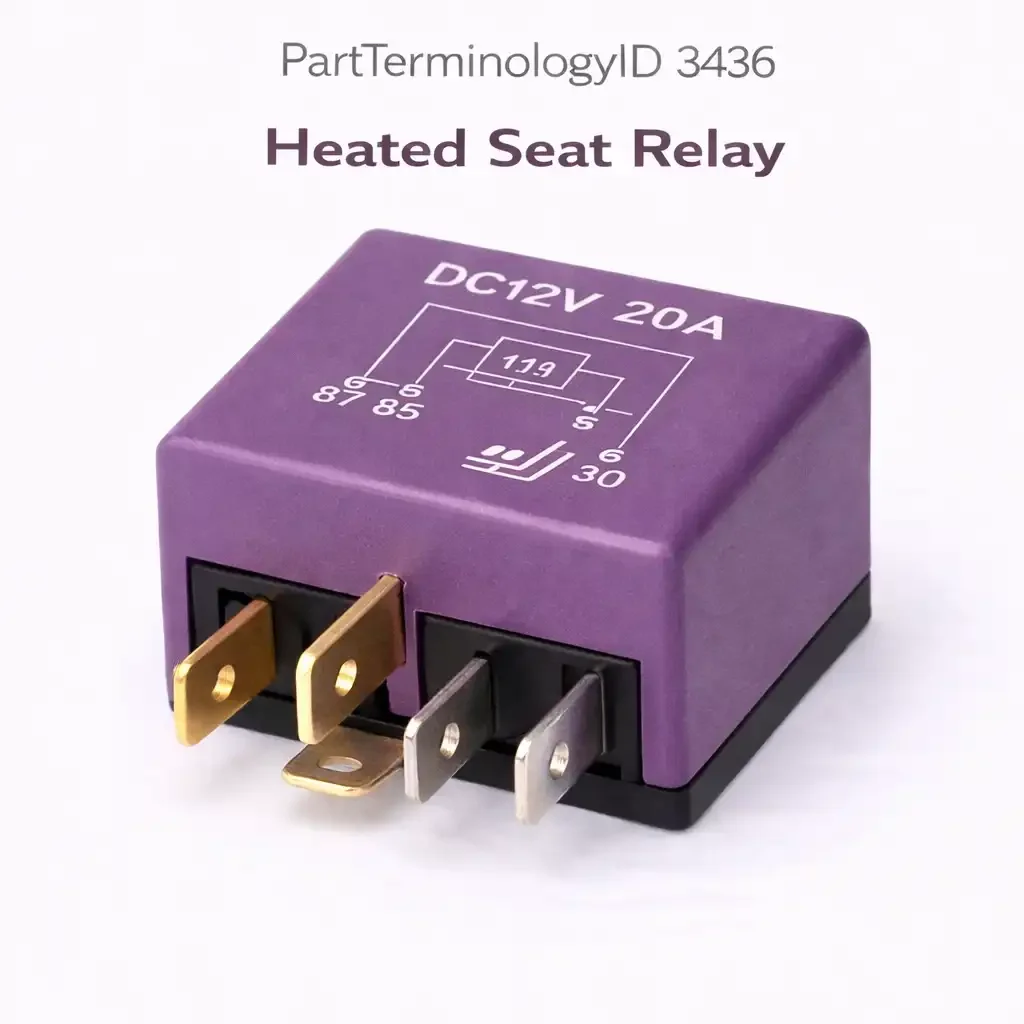
PartTerminologyID 3436, Heated Seat Relay, is the relay that supplies battery voltage to the resistive heating element network embedded in the seat cushion and seat back of a vehicle seat, providing occupant warmth by converting electrical current into radiant heat through the seat surface material. The relay is positioned between the battery supply circuit and the seat heating element, switching the element on and off in response to commands from the seat heat control switch or the BCM-based seat heating control module, which also monitors the seat thermistor to regulate element temperature within the selected comfort range. The four attributes that determine correct fitment and prevent the most common return scenarios are the per-seat relay assignment on applications where each seat position has its own dedicated relay; the contact current rating relative to the combined draw of the cushion and back heating elements; the thermistor-based temperature regulation cycle and how it interacts with the relay switching frequency; and the symptom distinction between a relay fault, a heating element fault, and a thermistor fault, which produce overlapping symptoms that generate the majority of wrong-component orders in this category.
What the Heated Seat Relay Does
Seat heating element circuit and element layout
Most heated seat installations use two separate heating element sections per seat position: one embedded in the seat cushion and one in the seat back. These elements may be wired in series, parallel, or as independently switched zones depending on the application. On series-wired installations, a break in either element removes heat from the entire seat. On parallel-wired installations with separate cushion and back element circuits, a failed element affects only its zone while the other continues to heat. The relay supplies the main power feed to whichever element configuration the application uses, and its contact current rating must match the combined draw of all elements in the circuit it supplies. Current draw per element ranges from 3 to 8 amperes, and a seat with two elements wired in parallel through a single relay requires a relay contact rated for the combined 6 to 16 ampere load.
Temperature regulation cycle and thermistor interaction
The heated seat control module monitors a negative temperature coefficient thermistor embedded near the seat heating element and cycles the relay on and off to maintain the seat surface temperature within the selected heat level band. At the low heat setting, the relay duty cycle is shorter and the element receives power for less of each cycle period. At the high heat setting, the relay is closed for a greater proportion of each cycle. This means the heated seat relay switches on and off repeatedly throughout the heating session rather than remaining continuously closed for a long period, as the defroster relay does. The switching frequency places different demands on the relay contact compared to a continuously-closed relay, accelerating contact wear through arcing at each switching event. A relay that has exceeded its rated switching cycle life will show erratic heating behavior with the seat warming inconsistently before failing completely.
Per-seat relay assignment on multi-seat applications
On vehicles where heated seats are provided at multiple positions, each seat position typically has its own dedicated relay. The driver seat relay, front passenger seat relay, and any rear seat relays are separate components even if they share the same part number across positions. A heated seat failure at one position with correct operation at all other positions points directly to that position's relay, wiring, element, or thermistor, since a single-relay fault cannot affect multiple seats simultaneously. Confirming which seat position is affected and which relay serves that position before ordering prevents orders for the wrong position's relay on applications where the part numbers differ by position.
Overheat protection and stuck-closed safety consideration
A heated seat relay contact stuck in the closed position bypasses the thermistor-based temperature regulation and allows the heating element to run at maximum current without interruption. Seat surface temperatures can reach levels that cause discomfort and, with extended operation, contact burns through seat material, particularly for occupants with reduced sensation or for child seats placed on a heated seat. A stuck-closed relay that bypasses the temperature regulation is a safety-relevant fault rather than a simple comfort feature failure. Buyers reporting a seat that heats excessively without responding to the heat level switch, or that heats without the switch being activated, should check for a stuck-closed relay contact before concluding the control module has failed. Removing the relay from its socket should immediately stop heating if the relay contact is the fault.
Top Return Scenarios
Scenario 1: "Heated seat does not work at all on driver side, passenger side works fine"
The driver seat relay has failed open or is not receiving its activation signal from the seat heat switch or BCM. The passenger seat relay functioning correctly confirms the BCM is capable of activating seat heat relays and that the fault is specific to the driver seat circuit. Testing for BCM coil activation voltage at the driver seat relay when the driver seat heat switch is pressed, then testing for relay contact output at the seat element connector, isolates whether the fault is in the relay coil circuit or the relay contact. A relay that receives coil voltage but produces no contact output has a failed contact and requires replacement.
Prevention language: "One seat position not heating while others heat correctly isolates the fault to that position's relay, element, or thermistor. Test BCM coil activation voltage at the relay for the non-heating position first. Coil voltage present with no contact output confirms relay contact failure. No coil voltage indicates a BCM output fault or switch fault upstream of the relay."
Scenario 2: "Heated seat works on high setting but not on low setting, or cycles on and off erratically"
Erratic cycling behavior that does not correspond to a normal thermistor regulation cycle is most commonly caused by an intermittent relay contact that drops out inconsistently, or by a thermistor that is providing incorrect temperature readings to the control module and causing the module to cycle the relay at an abnormal rate. A relay fault and a thermistor fault produce similar symptoms at this stage of diagnosis. Measuring contact voltage drop under element load during a heating cycle distinguishes a degraded relay contact from a thermistor fault: elevated contact resistance produces a measurable voltage drop, while a thermistor fault produces correct voltage at the element with erratic switch timing from the module.
Prevention language: "Erratic seat heating that cycles inconsistently can indicate either a degraded relay contact or a faulty thermistor. Measure contact voltage drop under element load. A drop above 0.15 volts points to the relay. Correct relay contact voltage with erratic cycling points to the thermistor sending incorrect temperature data to the control module."
Scenario 3: "Seat gets too hot and does not regulate temperature, heats even when switched off"
The relay contact is stuck closed. Temperature regulation by the control module is bypassed because the contact remains closed regardless of the module's switching commands. Remove the relay from its socket: if heating stops immediately, the relay contact is the fault. If the seat continues to heat after relay removal, the element is being supplied from another circuit path, possibly indicating a wiring fault that bypasses the relay entirely. A stuck-closed relay on a heated seat circuit is a safety concern and warrants immediate relay replacement rather than monitoring for additional symptoms.
Prevention language: "A seat that heats excessively or heats with the switch off indicates a stuck-closed relay contact. Remove the relay immediately. Heating stops on relay removal confirms a stuck-closed contact. This fault bypasses thermistor temperature regulation and can produce surface temperatures capable of causing discomfort or contact burns with extended operation. Replace the relay before returning the vehicle to service."
Listing Requirements
PartTerminologyID: 3436
controlled circuit: seat heating elements (cushion and/or back) (mandatory)
per-seat relay assignment and position identification (mandatory)
contact current rating vs. combined element draw (mandatory)
thermistor temperature regulation cycling note (mandatory)
stuck-closed safety note for overheating symptom (mandatory)
relay vs. element vs. thermistor fault symptom differentiation (mandatory)
OEM part number cross-reference (mandatory)
FAQ (Buyer Language)
My driver seat does not heat at all. The passenger seat heats fine. Do I need the relay or the heating element?
Start with the relay. A relay failure is more common than a complete element failure on a driver seat that receives more use cycles than any other seat position. Test for relay contact output voltage at the seat element harness connector with the heat switch activated. Voltage present at the connector with no heat indicates a failed element. No voltage at the connector confirms the relay is not supplying the element circuit and the relay is the first replacement target. If relay replacement does not restore heating, then test element resistance at the connector to confirm element integrity.
How do I know if my seat has a relay or if heating is controlled directly by the switch?
Most factory-installed heated seat systems from the mid-1990s onward use a dedicated relay to supply the element current, with the switch or BCM providing only the low-current coil activation signal. Vehicles with aftermarket seat heating kits may supply element current directly through the switch without a separate relay. Check the fuse box label or the body electrical service manual for the application to confirm whether a dedicated heated seat relay is present before ordering.
I replaced the relay but the seat still does not heat. What next?
With a confirmed new relay installed, test relay contact output voltage at the seat element harness connector with the heat switch activated. Voltage present at the connector confirms the relay is now supplying the circuit correctly. No heat with correct voltage at the connector indicates a failed heating element or a broken wire between the connector and the element. Test element resistance at the connector terminals: an open circuit reading confirms a broken element. If contact output voltage is absent even with the new relay, confirm the relay coil is receiving activation voltage from the switch or BCM, since a BCM output fault that was present when the original relay failed will also prevent the new relay from activating.
What Sellers Get Wrong About PartTerminologyID 3436
The most common listing error is omitting the per-seat position note. Heated seat relays on applications with multiple heated seat positions may share the same part number across all positions or may have position-specific part numbers, and a listing that does not address this distinction forces buyers to order and test before knowing whether the relay is correct for their specific position. The listing must state whether the relay applies to the driver position, passenger position, rear positions, or all positions interchangeably, and must flag applications where position-specific part numbers exist.
The second most common error is omitting the stuck-closed safety note. Sellers who describe only the seat-does-not-heat failure mode miss the safety-relevant overheating failure mode that requires immediate relay removal. A buyer whose seat is overheating needs to know to remove the relay immediately, not to order a replacement and wait for delivery. The stuck-closed note with the relay removal instruction and the safety context of contact burn risk gives buyers the urgency guidance that the symptom requires.
The third error is conflating relay faults with element faults in the symptom description. Listings that describe heating element symptoms as relay symptoms generate returns from buyers whose element has failed and who correctly installed the relay but found no improvement. The three-way differentiation between relay fault symptoms, element fault symptoms, and thermistor fault symptoms must be present in the listing so that a buyer with any of these three presentations can confirm which component matches their symptom before placing the order.
Cross-Sell Logic
Seat Heating Element: if relay contact output voltage is confirmed at the element connector but the seat does not heat, the element resistance should be tested; an open circuit resistance confirms element failure and the element or seat assembly is the replacement target
Seat Thermistor: if the relay is functioning correctly but the seat heats erratically or cycles at an abnormal rate, the thermistor is providing incorrect temperature feedback to the control module; a thermistor resistance test at the known temperature of the seat surface confirms thermistor accuracy
Heated Seat Control Module: if neither the driver nor passenger seat relay receives BCM coil activation voltage when their respective switches are pressed, and switch inputs are confirmed correct, the seat heating control module output has failed; single-seat failures do not indicate module failure
Heated Seat Switch: if no relay coil activation voltage is present from the BCM when the switch is pressed, and other BCM outputs are functioning correctly, the seat heat switch may have failed to provide the BCM with its input signal
Final Take for PartTerminologyID 3436
Heated Seat Relay (PartTerminologyID 3436) is the seat comfort relay where per-seat position assignment, contact current rating, thermistor regulation cycle explanation, stuck-closed safety guidance, and three-way fault differentiation between relay, element, and thermistor are the five listing attributes that prevent the most common wrong-component orders and safety-relevant misdiagnoses in this category. The stuck-closed overheating note is the most safety-critical content in the listing and must be present without exception. The per-seat position note prevents the single largest source of wrong-application orders. The three-way fault differentiation prevents element buyers from ordering relays and relay buyers from ordering elements. Sellers who address all five attributes in their listings give buyers the complete diagnostic and safety guidance needed to identify the correct component, confirm the fault, and address overheating symptoms with appropriate urgency on every heated seat complaint.